

Compare the finished analysis before you choose a platform
See the report CodePulse produces from read-only GitHub workflow data, or connect your own repositories and evaluate the fit with real evidence.
Read-only GitHub · Your code stays yours · Team-level by default · No credit card
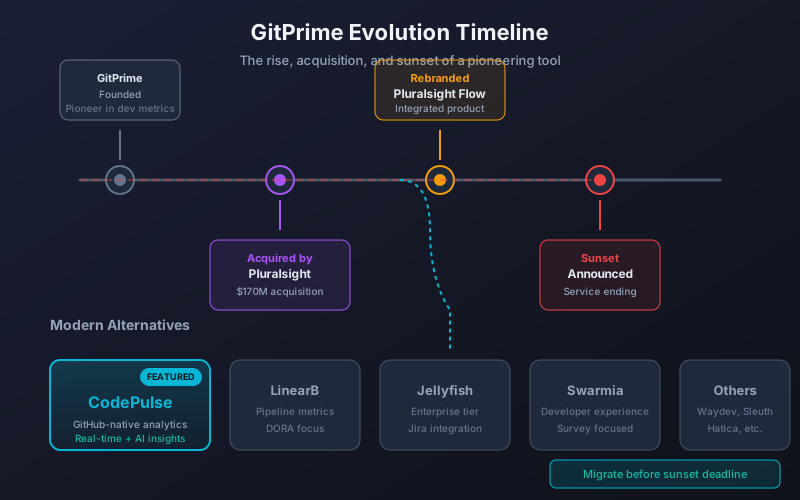
GitPrime has had four ownership changes in six years: GitPrime (2015-2019), Pluralsight (2019-2021), Vista Equity Partners' take-private (2021-2024), a creditor consortium (2024-2025), and Appfire (February 2025-present). Along the way, it was used for stack ranking, drove senior engineers away from companies, and stagnated under corporate ownership. If you're searching for alternatives, you're looking for what made GitPrime great before the acquisitions ruined it.
The product GitPrime became is now being shut down: Appfire has confirmed Pluralsight Flow's renewals ended June 30, 2026, and the product reaches end of life on December 31, 2027. See where Flow customers are moving next - sunset dates, pricing math, and an honest side-by-side.
What happened to GitPrime and what are the best alternatives?
GitPrime was acquired by Pluralsight in 2019 for $170M, taken private by Vista Equity Partners in 2021, handed to a creditor consortium in 2024, then sold to Appfire in February 2025 - four ownership changes in six years, and now a shutdown date (Appfire is retiring Flow on December 31, 2027; renewals closed June 30, 2026). The product stagnated under Pluralsight (multiple rounds of layoffs, 2.9/5 Glassdoor rating), pricing became inflexible ($10K+ minimums), and it gained a reputation for enabling micromanagement and stack ranking. The best alternatives are CodePulse (GitHub-native, transparent pricing, anti-surveillance philosophy), LinearB (multi-provider with workflow automation), and Swarmia (developer experience focus). If you loved GitPrime for its original simplicity and team-focused approach, CodePulse is the closest match.
"GitPrime defined the category of engineering analytics. Its acquisition didn't kill the need it addressed, it scattered the solution across a dozen newer tools."
GitPrime launched in 2015 with a simple premise: engineering work is measurable if you look at the right data. It connected directly to GitHub, parsed commits and pull requests, and gave engineering leaders visibility they'd never had before. No Jira tickets to reconcile. No sprint velocity debates. Just what actually happened in the code.
Then Pluralsight acquired GitPrime in 2019 for $170 million. The tool became Pluralsight Flow, and while the core functionality survived, the product evolved toward enterprise complexity. Pricing increased. Setup became more involved. The tool that once took minutes to configure now required implementation projects. Individual leaderboards were added, contradicting GitPrime's original team-focused philosophy. GitPrime's arc is the template for a broader pattern we dig into in our analytics tool acquisitions research - what happens to engineering-analytics products after they're rolled up.
The GitPrime Legacy (and What Happened)
GitPrime did several things right that made it beloved among engineering managers:
- GitHub-native philosophy: It treated Git as the source of truth, not Jira or project management tools
- Fast setup: OAuth with GitHub, wait for sync, get insights
- Clear metrics: Cycle time, PR throughput, code churn were presented without enterprise jargon
- Reasonable pricing: Accessible to mid-size teams, not just Fortune 500
- Developer-aware design: Metrics were presented as team health indicators, not surveillance tools
"What GitPrime users miss most isn't a specific feature. It's the feeling that the tool was built for them, not for procurement departments."
The Pluralsight acquisition changed the product's trajectory. Pluralsight Flow expanded integration breadth (GitLab, Bitbucket, Azure DevOps, Jira) but added enterprise complexity. The simple GitHub-focused tool became a platform requiring multiple integrations to unlock full value. Pricing shifted to enterprise tiers. The "set up in minutes" promise became "schedule an implementation call."
Many GitPrime users found themselves paying more for features they didn't need, while losing the simplicity that made GitPrime valuable in the first place.
Then in February 2025, Pluralsight sold Flow to Appfire, creating yet another ownership transition. Four ownership changes in six years - and Appfire has since announced Flow will be retired on December 31, 2027. For teams evaluating a long-term analytics partner, this instability is a serious risk factor.
What Users Actually Say About GitPrime / Pluralsight Flow
GitPrime and its successor Pluralsight Flow have accumulated some of the most damning user feedback in the engineering analytics category. The criticism comes from developers, tech leads, CTOs, and founders across Hacker News, Capterra, TrustRadius, and Trustpilot.
Built for Micromanagers, Not Teams
"Not a fan of GitPrime. It's built for micro managers, measures mostly meaningless metrics."-- Hacker News commenter
This is the most consistent criticism. GitPrime was used at multiple companies for stack ranking -- literally ranking engineers against each other during quarterly reviews. One Hacker News commenter described GitPrime being used for stack ranking on a small 4-person team. The effect on engineering culture was predictable and devastating.
A Capterra reviewer (Founder/CEO) noted it was "hard to drive adoption to engineering teams" precisely because the tool targets management rather than developers. When engineers see the tool as surveillance, adoption dies.
Metrics That Punish the Wrong People
"I used to work at a company which used GitPrime... it lacks any context. The easiest way to rank well was to avoid complex work, never fix bugs requiring investigation, never help junior team members, and instead focus on simple work and trivial refactoring."-- Hacker News commenter, former user
A tech lead shared that despite focusing on pairing and guidance -- high-impact work -- "commits were low but impact was high," and this "counted against me during promotion review." Another commenter reported that such metrics "pretty much end mentoring, documentation and deep debugging." That same commenter successfully recruited five senior engineers away from the company using these practices.
When your analytics tool drives away your most experienced engineers, it is not measuring productivity. It is destroying it.
Inaccurate and Gameable Metrics
GitPrime's reliance on commit volume and lines of code made it trivially gameable. One user noted you could game results "if you write a script to split your commits and artificially remove churn." The platform is "completely blind to the language" and "doesn't understand the code one bit" -- it cannot distinguish between original work and copied code. At one company, the platform's "top coder" was actually plagiarizing code, which required extensive rework after the person was terminated.
The churn metric is particularly unfair: "If Alice makes one commit per day, she will appear to have low churn. If Bob makes 10 commits accomplishing the exact same work, he's going to appear to have a problem with churn."
Product Stagnation Under Pluralsight
After the Pluralsight acquisition, the product stagnated. Users and analysts report that the "platform has remained relatively stagnant over the past couple of years" and that "since the acquisition, product development has slowed while competitors have advanced." Pluralsight went through multiple rounds of layoffs (2022-2024) and only 34% of employees would recommend working there (Glassdoor, 2.9/5 rating).
Pricing Became Inflexible
"When Pluralsight bought them, there was no more flex in the price."-- CTO, Capterra reviewer (left after one year despite loving the features)
Pricing starts at approximately $10K per year with no free trial. A VP of Software Engineering found a competitor offering similar features at one-third the cost. Another reviewer noted pricing "isn't catered" to smaller projects or teams. When the value proposition erodes but the price increases, teams leave.
What GitPrime Users Miss Most
Based on conversations with former GitPrime users who've tried various alternatives, here's what they consistently cite as lost in the transition:
1. Speed of Setup
GitPrime's original promise was "connect GitHub, see metrics." The modern enterprise analytics market often requires multi-week implementation projects, integration mapping sessions, and configuration calls. Former GitPrime users miss the instant gratification of connecting a repo and seeing data within hours.
2. GitHub-First Thinking
Many tools now prioritize Jira integration or multi-provider support. This means GitHub depth gets sacrificed for breadth. GitPrime understood that for many teams, everything meaningful happens in GitHub, and building deep insight there was more valuable than shallow integration everywhere.
3. Transparent Pricing
"Contact sales" wasn't the GitPrime way. You could see pricing, understand what you'd pay, and make a decision without a 3-call sales process. The enterprise analytics market has largely abandoned this transparency.
4. Team-Focused Philosophy
GitPrime positioned metrics as tools for engineering managers to improve team health. Pluralsight Flow introduced leaderboards and individual rankings, which shifted the perception from "team improvement tool" to "surveillance tool."
CodePulse: Built for the Post-GitPrime Era
CodePulse was built by engineers who remembered what made GitPrime great and watched the category lose its way. We didn't set out to clone GitPrime. We set out to deliver on its original promise while learning from its evolution.
/// Our Take
GitPrime proved that engineering analytics could be simple, fast, and valuable. The market responded by making everything complex, slow, and expensive. CodePulse is our bet that the original vision was right.
We chose GitHub-only depth over multi-provider breadth. We chose 5-minute setup over enterprise implementation. We chose transparent pricing over sales processes. These aren't limitations. They're deliberate choices that let us focus on what GitPrime did well.
What We Inherited from GitPrime's Philosophy
- GitHub as source of truth: We don't require Jira to get value. Your Git data tells the story.
- Setup in minutes: OAuth with GitHub, initial sync runs automatically, see metrics within an hour for most repositories.
- Clear, actionable metrics: Cycle time breakdown, PR throughput, review patterns presented without enterprise jargon.
- Transparent pricing: See our pricing page before talking to anyone.
- Anti-surveillance design: No individual rankings or leaderboards. Team health over individual monitoring.
What We Added Beyond GitPrime
- Review Network visualization: Interactive graph showing who reviews whose code, revealing collaboration patterns GitPrime couldn't surface.
- File Hotspots and Knowledge Silos: Identify risky code areas and single points of failure in your codebase.
- 15 Award categories: Positive recognition for helpful behaviors, celebrating what commits can't count.
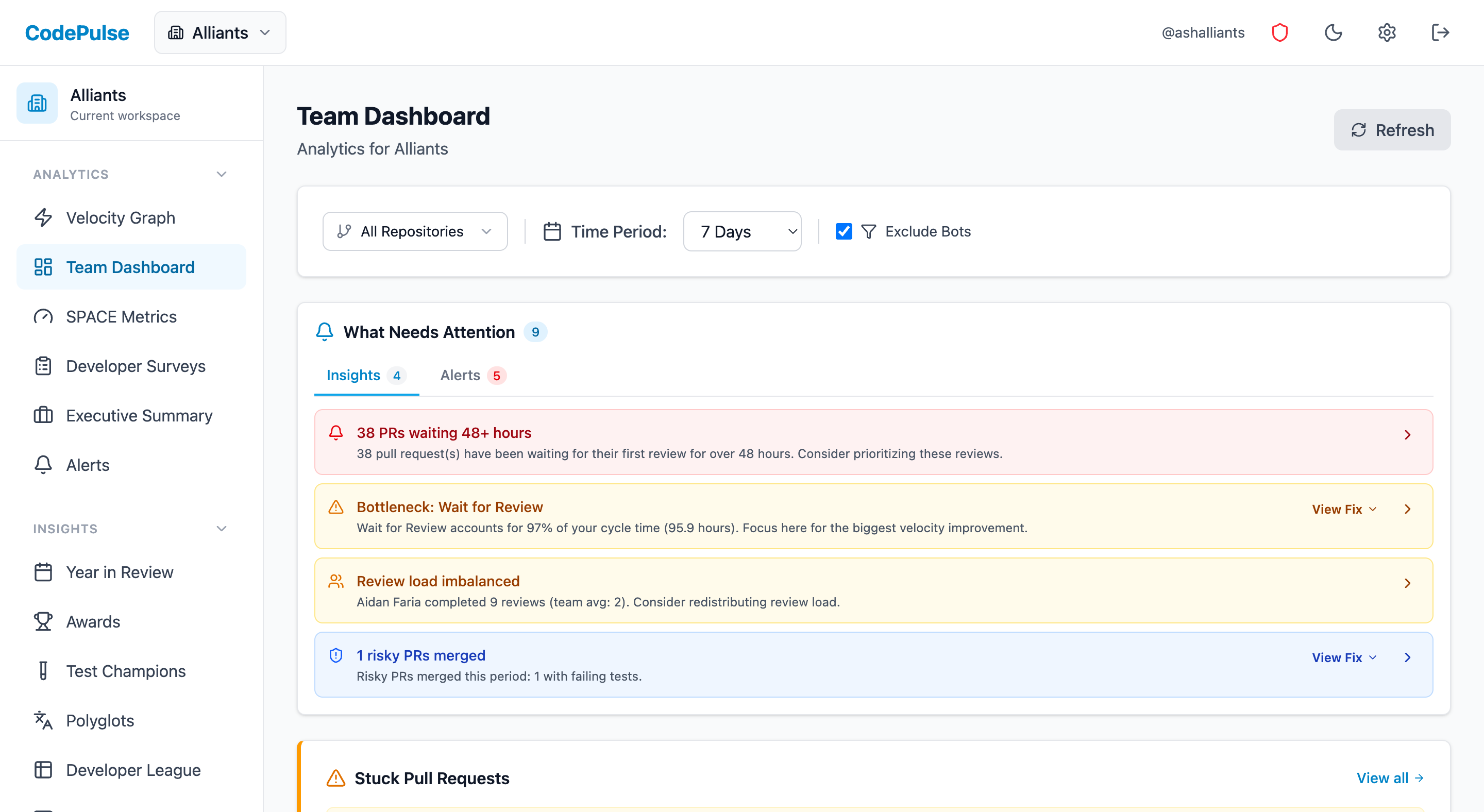
- Real-time alerts: Get notified when PRs get stuck, not in a report days later.
- Modern architecture: Near real-time data sync, not batch processing with delays.
// How to See This in CodePulse
Former GitPrime users will find familiar concepts in new locations:
- Cycle time: Dashboard shows the 4-stage breakdown (Coding, Waiting, Review, Merge)
- PR throughput: Pull Requests page with filtering and trends
- Team patterns: Review Network for collaboration insights
- Code health: File Hotspots and Knowledge Silos
Feature Comparison: GitPrime vs CodePulse
Here's how the original GitPrime (before Pluralsight) compared to CodePulse today:
| Feature | GitPrime (Original) | CodePulse |
|---|---|---|
| Primary data source | GitHub (later expanded) | GitHub |
| Setup time | Minutes | 5 minutes |
| Cycle time tracking | Yes | Yes (4-stage breakdown) |
| PR throughput | Yes | Yes |
| Code churn analysis | Yes | Yes |
| Review metrics | Basic | Advanced (Review Network graph) |
| Code health | Commit risk | File Hotspots, Knowledge Silos |
| Individual rankings | No (added later) | No (by design) |
| Developer recognition | Limited | 15 award categories |
| Real-time alerts | Limited | Configurable alert rules |
| Pricing transparency | Yes (originally) | Yes |
| Multi-provider support | GitHub only (originally) | GitHub only |
| Jira integration | Added later | Not required |
The Multi-Owner Journey: GitPrime vs Pluralsight Flow vs CodePulse
GitPrime has had four ownership changes in six years - and, as of mid-2026, a shutdown date. Each transition changed the product's direction, pricing, and philosophy. Here is how the evolution played out:
| Aspect | GitPrime (2015-2019) | Pluralsight Flow (2019-2025) | Appfire (Feb 2025+) | CodePulse |
|---|---|---|---|---|
| Target market | Engineering teams | Enterprise | Unknown (new owner) | Engineering teams |
| Pricing model | Transparent | $38-50/seat/month, $10K+ min | TBD | Transparent (free tier) |
| Setup complexity | Low | High | High | Low |
| Integration breadth | Narrow (GitHub) | Wide (multi-provider) | Wide | Narrow (GitHub) |
| Integration depth | Deep | Moderate | Unknown | Deep |
| Philosophy | Team improvement | Executive reporting + stack ranking | Unknown | Team improvement |
| Individual rankings | No | Yes (leaderboards) | Yes | No |
| Data freshness | Good | Delayed ("reports update with delay") | Unknown | Near real-time (15-min sync) |
| Product development | Active | "Relatively stagnant" (multiple sources) | Unknown | Active, frequent releases |
| Employee satisfaction | Strong | 2.9/5 Glassdoor, multiple rounds of layoffs | New transition | Focused team |
"CodePulse isn't trying to be Pluralsight Flow. We're trying to be what GitPrime would have become if it had stayed independent and kept its focus."
Migration Guide for GitPrime Teams
If you're coming from GitPrime (or its successor Pluralsight Flow), here's how to transition to CodePulse:
Migration Timeline
Single OAuth flow. No integration mapping or configuration calls.
Historical PR data syncs automatically. Watch the dashboard populate.
Find cycle time, throughput, and review metrics in the Dashboard and Pull Requests pages.
Explore Review Network, File Hotspots, and Knowledge Silos. These go beyond GitPrime.
Set up notifications for stuck PRs, large changes, or review bottlenecks.
Keep your existing tool active while validating CodePulse meets your needs.
Metric Mapping: GitPrime to CodePulse
| GitPrime Metric | CodePulse Equivalent | Location |
|---|---|---|
| Cycle Time | Cycle Time (4 stages) | Dashboard |
| PR Throughput | PRs Merged | Dashboard, Pull Requests |
| Code Churn | Code Churn | Developer Detail, Repository Detail |
| Active Days | Activity metrics | Developers page |
| Commit Risk | File Hotspots | File Hotspots page |
| Review Metrics | Review Network | Review Network page |
| Team Overview | Executive Summary | Executive Summary page |
What Won't Transfer
Be aware of these differences when migrating:
- Historical data: CodePulse syncs from your GitHub history, so you'll get the same underlying data, but in our format. Historical reports from GitPrime/Flow won't import directly.
- Jira correlations: If you relied on issue-to-code mapping, CodePulse doesn't have this. Consider whether you actually used it or if it was configured but ignored.
- Custom dashboards: Any custom views in GitPrime/Flow need to be recreated. Our Dashboard and Executive Summary cover most use cases.
- Individual rankings: If your team used leaderboards, they won't exist in CodePulse. This is intentional. If rankings were valuable, CodePulse may not be right.
Frequently Asked Questions
GitPrime was acquired by Pluralsight in 2019 for $170 million and rebranded as Pluralsight Flow. Pluralsight was taken private by Vista Equity Partners in 2021, handed to a creditor consortium in 2024 after Vista wrote its equity down to near zero, and then sold to Appfire in February 2025 - four ownership changes in six years, and now a shutdown date: Appfire is retiring Flow on December 31, 2027, with renewals already closed as of June 30, 2026. The product stagnated under Pluralsight, with users and analysts noting it "remained relatively stagnant" while competitors advanced.
Related Guides
Still evaluating options? These guides cover related comparisons:
- Pluralsight Flow Alternative - Direct comparison with GitPrime's successor
- LinearB Alternative - If you need multi-provider support or gitStream automation
- Engineering Analytics Tools Comparison - Full overview of the market
Making Your Decision
GitPrime proved that engineering analytics could be simple, valuable, and respectful of developers. Then it was acquired, used for stack ranking, stagnated under corporate ownership, and changed hands three more times. Four ownership changes in six years scattered the original promise across enterprise tools with enterprise complexity - and the product Appfire ended up with is now being retired. If you're looking for what GitPrime represented, here's the honest assessment:
- If you need multi-provider support (GitLab, Bitbucket): Pluralsight Flow or LinearB are better fits, despite their complexity.
- If you need deep Jira integration: Flow, LinearB, or Jellyfish provide this. CodePulse doesn't.
- If you're GitHub-focused and want GitPrime's original simplicity: CodePulse delivers this with modern improvements.
- If anti-surveillance philosophy matters: CodePulse aligns with GitPrime's original team-focused approach.
The best GitPrime alternative depends on why you loved GitPrime. If it was the GitHub depth and fast setup, CodePulse carries that forward. If it was features that came later (Jira, multi-provider), the enterprise tools handle that better.
Start a free trial and see if CodePulse delivers what you remember from GitPrime's best days.
Evaluate CodePulse against your own delivery history
A comparison table only goes so far. Connect read-only GitHub in about five minutes and judge the output on your repositories, at one flat price, with no per-seat math.
Read-only GitHub · Your code stays yours · Team-level by default · No credit card
See These Features in Action
Compare contribution patterns for coaching, not surveillance.
Break down cycle time into coding, waiting, review, and merge phases.
Related Guides
Jellyfish vs LinearB vs Swarmia: Full 2026 Comparison
Compare Jellyfish, LinearB, Swarmia, Allstacks, Haystack and more engineering analytics tools. Features, pricing, cycle time benchmarks, and integrations.
5 LinearB Alternatives for 2026 (With Pricing)
An honest comparison of CodePulse vs LinearB. We tell you when to choose LinearB instead, because the best tool is the one that makes the right trade-offs for your situation.
Pluralsight Flow Alternative: Why Teams Are Switching
Pluralsight Flow is built for enterprise reporting - but if you need team-focused insights without leaderboards or enterprise pricing, there are better options. This guide compares the trade-offs.
Sleuth Alternative: Why Teams Switch to CodePulse
Honest comparison of Sleuth vs CodePulse for engineering analytics. Feature comparison, pricing, and a decision framework for choosing the right tool.