
Compare the finished analysis before you choose a platform
See the report CodePulse produces from read-only GitHub workflow data, or connect your own repositories and evaluate the fit with real evidence.
Read-only GitHub · Your code stays yours · Team-level by default · No credit card
While most engineering analytics platforms focus on velocity metrics like cycle time and deployment frequency, code quality analytics require a different lens. This guide compares how different tools approach code quality measurement, from hotspot detection to knowledge silo identification to test analytics.
What are the best code quality analytics tools?
The best code quality analytics tool depends on your focus. For codebase-level risk detection (file hotspots, knowledge silos, review sentiment), CodePulse and Swarmia lead. For quality metrics tied to business outcomes via Jira, LinearB offers the strongest integration. For executive portfolio-level quality views, Jellyfish is the top choice but comes with enterprise pricing. Most platforms gate quality features behind premium tiers.
If you're evaluating tools specifically for code quality insights, this comparison covers what each platform offers, where the gaps are, and which tool fits your team.
What is Code Quality Analytics?
Code quality analytics go beyond "how fast are we shipping?" to answer questions like:
- Where are our riskiest files? Which parts of the codebase change frequently and might need architectural attention?
- Who knows what? Are there knowledge silos where only one person understands critical code?
- How healthy is our review culture? Are reviews thorough, or are PRs rubber-stamped?
- What's our test coverage story? How often do PRs ship with failing CI checks?
- Are we accumulating technical debt? Is code churn healthy refactoring or problematic rework?
Key Quality Metrics Categories
| Category | What It Measures | Why It Matters |
|---|---|---|
| Code Hotspots | Files with high change frequency | Identifies architectural risk and complexity |
| Knowledge Silos | Code owned by single contributors | Bus factor, onboarding risk |
| Code Churn | Ratio of deletions to additions | Technical debt patterns |
| Review Quality | Coverage, depth, sentiment | Process health and team culture |
| Test Health | CI pass rates, flaky tests | Release confidence |
| PR Size | Lines changed per PR | Review effectiveness, risk |
How Do Code Quality Analytics Tools Compare?
Code quality tools fall into two distinct categories that buyers frequently confuse. Static analysis tools (SonarQube, CodeClimate, Codacy) scan source code for bugs, vulnerabilities, and style violations. Engineering analytics platforms (CodePulse, LinearB, Swarmia, Jellyfish) analyze the development workflow - PR patterns, review culture, code churn, knowledge distribution - to surface process-level quality risks. Most teams need both, but they solve different problems.
Static Analysis Tools vs Engineering Analytics Platforms
| Dimension | Static Analysis (SonarQube, CodeClimate, Codacy) | Engineering Analytics (CodePulse, LinearB, Swarmia) |
|---|---|---|
| What it scans | Source code structure | Git workflow data (PRs, reviews, commits) |
| Finds | Bugs, vulnerabilities, code smells, complexity | Process bottlenecks, knowledge silos, review culture gaps |
| Answers | "Is this code well-written?" | "Is the process producing this code healthy?" |
| When it runs | CI pipeline (per commit/PR) | Continuous (aggregates over time periods) |
| Blind spots | Cannot detect knowledge silos, review rubber-stamping, or team dynamics | Cannot detect syntax errors, security vulnerabilities in code, or test coverage gaps |
Tool-by-Tool Quality Feature Breakdown
LinearB
Quality Features:
- PR size tracking and benchmarks
- Review coverage metrics
- Rework rate tracking (code modified within 21 days)
- Investment allocation (feature vs maintenance work)
Gaps:
- No visual hotspot mapping
- Knowledge silo detection is limited
- Test analytics require Jira integration for full context
Best for: Teams wanting quality metrics tied to business work via Jira
Haystack (Hatica)
Quality Features:
- PR quality scoring
- Developer wellbeing metrics (to prevent burnout-driven quality drops)
- Review workload distribution
- Sprint health indicators
Gaps:
- Less focus on codebase-level analysis (hotspots, ownership)
- Newer platform with evolving feature set
- Limited file-level insights
Best for: Teams prioritizing developer experience alongside quality
Jellyfish
Quality Features:
- Investment allocation tracking
- Work type classification (feature vs bug fix vs maintenance)
- Portfolio-level quality trends
- Executive reporting on quality investment
Gaps:
- Designed for executive view, less tactical quality insights
- No hotspot visualization
- Limited code-level analysis
- Enterprise pricing makes it inaccessible for smaller teams
Best for: Large organizations tracking quality investment at portfolio level
Pluralsight Flow
Quality Features:
- Deep git-level analytics including churn
- Historical trend analysis
- Team efficiency metrics
- Learning integration for skill gaps
Gaps:
- Interface feels dated
- Focus on individual developer metrics raises privacy concerns
- Less emphasis on modern code quality patterns
Best for: Organizations already using Pluralsight wanting combined learning and analytics
Swarmia
Best for: GitHub-first teams wanting quality metrics with Slack integration
Pros:
- Working agreement tracking (define standards, measure compliance)
- Review distribution and load balancing visibility
- Investment balance tracking (new features vs maintenance)
- Slack-native notifications and digests
Cons:
- No file-level hotspot detection or knowledge silo mapping
- Less depth in code-level quality metrics than CodePulse or Pluralsight Flow
- Pricing scales quickly with team size
CodePulse
Quality Features:
- File Hotspots: Visual identification of frequently-changed files with change count and contributor data
- Knowledge Silo Detection: Identifies files with single owners, highlights bus factor risks
- Code Churn Rate: Per-developer and repo-level churn tracking with "Refactoring Hero" recognition for healthy cleanup
- Review Coverage: Percentage of PRs receiving reviews, tracks merge-without-approval rates
- Review Sentiment: AI-powered analysis of review comment tone to identify toxic patterns
- Test Failure Rate: CI pass/fail tracking tied to PRs
- PR Size Optimization: Tracks average PR size with file type exclusions for accurate measurement
Gaps:
- GitHub-only (no GitLab or Bitbucket support)
- No predictive quality scoring (planned)
- Jira integration less deep than competitors
Best for: GitHub-centric teams wanting comprehensive code quality insights with transparent pricing
📊CodePulse Quality Metrics Dashboard
Navigate to the Dashboard to see your quality metrics at a glance:
- Test Failure Rate: Percentage of PRs with failing CI checks
- Review Coverage: Percentage of PRs that received reviews
- Merge Without Approval Rate: PRs that bypassed review process
- Average PR Size: Lines changed per PR (excluding docs, deps, config)
- File Hotspots page for visual identification of high-risk areas
- Review Insights for sentiment analysis and review culture health
What Quality Features Does Each Platform Offer?
Static Analysis Tools
| Feature | SonarQube | CodeClimate | Codacy |
|---|---|---|---|
| Static Code Analysis | Yes | Yes | Yes |
| Security Vulnerability Scanning | Yes | Limited | Yes |
| Code Complexity Metrics | Yes | Yes | Yes |
| Test Coverage Reporting | Yes | Yes | Yes |
| File Hotspot Detection | No | No | No |
| Knowledge Silo Alerts | No | No | No |
| Review Culture Analysis | No | No | No |
| PR Workflow Analytics | No | Partial | Partial |
Engineering Analytics Platforms
| Feature | LinearB | Haystack | Jellyfish | Swarmia | Flow | CodePulse |
|---|---|---|---|---|---|---|
| File Hotspot Detection | Limited | No | No | No | Partial | Yes |
| Knowledge Silo Alerts | No | No | No | No | No | Yes |
| Code Churn Tracking | Rework only | Limited | No | Limited | Yes | Yes |
| Review Coverage % | Yes | Yes | Partial | Yes | Yes | Yes |
| Review Sentiment Analysis | No | Limited | No | No | No | Yes |
| Test Failure Tracking | Yes | Yes | Partial | Yes | Yes | Yes |
| PR Size Analysis | Yes | Yes | Yes | Yes | Yes | Yes |
| Working Agreements | Yes | No | No | Yes | No | Partial |
| Bot Activity Filtering | Yes | Yes | Yes | Yes | Yes | Yes |
| Quality Alerts | Yes | Yes | Limited | Yes | Limited | Yes |
How Do Code Quality Analytics Platforms Compare on Pricing?
Pricing is where the code quality analytics market gets murky. Per-seat pricing punishes growing teams, and most platforms gate their best quality features behind enterprise tiers that require sales conversations. Here is the full breakdown across both static analysis tools and engineering analytics platforms.
| Tool | Free Tier | Team Price | Enterprise Price | Per-Seat or Flat |
|---|---|---|---|---|
| SonarQube | Community Edition (self-hosted, open source) | Developer Ed. ~$150/year (self-hosted) | Enterprise from ~$20,000/year | Per-instance (LOC-based tiers) |
| SonarCloud | Free for public repos | From ~$14/month (small teams) | Custom pricing | Per-LOC analyzed |
| CodeClimate | Quality: free for OSS | ~$15-20/dev/month (Velocity) | Custom pricing | Per-seat |
| Codacy | Free for open source | From ~$15/dev/month | Custom pricing | Per-seat |
| CodePulse | Full quality features included | $199/month (up to 50 devs) | $449/month (unlimited) | Flat pricing |
| LinearB | Limited free tier | ~$20/dev/month | Custom pricing | Per-seat |
| Swarmia | Limited free tier | ~$15-20/dev/month | Custom pricing | Per-seat |
| Jellyfish | No free tier | No team plan | From ~$40,000+/year | Enterprise contract |
🔥 Our Take
Per-seat pricing is a tax on growth. A 100-person engineering team paying $20/dev/month spends $24,000/year on analytics. At 200 people, that doubles - but the platform is not twice as useful.
Flat pricing means your analytics budget stays predictable as you hire. CodePulse charges $199/month for up to 50 developers and $449/month for unlimited - the cost does not scale with headcount. That is a deliberate choice: analytics tools should become cheaper per person as teams grow, not more expensive.
Beyond sticker price, look at what each tier actually includes. SonarQube's free Community Edition is powerful for static analysis but lacks branch analysis and security hotspot triage. CodeClimate's free Quality tier covers static analysis but its Velocity product (the engineering analytics side) is per-seat. Codacy's free tier is limited to open-source projects. Most engineering analytics platforms reserve hotspot detection and sentiment analysis for premium plans - CodePulse includes them at every tier.
What Integration Depth Do Code Quality Platforms Offer?
Integration depth determines how much useful data a platform can actually extract. A webhook-only integration sees events as they happen but cannot pull historical data. A REST API integration can query history but often misses real-time context. A full GitHub App integration gets both - plus access to granular data like file-level diffs, check run details, and review comments with threading context.
| Platform | GitHub Integration Type | Data Depth | Historical Backfill |
|---|---|---|---|
| SonarQube / SonarCloud | CI plugin + webhook | Code scanning results only - no PR workflow data | Per-scan only |
| CodeClimate | GitHub App (Quality) + OAuth (Velocity) | Code analysis per PR; velocity metrics from Git | Limited historical analysis |
| Codacy | GitHub App | Code analysis per commit/PR; basic PR metrics | Limited to recent commits |
| LinearB | GitHub App + Jira/Linear | PR metrics, cycle time, investment allocation | Yes (depth varies by plan) |
| Jellyfish | GitHub App + Jira | High-level engineering metrics, portfolio allocation | Yes (enterprise onboarding) |
| Swarmia | GitHub App + Slack + Jira | PR metrics, working agreements, team health | Yes (90 days typical) |
| CodePulse | GitHub App (GraphQL + REST + webhooks) | Full PR lifecycle, file diffs, review comments, check runs, commit stats | 6-month automatic backfill on connect |
Review quality analysis is where the gap is widest: platforms that only track "was this PR reviewed?" miss the 68% of reviewed PRs that receive zero comments. CodePulse tracks review depth, sentiment, and comment categorization because the GitHub App integration pulls full review body and comment threading data.File-level insights are another differentiator - hotspot detection and knowledge silo mapping require file-level diff data from every PR, not just metadata. And historical context matters too: a 6-month backfill on connection means you see patterns from day one instead of waiting weeks to accumulate enough data for meaningful trends.
How Do You Choose the Right Code Quality Tool?
Questions to Ask
- Do you need codebase-level insights? If you want to identify risky files and knowledge silos, prioritize tools with hotspot detection.
- How important is review culture? If toxic reviews are a concern, look for sentiment analysis capabilities.
- What's your budget? Quality features are often premium. Check what's included in your price tier.
- GitHub vs multi-platform? If you're GitHub-only, tools like CodePulse offer deep integration. Multi-platform teams may need broader support.
- Executive vs tactical focus? Jellyfish excels at portfolio-level reporting; CodePulse and LinearB offer more tactical quality insights.
Recommendations by Use Case
| Use Case | Recommended Tool | Why |
|---|---|---|
| Identify architectural risks | CodePulse | Visual hotspot detection + knowledge silo alerts |
| Improve review culture | CodePulse | Review sentiment analysis + load balancing insights |
| Track tech debt investment | LinearB or Jellyfish | Investment allocation with Jira integration |
| Prevent burnout-driven quality drops | Haystack | Developer wellbeing focus |
| Executive quality reporting | Jellyfish | Portfolio-level views for leadership |
| Budget-conscious quality analytics | CodePulse | Full quality features in free tier |
How Do You Get Started with Code Quality Analytics?
Start with a clear goal and expand from there:
- Define your quality goals: Are you trying to reduce bugs? Improve review culture? Identify risky code? Different goals may point to different tools.
- Start with a trial: Most tools offer free trials. Test with a subset of repositories to see how useful the quality insights are.
- Look at the data quality: Do metrics exclude bot activity? Are generated files filtered out? Accurate quality metrics require clean data.
- Involve tech leads: Staff engineers and tech leads often have the best intuition about which quality metrics matter for your codebase.
- Plan for action: Quality metrics are only valuable if you act on them. Ensure you have a process to address hotspots and knowledge silos.
For a broader comparison of engineering analytics platforms, see our Engineering Analytics Tools Comparison.
To dive deeper into specific quality metrics, explore:
- Understanding Code Churn - Distinguishing healthy refactoring from problematic rework
- Code Hotspots and Knowledge Silos - Identifying and mitigating architectural risks
- Code Review Culture and Sentiment - Building psychological safety in reviews
- 2025 Engineering Benchmarks - Our analysis of 803,000+ PRs across 262,000 repositories
- Engineering Analytics Tools Comparison - Full-spectrum platform comparison beyond quality metrics
What the Data Says About Code Quality
Context matters when evaluating quality tools. Here is what we found analyzing 803,000+ merged pull requests across 262,000 repositories in the CodePulse 2025 Code Review Study:
| Finding | Number | Implication for Quality Tools |
|---|---|---|
| PRs over 1,000 lines with no formal review | 90% | PR size tracking and review enforcement are table-stakes quality features |
| "Reviewed" PRs with zero comments | 68% | Review coverage alone is a vanity metric; you need review depth analysis |
| Global self-merge rate | 71% | Merge-without-approval tracking catches a real and widespread problem |
| First-time contributor wait penalty | 10.9x longer | Review load distribution tools directly impact onboarding speed |
"68% of 'reviewed' PRs receive zero comments. If your quality tool only tracks review coverage, you're measuring the wrong thing."
These numbers explain why surface-level metrics (coverage percentage, PR count) are insufficient. The tools that surface review depth, actual engagement, and code-level risk patterns deliver materially different insights than those that stop at pass/fail metrics.
Frequently Asked Questions
The top code quality analytics platforms are CodePulse, LinearB, Jellyfish, Swarmia, and Pluralsight Flow. CodePulse leads in codebase-level risk detection (file hotspots, knowledge silos, review sentiment). LinearB is strongest for teams using Jira to tie quality metrics to business outcomes. Jellyfish suits enterprise organizations tracking quality investment at portfolio level. The best choice depends on your team size, Git provider, and whether you need tactical or executive-level insights.
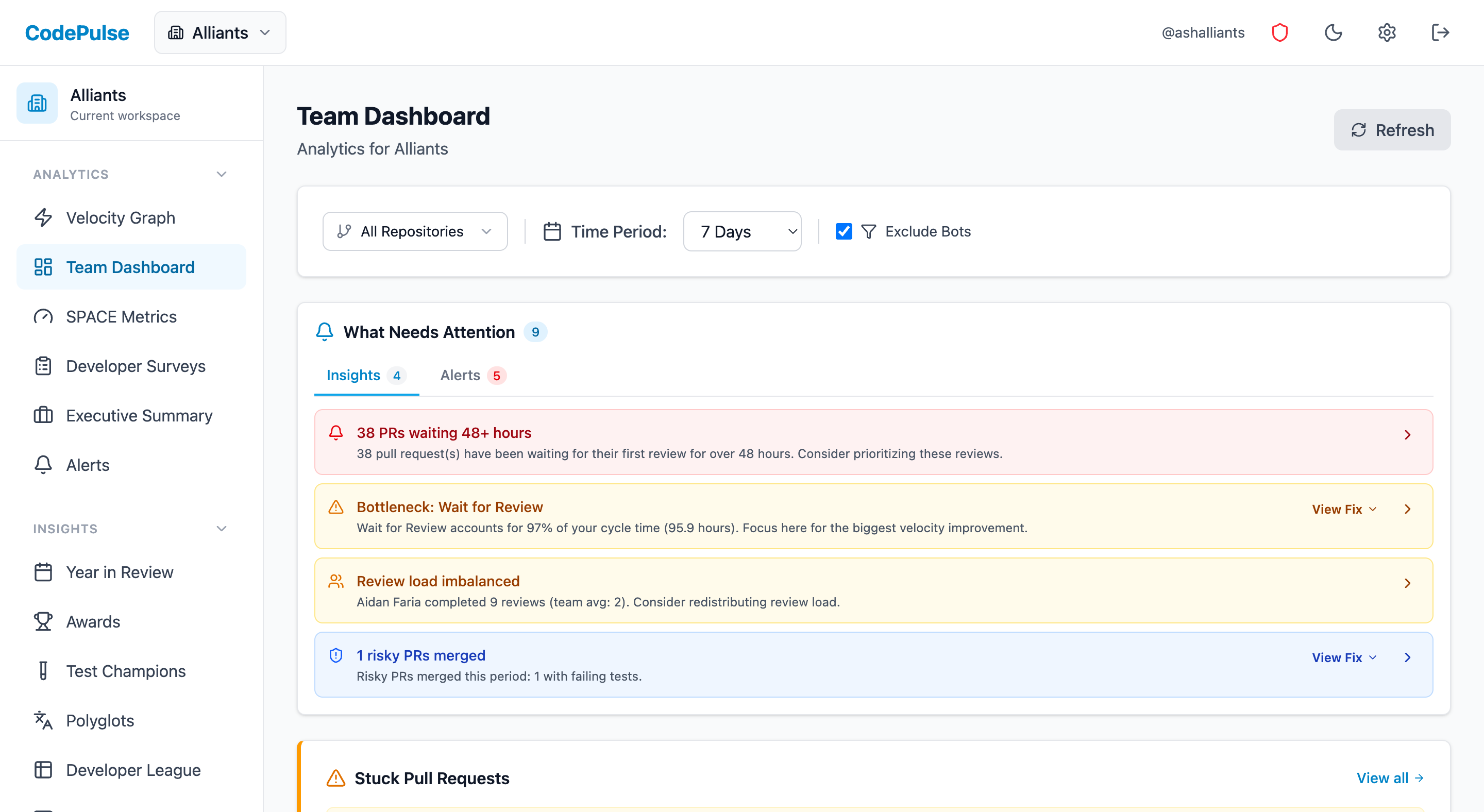
Evaluate CodePulse against your own delivery history
A comparison table only goes so far. Connect read-only GitHub in about five minutes and judge the output on your repositories, at one flat price, with no per-seat math.
Read-only GitHub · Your code stays yours · Team-level by default · No credit card
See These Features in Action
Find high-churn files and correlate change frequency with ownership.
Flag large PRs, single-owner changes, and untested modifications.
Related Guides
Jellyfish vs LinearB vs Swarmia: Full 2026 Comparison
Compare Jellyfish, LinearB, Swarmia, Allstacks, Haystack and more engineering analytics tools. Features, pricing, cycle time benchmarks, and integrations.
High Code Churn Isn't Bad. Unless You See This Pattern
Learn what code churn rate reveals about your codebase health, how to distinguish healthy refactoring from problematic rework, and when to take action.
The 'Bus Factor' File That Could Kill Your Project
Use the Bus Factor Risk Matrix to identify where knowledge concentration creates hidden vulnerabilities before someone leaves.
5 Signs Your Code Review Culture Is Toxic (Fix #3 First)
Assess and improve your code review culture. Identify toxic patterns and build psychological safety in your engineering team.
Engineering Benchmarks 2026: Use Them Without Gaming
A practical guide to using engineering benchmarks effectively - choosing the right comparison, setting targets, and communicating to leadership without falling into metric traps.
Engineering Metrics Tools: What You'll Actually Pay (2026)
The hidden costs and pricing traps in engineering metrics tools. Real pricing data and what vendors hide.
Engineering Analytics ROI: The Budget Approval Playbook
Calculate the ROI of engineering analytics tools with formulas for time savings, payback period, and a business case template tailored to CFOs, CTOs, and CEOs.