
Compare the finished analysis before you choose a platform
See the report CodePulse produces from read-only GitHub workflow data, or connect your own repositories and evaluate the fit with real evidence.
Read-only GitHub · Your code stays yours · Team-level by default · No credit card
The best developer productivity platform for most GitHub-native teams in 2026 is CodePulse, which tracks 50+ metrics across velocity, quality, and collaboration with a free tier and 5-minute setup. According to the 2024 DORA State of DevOps Report, teams that adopt dedicated engineering analytics tools ship 30% faster while reducing burnout. But "developer productivity platform" now spans four distinct categories - metrics platforms, developer experience tools, internal developer portals, and workflow automation engines - and choosing the wrong category wastes budget on a tool that does not address your actual problem.
This guide ranks and compares the 9 best developer productivity platforms across those categories, with honest assessments of where each tool excels and where it falls short. We built CodePulse, so we are transparent about our biases and where competitors genuinely do things we do not. Developer productivity software succeeds or fails on real-world usability, performance at scale, reliability, and support as much as raw metric count, so we cover those dimensions explicitly below, not just metric depth.
What is the best developer productivity platform?
For GitHub-native teams under 200 engineers who want deep PR analytics, cycle time breakdowns, and code quality metrics with a generous free tier, CodePulse is the strongest option. For developer experience measurement through surveys, DX (formerly GetDX) leads the space. For enterprise portfolio visibility across Jira, Git, and CI/CD, Jellyfish offers the broadest integration surface. For teams wanting metrics plus workflow automation, LinearB combines analytics with gitStream. No single platform covers every need, which is why the best teams often pair a metrics tool with a DX survey tool.
What Is a Developer Productivity Platform?
A developer productivity platform is any tool that helps engineering leaders understand, measure, and improve how their teams build software. But that definition is so broad it is almost useless. The real question is: what kind of productivity problem are you solving?
The market breaks into four distinct categories:
| Category | What It Measures | Example Tools |
|---|---|---|
| Engineering Analytics | DORA metrics, cycle time, PR throughput, code quality | CodePulse, LinearB, Plandek |
| Developer Experience (DX) | Developer sentiment, friction points, satisfaction surveys | DX, Swarmia |
| Internal Developer Portals | Service catalogs, scorecards, production readiness | Cortex, Backstage |
| Workflow Automation | CI/CD orchestration, review routing, deployment intelligence | LinearB (gitStream), Sleuth |
The tools ranked in this guide span all four categories. Some focus on one (DX does surveys only; Cortex does portals only). Others try to cover multiple categories in a single platform (Swarmia combines analytics with DX surveys; LinearB combines analytics with workflow automation). Understanding this taxonomy prevents you from comparing apples to oranges.
"The biggest mistake engineering leaders make is buying a developer productivity platform that solves the wrong category of problem. A metrics dashboard will not fix tooling friction. A survey tool will not reduce cycle time."
How Did We Evaluate These Platforms?
We assessed each platform across seven dimensions. These criteria reflect what engineering leaders at 50-500 person teams consistently tell us matters most when evaluating developer productivity tools.
| Criterion | Weight | What We Looked For |
|---|---|---|
| Metric Depth | 25% | Number and quality of metrics tracked. DORA coverage. Cycle time granularity. |
| Setup Speed | 15% | Time from sign-up to first actionable insight. Onboarding friction. |
| GitHub Integration | 15% | Depth of GitHub data extraction. PR-level detail. Review analytics. |
| Privacy Posture | 15% | Team-level vs individual tracking. Anti-surveillance positioning. |
| Pricing Transparency | 10% | Public pricing. Free tier. No hidden "contact sales" gates. |
| Executive Reporting | 10% | Board-ready dashboards. Health scores. Trend summaries. |
| Breadth of Platform | 10% | Coverage across analytics, DX, portals, and automation. |
A note on methodology: we have direct product expertise with CodePulse (we built it) and have evaluated each competitor through published documentation, public demos, customer reviews on G2 and Gartner Peer Insights, and conversations with engineering leaders who have used multiple platforms. We state clearly where we lack firsthand experience.
Which Are the 9 Best Developer Productivity Platforms for 2026?
1. CodePulse
Category: Engineering Analytics | Best for: GitHub-native teams under 200 engineers
CodePulse is a GitHub-native engineering analytics platform that goes deep on PR metrics, cycle time breakdowns, code quality, and review culture. It tracks 50+ metrics across velocity, quality, productivity, and collaboration categories. The 4-stage cycle time breakdown (coding, waiting for review, in review, merge) surfaces bottlenecks that aggregate cycle time numbers hide.
Strengths: Real-time sync (15-minute intervals). Free tier with full dashboard metrics. Deep review analytics including sentiment analysis and review quality scoring. 15 developer award categories that encourage healthy behaviors. File hotspot and knowledge silo detection. Industry benchmarks by team size and sector. Engineering health score (A-F letter grade) for executive reporting. 5-minute setup with GitHub App integration.
Limitations: GitHub only (no GitLab or Bitbucket support). No built-in survey or developer experience measurement. No Jira or Linear integration for issue-level tracking. Smaller team behind the product compared to venture-backed competitors. No workflow automation features.
Pricing: Free for teams up to 10 developers. Pro is $199/month flat for up to 50 developers ($1,788/year billed annually). Business is $449/month flat for up to 150 developers.
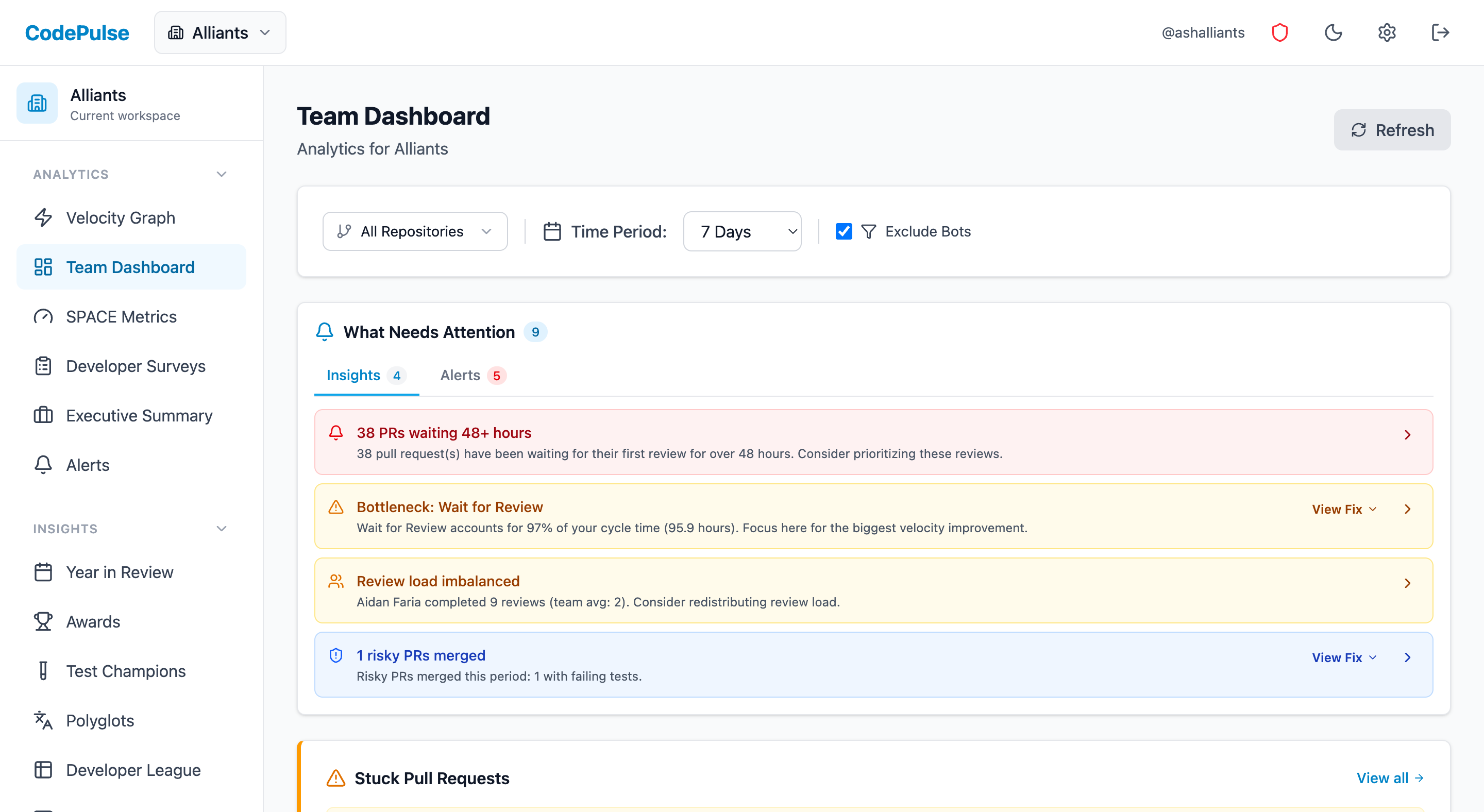
📊 How to See This in CodePulse
Navigate to the Dashboard to see cycle time breakdowns, PR throughput, and quality metrics at a glance:
- The Executive Summary provides an A-F health grade with trend analysis
- Review Network visualizes reviewer-author collaboration patterns
- File Hotspots surfaces high-risk files with single-owner knowledge silos
2. Swarmia
Category: Engineering Analytics + DX | Best for: Teams wanting metrics plus working agreements
Swarmia combines engineering metrics with developer experience measurement. Its "working agreements" feature lets teams set team-level targets (e.g., "PRs reviewed within 4 hours") and track adherence without finger-pointing at individuals. The developer experience surveys provide qualitative data alongside quantitative metrics.
Strengths: Working agreements bridge metrics and behavior change. Developer surveys add qualitative context to quantitative data. Clean, focused UI. Good Slack integration for nudges. Free tier for up to 9 developers. Supports GitHub and GitLab.
Limitations: Metric depth is thinner than CodePulse or LinearB. No review sentiment analysis or code quality scoring beyond basic PR size. Survey features are simpler than dedicated DX tools. Limited executive reporting compared to Jellyfish. No workflow automation.
Pricing: Free for up to 9 developers. Standard is EUR 42 per developer per month billed annually (EUR 49 monthly), with add-on modules at EUR 4-22.
3. LinearB
Category: Engineering Analytics + Automation | Best for: Teams wanting metrics plus workflow automation
LinearB pairs engineering metrics with gitStream, an open-source workflow automation engine that routes PRs, enforces review policies, and automates labeling based on change type. The investment profile feature tracks where engineering time goes across new features, maintenance, and technical debt.
Strengths: gitStream automation is genuinely useful for enforcing PR standards. Investment tracking (feature vs. maintenance vs. debt) fills a gap most analytics tools ignore. Good DORA metrics coverage. Supports GitHub, GitLab, and Bitbucket. Jira integration for issue-level tracking.
Limitations: The platform tries to do many things, and some features feel shallow compared to specialized tools. Review analytics lack the depth of CodePulse (no sentiment analysis, no review quality scoring). The free tier is limited. Setup is more complex due to Jira integration requirements. Pricing is not fully transparent above the free tier.
Pricing: Free tier available. Published pricing runs $420-549 per contributor per year. Enterprise requires custom quote.
4. DX (formerly GetDX)
Category: Developer Experience | Best for: Organizations focused on measuring developer sentiment and friction
DX is a pure developer experience platform built on the SPACE framework research from Microsoft, GitHub, and the University of Victoria. It measures developer productivity through structured surveys, not Git metrics. The platform was founded by researchers who authored the original SPACE paper.
Strengths: The most research-backed approach to developer experience measurement. Benchmarked survey instruments validated across hundreds of organizations. Identifies systemic friction (build times, CI flakiness, onboarding gaps) that Git metrics cannot capture. Strong privacy posture with anonymous, team-level results only.
Limitations: No Git-based metrics at all. You need a separate analytics tool for cycle time, PR throughput, and DORA metrics. Surveys require active developer participation, which not every team sustains. Higher cost than pure analytics tools. Limited value for teams under 30 engineers where you can just talk to people.
Pricing: Custom pricing. Typically $30-50/developer/month for enterprise contracts.
5. Jellyfish
Category: Engineering Management Platform | Best for: Enterprise organizations (200+ engineers) needing business alignment
Jellyfish is an enterprise engineering management platform that connects engineering work to business outcomes. It excels at portfolio-level visibility: tracking how engineering investment maps to product initiatives, strategic priorities, and business goals. The platform integrates with Jira, Git, CI/CD, and calendar tools to build a comprehensive picture of where engineering effort goes.
Strengths: Excellent business alignment reporting. Board-ready dashboards that translate engineering work into language executives understand. Strong headcount planning and capacity modeling features. Broad integration surface (20+ tools). Solid customer success for enterprise onboarding.
Limitations: Expensive. Quote-only pricing - buyers report a median $35,920 annual contract (Vendr, 91 purchases). Overkill for teams under 100 engineers. Setup takes weeks, not minutes. The depth of Git-level metrics (review quality, code hotspots, knowledge silos) is thinner than focused analytics tools. Privacy concerns from teams wary of calendar and activity data collection. If the price or the setup time is the blocker, our Jellyfish alternatives guide ranks the lighter-weight options.
Pricing: Quote-only. Buyers report a median annual contract of $35,920 across 91 purchases (Vendr).
6. Cortex
Category: Internal Developer Portal | Best for: Platform engineering teams managing service catalogs
Cortex is an internal developer portal (IDP) that helps platform teams manage service catalogs, enforce production readiness standards, and track scorecards across hundreds of microservices. It is less about measuring developer productivity and more about ensuring operational excellence across a service-oriented architecture.
Strengths: Excellent service catalog and scorecard functionality. Production readiness checklists that enforce standards (ownership, documentation, on-call, SLOs). Strong integration with incident management tools (PagerDuty, OpsGenie). Initiative tracking for platform migrations. Free tier for small teams.
Limitations: Not a metrics platform. No DORA metrics, cycle time, or PR analytics. Scorecards measure compliance, not delivery performance. Most valuable at scale (50+ services). Requires investment in defining and maintaining scorecards. Overlaps with Backstage (open-source) for basic catalog functionality.
Pricing: Free tier available. Paid plans start at $25/developer/month.
7. Faros AI
Category: Engineering Analytics | Best for: Data teams wanting a queryable engineering data warehouse
Faros AI takes a data-infrastructure approach to engineering analytics. It ingests data from 50+ sources into a normalized data model, then exposes it through pre-built dashboards and a SQL-queryable warehouse. The open-source connector framework (based on Airbyte) means you can extend it to custom data sources.
Strengths: Broadest integration surface in the market (50+ connectors). SQL-queryable data warehouse for custom analysis. Open-source connectors. Strong DORA metrics and delivery pipeline visibility. Good for organizations with strong data engineering teams who want to build custom dashboards.
Limitations: The breadth-over-depth approach means individual integrations are thinner. Setup requires data engineering effort. The UI is functional but less polished than purpose-built tools. No review quality analysis, no developer experience surveys, no workflow automation. Pricing is not publicly available.
Pricing: Open-source community edition available. Enterprise pricing requires custom quote.
"The tools that try to be everything for everyone end up being adequate at everything and excellent at nothing. Pick a tool that is opinionated about the problem it solves."
8. Sleuth
Category: Deployment Intelligence | Best for: Teams focused on deployment tracking and DORA metrics
Sleuth is a deploy-centric platform that tracks changes from commit to production. It maps deployments to code changes, feature flags, and incidents to build a clear picture of what shipped, when, and what broke. The DORA metrics implementation is among the most accurate in the market because it tracks actual deployments, not just PR merges.
Strengths: Deployment-centric model gives more accurate DORA metrics than PR-based proxies. Change failure rate tracking tied to actual incidents. Good feature flag integration (LaunchDarkly, Split). Lightweight setup for teams already using GitHub Actions or similar CI/CD. Slack-native notifications.
Limitations: Narrower scope than full analytics platforms. No review quality analysis, no developer awards, no code hotspot detection. Limited executive reporting capabilities. Smaller company with less enterprise support infrastructure. No developer experience measurement.
Pricing: Free for up to 5 developers. Startup tier from $20/developer/month. Growth tier from $35/developer/month.
9. Plandek
Category: Engineering Analytics | Best for: Jira-heavy organizations wanting delivery forecasting
Plandek is a delivery analytics platform with deep Jira integration. It connects issue tracker data with Git and CI/CD data to provide end-to-end delivery visibility from planning through deployment. The forecasting features help predict delivery dates based on historical throughput.
Strengths: The deepest Jira integration available. Delivery forecasting based on Monte Carlo simulation. Flow metrics aligned with Kanban methodology. Good enterprise onboarding support. Strong in regulated industries (fintech, healthcare) where compliance tracking matters.
Limitations: Weaker GitHub-native experience compared to CodePulse or Sleuth. The Jira dependency means less value for teams using Linear, Asana, or GitHub Issues. No developer experience surveys. No internal developer portal features. Limited code-level analysis (no hotspots, no knowledge silos). Pricing requires contacting sales.
Pricing: Custom pricing. Typically aimed at mid-market and enterprise.
How Do Developer Productivity Platforms Compare?
| Platform | Category | DORA | Review Analytics | DX Surveys | Free Tier | Best For |
|---|---|---|---|---|---|---|
| CodePulse | Analytics | Yes | Deep (sentiment + quality) | No | Yes | GitHub teams <200 |
| Swarmia | Analytics + DX | Yes | Basic | Yes (built-in) | Yes (9 devs) | Working agreements |
| LinearB | Analytics + Automation | Yes | Moderate | No | Limited | Automation + Jira |
| DX | Developer Experience | No | No | Yes (research-backed) | No | DX measurement |
| Jellyfish | Engineering Management | Yes | Basic | No | No | Enterprise 200+ |
| Cortex | Internal Dev Portal | No | No | No | Yes | Service catalogs |
| Faros AI | Data Platform | Yes | Basic | No | OSS edition | Custom analytics |
| Sleuth | Deploy Intelligence | Yes (deploy-based) | No | No | Yes (5 devs) | DORA + deploys |
| Plandek | Delivery Analytics | Yes | Basic | No | No | Jira-heavy orgs |
🔥 Our Take
"Developer productivity" as a category is a marketing invention, not a technical one.
The term groups together tools that share almost no functionality. A survey tool (DX), a service catalog (Cortex), and a Git analytics platform (CodePulse) all call themselves "developer productivity" tools, but they solve completely different problems. This is not accidental. "Developer productivity" is the keyword that VPs of Engineering search for, so every vendor optimizes for it. The danger is buying a platform that sounds like it covers everything but actually covers one narrow slice. Before comparing tools, define your specific problem. If you cannot articulate it in one sentence, you are not ready to buy anything.
"If your team's biggest problem is long cycle times, a developer experience survey will not fix it. If your biggest problem is tooling friction, a Git analytics dashboard will not fix it. Match the tool to the problem, not the buzzword."
Which Platform Fits Which Team?
The "best" developer productivity platform depends as much on how your team operates as on what features you need. We see four recurring team archetypes choose differently.
For DevOps and Platform Teams
DevOps teams care most about deployment frequency, lead time, change failure rate, and mean time to restore - the four DORA metrics. Tools that surface DORA directly from CI/CD signals (CodePulse, Sleuth, LinearB) outrank survey-heavy platforms here. For teams without dedicated CI/CD instrumentation, CodePulse computes deployment frequency from merge-to-default-branch events out of the box.
For Distributed and Remote Teams
Distributed teams need cycle-time visibility that accounts for time-zone handoffs and review wait time across regions. Async-friendly review notifications and weekend-work alerts matter more than real-time dashboards. CodePulse and Swarmia both surface time-zone-aware cycle time. See our guide on developer productivity tools for remote teams for the full decision matrix.
For Agile Teams Running Scrum or Kanban
Agile teams want sprint-aligned data: how much shipped this sprint, what got stuck, where the bottlenecks were. Tools with strong Jira and Linear integration (LinearB, Jellyfish, CodePulse) win here over pure-Git platforms. The strongest signal is whether the platform models PRs at the sprint level, not just the calendar week.
For Large Enterprise Organizations (500+ Engineers)
At scale, the question shifts from "are we fast?" to "where is the budget going and where are the risks?" Enterprise platforms (Jellyfish, Faros AI, Plandek) model business units, tribes, and squads natively. For organizations under 500 engineers wanting enterprise reporting without the enterprise procurement cycle, CodePulse offers board-ready exports and executive summary views on flat pricing.
Our Take
Per-seat pricing is the single biggest reason developer productivity platforms get ripped out at 200 engineers.
A flat-tier platform that costs the same whether you have 50 or 500 engineers will outlast any per-seat tool whose annual bill doubles every two hires. Scalability is a pricing problem before it is a technical one.
How Do the Top Tools Compare on Usability, Reliability, and Support?
Rankings and category breakdowns only get you so far. When engineering leaders search for "best developer productivity software" alongside qualifiers like usability, reliability, or customer support, they are asking a narrower question: which tool holds up on the specific dimension they care about most. The table below answers each dimension directly, platform by platform.
| Platform | Ease of Setup & Usability | Performance & Scale | Reliability | Customer Support & Onboarding | Best For |
|---|---|---|---|---|---|
| CodePulse | 5-min GitHub OAuth, no config | flat pricing to 500 eng | SaaS, status page | founder-led, email + Slack | GitHub-native teams wanting depth without per-seat cost |
| LinearB | multi-tool setup, Jira config required | per-contributor pricing | SaaS, enterprise contract terms | email and chat support | teams wanting analytics plus PR automation |
| Jellyfish | sales-led onboarding | enterprise-scale platform | SaaS, enterprise contract terms | enterprise onboarding and account management | enterprise portfolio and business-alignment reporting |
| Swarmia | self-serve, free tier under 10 devs | per-developer billing, scales to enterprise | SaaS, in-app support | in-app and email support | teams wanting metrics plus working agreements |
| Sleuth | lightweight, needs CI/CD pipeline setup | narrow deploy-metrics scope, per-dev pricing | SaaS, 24/7 support on Enterprise | 24/7 support and dedicated CS on Enterprise | deployment-centric DORA metrics tracking |
| Allstacks | sales-led, no public pricing | Enterprise tier scales past 500 contributors | SaaS, single-tenant option on Enterprise | dedicated CSM on Enterprise, TAM available as add-on | large orgs wanting hands-on onboarding |
| Faros AI | custom connectors, partner-led implementation | scales to enterprise, tiered by connector count | SaaS | support tier details not publicly listed | data teams wanting a queryable warehouse |
| Plandek | many config options, steeper learning curve | $25-55 per contributor per month | SaaS, quarterly business reviews included | free CS support plus dedicated account manager | Jira-heavy orgs wanting delivery forecasts |
| Waydev | sales-led custom quote | on-premise option at Enterprise tier | SaaS or self-hosted at Enterprise tier | priority support and SLA on Enterprise | teams wanting AI coding-agent visibility |
Our Take
There is no "best" engineering analytics tool. There's the tool that makes the right trade-offs for your situation.
CodePulse is great for GitHub-focused teams who want depth without integration complexity. It's wrong for teams who need Jira correlation. Be honest about what you need.
Which Developer Productivity Software Is Easiest to Use?
CodePulse and Swarmia are the fastest to set up, both self-serve without a sales call. CodePulse connects through a single GitHub App install with no configuration required before the first dashboard populates. Swarmia offers a free plan for companies with fewer than 10 software developers, so small teams can connect their tools and see data without committing budget. Jellyfish, Faros AI, and Allstacks route new customers through a sales process before any data connects: none publishes self-serve pricing, and each requires a demo or quote to begin. If your team wants to be looking at real data on day one, prioritize self-serve OAuth setup over a tool that requires a sales call first.
Which Developer Productivity Software Performs Best at Scale?
CodePulse and Swarmia hold flat or tier-based pricing up to 500 engineers, so the annual bill does not double every time headcount doubles. Jellyfish, Faros AI, and Allstacks target the opposite end of the market: each is built for large enterprise organizations and prices its top tiers through a quote-based sales process rather than publishing rates. Allstacks lifts its contributor cap on the Enterprise tier (Premium covers up to 500 contributors). LinearB and Sleuth scale technically but bill per contributor, which raises total cost as teams grow. See our guide to scalable developer productivity software for a full breakdown of data limits and org-modeling depth at each team size.
Which Developer Productivity Software Is the Most Reliable?
All nine platforms in this comparison are SaaS products, so reliability differentiates mainly by whether uptime and incident-response commitments are public or only available on Enterprise contracts. CodePulse publishes a public status page so customers can check uptime without opening a support ticket. Most competitors bundle reliability commitments into Enterprise-tier contracts instead of publishing them: Sleuth's Enterprise plan lists dedicated 24/7 support and dedicated Customer Success, and Waydev's Enterprise tier lists priority support and SLAs alongside self-hosted deployment options. Ask each vendor for their SLA in writing before you sign, rather than assuming SaaS uptime is uniform across the category.
Which Developer Productivity Software Has the Best Customer Support?
There is no single "best" answer here: it depends on whether your team wants direct access to the people who build the product, or an account manager backed by a larger support organization. Customer support is CodePulse's weakest axis relative to venture-backed competitors, and we are not going to oversell it here: CodePulse support is founder-led, a small team answering email and Slack directly, with no ticket queue to route through first, and no 24/7 desk or dedicated CSM program. Several competitors structure support around account-management tiers instead. Sleuth and Allstacks both list a dedicated Customer Success Manager on their Enterprise tiers, with standard support on lower tiers, and Faros AI reserves dedicated support for its Enterprise tier. Plandek includes a dedicated Customer Success Account Manager and free technical support on its plan. Swarmia provides in-app and email support for setup. If a formal account-management structure matters more to you than direct access to a small team, those vendors' Enterprise tiers are built for that.
Which Developer Productivity Software Has the Best Integrations and Compatibility?
Faros AI and Allstacks have the broadest integration surface among these nine platforms. Faros AI connects to source control, project management, CI/CD, and incident-management systems, with unlimited connectors on its top tier, and Allstacks does not limit or charge extra for integrations, connecting to GitHub, Bitbucket, Jira, and Azure DevOps. CodePulse and Sleuth take the opposite approach, prioritizing depth over connector count: both go deep on GitHub and CI/CD data, exposing PR-level review detail and deployment-to-incident mapping that broader platforms do not surface. LinearB and Jellyfish sit in between, adding Jira project hierarchies and a wide tool-integration surface respectively. For a full connector-by-connector matrix across all nine platforms and 10 source systems, see our developer productivity platform integrations comparison.
How Do Pricing, Support, and Platform Coverage Compare at a Glance?
The table below condenses the four attributes buyers ask about most often - how each platform charges, whether the price is public, what support you get, and which source systems it covers - using published figures as of July 2026. Where a vendor does not publish a number, we say so rather than guessing.
| Platform | Pricing model | Published price? | Support model | Platform coverage |
|---|---|---|---|---|
| CodePulse | Flat tiers | Yes - free to 10 devs; Pro $199/mo flat to 50 devs ($1,788/yr annual); Business $449/mo flat, to 150 devs | Self-serve: email + docs, no sales team | GitHub only (by design) |
| Swarmia | Per developer | Yes - free to 9 devs; Standard EUR 42/dev/mo annual (EUR 49 monthly); modules EUR 4-22 | Self-serve: in-app + email | GitHub + GitLab |
| LinearB | Per contributor | Yes - published $420-549/contributor/yr | Email + chat support | GitHub, GitLab, Bitbucket + Jira |
| DX | Quote-only | No - see vendor | Sales-led enterprise contracts | Survey-based; works alongside any SCM |
| Jellyfish | Quote-only | No - buyers report a $35,920 median annual contract (Vendr, 91 purchases) | Dedicated enterprise CS; reviewers praise post-sale customer success | Multi-SCM + Jira, CI/CD (20+ integrations) |
| Cortex | Per developer | See vendor | In-app + email; enterprise onboarding | Portal across SCM + incident tools |
| Faros AI | Quote-only (OSS edition available) | See vendor | Support tier details not publicly listed | Multi-SCM, 50+ connectors |
| Sleuth | Per developer | See vendor | 24/7 support + dedicated CS on Enterprise | GitHub + CI/CD deploy tracking |
| Plandek | Quote-based | See vendor | Dedicated account manager + free technical support | Jira-first; Git + CI/CD |
How Do You Choose the Right Developer Productivity Software for Your Team?
Use this decision matrix to narrow your shortlist based on your team's specific situation. For a broader framing of the category - how SEI platforms differ from narrower devex or delivery tools - our software engineering intelligence platform guide is worth reading before shortlisting.
| Your Situation | Start With | Why |
|---|---|---|
| GitHub-native team, want fast setup | CodePulse | 5-minute setup, free tier, deepest GitHub PR analytics |
| Want metrics + team behavior nudges | Swarmia | Working agreements bridge data and action |
| Need automation + Jira integration | LinearB | gitStream automates PR routing and enforcement |
| Developer friction is your #1 problem | DX | Research-backed surveys surface systemic friction |
| 200+ engineers, board reporting needed | Jellyfish | Business alignment and portfolio-level visibility |
| Microservices with production readiness gaps | Cortex | Scorecards and service catalogs for platform teams |
| Want a queryable engineering data warehouse | Faros AI | 50+ connectors with SQL access to normalized data |
| Deployment tracking is the priority | Sleuth | Most accurate DORA via actual deployment tracking |
| Jira-centric org wanting delivery forecasts | Plandek | Monte Carlo forecasting with deep Jira integration |
A practical approach for teams evaluating their first developer productivity tool:
- Define your problem in one sentence. "We do not know why PRs take 5 days to merge" is a metrics problem. "Developers say builds are slow but we have no data" is a DX problem. "We have 200 microservices and no one knows who owns what" is a portal problem.
- Start with a free tier. CodePulse, Swarmia, Cortex, and Sleuth all offer free options. Get data flowing before committing budget.
- Evaluate for 30 days with real data. Demo environments with fake data tell you nothing about how a tool handles your repository structure, team size, and workflow patterns.
- Check the first 5-minute experience. If setup takes more than an afternoon, adoption will stall. According to the 2024 DORA Report, tool adoption is the single biggest predictor of whether metrics programs succeed.
- Get developer buy-in early. Any productivity tool that developers perceive as surveillance will fail. Share dashboards with your team from day one. Use team-level metrics in public, individual metrics only for self-improvement.
"The best developer productivity platform is the one your team actually uses. A $50/seat tool that gathers dust is infinitely less valuable than a free tool that becomes part of your weekly standup."
What Integrations Do Developer Productivity Platforms Offer?
Every major developer productivity platform integrates with GitHub, GitLab, and Azure DevOps natively, plus Jira and Slack. The differences emerge in second-tier integrations: Linear, MS Teams, PagerDuty, Datadog, observability stacks, and proprietary CI/CD systems.
CodePulse leads on GitHub and Azure DevOps depth (full PR review tree, comment-level sentiment, file hotspot tracking). LinearB and Jellyfish lead on PM tool breadth (Jira project hierarchies, custom field mapping, multi-project rollups). Cortex and Backstage lead on service catalog integrations.
For a full integration matrix covering 10 source systems across all 9 platforms, see our developer productivity platform integrations comparison.
How Do These Platforms Scale for Growing Teams?
Scalability for developer productivity platforms means three distinct things: data ingestion at scale (millions of PRs per year), org-structure modeling (squads, tribes, business units), and pricing that does not penalize growth. The three usually conflict - tools optimized for ingestion volume often use per-seat pricing, while flat-priced tools sometimes cap data retention.
Jellyfish, Faros AI, and Plandek were purpose-built for 500+ engineer organizations and model business units natively. CodePulse and Swarmia work well up to 500 engineers on flat or tier-based pricing. LinearB and Sleuth scale to enterprise but bill per developer, which gets expensive past 200.
For a full scalability comparison including data limits, org modeling depth, and total cost of ownership at different team sizes, see our dedicated guide on scalable developer productivity software.
Frequently Asked Questions
It depends on your primary need. For GitHub-native teams wanting deep PR analytics and code quality metrics with a free tier, CodePulse is the best fit. For developer experience surveys and sentiment data, DX (formerly GetDX) leads the market. For enterprise portfolio visibility across 500+ engineers, Jellyfish is the strongest option. For teams needing workflow automation alongside metrics, LinearB offers gitStream integration.
Related Guides
Evaluate CodePulse against your own delivery history
A comparison table only goes so far. Connect read-only GitHub in about five minutes and judge the output on your repositories, at one flat price, with no per-seat math.
Read-only GitHub · Your code stays yours · Team-level by default · No credit card
See These Features in Action
Compare contribution patterns for coaching, not surveillance.
Board-ready engineering performance in a single page.
Related Guides
Developer Productivity Metrics That Don't Backfire
Stop treating engineers like factory workers. Learn which developer productivity metrics destroy trust, why lines of code fail, and how to measure productivity, including with AI tools, without surveillance.
Jellyfish vs LinearB vs Swarmia: Full 2026 Comparison
Compare Jellyfish, LinearB, Swarmia, Allstacks, Haystack and more engineering analytics tools. Features, pricing, cycle time benchmarks, and integrations.
Scalable Developer Productivity Software (2026)
Which developer productivity platforms scale to 500+ engineers without breaking budgets. Data limits, org modeling, and pricing-at-scale compared across 9 platforms.
Developer Productivity Platform Integrations Compared (2026)
A complete integration matrix for 9 developer productivity platforms across GitHub, GitLab, Azure DevOps, Jira, Linear, Slack, PagerDuty, Datadog, and more.
Developer Productivity for Remote & Distributed Teams (2026)
How to measure and improve developer productivity in remote and distributed engineering teams. Async patterns, time-zone-aware cycle time, and weekend-work guardrails.
Best Developer Experience Platforms for 2026 (Ranked)
We compared 10 developer experience platforms across internal developer portals, DX surveys, and platform engineering. Honest rankings, real pricing, and a category map.
What is Developer Productivity? (It's Not What You Think)
Developer productivity means sustainable delivery with team health - not lines of code. Learn the frameworks, dimensions, and what NOT to measure.
How to Track Developer Productivity Without Creating Surveillance
Build a sustainable tracking system with dashboards, alerts, and review cadences that surfaces the right information at the right time - without drowning your team in data.
Improve Developer Productivity Without Burnout
A practical guide to improving developer productivity through friction reduction, not pressure. The 5 highest-impact interventions that actually work.
McKinsey Developer Productivity Metrics: How to Respond
McKinsey's 2023 article on measuring developer productivity sparked industry backlash. Here's what they got right, what they got wrong, and a better approach for VPs facing pressure to implement their recommendations.
Affordable Developer Productivity Platforms
How growing teams of 10 to 100 engineers get cycle time and review visibility without a per-seat bill that triples when you hire. Flat vs per-seat pricing, a five-minute cost test, and which platforms stay affordable as you scale.