
Compare the finished analysis before you choose a platform
See the report CodePulse produces from read-only GitHub workflow data, or connect your own repositories and evaluate the fit with real evidence.
Read-only GitHub · Your code stays yours · Team-level by default · No credit card
Tracking DORA metrics manually is a waste of engineering time. The best DORA tools pull data straight from your Git repos and CI/CD pipelines, then calculate the four key metrics without anyone touching a spreadsheet. The challenge is choosing which automated tool fits your stack.
Worth knowing before you shortlist: DORA now publishes five metrics. Deployment rework rate joined the original four, and mean time to recovery is now called failed deployment recovery time. "Four key metrics" below means the original set, so check whether a tool also reports rework rate if that matters to you.
We evaluated eight DORA metrics platforms across automation depth, setup complexity, metric accuracy, pricing transparency, and real-world usefulness for engineering managers and VPs. This is not a feature checklist. It is an opinionated ranking based on what actually helps teams improve their delivery performance - with a focus on how much each tool automates versus how much manual work it still requires from you.
What are the best automated DORA metrics tools?
The best DORA metrics tool depends on your stack and team size. For GitHub-native teams wanting zero-config tracking, CodePulse derives DORA from PR data in under 5 minutes (free tier included). For pipeline-level deployment accuracy, Sleuth offers the most precise deployment frequency data. For enterprise portfolio views, Jellyfish provides business alignment reporting. LinearB adds workflow automation via gitStream. Swarmia combines automated DORA with developer experience metrics. Faros AI is the strongest option for multi-tool data aggregation.
Why DORA Metrics Matter
The DORA research program (now part of Google Cloud) has studied over 39,000 engineering professionals across ten years. The conclusion is consistent: teams that perform well on the four DORA metrics (deployment frequency, lead time for changes, change failure rate, and mean time to recovery) deliver more business value with less burnout.
According to the most recent Accelerate State of DevOps Report, elite-performing teams deploy on demand (multiple times per day), maintain lead times under one hour, keep change failure rates below 5%, and restore service in under one hour. These are not aspirational targets for startups. They are measured outcomes from teams of all sizes across every industry.
The real value of DORA metrics is not the numbers themselves. It is the conversations they trigger. When your VP asks why lead time jumped from 24 hours to 72 hours last quarter, you need a tool that can show exactly where the bottleneck sits: coding time, review wait time, or merge queue delays.
"DORA metrics are not KPIs to optimize. They are signals that tell you where your delivery process is broken and where it is working."
What Should You Look For in an Automated DORA Tool?
We assessed each platform against six criteria that matter most to engineering managers and VPs who need automated, actionable DORA data - not dashboards that collect dust because someone forgot to update the spreadsheet.
| Criterion | What We Measured | Why It Matters |
|---|---|---|
| Automation level | How much DORA data is calculated without manual input | Manual tracking gets abandoned within weeks |
| Setup speed | Time from signup to first DORA dashboard | If setup takes weeks, adoption dies |
| Metric accuracy | How closely the tool tracks actual DORA definitions | Misleading proxies erode trust in the data |
| Actionability | Whether the tool helps you fix problems, not just see them | Dashboards without drill-down are reporting theater |
| Pricing transparency | Published pricing vs. "contact sales" | Opaque pricing wastes evaluation time |
| Integration depth | Git providers, CI/CD, issue trackers, and Slack | DORA data in isolation lacks context |
| Anti-surveillance posture | Whether the tool positions metrics as team health vs. individual ranking | Surveillance tools destroy engineering culture |
The 8 Best DORA Metrics Tools
For a side-by-side on pricing, GitHub-native depth, and how each tool actually calculates DORA's four metrics, see our DORA metrics tools comparison. The rundown below covers each tool in more depth.
1. CodePulse
Best for: GitHub-native teams (10-200 engineers) that want fully automated DORA metrics without pipeline instrumentation.
CodePulse derives DORA metrics from PR and commit data the moment you connect your GitHub account. Deployment frequency is calculated from PRs merged per working day. Lead time for changes maps to PR cycle time (creation to merge). Change failure rate uses CI check failure data from GitHub status checks. There is nothing to tag, no pipeline to configure, and no deployment events to map. It works out of the box for teams practicing trunk-based development where every merge to main triggers a deployment.
Honest limitation: CodePulse calculates deployment frequency from PR merges, not actual deployments. For teams with separate release branches or manual deployment gates, this proxy will overcount or undercount true deployment frequency. Mean time to recovery (MTTR) is estimated rather than measured from incident management tools.
What stands out: The cycle time breakdown splits lead time into four phases (coding, waiting for review, in review, merge), which gives engineering managers the drill-down needed to identify specific bottlenecks. Review coverage, merge-without-approval rates, and change failure tracking are included in the free tier. Setup takes under 5 minutes.
- Pricing: Free tier available. Pro from $199/month for 50 developers.
- Integrations: GitHub, Slack, Jira, Linear.
- DORA coverage: 3 of 4 metrics natively (deployment frequency proxy, lead time, change failure rate). MTTR estimated.
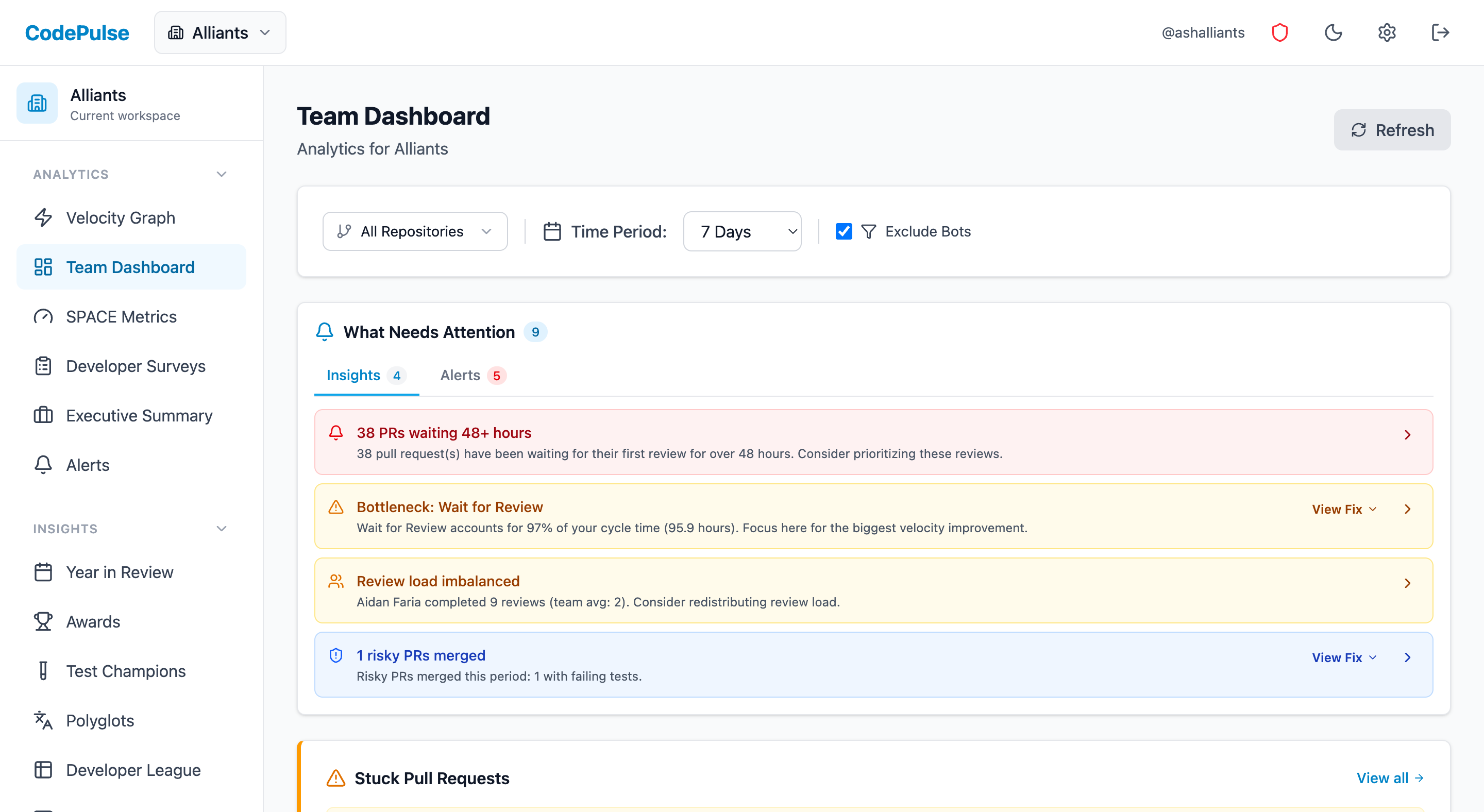
📊 How to See DORA Metrics in CodePulse
Navigate to Dashboard to view your DORA metrics:
- Deployment frequency (PRs merged per day) on the main dashboard card
- Lead time via the cycle time breakdown with four-phase drill-down
- Change failure rate via test failure rate percentage
- Engineering health grade (A-F) composites all four dimensions
2. Sleuth
Best for: Teams that want fully automated, pipeline-level DORA tracking tied to actual deployments.
Sleuth was built from the ground up to track deployments, not just code merges. It monitors your deployment pipeline directly (GitHub Actions, CircleCI, Jenkins, ArgoCD) and correlates each deploy with the code changes, PRs, and issues it includes. Once connected, all four DORA metrics are calculated without manual input. That gives you the most accurate deployment frequency and lead time data of any tool in this list.
Change failure rate is tracked by correlating deploys with incident reports (PagerDuty, Opsgenie) and rollbacks. MTTR is measured from incident creation to the deploy that fixes the issue. If pipeline-level accuracy matters to your team, Sleuth is the benchmark.
- Pricing: Free for small teams. Growth plans from $20/dev/month.
- Integrations: GitHub, GitLab, Bitbucket, all major CI/CD, PagerDuty, Opsgenie, LaunchDarkly.
- DORA coverage: All 4 metrics natively with pipeline-level accuracy.
3. LinearB
Best for: Teams that want DORA metrics bundled with workflow automation and investment allocation tracking.
LinearB combines DORA metrics with its gitStream workflow automation engine, which lets you auto-route PRs, enforce review policies, and classify work types (feature, bug fix, infrastructure). DORA metrics are derived from Git and Jira data. The investment profile feature categorizes engineering effort into new features, maintenance, and tech debt, which is valuable for VP-level reporting.
The platform has evolved significantly in recent years. The free tier covers up to 8 contributors with basic DORA dashboards. Paid plans unlock workflow automation and deeper analytics. LinearB supports GitHub, GitLab, and Bitbucket.
- Pricing: Free for 8 contributors. Paid plans from ~$35/dev/month.
- Integrations: GitHub, GitLab, Bitbucket, Jira, Slack.
- DORA coverage: All 4 metrics derived from Git + issue tracker data.
4. Jellyfish
Best for: Enterprise organizations (200+ engineers) that need to align engineering metrics with business outcomes.
Jellyfish positions itself as an engineering management platform rather than a DevOps metrics tool. DORA metrics are one component of a broader analytics suite that includes investment categorization (mapping engineering work to product initiatives), capacity planning, and executive reporting. The platform aggregates data from Git, Jira, and HR systems.
The value proposition is strongest for VPs and CTOs who need to present engineering performance to the board in business terms. If your primary need is "show me DORA metrics for my 15-person team," Jellyfish is overkill.
- Pricing: Enterprise contracts. Typically $100,000+ annually.
- Integrations: GitHub, GitLab, Bitbucket, Jira, 15+ HR and PM tools.
- DORA coverage: All 4 metrics with business context overlay.
5. Swarmia
Best for: Teams that want DORA metrics combined with developer experience tracking and working agreements.
Swarmia takes a developer-experience-first approach to DORA metrics. Beyond the four keys, it tracks working agreements (team-defined standards like "review PRs within 4 hours"), developer satisfaction surveys, and investment balance. The working agreements feature is unique: teams set their own targets and the tool tracks compliance, which gives managers a lightweight way to drive process improvements without top-down mandates.
DORA metrics in Swarmia are derived from Git and Jira data. The platform supports GitHub and GitLab. Pricing is per-developer, which can add up quickly for larger organizations.
- Pricing: Free for startups (up to 14 devs). Paid from ~$20/dev/month.
- Integrations: GitHub, GitLab, Jira, Linear, Slack.
- DORA coverage: All 4 metrics with SPACE framework overlay.
6. Faros AI
Best for: Teams with complex tool ecosystems that need a unified data model across 50+ engineering tools.
Faros AI takes a data-platform approach to engineering metrics. It ingests data from over 50 tools (Git providers, CI/CD, issue trackers, incident management, communication tools) and normalizes everything into a unified graph model. DORA metrics are calculated from this aggregated dataset, which means deployment frequency can incorporate data from multiple CI/CD systems simultaneously.
The open-source Community Edition provides the core data pipeline. The commercial edition adds pre-built dashboards, anomaly detection, and enterprise support. Faros is the strongest choice for organizations running diverse tool stacks where no single tool has complete visibility.
- Pricing: Open-source core available. Commercial edition pricing on request.
- Integrations: 50+ connectors including GitHub, GitLab, Bitbucket, Jenkins, CircleCI, Jira, PagerDuty.
- DORA coverage: All 4 metrics from aggregated multi-tool data.
7. Haystack
Best for: Small-to-mid-size GitHub teams that want lightweight DORA tracking with a focus on developer productivity.
Haystack focuses on making engineering work visible to managers without overwhelming them with data. DORA metrics are presented alongside developer activity metrics (commits, PRs, reviews) in a clean interface. The tool is GitHub-first and emphasizes speed of setup over breadth of integrations.
Compared to CodePulse, Haystack has less depth in code quality metrics (no file hotspots, knowledge silo detection, or review sentiment analysis). Compared to Sleuth, it lacks pipeline-level deployment tracking. Its strength is simplicity for teams that want DORA basics without complexity.
- Pricing: Free tier available. Paid plans from ~$15/dev/month.
- Integrations: GitHub, Slack.
- DORA coverage: Deployment frequency and lead time from Git data. Limited change failure and MTTR tracking.
8. Propelo (formerly LevelOps)
Best for: Teams that need DORA metrics integrated with full SDLC visibility from planning through deployment.
Propelo (formerly LevelOps) provides DORA metrics as part of a broader software engineering intelligence platform. It tracks the full software delivery lifecycle from issue creation through deployment, which gives a more complete picture of lead time than tools that only measure from first commit or PR creation.
The platform supports a wide range of integrations including GitHub, GitLab, Jira, Jenkins, and Azure DevOps. Propelo differentiates on its "engineering velocity" scoring system that combines DORA metrics with planning efficiency and developer productivity signals.
- Pricing: Open-source edition available. Enterprise pricing on request.
- Integrations: GitHub, GitLab, Bitbucket, Jira, Jenkins, Azure DevOps, CircleCI.
- DORA coverage: All 4 metrics with full SDLC context.
Which DORA Metrics Tools Offer the Best Automation?
| Tool | Automation Level | DORA Source | Setup Time | Free Tier | Best For |
|---|---|---|---|---|---|
| CodePulse | Fully automated | PR + commit data | < 5 min | Yes | GitHub teams, fast setup |
| Sleuth | Fully automated | CI/CD pipelines | ~30 min | Yes (limited) | Deployment accuracy |
| LinearB | Fully automated | Git + issue tracker | ~15 min | Yes (8 contributors) | Workflow automation |
| Jellyfish | Semi-automated | Git + Jira + HR | Weeks (enterprise) | No | Enterprise portfolios |
| Swarmia | Fully automated | Git + issue tracker | ~15 min | Yes (14 devs) | Developer experience |
| Faros AI | Semi-automated | 50+ tool connectors | Hours to days | Open-source core | Multi-tool aggregation |
| Haystack | Fully automated | Git data | ~10 min | Yes | Simplicity |
| Propelo | Semi-automated | Full SDLC pipeline | ~1 hour | Open-source edition | End-to-end SDLC |
🔥 Our Take
Most teams do not need pipeline-level deployment tracking to get value from DORA.
The DORA purist argument is that deployment frequency must be measured at the pipeline level. In practice, 80% of teams running trunk-based development or continuous deployment get identical results from PR merge frequency. The remaining 20% (teams with release trains, staging gates, or manual deployment processes) do need pipeline-level tools like Sleuth. Before spending weeks instrumenting your pipeline, ask: does your merge-to-deploy lag actually matter for your decision-making? If every merge hits production within an hour, PR-based DORA metrics are accurate enough.
How Do Automated DORA Metrics Tools Work?
Not all DORA tools automate the same amount of work. Some connect to your Git provider and start calculating metrics within minutes. Others require you to configure pipeline integrations, tag deployments manually, or maintain custom connectors. The difference matters because the tools that need feeding are the ones that get abandoned.
Fully Automated: Connect and Go
You authenticate with your Git provider, select your repositories, and the tool starts calculating DORA metrics on its own. No ongoing input from your team. CodePulse automates deployment frequency and lead time from GitHub PR data alone - no CI/CD integration needed. Sleuth and LinearB also reach full automation, though Sleuth requires connecting your deployment pipeline for its most accurate metrics.
Semi-Automated: Some Assembly Required
Semi-automated tools pull data from your systems but need manual configuration, tagging, or mapping to produce accurate DORA metrics. Jellyfish requires mapping engineering work to business initiatives through its categorization system. Faros AI needs connector configuration for each tool in your stack, which can take days for complex environments. Propelo requires deployment event mapping to track the full SDLC accurately. These tools deliver more contextual data, but the setup and ongoing maintenance cost is real.
Manual Dashboard: You Do the Math
Spreadsheets, custom Grafana dashboards, and homegrown scripts fall into this category. You query your own data sources, calculate the metrics yourself, and update the dashboard. The DORA team's own Quick Check survey is manual by design - it measures self-reported perception, not actual system data. Manual approaches work for one-time assessments but break down when you need continuous, automated DORA tracking.
| Automation Level | How It Works | Examples | Ongoing Effort |
|---|---|---|---|
| Fully automated | Connect Git/CI, metrics calculated automatically | CodePulse, Sleuth, LinearB, Swarmia, Haystack | None |
| Semi-automated | Data ingested, but requires manual tagging or config | Jellyfish, Faros AI, Propelo | Periodic re-configuration |
| Manual dashboard | You query data, calculate metrics, update the view | Grafana, spreadsheets, DORA Quick Check | Constant (breaks without maintenance) |
The practical difference: a fully automated DORA tool gets checked at every standup. A manual dashboard gets updated before quarterly reviews, if someone remembers. Automated tracking turns the four key metrics into a living signal rather than a periodic report.
"DORA metrics were designed to study thousands of organizations, not manage your specific team. They are signals, not targets. Use automated tracking to watch the signals, not to optimize for 'elite' status."
How to Choose Based on Your Stack
The right automated DORA tool depends on three factors: your Git provider, your deployment model, and how much manual configuration you are willing to maintain. If your team runs on the Microsoft stack, weigh azure devops vs jira before you commit, since the tracker you standardise on shapes which DORA tools can derive lead time end to end.
GitHub-Only Teams (Trunk-Based Development)
If your team works exclusively on GitHub and deploys on every merge to main, start with CodePulse or Haystack. Both connect in minutes and derive DORA from PR data. CodePulse has deeper analytics (cycle time breakdown, review network, file hotspots); Haystack is simpler. If you need workflow automation (auto-routing PRs, enforcing review policies), add LinearB.
Multi-Provider Teams (GitHub + GitLab + Bitbucket)
For organizations spanning multiple Git providers, LinearB, Swarmia, or Faros AI provide cross-platform coverage. Faros AI is the strongest option if you also need to aggregate CI/CD data from Jenkins, CircleCI, and other tools into a single view.
Enterprise Teams (200+ Engineers, Board Reporting)
Jellyfish is purpose-built for this use case. It maps engineering effort to business initiatives, provides portfolio-level views, and generates executive reports. Faros AI is a strong alternative if you prefer a data-platform approach. For GitHub-native enterprises, CodePulse's executive summary dashboard provides engineering health grades and DORA benchmarks at a lower price point.
Teams That Need Pipeline-Level Accuracy
If your release process involves separate deployment pipelines, feature flags, or multi-stage rollouts, Sleuth provides the most accurate deployment-level DORA data. Propelo is also strong here with its full SDLC visibility from issue to deployment.
"The best DORA tool is the one your team will actually look at every sprint. Accuracy matters less than adoption."
"If your merge-to-deploy lag is under one hour, measuring deployment frequency from PR merges is not a compromise. It is the practical choice."
How Do You Automate DORA Reporting at Enterprise Scale?
At enterprise scale, the gap between dashboards and reports gets wide. Engineering managers want dashboards. Boards want PDF reports. Auditors want signed exports with timestamps for SOC2 evidence. Most DORA tools optimize for the first audience and treat the other two as afterthoughts, which is why VPs end up rebuilding board slides in PowerPoint every quarter.
Automated enterprise DORA reporting has three requirements. First, scheduled exports - the report regenerates on a cadence (monthly, quarterly) without anyone clicking a button. Second, multi-business-unit roll-ups - the same data model rolls up from squad to tribe to BU so the board sees portfolio-level signal while EMs see squad-level detail. Third, audit-trail metadata - every report needs a generated-at timestamp, the data window, and a snapshot version, so auditors can verify the same data was used in prior compliance reviews.
CodePulse ships board-ready executive summary exports out of the box, plus an on-demand engineering health HTML report that captures the full org snapshot in one file. Jellyfish, Faros AI, and Plandek offer similar enterprise reporting modules with deeper customization but heavier procurement cycles. For most engineering organizations under 500 engineers, the report layer matters as much as the dashboard layer.
How to See This in CodePulse
Navigate to Executive Summary for board-ready DORA exports, or visit /sample-report to see what the on-demand engineering health HTML report looks like before downloading your own.
Frequently Asked Questions
CodePulse is the strongest DORA metrics tool for GitHub-centric teams. It connects in under 5 minutes, derives deployment frequency and lead time from PR merge data, and includes cycle time breakdown, review coverage, and change failure rate tracking. For teams that also need CI/CD pipeline-level deployment tracking, Sleuth or Faros AI offer deeper pipeline integrations.
Continue Reading
- DORA Four Keys Implementation Guide - How to implement DORA metrics using only GitHub data
- Deployment Frequency and Lead Time Guide - Deep dive into the two throughput DORA metrics
- Engineering Analytics Tools Comparison - Broader comparison beyond DORA-specific tools
- How We Cut PR Cycle Time by 47% - Practical playbook for improving lead time for changes
- Developer Productivity Assessment - Free interactive assessment to benchmark your team before picking a tool
Evaluate CodePulse against your own delivery history
A comparison table only goes so far. Connect read-only GitHub in about five minutes and judge the output on your repositories, at one flat price, with no per-seat math.
Read-only GitHub · Your code stays yours · Team-level by default · No credit card
See These Features in Action
Explore all featuresRelated Guides
No CI/CD Access? Here's How Google Measures DORA Anyway
Measure DORA Four Keys (deployment frequency, lead time, change failure rate, time to restore) using only GitHub data - no CI/CD integration required.
Measure Deploy Frequency Without CI/CD (The Hack)
Master DORA deployment frequency and lead time using GitHub data alone, without requiring CI/CD pipeline access.
Jellyfish vs LinearB vs Swarmia: Full 2026 Comparison
Compare Jellyfish, LinearB, Swarmia, Allstacks, Haystack and more engineering analytics tools. Features, pricing, cycle time benchmarks, and integrations.
We Cut PR Cycle Time by 47%. Here's the Exact Playbook
A practical playbook for engineering managers to identify bottlenecks, improve review processes, and ship code faster - without sacrificing review quality.
Best Engineering Analytics Tools for 2026 (Ranked by Real Users)
We ranked the 10 best engineering analytics tools based on metric depth, setup speed, pricing transparency, and privacy posture. Honest pros and cons for each.
Datadog DORA Metrics: What It Costs and Where It Stops
Datadog does not sell DORA metrics - it sells the plumbing. What the free feature requires, what the feeder products cost, and where it stops being engineering analytics.
How to Measure Developers Without Becoming the Villain
Learn how to implement engineering metrics that developers actually trust, focusing on insight over surveillance and team-level patterns.
Developer Velocity: Metrics Beyond Story Points
Measure developer and engineering velocity without story points: cycle time, deployment frequency, flow efficiency and sustainable pace, plus what DORA tracks today.