
Compare the finished analysis before you choose a platform
See the report CodePulse produces from read-only GitHub workflow data, or connect your own repositories and evaluate the fit with real evidence.
Read-only GitHub · Your code stays yours · Team-level by default · No credit card
"Software engineering intelligence" is the category term that vendors like Jellyfish, LinearB, and Gartner are pushing hard. This guide cuts through the marketing to explain what these platforms actually do, when they're worth the investment, and when a simpler approach works better.
What is a software engineering intelligence platform?
A software engineering intelligence (SEI) platform aggregates data from Git, CI/CD, and project management tools to give engineering leaders visibility into delivery performance, team health, and resource allocation. Leading platforms include Jellyfish ($100K+/yr for enterprises), LinearB (free tier + paid), CodePulse ($199/mo for 50 devs), and Swarmia ($15-20/dev/month). Most teams of 50+ engineers benefit from one; smaller teams can start with GitHub Insights.
What "Engineering Intelligence" Actually Means
The term "software engineering intelligence" emerged around 2021-2022, coined largely by Jellyfish and picked up by Gartner analysts. Before that, the space went by "engineering analytics," "developer productivity platforms," or "value stream management." The rebrand happened for a reason: vendors needed a category that sounded strategic enough to justify six-figure contracts.
Strip away the marketing and an SEI platform does three things:
- Aggregates data from Git repos, CI/CD pipelines, issue trackers, and sometimes calendars or Slack
- Calculates metrics like cycle time, deployment frequency, review coverage, and investment allocation
- Surfaces patterns that humans miss: bottlenecks, knowledge silos, burnout risk, and delivery trends
The question is not whether visibility into your engineering organization is valuable. It is. The question is how much complexity and cost you need to get it.
🔥 Our Take
Most teams that buy an SEI platform are buying a solution to a communication problem, not a data problem.
If your VP of Engineering cannot explain to the CEO why features are late, no dashboard fixes that. The platform helps you gather evidence faster, but the hard work is still translating engineering reality into business language. Buy the tool after you know what questions you need to answer, not before.
The SEI Market in 2026
The engineering intelligence market has consolidated around a few tiers. Understanding where each vendor sits helps you avoid overpaying for capabilities you do not need.
| Tier | Platforms | Best For | Typical Cost |
|---|---|---|---|
| Enterprise | Jellyfish, Allstacks | 500+ engineers, board-level reporting, R&D capitalization | $40K-150K/year |
| Mid-Market | LinearB, Swarmia, Faros AI | 50-500 engineers, team leads and EMs | $5K-30K/year |
| SMB / Startup | CodePulse, Sleuth, Haystack | 10-200 engineers, fast setup, GitHub-native | Free-$5K/year |
| Open Source | Apache DevLake, GrimoireLab | Self-hosted, customizable, privacy-strict | Free (+ hosting) |
"The right SEI platform is the cheapest one that answers your three most important questions. Everything else is shelf-ware."
What SEI Platforms Actually Measure
Every SEI platform measures some subset of these metric categories. The difference is depth, data sources, and how they present the information.
Delivery Performance (DORA Metrics)
Deployment frequency, lead time for changes, change failure rate, and mean time to recovery. These are table stakes. If a platform cannot calculate DORA metrics from your existing data, look elsewhere. Most platforms derive these from Git data and CI/CD events.
Flow and Cycle Time
How long work takes from first commit to production. The best platforms break this into phases: coding time, waiting for review, in review, and merge-to-deploy. This granularity is where you find actionable bottlenecks, not in aggregate cycle time numbers.
Investment Allocation
What percentage of engineering effort goes to features vs. maintenance vs. technical debt vs. incidents. This is the metric that boards care about most. Jellyfish and Allstacks are strongest here because they connect to project management tools. CodePulse derives this from PR labels and work classification.
Team Health Signals
Review load balance, weekend work patterns, knowledge concentration (bus factor), and context switching frequency. These are leading indicators of burnout and attrition. Swarmia leads here with its SPACE framework integration. CodePulse surfaces these through behavioral signals in Git data.
When You Actually Need an SEI Platform
Not every team needs dedicated engineering intelligence tooling. Here is a decision framework based on team size and organizational maturity.
You probably do not need one if:
- Your team is under 20 engineers and everyone talks daily
- You can answer "what shipped this week?" without checking a tool
- Your biggest problem is hiring, not visibility
- GitHub Insights and your CI/CD dashboard give you enough data
You probably need one if:
- You manage 50+ engineers across multiple teams or repos
- Board meetings require engineering metrics you currently assemble manually
- You suspect review bottlenecks or knowledge silos but cannot prove it
- You are evaluating headcount requests and need delivery data to justify them
- Your cycle time feels slow but nobody knows which phase is the bottleneck
"If your engineering org has more than 3 teams and the VP cannot explain delivery velocity without opening 4 tools, you need an SEI platform."
How to Evaluate SEI Platforms (The 6 Questions)
Skip the feature matrix. Ask these 6 questions during your evaluation and the right platform becomes obvious:
- How fast is time-to-value? Can you get useful insights in under a day, or does setup take weeks? GitHub-native tools like CodePulse deliver in minutes. Enterprise tools like Jellyfish may take 4-8 weeks.
- What access level does it require? Read-only Git access is the minimum security bar. Tools requiring write access, CI/CD credentials, or HR system integration increase your security review timeline.
- Does it support your Git provider? GitHub-only, GitLab, Bitbucket, Azure DevOps? Multi-provider support matters if you are in a migration or have acquired teams on different platforms.
- How does it handle team-level vs. individual metrics? Platforms that default to individual developer rankings create surveillance concerns. The best tools show team-level patterns and only drill into individuals for debugging specific bottlenecks.
- What does it cost at your scale? Get pricing for your actual team size. Per-developer pricing adds up quickly. A 200-engineer team at $20/dev/month is $48,000/year. Compare that to flat-rate options.
- Can you get out? Data portability matters. CSV export is the minimum. API access for custom dashboards is better. Vendor lock-in through proprietary metric definitions is a red flag.
📊 How to See This in CodePulse
CodePulse answers all 6 evaluation questions with a bias toward simplicity:
- 5-minute setup via GitHub App (read-only access)
- Team-level metrics by default, individual drill-down only when needed
- Flat pricing: $199/mo for up to 50 developers
- CSV export and API access on all plans
- Navigate to Executive Summary for board-ready metrics
Build vs. Buy: The Real Math
Engineering teams love building tools. But building your own SEI platform is rarely the right call. Here is the math:
| Approach | Setup Time | Annual Cost (100 devs) | Maintenance |
|---|---|---|---|
| Custom Grafana/Metabase | 4-8 weeks | $30K-60K (engineer time) | Ongoing (1-2 days/sprint) |
| Open-Source (DevLake) | 1-2 weeks | $5K-15K (hosting + maintenance) | Moderate (updates, bug fixes) |
| CodePulse | 5 minutes | $1,788-3,588 | None |
| Jellyfish | 4-8 weeks | $40K-100K | None (but admin overhead) |
Build your own only if: (a) you need metrics no commercial tool provides, (b) you have strict data residency requirements, or (c) your team genuinely enjoys maintaining internal tools. For everyone else, the SaaS options pay for themselves in the first month through time saved assembling reports manually.
5 Mistakes Teams Make When Buying SEI Platforms
- Buying the enterprise tier when you are a startup. Jellyfish is built for 500+ engineer organizations with multiple business units. If you have 40 engineers and a single product, you are paying for complexity you do not need.
- Treating it as a surveillance tool. The fastest way to kill an SEI initiative is to use it for individual performance reviews. Teams will game the metrics and you will get worse data than you had before.
- Not defining questions before buying. Write down the 3 questions you need answered. Then evaluate which platform answers them. Do not start with a feature comparison spreadsheet.
- Ignoring the data quality problem. Your metrics are only as good as your data. If PRs sit open for days before review because engineers batch their work, your cycle time numbers will be misleading regardless of which platform you use.
- Expecting the tool to fix process problems. An SEI platform reveals problems. It does not fix them. Budget time for acting on the insights, not just collecting them.
"An engineering intelligence platform without a plan for acting on the data is an expensive screensaver."
Getting Started
If you are evaluating SEI platforms, start with the lowest-commitment option that answers your immediate questions. You can always upgrade later.
- Write down your 3 most important questions (e.g., "Why is our cycle time increasing?", "How should we allocate engineering investment?", "Which teams need help?")
- Try a free-tier tool first. Sign up for CodePulse and connect your GitHub repos. You will have baseline metrics in 5 minutes.
- Give it 2 weeks. Let the data accumulate before drawing conclusions. Cycle time trends need at least 2 weeks of data to show meaningful patterns.
- Present findings to your team. Use the Executive Summary view to build your first board-ready slide.
For deeper comparisons, see our full engineering analytics tools comparison or explore specific alternatives: Jellyfish alternatives, LinearB alternatives, and Swarmia alternatives.
Frequently Asked Questions
A software engineering intelligence (SEI) platform aggregates data from Git repositories, CI/CD pipelines, project management tools, and sometimes HR systems to give engineering leaders visibility into delivery performance, team health, and investment allocation. Examples include Jellyfish, LinearB, CodePulse, Allstacks, and Faros AI.
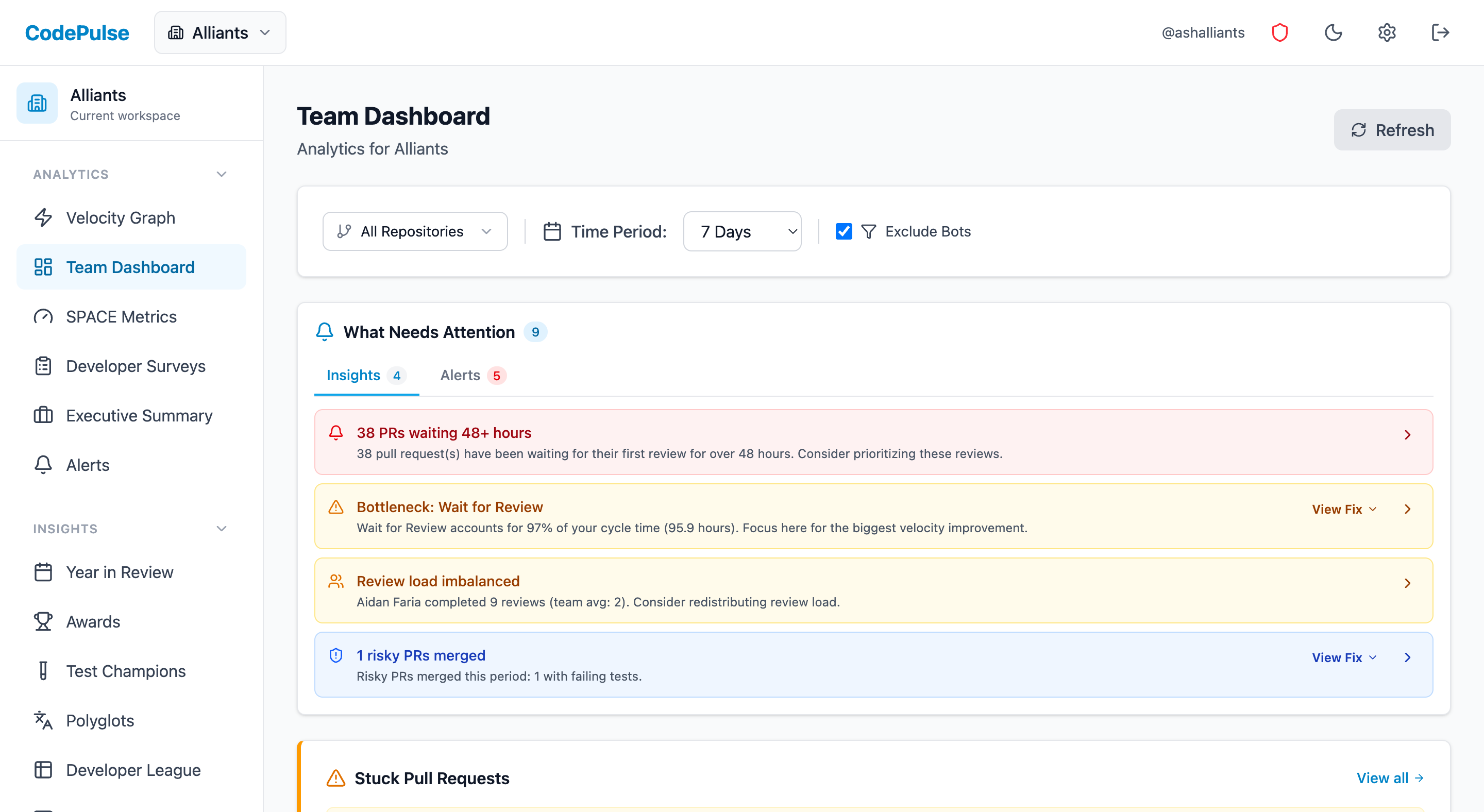
Evaluate CodePulse against your own delivery history
A comparison table only goes so far. Connect read-only GitHub in about five minutes and judge the output on your repositories, at one flat price, with no per-seat math.
Read-only GitHub · Your code stays yours · Team-level by default · No credit card
See These Features in Action
Board-ready engineering performance in a single page.
Track all four DORA metrics and benchmark against industry standards.
Related Guides
Jellyfish vs LinearB vs Swarmia: Full 2026 Comparison
Compare Jellyfish, LinearB, Swarmia, Allstacks, Haystack and more engineering analytics tools. Features, pricing, cycle time benchmarks, and integrations.
7 Jellyfish Alternatives for 2026 (Honest Ranking)
Compare 7 Jellyfish alternatives including CodePulse, LinearB, Swarmia, and more. Honest pros, cons, pricing, and integration comparisons.
5 LinearB Alternatives for 2026 (With Pricing)
An honest comparison of CodePulse vs LinearB. We tell you when to choose LinearB instead, because the best tool is the one that makes the right trade-offs for your situation.
Swarmia Alternatives: Cheaper, Deeper Analytics 2026
A Swarmia alternative worth considering: where Swarmia falls short on customization and per-seat pricing, and which cheaper, GitHub-native tools fit better.
Gartner MQ for Developer Productivity: Who Won, Who Pays
The inaugural 2026 Gartner Magic Quadrant for Developer Productivity Insight Platforms: announced Leaders, what they cost per buyer-reported data, and when you do not need one.
Engineering Analytics Tools: What User Reviews Really Say
An aggregation of what reviewers on G2, Capterra, TrustRadius and Gartner Peer Insights say about Jellyfish, Swarmia, LinearB and Allstacks - the recurring complaint patterns vendors do not quote.