
Understand the system around the team, not a developer leaderboard
Preview team-level workload, collaboration, and delivery signals designed for process improvement rather than performance grading.
Read-only GitHub · Your code stays yours · Team-level by default · No credit card
Measuring developer productivity is contentious. Get it wrong, and you create surveillance culture, gaming, and attrition. Get it right, and you enable growth, remove obstacles, and demonstrate engineering value to the organization. This guide shows you how to approach productivity measurement ethically and effectively.
How should you measure developer productivity without creating surveillance culture?
Focus on team-level metrics rather than individual output. Track cycle time, deployment frequency, and review coverage at the team level. Use individual data only for self-reflection and 1:1 coaching, never for performance rankings. Surveillance-style metrics add pressure to teams that are often stretched already. Microsoft Research's SPACE framework recommends measuring across five dimensions, including satisfaction and collaboration, not just activity counts. CodePulse takes this approach: team-focused dashboards by default, with individual views available for self-reflection.
The key insight: productivity measurement should help developers succeed, not catch them failing. When engineers feel that metrics are used for them rather thanagainst them, resistance transforms into engagement.
If you are evaluating developer productivity tools, start with the metrics and behaviors you want to improve. The right developer metrics should make work easier, not just more measurable. Use our free developer productivity assessment to benchmark where your team stands today.
🔥 Our Take
The phrase "engineering productivity" is a trap. It implies engineers are like factory workers with countable outputs. They're not. Software development is creative knowledge work. Stop trying to measure it like an assembly line.
The "productivity" framing leads to bad metrics: lines of code, commit counts, story points completed. Better framing: "engineering effectiveness" or "delivery capability." You're not measuring how hard people work - you're measuring how well your system enables great work.
"The most important engineering work is unmeasurable: architecture decisions that prevented problems, mentorship that made someone better, documentation that saved hours of confusion."
Why Is Measuring Developer Productivity So Hard?
Why Measuring Productivity Is Hard
Software development doesn't work like manufacturing. You can't simply count output because:
- Quality matters more than quantity: One elegant solution beats ten hacky workarounds
- Problems vary dramatically: Some tasks take hours, others take weeks
- Value isn't always visible: Prevention, maintenance, and architecture don't produce "output"
- Collaboration amplifies impact: Helping others succeed doesn't show up in individual metrics
The Measurement Trap
Whatever you measure, people optimize for. If you measure lines of code, you get verbose code. If you measure tickets closed, you get ticket-splitting. If you measure commits, you get tiny commits.
This isn't malice - it's human nature. People respond to incentives. The trap is thinking you can find metrics immune to gaming. You can't.
The LOC Problem
The fact that anyone still tracks lines of code is embarrassing. In the age of AI coding assistants, it's not just useless - it's counterproductive. A developer who deletes 500 lines while maintaining functionality has done better work than one who adds 500.
LOC rewards verbosity, not value. With Copilot and other AI tools generating code, the metric is now literally meaningless. If you see lines of code on a productivity dashboard, run the other way - you're looking at a tool built by people who don't understand software.
The Alternative Approach
Instead of searching for "un-gameable" metrics, use metrics for insight rather than evaluation. Metrics become tools for conversation, not judgment. This removes the incentive to game and creates genuine value.
What Is the Difference Between Output and Outcome Metrics?
Output Metrics (Use Carefully)
Output metrics measure activity: PRs merged, commits made, lines changed. They're easy to measure but dangerous to optimize for.
Appropriate uses:
- Trend analysis: Is this developer's output declining? (Might indicate blockers or burnout)
- Capacity planning: How much throughput can we expect from the team?
- Self-reflection: Developers reviewing their own patterns
Inappropriate uses:
- Performance ranking
- Compensation decisions
- Comparing individuals
Outcome Metrics (More Meaningful)
Outcome metrics measure results: customer impact, business goals achieved, problems solved. They're harder to measure but more meaningful.
Examples:
- Features shipped that drove measurable user engagement
- Bug fixes that reduced support tickets by X%
- Performance improvements that improved conversion
- Platform work that accelerated other teams
The challenge: connecting engineering work to business outcomes requires product analytics, not just Git data.
Balancing Both
A complete picture combines output indicators (are we producing work?) with outcome indicators (does the work matter?). Neither alone tells the full story.
What Research Says About Developer Productivity
The SPACE Framework
Microsoft Research's SPACE framework identifies five dimensions of productivity:
- Satisfaction and well-being: How developers feel about their work
- Performance: Outcomes of the developer's work
- Activity: Actions and outputs (the traditional focus)
- Communication and collaboration: How people work together
- Efficiency and flow: Ability to do work without interruption
Activity alone (what most metrics capture) is just one dimension. True productivity measurement includes subjective elements like satisfaction and flow.
A newer option is the DX Core 4, published by the developer-experience vendor DX. It condenses DORA, SPACE and DevEx into four dimensions: speed, effectiveness, quality and impact. Treat it as one vendor's synthesis rather than settled research, but the framing is useful because it forces a balance: any speed number should sit next to a quality number. For a comparison of the older frameworks, see our SPACE framework guide.
Key Research Findings
- Interruptions are expensive: In observational work by UC Irvine's Gloria Mark, interrupted workers took about 23 minutes on average to get back to the original task, though that interval includes time spent on other work in between. Protecting focus time beats pushing people harder.
- Speed and stability rise together: DORA's long-running research has found that the teams that deliver fastest also tend to be the most stable, because good practices cut rework instead of slowing teams down.
How Do You Measure Developer Productivity in the AI Era?
AI coding tools make the oldest measurement mistake worse. Activity counts such as commits, PRs and lines changed go up whenever a tool generates more code, whether or not anything valuable shipped. And developers' own sense of how much faster they are is not a reliable substitute.
The clearest example is METR's early-2025 randomized trial: 16 experienced open-source developers completed 246 real tasks in their own repositories, with AI allowed or disallowed at random. Before the study they expected AI to speed them up by 24%, and afterwards they still believed it had sped them up by 20%. The measured result was a 19% slowdown.
Two cautions before you quote that. METR said the study does not show that AI fails to speed up most developers, and in a February 2026 update it said its earlier results no longer reflect current tools, and that its newer data is an unreliable signal because many developers declined to work without AI. The lasting lesson is about measurement, not about AI: perceived speedup and real speedup can differ by a wide margin, so you need data from the work itself.
What to measure instead
- Team-level outcomes before and after adoption: cycle time, review time and PR size, compared against the team's own baseline.
- Quality counterweights: change fail rate and rework, because faster code that comes back is not faster delivery. DORA's 2025 report describes AI as an amplifier of existing strengths and weaknesses, which is why the quality side has to be watched.
- Review load: if AI raises PR volume, the cost often lands on reviewers.
In CodePulse, the AI ROI page compares revert-based rework for PRs that contain AI-assisted commits against everything else, at organization and team level only, never per developer. Attribution relies on AI co-author trailers in commit messages, so it reflects tools that add them. For the wider picture, see our guides on the impact of AI coding tools and measuring Claude Code usage.
How Do You Measure Productivity Ethically?
Principle 1: Transparency
Everyone should know what's being measured and why. No secret dashboards. No metrics collected without disclosure.
Principle 2: Context Before Judgment
Numbers without context are meaningless. A developer with low output might be:
- Working on a hard problem
- Blocked by unclear requirements
- Doing valuable work that doesn't show up in metrics
- Having personal challenges
Always seek context before drawing conclusions.
Principle 3: Team-Level by Default
Focus metrics at the team level. Individual metrics should be for self-reflection and coaching, not evaluation. See our guide on team measurement.
Principle 4: Improvement Over Evaluation
Use metrics to identify obstacles and improve processes, not to rank or punish individuals.
Principle 5: Developer Access First
Let developers see their own data before managers do. Self-reflection is valuable and non-threatening. When developers own their data narrative, trust increases.
Which Developer Metrics Destroy Trust?
Some metrics don't just fail to help - they actively damage your engineering culture. The flip side - how to use the same metrics constructively in an actual review cycle - is covered in our data-backed performance reviews guide. Developer wellbeing is already fragile. A 2021 survey by Haystack Analytics, a vendor, reported 83% of developers experiencing burnout. And the 2024 Stack Overflow Developer Survey found that only about one in five developers are happy at work; the rest were complacent or unhappy. Metrics that feel like surveillance add pressure to teams that are often stretched already.
"If you're using individual developer metrics for performance reviews, you've already lost. You'll get exactly what you measure: gamed numbers and eroded trust."
The Trust-Destroying Metrics
These metrics signal to engineers that you don't understand their work:
- Lines of code: Rewards verbosity, punishes elegant solutions and refactoring
- Commit counts: Rewards splitting work artificially, punishes thoughtful batching
- Individual velocity rankings: Turns teammates into competitors, discourages helping others
- Time-at-desk or active hours: Surveillance theater that measures presence, not output
- Individual story points completed: Story points are for team capacity, not individual performance
The High Velocity Trap
High velocity is often a warning sign, not a success metric. Teams going "fast" are often just generating work, not shipping value. If your team's output doubled but customer satisfaction didn't budge, you optimized the wrong thing.
Velocity measures motion, not progress. When velocity becomes a goal, it stops being useful - you'll get more PRs, but they'll be smaller, simpler, and less valuable. You'll hit your numbers while missing your targets.
The "High Performer" Illusion
That developer with the most commits? They might just be breaking work into tiny pieces. The one with the fastest cycle time? They might be cherry-picking easy tasks. Git metrics tell you what happened, not who's valuable.
Visibility bias is real. The best engineers often do invisible work: architecture, mentoring, documentation, code review. If you only track what's countable, you'll undervalue what matters.
🔥 Our Take
The moment you compare Alice's cycle time to Bob's, you've turned teammates into competitors. Individual developer metrics destroy trust. Metrics are for understanding systems, not judging people.
Performance reviews should use metrics as conversation starters, not scorecards. When engineers are ranked against each other, collaboration dies. Why would Alice help Bob if it hurts her relative standing?
Should You Measure Team or Individual Productivity?
Why Team Metrics Work Better
Software is a team sport. Individual productivity metrics fail because:
- They ignore collaboration (which you want to encourage)
- They can be gamed (splitting work, cherry-picking easy tasks)
- They strip context (different roles, different complexity)
- They create competition instead of collaboration
Team metrics encourage helping each other, shared ownership, and collective problem-solving.
Healthy Team Metrics
- Team cycle time: How fast does the team ship?
- Team deployment frequency: How often does the team release?
- Team review coverage: Is code getting reviewed?
- Team quality indicators: Change failure rate, rework ratio
When Individual Data Is Appropriate
Individual data isn't inherently bad. Appropriate uses include:
- Self-reflection: Developers examining their own patterns
- 1:1 coaching: Manager and developer looking at data together to identify support needs
- Workload balancing: Identifying if someone is overloaded
- Recognition: Highlighting positive contributions through awards (see our developer awards guide)
Building a Productivity-Positive Culture
Focus on Obstacles, Not Output
Instead of asking "how do we get more output?", ask "what's slowing us down?" Common obstacles:
- Unclear requirements creating rework
- Slow code reviews blocking progress
- Too many meetings fragmenting focus time
- Technical debt making changes difficult
- Manual processes that could be automated
Removing obstacles improves productivity more than pushing harder.
"Burnout is a management failure, not a personal weakness. If your team is burning out, you failed to set boundaries they couldn't set themselves."
Create Conditions for Flow
Flow state - deep focus on challenging work - is when developers are most productive. Support flow by:
- Protecting focus time (no-meeting blocks)
- Reducing interruptions (async communication)
- Clear priorities (so people know what to work on)
- Autonomy (let developers choose how to solve problems)
Learn more in our context switching patterns guide.
Celebrate the Right Things
What you celebrate signals what you value. Celebrate:
- Problems solved, not just code shipped
- Help given to teammates
- Quality improvements
- Knowledge sharing
- Sustainable pace maintained
Don't celebrate:
- Heroic long hours
- Highest output volume
- Individual achievements that came at team expense
📊 How to See This in CodePulse
CodePulse helps build a healthy productivity culture:
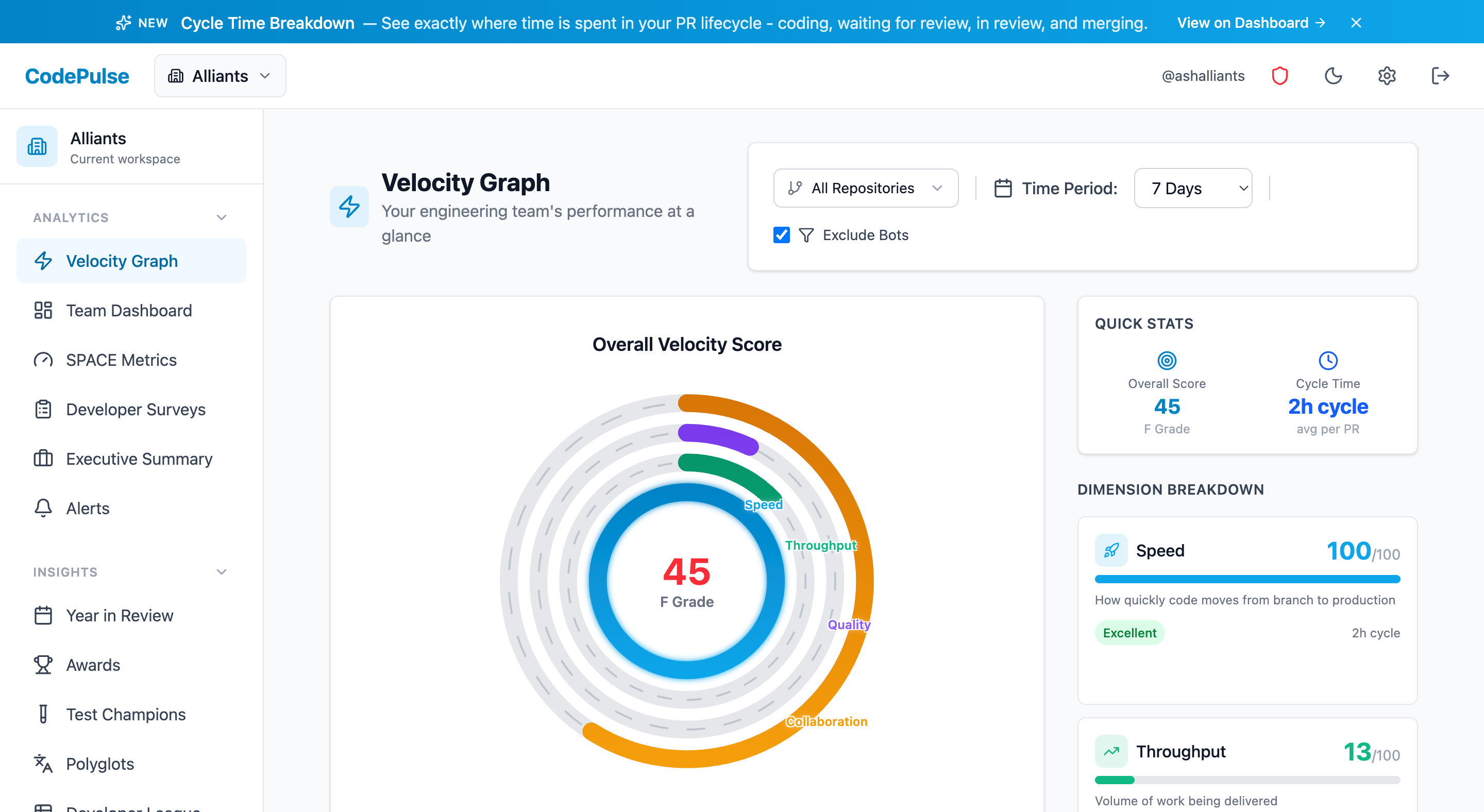
- Dashboard - Team-level metrics with trend analysis
- Awards - Recognize collaboration and quality, not just output
- Review Network - See collaboration patterns and knowledge sharing
Getting Started with Ethical Productivity Measurement
Step 1: Clarify Purpose
Be explicit about why you're measuring. Good reasons:
- "We want to identify and remove obstacles"
- "We want to track improvement over time"
- "We want data to inform process experiments"
Bad reasons:
- "We want to know who's not working hard enough"
- "We need to justify the team to leadership"
Step 2: Start with Team Metrics
Begin with team-level DORA metrics: cycle time, deployment frequency, change failure rate. These provide insight without individual surveillance.
Step 3: Make Everything Transparent
Share what you're measuring and why. Let everyone see the same dashboards. Address concerns openly.
Step 4: Use for Conversation
Bring metrics into retrospectives and 1:1s as discussion prompts. "What does this trend tell us?" rather than "Why is this number low?"
Step 5: Iterate Based on Feedback
Ask your team regularly: "Are these metrics helping us improve?" Adjust based on what you learn.
💡 The Ultimate Test
Ask your developers: "Do you find our productivity metrics useful for improving how we work?" If the answer is no, you have more work to do. If the answer is yes, you've built something valuable.
Continue Your Productivity Journey
This guide focused on the philosophy and ethics of productivity measurement. For practical next steps, explore our related guides:
- What is Developer Productivity? - Understand the three dimensions of productivity and popular frameworks like DORA and SPACE
- How to Improve Developer Productivity - The 5 highest-impact interventions that actually work
- Developer Productivity Tools Guide - Compare tools across categories with honest trade-offs
- Developer Productivity Engineering (DPE) - How Netflix, Meta, and Spotify approach productivity systematically
Frequently Asked Questions
The best approach is team-level metrics focused on delivery outcomes: cycle time, deployment frequency, change failure rate, and review coverage. Supplement with developer satisfaction surveys (the S in SPACE). Avoid individual output metrics like lines of code or commit counts, which reward volume over value and destroy trust when used for performance evaluation.
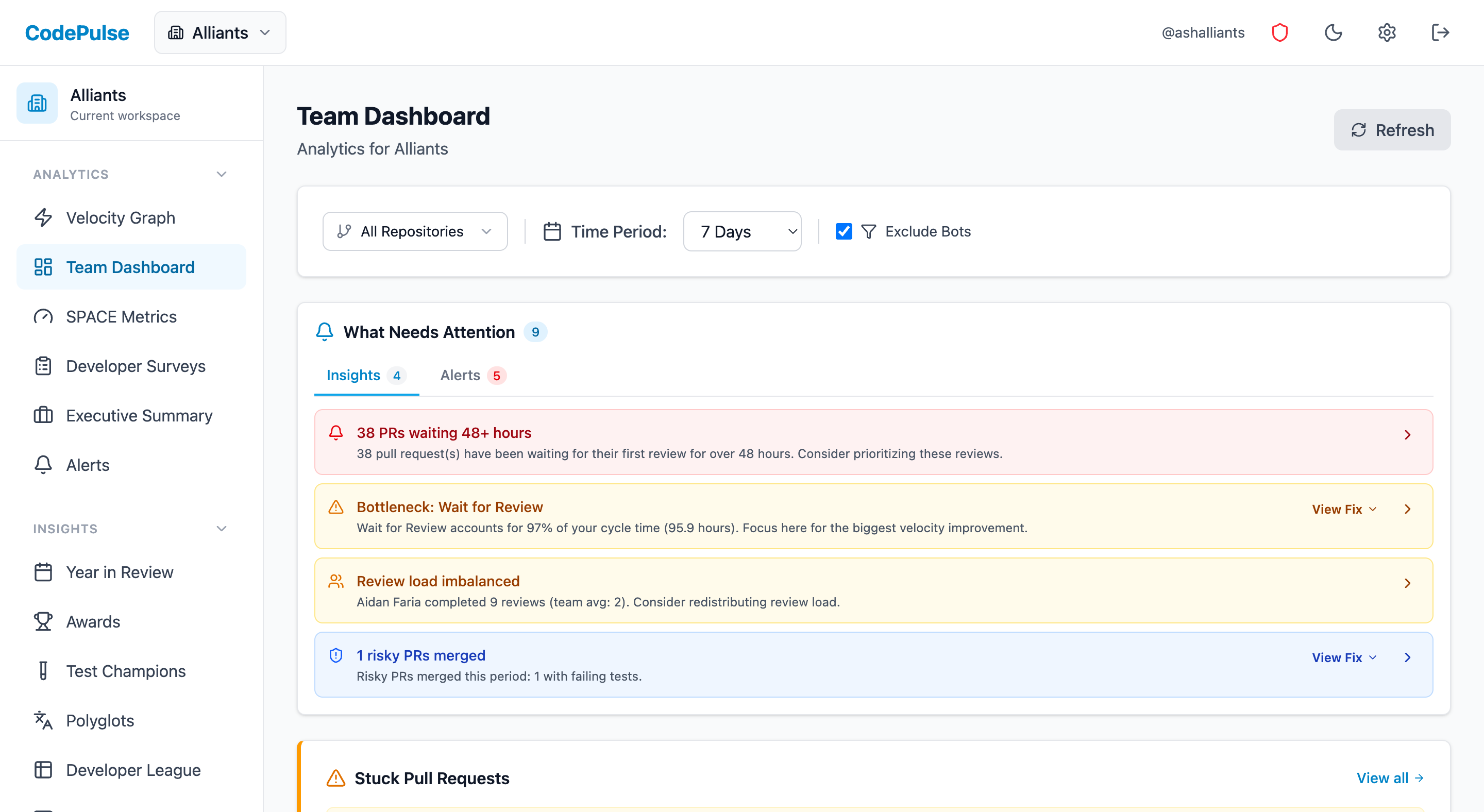
Get this view for your own teams
Connect GitHub for team-level workload, review distribution, and delivery signals. Individual views stay off unless your organisation explicitly turns them on.
Read-only GitHub · Your code stays yours · Team-level by default · No credit card
See These Features in Action
Compare contribution patterns for coaching, not surveillance.
Holistic developer productivity using the SPACE framework.
Related Guides
What is Developer Productivity? (It's Not What You Think)
Developer productivity means sustainable delivery with team health - not lines of code. Learn the frameworks, dimensions, and what NOT to measure.
Improve Developer Productivity Without Burnout
A practical guide to improving developer productivity through friction reduction, not pressure. The 5 highest-impact interventions that actually work.
Developer Productivity Tools: The 2026 Buyer's Guide
Compare developer productivity tools across 5 categories: IDEs, AI assistants, analytics platforms, and more. Honest trade-offs included.
Developer Productivity Engineering: What DPE Does
Developer Productivity Engineering (DPE) is how Netflix, Meta, and Spotify keep engineers productive. Learn what DPE teams do and how to start one.
Engineering Metrics That Won't Get You Reported to HR
An opinionated guide to implementing engineering metrics that build trust. Includes the Visibility Bias Framework, practical do/don't guidance, and a 30-day action plan.
The Performance Review Framework That Doesn't Destroy Trust
Learn how to measure engineering performance fairly and effectively without creating toxic culture, gaming, or surveillance dynamics.