
Compare the finished analysis before you choose a platform
See the report CodePulse produces from read-only GitHub workflow data, or connect your own repositories and evaluate the fit with real evidence.
Read-only GitHub · Your code stays yours · Team-level by default · No credit card
An honest comparison of 7 Allstacks alternatives for engineering teams that want better analytics without the enterprise price tag or daily-only data syncs.
What are the best alternatives to Allstacks?
CodePulse, LinearB, Jellyfish, Swarmia, Haystack, Faros AI, and Sleuth are the leading Allstacks alternatives. CodePulse offers real-time GitHub-native analytics at a fraction of the cost. LinearB adds workflow automation with gitStream. Jellyfish provides broader enterprise business alignment. The right choice depends on team size, integration needs, and whether you need Allstacks' unique delivery forecasting or R&D capitalization features.
Allstacks positions itself as a Value Stream Intelligence platform built for engineering leaders managing 100 to 2,000 contributors. Its ML-powered delivery forecasting and R&D software capitalization reporting are differentiators that no competitor fully replicates. But those capabilities come with trade-offs: daily-only data syncs, a complex setup process, and pricing that starts at $400 per contributor per year.
If you've used Allstacks and found yourself frustrated that your dashboard only reflects yesterday's reality, or that pulling together DORA reports requires more manual work than expected, you're echoing the most common complaints from verified reviewers. The patterns below come from TrustRadius, G2, and Gartner reviews from real engineering leaders.
If you are evaluating Allstacks or already using it and wondering whether the fit is right, this guide breaks down seven alternatives with honest assessments of what each does better and where each falls short. We also cover pricing, integration depth, and specific scenarios where Allstacks remains the stronger choice. For related comparisons, see our Jellyfish alternatives and LinearB alternatives guides.
The best engineering analytics tool is the one your team actually uses daily. A $600/year platform that updates once per day often loses to a $15/month tool with real-time data.
What Is Allstacks?
Allstacks is a software engineering intelligence platform founded in 2016 and headquartered in Raleigh, NC. The company has raised $27.5 million in funding, including a $10 million Series A led by Quadri Ventures with participation from M12 (Microsoft's venture fund). It serves roughly 45 enterprise customers and holds both SOC 1 and SOC 2 Type II certifications.
The platform's core value proposition is predictive delivery intelligence: ML models that analyze historical delivery data to forecast whether projects will hit their target dates. It also offers automated R&D software capitalization reporting (Section 174 compliant), DORA and SPACE framework metrics, investment categorization, and a new AI Intelligence Engine launched in 2025 for detecting cross-team bottlenecks.
Allstacks Premium starts at $400 per contributor per year ($33/month), with Enterprise at $600 per contributor per year. For a 200-engineer team, that is $80,000 to $120,000 annually. Pricing details are published on their pricing page.
7 Best Allstacks Alternatives and Competitors
Each alternative below solves a different slice of the engineering analytics problem. We list genuine strengths and trade-offs for every tool, including our own.
1. CodePulse
Best for: GitHub-native teams (10-200 engineers) wanting deep cycle time analysis, review network visibility, and code health insights with real-time data.
- 15-minute data sync vs. Allstacks daily refresh
- File hotspot and knowledge silo detection that no competitor matches at this depth
- Review network visualization showing actual collaboration patterns
- STRAIN risk scoring for identifying high-risk pull requests
- 5-minute self-serve setup, no professional services required
Pricing: Free tier available. Pro starts at $199/month, or $1,788/year billed annually. Business at $449/month ($4,188/year). Per-organization, not per-seat.
Trade-off: No delivery forecasting, no R&D capitalization, GitHub-first (Jira and Linear integration is for linking, not as a primary data source).
2. LinearB
Best for: Teams that want DORA metrics combined with workflow automation (gitStream) to enforce PR standards and auto-route reviews.
- gitStream workflow automation: auto-label, auto-assign, enforce review policies
- Out-of-the-box DORA metrics dashboard with benchmarks
- Investment allocation tracking across feature, maintenance, and tech debt
- Working agreements for team-level goals
Pricing: Free tier for up to 10 developers. Business at $29/dev/month. Enterprise at $59/dev/month. For 100 engineers, that is $34,800-70,800/year.
Trade-off: No predictive forecasting. gitStream has a learning curve. The platform tries to do many things, which can feel scattered. See our LinearB alternatives guide for deeper analysis.
3. Jellyfish
Best for: Enterprise organizations (500+ engineers) needing business alignment, capacity planning, and cross-functional reporting for engineering, product, and finance stakeholders.
- OKR alignment mapping engineering work to business outcomes
- Investment categorization with financial reporting
- R&D software capitalization (competing directly with Allstacks)
- Capacity planning and scenario modeling
- Multi-tool integration across GitHub, GitLab, Jira, and HR systems
Pricing: Not publicly listed. Industry estimates suggest $49/contributor/month (~$588/year). Requires annual contract with professional services onboarding.
Trade-off: Steep learning curve, long implementation (weeks to months), and overkill for teams under 200 engineers. See our Jellyfish alternatives guide.
4. Swarmia
Best for: Engineering teams that want flow metrics combined with developer experience measurement and working agreements in a clean, modern interface.
- Real-time data sync (not daily like Allstacks)
- Developer experience surveys integrated with system metrics
- Working agreements for team-level standards (PR size, review time targets)
- Clean, opinionated UX that avoids metric overload
- Free tier for teams up to 9 developers
Pricing: Free (up to 9 devs). Lite at EUR 10/dev/month. Standard at EUR 28/dev/month. For 100 engineers, roughly $33,600-$40,000/year.
Trade-off: No delivery forecasting, no R&D capitalization, limited customization for enterprise reporting. See our Swarmia alternatives guide.
5. Haystack
Best for: Engineering managers wanting ground-level visibility into developer workflows, PR health, and individual contribution patterns.
- Developer-level activity dashboards showing PR cadence and review patterns
- PR health scoring and bottleneck detection
- Sprint analytics tied to Jira and Linear
- Simple setup with GitHub and GitLab
Pricing: Not publicly listed. Reports suggest mid-range per-developer pricing. Contact sales for quotes.
Trade-off: Smaller company with a narrower feature set. No DORA metrics, no delivery forecasting, no executive-level reporting. Better suited for team leads than VPs.
6. Faros AI (Plurilock)
Best for: Engineering operations teams wanting a broad data platform that aggregates signals across 50+ DevOps tools into a unified data model.
- Broadest integration catalog in the category (50+ connectors)
- Open-source data model (Faros Community Edition available)
- Flexible dashboarding with custom metric definitions
- Acquired by Plurilock in 2023, adding cybersecurity and compliance capabilities
Pricing: Community edition is free (self-hosted). Enterprise pricing is not publicly listed. Contact sales for quotes.
Trade-off: Requires technical setup and data engineering skills. More of a data platform than a turnkey analytics product. The Plurilock acquisition has shifted some focus toward security use cases.
7. Sleuth
Best for: Teams that want deploy-centric DORA tracking tied directly to production releases, with observability tool integrations.
- Real-time deployment tracking with change failure rate and MTTR
- Integrations with Datadog, Sentry, PagerDuty, and LaunchDarkly
- Change lead time measured from commit to production deploy
- AI-powered review summaries for faster PR triage
Pricing: Startup plan is free. Growth at $35/developer/month. Enterprise at $45/developer/month. For 100 engineers, $42,000-54,000/year.
Trade-off: Focused narrowly on deployments and DORA. No cycle time breakdown, no code quality metrics, no investment tracking. Best paired with another tool for broader engineering analytics.
Quick Comparison: All 7 Alternatives
| Tool | Best For | Data Refresh | GitHub | Jira | Setup | Starting Price |
|---|---|---|---|---|---|---|
| CodePulse | GitHub-native depth | 15 min | Deep | Link | 5 min | Free / $199/mo |
| LinearB | DORA + automation | Near real-time | Good | Full | Hours | Free / $29/dev/mo |
| Jellyfish | Enterprise alignment | Near real-time | Standard | Full | Weeks | ~$49/dev/mo |
| Swarmia | Flow + DevEx | Real-time | Good | Full | Hours | Free / EUR 10/dev/mo |
| Haystack | Developer workflows | Near real-time | Good | Full | Hours | Contact sales |
| Faros AI | Broad data platform | Configurable | Standard | Full | Days | Free (CE) / Contact |
| Sleuth | Deploy-centric DORA | Real-time | Good | Full | Hours | Free / $35/dev/mo |
Allstacks vs CodePulse: A Closer Look
Allstacks and CodePulse serve different segments of the engineering analytics market. A head-to-head comparison shows they solve different problems rather than competing directly. For readers doing budget work first, our Allstacks pricing review covers how Allstacks's per-seat pricing scales for mid- to large-size teams.
| Aspect | Allstacks | CodePulse |
|---|---|---|
| Primary purpose | Delivery forecasting + portfolio intelligence | Cycle time analysis + code health + review patterns |
| Target team size | 100-2,000 contributors | 10-200 engineers |
| Key buyer | VP Engineering / CTO / Finance | VP Engineering / EM / Team Lead |
| Data refresh | Daily (once per day) | Every 15 minutes |
| Setup time | Weeks (with professional services) | 5 minutes (self-serve) |
| Pricing (100 engineers) | $40,000-60,000/year | $1,788-4,188/year |
| Delivery forecasting | ML-powered, project and milestone level | Not available |
| R&D capitalization | SOC 1 certified automation | Not available |
| Code health | Not available | File hotspots, knowledge silos, STRAIN scoring |
| Review analytics | Basic metrics | Review network graphs, reviewer load balancing |
| Alerting | Underdeveloped (per user feedback) | Built-in alert rules evaluated every 30 minutes |
| Test file exclusion | Cannot exclude test files from churn metrics | Configurable exclusions for merge commits |
If your primary need is predicting whether a project will ship on time or automating R&D capitalization reports, Allstacks does those things and CodePulse does not. If you need real-time visibility into code review bottlenecks, file-level risk, and developer collaboration patterns, CodePulse goes deeper at a lower price point.
What Allstacks Does Well
Any honest comparison should acknowledge where the competitor does well. Here is what Allstacks gets right.
Predictive Delivery Forecasting
This is Allstacks' strongest feature. Its ML models analyze historical delivery patterns to predict whether projects will hit target dates, surfacing risk early. The visual timeline comparing targets against forecasts gives engineering leaders a tool they can bring to executive meetings with confidence. No other platform in this comparison matches its forecasting depth.
R&D Software Capitalization
Automated Section 174-compliant capitalization reporting saves finance teams hundreds of hours during audit season. Allstacks is SOC 1 certified for this capability, which matters for public companies and late-stage startups preparing for IPO. One customer (Enverus) reported a 90% reduction in R&D capitalization audit effort.
Enterprise Compliance Posture
Holding both SOC 1 and SOC 2 Type II certifications, plus offering private cloud deployment options through AWS and Azure marketplaces, Allstacks checks enterprise procurement boxes that many competitors cannot. For organizations where compliance is a hard requirement, this narrows the field fast.
Broad Framework Support
Allstacks supports DORA, SPACE, and Flow frameworks in a single platform, letting organizations standardize on one tool for multiple measurement approaches. The AI Intelligence Engine (launched in 2025) adds automated cross-team bottleneck detection on top of these frameworks.
AI Tool Impact Measurement
With GitHub Copilot and Cursor integrations, Allstacks can measure how AI coding tools affect cycle time, code quality, and throughput. Engineering leaders who need to justify AI tool spend to their board will find this useful.
Where Allstacks Struggles
Daily-Only Data Sync
This is the most frequently cited limitation in user reviews. Allstacks updates data once per day. For teams accustomed to real-time dashboards (Slack notifications about stuck PRs, live cycle time tracking), this lag makes the platform feel disconnected from actual workflows. Every alternative on this list offers faster data refresh.
Complex Setup and Onboarding
Users report that initial setup is overwhelming, with too many integrations and metrics to configure. Getting reliable insights typically requires professional services engagement, and teams report it takes weeks to reach the “useful dashboard” stage. Compare that to tools like CodePulse (5 minutes) or Sleuth (under an hour).
Limited Chart Customization
G2 and Gartner reviews consistently mention limited data granularity and inflexible default views. Teams that need custom dashboards or want to drill into specific developer or repository patterns find the interface constraining. The standard dashboards work for directors reviewing portfolio health, but managers wanting team-level detail often need workarounds.
Narrow Target Audience
Allstacks is built primarily for portfolio-level leaders managing 100+ engineers. Individual contributors, team leads, and engineering managers at smaller organizations find limited value at the price point. The platform does not surface file-level code health, review network patterns, or developer-specific workflow insights.
No Workflow Automation
Unlike LinearB (gitStream) or Swarmia (working agreements), Allstacks does not automate any part of the development workflow. It observes and reports, but does not act. Teams wanting to enforce PR size limits, auto-assign reviewers, or set review SLAs need a separate tool.
What Allstacks Users Are Saying
These complaints come from verified reviews on TrustRadius, G2, and Gartner:
"Data only syncs once per day... fine for weekly planning but not much help when you need to make mid-sprint decisions." -- A reviewer on TrustRadius
A Senior Engineer on TrustRadius noted that "it's painful that Jira items don't automatically get pulled in to Allstacks," while an Engineering Manager requested "faster processing of Jira information." A Technical PM reported "server connection errors" and login issues that needed fixing.
On the customization front, users consistently ask for more flexibility. Dashboards "don't offer much flexibility, and teams that want more than forecasting often end up needing a second tool." Alerting is described as "underdeveloped," with users wanting better Slack integration and more notification options. Multiple reviewers note that DORA reports require "more manual work than expected" to assemble properly.
A Data Analyst and Team Lead on TrustRadius identified "user management" as "the biggest opportunity for improvement," highlighting friction beyond the analytics features themselves.
* Our Take
Allstacks built something unique with its delivery forecasting and R&D capitalization combo. If you are a VP at a 500-engineer organization managing $50M+ in engineering spend and need to predict project timelines while automating Section 174 compliance, Allstacks solves both problems in one tool.
But if your primary pain is understanding why PRs take three days to merge, which files create the most rework, or where review bottlenecks hide, Allstacks is not built for that depth. The daily-only sync and portfolio-level focus mean operational teams often outgrow it or need a complementary tool for day-to-day decisions.
Where CodePulse Fits Better
Real-Time Cycle Time Analysis
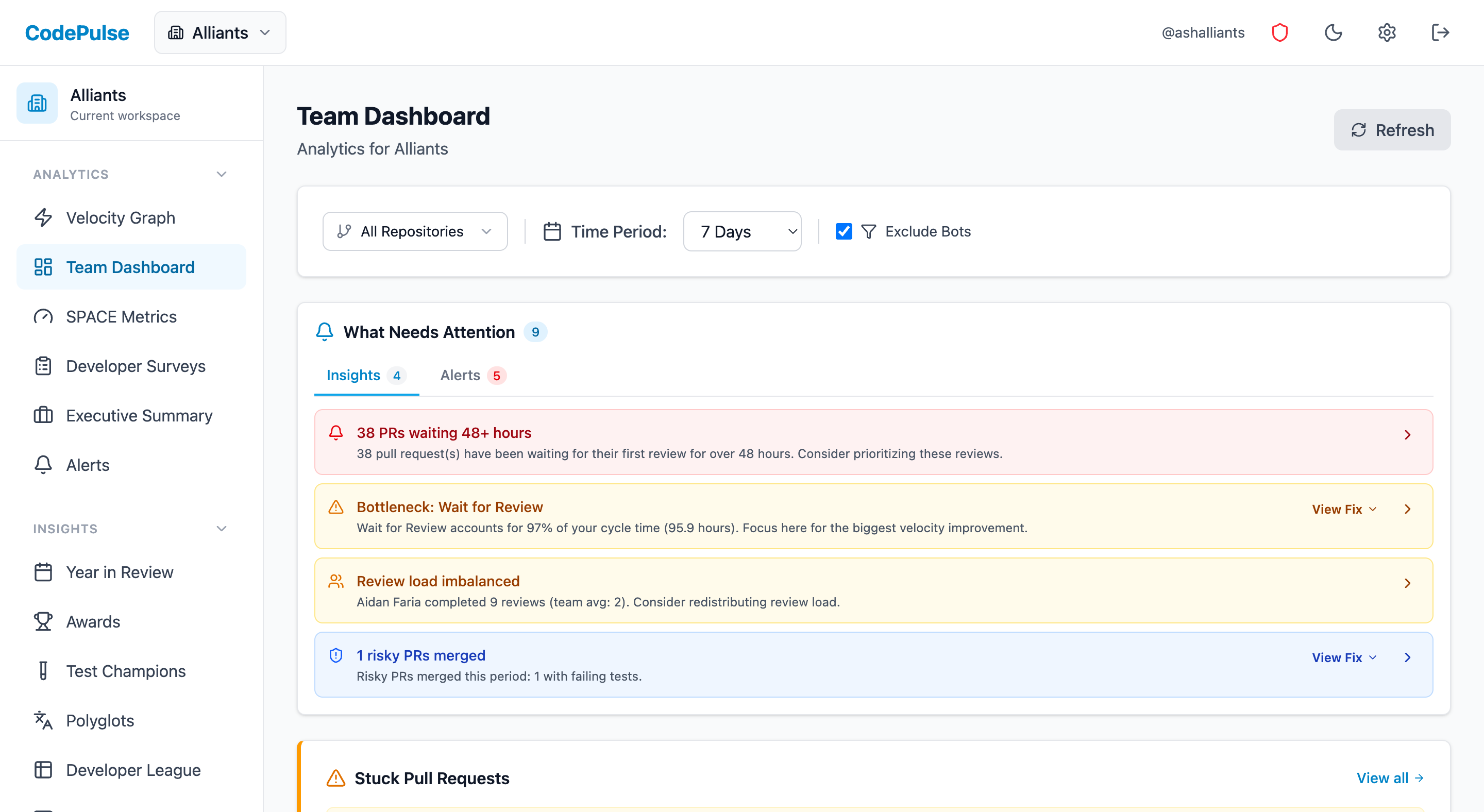
CodePulse breaks cycle time into four phases (coding, waiting for review, in review, merge) with 15-minute data freshness. Engineering managers can see this morning's PR bottleneck, not yesterday's. The dashboard shows trend lines that update throughout the day, not once at midnight. If you want a lightweight first look without connecting anything, our free GitHub PR Chrome extension surfaces PR age and complexity right in your pull request list.
Review Network Visualization
The review network maps who reviews whose code, showing collaboration patterns that spreadsheets and stand-ups miss. When one senior engineer is reviewing 40% of all PRs, CodePulse shows it visually. Allstacks does not offer this level of review pattern analysis.
File Hotspot and Knowledge Silo Detection
File hotspots identify modules with high churn, single-author dependencies, and compounding complexity. This is the code health layer that Allstacks does not cover. When a critical module has only one person who understands it, that is a business risk that delivery forecasting cannot predict.
Developer Recognition
The awards system highlights positive contributions: thorough reviewers, consistent shippers, mentors who unblock others. Allstacks focuses on delivery risk and forecasts. CodePulse balances accountability with recognition, something most analytics tools ignore.
Minutes to Value
Install the GitHub App, select repositories, and see your first metrics in under five minutes, timestamped step by step. No professional services, no week-long onboarding, no configuration wizards. For teams evaluating multiple tools, CodePulse lets you reach a decision faster because the trial shows real data immediately.
Based on our analysis of 803,000+ merged PRs: 92% of PR cycle time is spent waiting for the first review. Real-time visibility into that waiting period is where daily-sync tools fall short.
Allstacks vs LinearB
LinearB and Allstacks overlap on DORA metrics and investment tracking but diverge on automation and pricing philosophy.
| Aspect | Allstacks | LinearB |
|---|---|---|
| Core differentiator | ML delivery forecasting | gitStream workflow automation |
| DORA metrics | Requires configuration | Out-of-the-box |
| Workflow automation | None | gitStream (auto-label, auto-assign, enforce policies) |
| R&D capitalization | SOC 1 certified | Not available |
| Data refresh | Daily | Near real-time |
| Free tier | Trial only | Yes (up to 10 devs) |
| Pricing (100 devs) | $40,000-60,000/year | $34,800-70,800/year |
If you need to predict project timelines and automate financial reporting, Allstacks wins. If you want to enforce development standards automatically (PR size limits, required reviewers, label policies), LinearB's gitStream is the only option in this comparison. For a deeper look, see our LinearB alternatives guide.
Integration Depth: Allstacks vs Alternatives
| Integration | Allstacks | CodePulse | LinearB | Jellyfish |
|---|---|---|---|---|
| GitHub | Full (Cloud + Server) | Deep (PRs, commits, files, reviews) | Full | Standard |
| GitLab | Full | Planned | Full | Full |
| Bitbucket | Full (Cloud + Server) | No | Full | Full |
| Azure DevOps | Full | No | Limited | Full |
| Jira | Full (Cloud + Data Center) | Issue linking | Full | Full |
| Linear | Supported | Issue linking | Limited | No |
| CI/CD | GitHub Actions, GitLab CI, Jenkins, CircleCI | Not required (PR-based) | GitHub Actions, Jenkins | Various |
| Slack | Basic notifications | Not yet | Full | Full |
| HR Systems | No | No | No | BambooHR, Workday |
| Observability | No | No | No | No |
Allstacks covers the broadest range of source code and project management integrations in this comparison. If your organization uses Azure DevOps or Bitbucket alongside Jira, Allstacks has full support where some competitors do not. CodePulse trades breadth for depth: GitHub-only, but with file-level analysis that broader platforms skip. For the fuller picture across the platforms in this table, our developer productivity platform integrations guide breaks down what each one actually connects to.
When to Choose Allstacks Instead
Allstacks remains the stronger choice in several specific scenarios. If multiple items below describe your situation, Allstacks is probably the right tool.
| Situation | Why Allstacks |
|---|---|
| You manage 200+ contributors across multiple product lines | Portfolio-level forecasting scales where team-level tools do not |
| You need R&D capitalization reporting | SOC 1 certified, Section 174 compliant automation |
| Your board asks “will this ship on time?” monthly | ML-powered delivery forecasting with visual timelines |
| You use Azure DevOps or Bitbucket (not GitHub) | Full integration support for non-GitHub platforms |
| SOC 1 certification is a procurement requirement | Only platform with both SOC 1 and SOC 2 Type II |
| You need private cloud deployment | Available on AWS and Azure marketplaces |
| You are measuring GitHub Copilot / AI tool ROI | Native Copilot and Cursor impact measurement |
If more than three of these apply to your organization, Allstacks is likely the better fit. The daily data sync and higher price point are acceptable trade-offs when your primary need is delivery prediction and financial reporting at scale.
CodePulse Limitations (We're Being Honest)
CodePulse is not a drop-in Allstacks replacement. Here is what we do not do:
- No delivery forecasting: We do not predict whether projects will ship on time. Use Allstacks, LinearB, or your project management tool for that.
- No R&D capitalization: We do not generate Section 174-compliant financial reports. If this is a hard requirement, Allstacks or Jellyfish are your options.
- No Bitbucket or Azure DevOps: CodePulse is GitHub-native. Teams on other platforms should look at LinearB, Allstacks, or Jellyfish.
- No OKR alignment: We do not map engineering work to organizational objectives. Jellyfish and Allstacks handle this.
- No workflow automation: We do not auto-assign reviewers or enforce PR policies. LinearB's gitStream and Swarmia's working agreements cover this.
- No HR system integration: We do not ingest BambooHR, Workday, or similar data. Jellyfish is the leader here.
- No deploy tracking: We measure cycle time through merge, not through production deployment. Sleuth is purpose-built for deploy-centric DORA tracking.
These are trade-offs we chose deliberately. CodePulse goes deep on GitHub-native analytics, code health, and review patterns instead of spreading thin across every enterprise use case.
Decision Matrix
| Your Situation | Recommendation |
|---|---|
| GitHub team, 10-200 engineers, want real-time PR analytics | CodePulse |
| 200+ engineers, need delivery forecasting + financial reporting | Allstacks |
| Want DORA metrics + workflow automation in one tool | LinearB |
| Enterprise, multi-tool stack, need business alignment + R&D cap | Jellyfish |
| Care about developer experience + flow metrics | Swarmia |
| Small team, want ground-level developer workflow visibility | Haystack |
| Need a flexible data platform with 50+ integrations | Faros AI |
| Deploy-centric teams wanting production DORA tracking | Sleuth |
| Azure DevOps or Bitbucket shop, need enterprise analytics | Allstacks or Jellyfish |
| Budget under $5K/year, GitHub-only | CodePulse |
Pricing Reality
Engineering analytics pricing varies wildly. Here is what you will actually pay, based on published pricing pages and industry estimates for tools that do not list prices publicly. For an interactive model that compares costs across vendors on your own headcount assumptions, try our pricing comparison calculator.
| Tool | Per-Contributor Cost | 100-Engineer Annual Cost | Free Tier | Contract |
|---|---|---|---|---|
| Allstacks | $33-50/mo | $40,000-60,000 | Trial only | Annual |
| CodePulse | Flat rate (not per-seat) | $1,788-4,188 | Yes | Monthly or annual |
| LinearB | $29-59/mo | $34,800-70,800 | Yes (10 devs) | Monthly or annual |
| Jellyfish | ~$49/mo (est.) | ~$58,800 (est.) | No | Annual |
| Swarmia | EUR 10-28/mo | $13,200-33,600 | Yes (9 devs) | Monthly or annual |
| Haystack | Not public | Contact sales | No | Annual |
| Faros AI | Not public | Contact sales | Yes (CE) | Annual |
| Sleuth | $35-45/mo | $42,000-54,000 | Yes (startup) | Monthly or annual |
* The Total Cost Calculation
Per-contributor pricing penalizes growing teams. A 100-engineer team at Allstacks pays $40,000+/year, and that cost scales linearly as you hire. CodePulse's flat-rate model means the same team pays $1,788-4,188/year, flat within its developer band. Factor in setup time (weeks vs. minutes) and professional services fees, and the gap grows larger. The real question is whether Allstacks' delivery forecasting and R&D capitalization save enough time and risk to justify the 10-20x price difference.
The Honest Verdict
Choose Allstacks if: you manage 200+ contributors, need ML-powered delivery forecasting, require R&D capitalization compliance, or your procurement process mandates SOC 1 certification. Allstacks solves those problems and no alternative fully replicates that combination.
Choose CodePulse if: you are a GitHub-native team wanting real-time cycle time analysis, code health insights, and review network visibility at a fraction of the cost. Best for engineering managers and VPs at 10-200 engineer organizations.
Choose LinearB if: you want DORA metrics combined with workflow automation. gitStream is a unique differentiator no other tool matches.
Choose Swarmia if: developer experience matters as much as flow metrics. The cleanest UX in the category, with meaningful free tier and working agreements.
The most expensive analytics tool is the one nobody opens. Pick the tool your team will actually use every morning, not the one with the longest feature list.
If you want to test CodePulse before deciding, start a free trial. You will see real data from your repositories in five minutes, no sales call required. If Allstacks turns out to be the better fit, we would rather you know that upfront than find out after a long procurement cycle.
Frequently Asked Questions
Allstacks is the only one of the three with ML-based delivery forecasting as its core product - it predicts schedule risk at project and milestone level. Jellyfish reports delivery against roadmap commitments but does not forecast; LinearB projects sprint-level flow rather than milestone risk. The trade-off is data freshness: Allstacks syncs daily, so its predictions describe yesterday. Teams that mainly want early warning on slipping work often pair real-time analytics (CodePulse, 15-minute sync) with their existing project tracker instead of buying prediction.
Related Comparisons
- 7 Best Jellyfish Alternatives – Enterprise engineering analytics platforms compared
- 7 Best LinearB Alternatives – DORA metrics and workflow automation tools compared
- 7 Best Swarmia Alternatives – Developer experience and flow metrics tools compared
- Engineering Analytics Tools Comparison – Feature and pricing comparison across all major platforms
- Engineering Metrics Tools: Features and Pricing – Features and pricing across engineering analytics tools
Evaluate CodePulse against your own delivery history
A comparison table only goes so far. Connect read-only GitHub in about five minutes and judge the output on your repositories, at one flat price, with no per-seat math.
Read-only GitHub · Your code stays yours · Team-level by default · No credit card
See These Features in Action
Board-ready engineering performance in a single page.
Track all four DORA metrics and benchmark against industry standards.
Related Guides
7 Jellyfish Alternatives for 2026 (Honest Ranking)
Compare 7 Jellyfish alternatives including CodePulse, LinearB, Swarmia, and more. Honest pros, cons, pricing, and integration comparisons.
5 LinearB Alternatives for 2026 (With Pricing)
An honest comparison of CodePulse vs LinearB. We tell you when to choose LinearB instead, because the best tool is the one that makes the right trade-offs for your situation.
Swarmia Alternatives: Cheaper, Deeper Analytics 2026
A Swarmia alternative worth considering: where Swarmia falls short on customization and per-seat pricing, and which cheaper, GitHub-native tools fit better.
Jellyfish vs LinearB vs Swarmia: Full 2026 Comparison
Compare Jellyfish, LinearB, Swarmia, Allstacks, Haystack and more engineering analytics tools. Features, pricing, cycle time benchmarks, and integrations.
Engineering Metrics Tools: What You'll Actually Pay (2026)
The hidden costs and pricing traps in engineering metrics tools. Real pricing data and what vendors hide.
Allstacks Pricing in 2026: Enterprise Cost Analysis
Allstacks is enterprise-only with estimated costs of $25-50/dev/month. We analyze the real cost of ML-powered delivery forecasting, hidden implementation expenses, and how it compares to simpler alternatives.
Best Faros AI Alternative for 2026 (Honest Comparison)
Compare 7 Faros AI alternatives including CodePulse, Jellyfish, LinearB, and more. Honest pros, cons, pricing, and integration comparisons for engineering teams.
Engineering Analytics Tools: What User Reviews Really Say
An aggregation of what reviewers on G2, Capterra, TrustRadius and Gartner Peer Insights say about Jellyfish, Swarmia, LinearB and Allstacks - the recurring complaint patterns vendors do not quote.