
Compare the finished analysis before you choose a platform
See the report CodePulse produces from read-only GitHub workflow data, or connect your own repositories and evaluate the fit with real evidence.
Read-only GitHub · Your code stays yours · Team-level by default · No credit card
Choosing an engineering metrics tool is a leadership decision, not a tooling tweak. This guide compares the features and pricing models that matter most to VPs, Directors, and Engineering Managers so you can select a platform that delivers executive visibility without creating a surveillance culture.
How much do engineering metrics tools cost, and which features matter?
Engineering metrics tools range from free (CodePulse, LinearB free tiers) to $50,000+/year (Jellyfish enterprise). Focus on five features that drive leadership decisions: cycle time breakdown, review load distribution, quality signals, executive summaries, and privacy controls. Per-developer pricing ($3-50/dev/month) is the most common model. The right tool is determined by team size: use free tiers under 50 engineers, mid-market tools for 50-200, enterprise platforms above 200.
Instead of chasing feature checklists, focus on outcomes: faster delivery, healthier review workflows, and the ability to explain engineering impact in plain business terms. The 2024 State of DevOps Report from Google's DORA program, which surveyed 39,000+ professionals, found that high-performing teams shrank from 31% to 22% year-over-year, meaning most teams are struggling to maintain delivery performance. The right metrics tool helps you identify why before it is too late.
"The best metrics tool is the one your team actually trusts. Every other feature is irrelevant if engineers view it as surveillance."
What to Compare: Features That Actually Matter
Most engineering metrics tools advertise dozens of capabilities. The comparison below narrows it to the features that map directly to leadership pain points. Skip the feature checkbox mentality - you're buying outcomes, not capabilities.
| Feature Area | Leadership Value | Questions to Ask |
|---|---|---|
| Cycle time breakdown | Pinpoints delivery bottlenecks | Do you see wait vs review vs merge time? |
| Review load distribution | Prevents reviewer overload and burnout | Can you see uneven reviewer workload? |
| Quality signals | Reduces risk before release | Do you track review coverage and rework? |
| Executive summaries | Makes engineering visible to the board | Is there a board-ready view? |
| Trust and privacy controls | Avoids metrics backlash | Can you restrict individual views? |
🔥 Our Take
Your engineering team doesn't need 7 analytics tools. They need one good one, used consistently.
Tool sprawl is a symptom of not knowing what you actually need to measure. Before buying another dashboard, ask: what decision will this data inform? If you can't answer that question clearly, you're buying software, not insight.
For a broader tool overview, see the Engineering Analytics Tools Comparison and the DORA Metrics Tools Comparison.
Pricing Models You Will Encounter
Engineering metrics pricing is rarely apples-to-apples. Most tools fall into one of these models, each with hidden implications:
| Pricing Model | Best For | Watch Out For | Example Range |
|---|---|---|---|
| Per developer | Teams with stable headcount | Costs spike during hiring; contractors add up | $20-60/dev/month |
| Per repository | Mono-repo teams | Expensive for microservice architectures | Varies widely |
| Tiered/Per org | Predictable budgeting | Hidden limits on users, repos, or retention | $5K-50K/year |
| Usage based | Variable workloads | Unpredictable bills; hard to forecast | Per event/query |
Actual Market Pricing (2024/2025)
Based on publicly available pricing and reported deal sizes:
- LinearB: Free tier for up to 8 contributors. Pro tier runs approximately $35/contributor/month (~$420/year). Enterprise approximately $46/contributor/month. Average reported deal size: ~$21,000/year.
- Jellyfish: Targets teams of 50+ engineers with enterprise-focused pricing. Approximately $49/contributor/month (~$588/year). Strong for business/OKR alignment but steep learning curve reported.
- Swarmia: Free startup tier for companies with fewer than 10 developers. Lite tier at €20/user/month (~$22), Standard at €39/user/month (~$43). Strong European market presence.
- Haystack: Growth tier at $20/member/month (annual) for teams under 100 engineers. Anti-surveillance positioning - no individual developer comparisons.
"There is no 'best' engineering analytics tool. There's the tool that makes the right trade-offs for your situation."
Pricing only matters if it aligns with value. Use the Engineering Analytics ROI Guide to quantify time savings and justify investment.
The Feature-Fit Framework: Match Tools to Your Stage
Smaller teams typically need visibility into cycle time and review flow first. Larger orgs usually require portfolio rollups, team comparisons, and executive reporting. Here's what actually matters at each stage:
| Org Profile | Key Features | Common Mistake | Price Sensitivity |
|---|---|---|---|
| 10-50 engineers | Basic cycle time, PR throughput | Overbuying enterprise tools | High: use free tiers |
| 50-150 engineers | Cycle time breakdown, review bottlenecks, alerts | Buying full portfolio tools too early | Medium: ROI matters |
| 150-500 engineers | Team comparisons, executive summaries, retention | Ignoring trust and rollout planning | Lower: value matters more |
| 500+ engineers | Multi-org rollups, governance, compliance | Letting metrics become surveillance | Enterprise pricing expected |
The Hidden Costs Nobody Talks About
Tool pricing is the obvious cost. These hidden costs determine whether you actually get value:
1. Integration and Setup Time
Most tools promise "5 minute setup." Reality: 2-4 weeks to meaningful dashboards. Factor in time to connect all repos, validate data accuracy, customize views, and train leadership on interpretation.
The claim is cheap, so make vendors show their work: ask which step the clock starts on, what it covers, and what is still missing when it stops. We hold ourselves to the same test and published our own setup timestamped step by step, including the part that keeps running in the background after the five minutes are up.
2. Trust Erosion Cost
According to the Jellyfish 2024 State of Engineering Management Report, 43% of engineers feel leadership is "out of the loop" on engineering challenges. Deploying a metrics tool poorly widens this gap. A failed rollout doesn't just waste the subscription - it makes your next attempt harder.
3. Data Quality Maintenance
Metrics drift happens. Bot accounts skew numbers. Archived repos pollute averages. Without ongoing maintenance, your dashboard becomes noise within 6 months.
4. Adoption Friction
If engineers don't use the tool, you've bought expensive shelfware. Adoption requires clear communication about how metrics will - and won't - be used.
🔥 Our Take
If you're using individual developer metrics for performance reviews, you've already lost.
You'll get exactly what you measure: gamed numbers and eroded trust. The moment you compare Alice's cycle time to Bob's, you've turned teammates into competitors. Ask vendors explicitly: "Can we disable individual views?" If the answer is unclear, keep looking.
A Practical Evaluation Process
Don't let sales demos drive your decision. Use this evaluation framework:
Week 1: Define Success Criteria
Before talking to vendors:
1. What decisions will this tool inform?
2. Who needs access? (Leadership only vs. team-wide)
3. What's your budget range? (Be realistic)
4. What's your timeline to value?
5. What trust concerns exist on the team?
Week 2-3: Shortlist and Trial
Narrow to 2-3 tools. Request trials with your actual repos - not demo data. Evaluate:
- Setup time: How long to meaningful dashboards?
- Data accuracy: Do cycle time numbers match your Git history?
- Privacy controls: Can you restrict individual developer views?
- Export capability: Can you get raw data out if you leave?
Week 4: Stakeholder Review
Show the shortlist to key stakeholders - including engineers. A tool that leadership loves but engineers distrust is worse than no tool at all.
How CodePulse Fits This Comparison
CodePulse focuses on GitHub-based signals that map directly to delivery, quality, and collaboration. It emphasizes team-level insights over individual scoring - by design.
- Cycle time and review bottlenecks in the Dashboard
- Review load balance in the Review Network
- Risky files and hotspots in File Hotspots
- Executive-ready summaries in the Executive Summary
📊 How to Evaluate Metrics Quality in CodePulse
Start with cycle time breakdowns and review coverage, then layer in collaboration and risk signals. If leadership can explain the story behind those metrics, you already have an executive-ready dashboard.
- Compare cycle time by team to spot review bottlenecks
- Check review load distribution for fairness issues
- Use hotspot trends to validate platform investments
Procurement Checklist for Engineering Metrics Tools
Before signing any contract, verify these items:
Data & Privacy
- ☐ Clear data access and permissions model documented
- ☐ Ability to exclude individual developer views
- ☐ Data retention policies align with your requirements
- ☐ Data export capability if you leave the platform
Metric Quality
- ☐ Transparent definitions for each metric
- ☐ Bot filtering to prevent data pollution
- ☐ Historical data validation against your Git history
- ☐ Clear methodology documentation
Organizational Fit
- ☐ Fast time-to-value for leadership reporting
- ☐ Documented ROI narrative tied to delivery outcomes
- ☐ Training and onboarding support included
- ☐ Rollout playbook for team communication
"More dashboards doesn't mean more insight - it often means less. Consolidate to one source of truth."
For security and governance, read the Security and Compliance Guide for GitHub Analytics. For rollout planning, see the Engineering Metrics Rollout Playbook.
Full Pricing Comparison
The table below consolidates publicly available pricing for the most common engineering metrics platforms. Where vendors do not publish exact numbers, we use reported deal sizes and community estimates (marked with ~). All annual figures assume monthly list pricing paid annually unless noted otherwise. For interactive side-by-side math on headcount scenarios, try our pricing comparison calculator.
| Tool | Pricing Model | Per-Dev Monthly | 50-Engineer Annual | 100-Engineer Annual | Free Tier | Contract |
|---|---|---|---|---|---|---|
| CodePulse | Flat rate (not per-seat) | $199/mo Pro, $449/mo Business | $1,788 (Pro) / $4,188 (Business) | $1,788 (Pro) / $4,188 (Business) | Yes | Monthly or annual |
| LinearB | Per developer | $29-59/dev | $17,400-35,400 | $34,800-70,800 | Yes (10 devs) | Monthly or annual |
| Jellyfish | Per contributor (est.) | ~$49/dev | ~$29,400 | ~$58,800 | No | Annual |
| Allstacks | Per contributor | $33-50/dev | $20,000-30,000 | $40,000-60,000 | Trial only | Annual |
| Swarmia | Per developer | EUR 10-28/dev | ~$6,600-16,800 | ~$13,200-33,600 | Yes (9 devs) | Monthly or annual |
| Haystack | Not public | Contact sales | Contact sales | Contact sales | No | Annual |
| Sleuth | Per developer | $35-45/dev | $21,000-27,000 | $42,000-54,000 | Yes (startup) | Monthly or annual |
| Apache DevLake | Open source | Free | Free (self-hosted) | Free (self-hosted) | Fully free | N/A |
The pattern is clear: most tools charge per developer, which means your analytics bill scales linearly with headcount. Flat-rate pricing (CodePulse) and open-source options (Apache DevLake) are the only models where cost stays constant as you hire.
Best for Budget: Recommendations by Team Size
Budget decisions depend on team size. A tool that is cheap at 10 engineers can become your third-largest software line item at 200. This table maps team size to the most cost-effective options:
| Team Size | Best Budget Option | Best Premium Option | Notes |
|---|---|---|---|
| 1-10 engineers | CodePulse (free) or Swarmia (free) | LinearB (free tier covers) | Start free, upgrade when you outgrow |
| 10-50 engineers | CodePulse Pro ($1,788/yr) | LinearB Business ($34,800/yr at 100) | CodePulse flat rate means no scaling cost anxiety |
| 50-150 engineers | CodePulse Business ($4,188/yr) | Swarmia Standard (~$16,800/yr) | Per-seat pricing starts hurting above 50 |
| 150-500 engineers | CodePulse Business ($4,188/yr) | Allstacks ($60K-100K) or Jellyfish ($88K-$294K) | Enterprise features justify premium only if you need forecasting or R&D cap |
| 500+ engineers | CodePulse Business ($4,188/yr) | Jellyfish or Allstacks | At this scale, per-seat pricing becomes a major budget line item |
The inflection point is around 50 engineers. Below that, most tools are affordable regardless of pricing model. Above 50, per-developer pricing starts compounding fast. A 200-person team on a $45/dev/month tool is spending $108,000 per year on analytics alone, which is more than a senior engineer's salary in most markets.
Total Cost of Ownership Analysis
License fees are what vendors quote. Total cost of ownership is what you actually pay. The gap between the two is where most procurement mistakes happen. Implementation services, training time, ongoing integration maintenance, and the risk that the tool never gets adopted all add up.
Total Annual Cost = License Fee
                 + Setup/Implementation
                 + Training Hours x Avg Hourly Rate
                 + Integration Maintenance (est. 2-5 hrs/month)
                 + Adoption Risk (tool nobody uses = $0 ROI)
This formula looks simple, but the last line is the one that matters most. A tool with a $60,000 license fee and 15% adoption delivers less value than a $4,000 tool with 90% daily active usage. Here is how the leading platforms compare on total first-year cost:
| Tool | License (100 eng) | Setup Cost | Time-to-Value | Training | Est. Total Year 1 |
|---|---|---|---|---|---|
| CodePulse | $1,788-4,188 | $0 (self-serve) | 5 minutes | Minimal | $2,000-5,000 |
| LinearB | $34,800-70,800 | Low | Hours | Medium | $38,000-75,000 |
| Jellyfish | ~$58,800 | $10K-25K (services) | Weeks | High | $75,000-90,000 |
| Allstacks | $40,000-60,000 | $5K-15K (services) | Weeks | High | $50,000-80,000 |
| Swarmia | $13,200-33,600 | $0 (self-serve) | Hours | Low | $14,000-35,000 |
| Sleuth | $42,000-54,000 | Low | Hours | Medium | $45,000-58,000 |
"The most expensive engineering analytics tool is the one nobody opens. A $4,000/year platform with 90% daily active usage delivers more value than a $60,000/year platform that only the VP checks monthly."
The tools with the lowest total cost of ownership share two traits: self-serve setup (no professional services required) and fast time-to-value (dashboards within minutes, not weeks). When evaluating vendors, ask for references from teams your size and measure how long it took them to get from purchase order to first actionable insight.
Frequently Asked Questions
Engineering metrics tools range from free to $50,000+ per year. CodePulse offers a free tier with Pro starting at $199/month for 50 developers ($3.98/dev/month). LinearB starts free for 8 contributors, with Pro at approximately $35/dev/month. Swarmia charges approximately $22-43/user/month depending on tier. Jellyfish targets enterprises with pricing around $49/dev/month (~$588/year per contributor). Most tools use per-developer pricing, which scales linearly with team size.
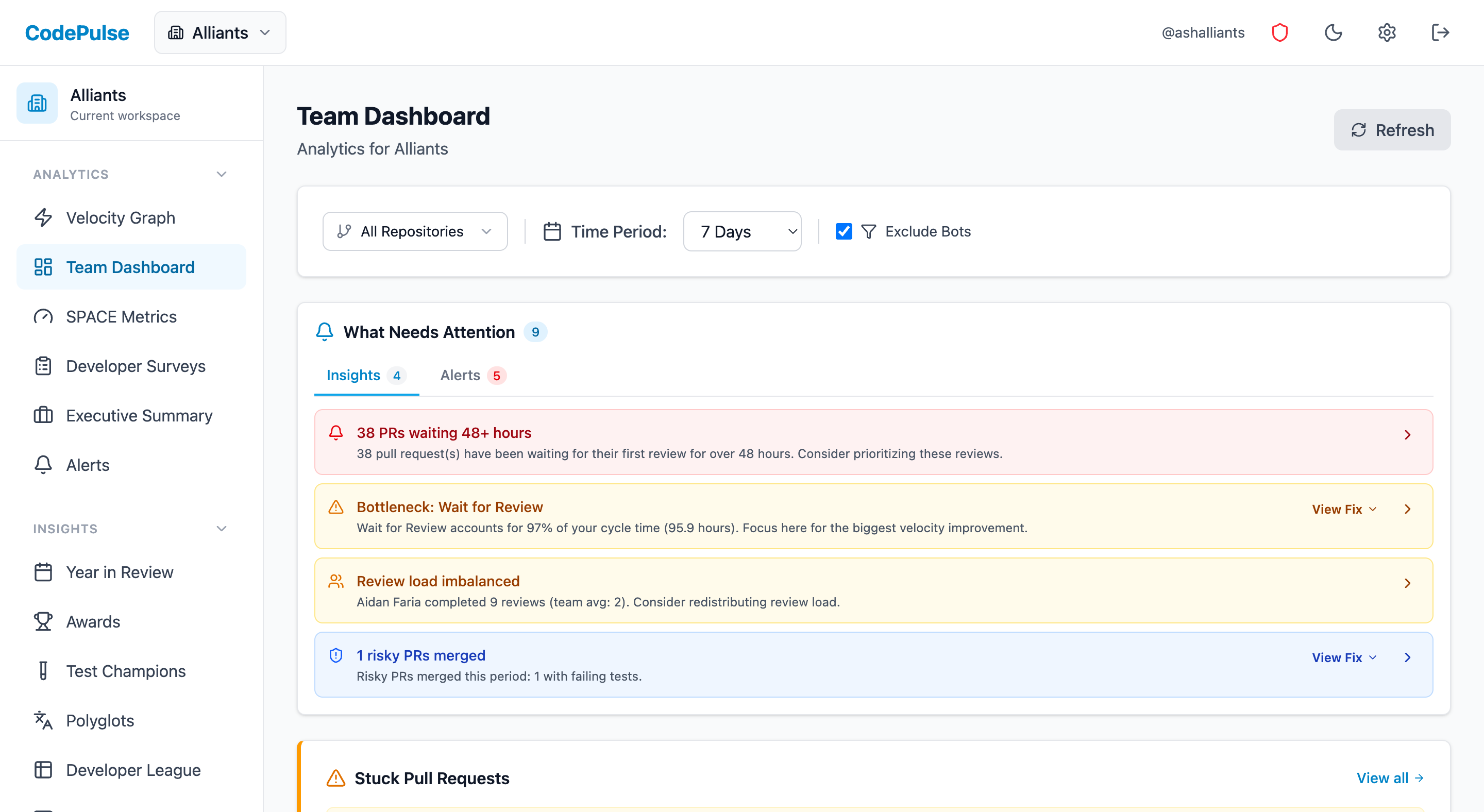
Evaluate CodePulse against your own delivery history
A comparison table only goes so far. Connect read-only GitHub in about five minutes and judge the output on your repositories, at one flat price, with no per-seat math.
Read-only GitHub · Your code stays yours · Team-level by default · No credit card
See These Features in Action
Board-ready engineering performance in a single page.
Track all four DORA metrics and benchmark against industry standards.
Related Guides
Jellyfish vs LinearB vs Swarmia: Full 2026 Comparison
Compare Jellyfish, LinearB, Swarmia, Allstacks, Haystack and more engineering analytics tools. Features, pricing, cycle time benchmarks, and integrations.
11 DORA Metrics Tools Ranked for 2026 (+ Pricing)
Compare the top DORA metrics tools including commercial platforms, open-source options, and native DevOps integrations. Find the right tool for your team size and needs.
Engineering Analytics ROI: The Budget Approval Playbook
Calculate the ROI of engineering analytics tools with formulas for time savings, payback period, and a business case template tailored to CFOs, CTOs, and CEOs.
5 LinearB Alternatives for 2026 (With Pricing)
An honest comparison of CodePulse vs LinearB. We tell you when to choose LinearB instead, because the best tool is the one that makes the right trade-offs for your situation.
Best Athenian Alternative for 2026 (Honest Review)
Compare 7 Athenian alternatives including CodePulse, LinearB, Swarmia, and more. Honest pros, cons, pricing, and velocity metrics comparisons.
LinearB Pricing in 2026: Full Breakdown & Hidden Costs
LinearB offers a free tier for 10 devs and Business at $30/dev/month. We review every tier, calculate real costs for teams of 25-200, and identify hidden expenses beyond the sticker price.