
Compare the finished analysis before you choose a platform
See the report CodePulse produces from read-only GitHub workflow data, or connect your own repositories and evaluate the fit with real evidence.
Read-only GitHub · Your code stays yours · Team-level by default · No credit card
Allstacks is a value stream intelligence platform that uses ML-powered delivery forecasting to predict software delivery outcomes. This review covers what Allstacks actually costs, its published per-contributor pricing tiers, and whether that price is justified for your team.
How much does Allstacks cost?
Allstacks publishes per-contributor pricing on its site: Premium is $400 per contributor per year (about $33/month), Enterprise is $600 per contributor per year for organizations with 101+ contributors (about $50/month), and a standalone R&D Cap module for automated capitalization reporting is $200 per contributor per year with unlimited contributors. There is no free tier. Larger organizations (50-2,000+ contributors) get volume discounts, and Allstacks says integrations are never separately charged.
Pricing Overview
Allstacks publishes tiered per-contributor pricing rather than requiring a sales call to see any numbers, which is consistent with their target market of large engineering organizations that need value stream intelligence across multiple toolchains. At $400-600 per contributor per year, Allstacks sits at the premium end of the engineering analytics market.
| Plan | Price | Pricing Model | Transparency |
|---|---|---|---|
| Premium | $400/contributor/year (~$33/mo) | Up to 500 contributors | Published on pricing page |
| Enterprise | $600/contributor/year (~$50/mo) | 101+ contributors, single-tenant option | Published on pricing page |
| R&D Cap | $200/contributor/year | Standalone or bundled, unlimited contributors | Published on pricing page |
Published pricing still means volume discounts and Enterprise single-tenant terms are negotiated through sales. For organizations evaluating multiple tools, getting an exact quote for your headcount can still add time to the decision timeline.
What You Get at Each Tier
Allstacks offers a single enterprise tier. The scope of your deployment determines which features are activated. Core capabilities include:
- ML delivery forecasting -- Predict delivery dates and identify risks before they become blockers. This is Allstacks' primary differentiator.
- Value stream mapping -- Visualize work flowing through your entire development pipeline from idea to production
- Investment allocation -- Categorize engineering effort by business initiative, maintenance, and tech debt
- Risk analysis -- Identify delivery risks using historical patterns and current signals
- 200+ data source connectors -- Connect to virtually any tool in your development ecosystem
- Custom reporting -- Build tailored views for different stakeholder audiences
The ML forecasting is what separates Allstacks from analytics-only platforms. If predicting delivery outcomes is your primary need, this is the tool designed for that problem.
Hidden Costs to Watch For
- Implementation complexity -- With 200+ connectors, configuration is not trivial. Expect dedicated implementation resources and potentially professional services.
- Data quality dependency -- ML forecasting is only as good as the underlying data. If your Jira hygiene is poor or your Git workflow is inconsistent, predictions will be unreliable.
- No small team option -- Published pricing starts at $400/contributor/year with no free tier, so there is no low-cost pathway for smaller teams to start small and grow into the platform.
- Integration maintenance -- More connectors means more maintenance. When any upstream tool changes its API, your pipeline may need attention.
- Training overhead -- ML-powered insights require users to understand probability ranges and confidence intervals. Not everyone finds this intuitive.
"ML-powered delivery forecasting sounds impressive in a demo. Whether the predictions are accurate enough to change your planning decisions is the real test."
🔥 Our Take
Allstacks is solving a different problem than most engineering analytics tools. If you need to predict when features will ship and identify delivery risks across a complex toolchain, the ML forecasting is genuinely differentiated. But most engineering teams do not need predictions -- they need visibility into what is happening now and actionable insights to improve it.
At $400-600 per contributor per year, Allstacks is a significant investment that makes sense only when you have both the scale and the forecasting need. For teams that primarily want DORA metrics, cycle time analysis, and review network insights, simpler and cheaper tools deliver more immediate value.
How Allstacks Compares to CodePulse Pricing
| Feature | Allstacks | CodePulse |
|---|---|---|
| Free Tier | No | Yes (up to 10 devs) |
| Starting Price | $400-600/contributor/year (~$33-50/mo) | $199/month flat (Pro, up to 50 devs) |
| 50-Dev Annual Cost | $20,000 (Premium) | $9,000 (Pro) / $15,000 (Business) |
| ML Forecasting | Yes (core feature) | No |
| Data Connectors | 200+ | GitHub, Jira, Linear |
| File Hotspots | No | Yes, with knowledge silo detection |
| Setup Time | Weeks (implementation required) | Under 5 minutes |
"200+ connectors is a strength when you have a complex toolchain. It is a liability when you just use GitHub."
Who Should Pay for Allstacks?
Allstacks is the right investment when:
- You have a large engineering organization with a complex, heterogeneous toolchain
- Delivery forecasting and risk prediction are primary decision-making needs
- You need value stream mapping across multiple tools (not just GitHub)
- Financial reporting on engineering investment is a board-level requirement
- You have the budget and implementation resources for an enterprise deployment
Look elsewhere when:
- Your team primarily uses GitHub and does not need 200+ connectors
- You want to start measuring today, not next quarter
- Code-level insights (hotspots, review patterns, knowledge silos) are your priority
- You need a free tier or affordable per-seat pricing
- Your team is under 100 engineers and does not need enterprise-scale tooling
"The best predictor of software delivery is not an ML model. It is a team that reviews PRs quickly, keeps scope small, and deploys frequently."
Frequently Asked Questions
Allstacks publishes its pricing: Premium is $400 per contributor per year, Enterprise (101+ contributors) is $600 per contributor per year, and a standalone R&D Cap capitalization module is $200 per contributor per year. Volume discounts apply for larger organizations, and exact enterprise or single-tenant terms are negotiated with sales.
Pricing last verified July 2026. Visit allstacks.ai/pricing for current pricing.
Related Reading
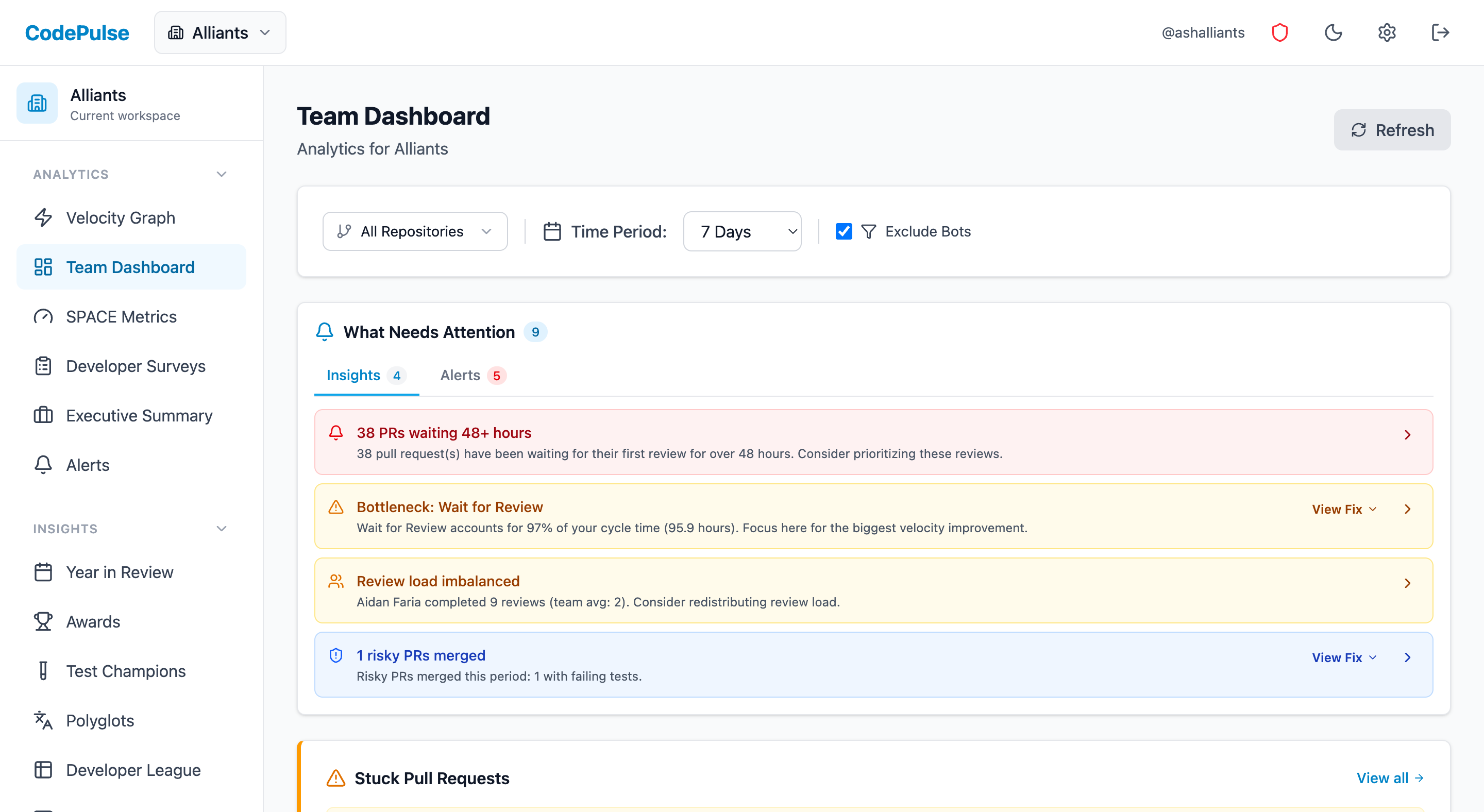
Evaluate CodePulse against your own delivery history
A comparison table only goes so far. Connect read-only GitHub in about five minutes and judge the output on your repositories, at one flat price, with no per-seat math.
Read-only GitHub · Your code stays yours · Team-level by default · No credit card
See These Features in Action
Board-ready engineering performance in a single page.
Track all four DORA metrics and benchmark against industry standards.
Related Guides
7 Best Allstacks Alternatives for Engineering Teams (2026)
An honest comparison of 7 Allstacks alternatives. Covers pricing, delivery forecasting trade-offs, integration depth, and when Allstacks is still the right choice.
Jellyfish vs LinearB vs Swarmia: Full 2026 Comparison
Compare Jellyfish, LinearB, Swarmia, Allstacks, Haystack and more engineering analytics tools. Features, pricing, cycle time benchmarks, and integrations.
Best Engineering Analytics Tools for 2026 (Ranked by Real Users)
We ranked the 10 best engineering analytics tools based on metric depth, setup speed, pricing transparency, and privacy posture. Honest pros and cons for each.