
See exactly where your delivery flow is waiting
Preview the phase-by-phase report for review pickup, active review, and merge time. Connect in about five minutes; the initial analysis runs after sync.
Read-only GitHub · Your code stays yours · Team-level by default · No credit card
Pull request size is one of the most impactful yet overlooked factors in development velocity. Research consistently shows that smaller PRs merge faster, have fewer defects, and create better team dynamics. This guide explores the data behind PR sizing and provides practical strategies for implementing size guidelines using CodePulse. To check where your team lands and find your optimal PR size, run our free PR Size Analyzer.
Our Take
Large PRs are a symptom of poor planning, not ambitious features. Any engineer who says "this can't be broken down" hasn't tried hard enough. The uncomfortable truth: large PRs are often easier to write but harder to review, which means you're optimizing for the author at the expense of everyone else.
The Science Behind PR Size Limits
The push for smaller PRs isn't arbitrary - it's grounded in cognitive science. Understanding why our brains struggle with large diffs helps teams commit to size limits with conviction rather than compliance.
Cognitive Load Theory
Cognitive load theory, developed by educational psychologist John Sweller, explains that our working memory has limited capacity. Code review demands three types of cognitive load simultaneously:
- Intrinsic load: Understanding the code's purpose and logic
- Extraneous load: Navigating the diff, switching between files, remembering context from earlier in the review
- Germane load: Building mental models of how the change fits into the larger system
As PR size increases, extraneous load dominates. Reviewers spend more mental energy on navigation and context-switching than on actually evaluating code quality.
Cognitive load breakdown by PR size:

PR Size        | Mental Model   | Context      | Review
(lines)        | Complexity     | Switches     | Quality
───────────────┼────────────────┼──────────────┼───────────
< 50           | Low            | 0-2          | Thorough
50-200         | Moderate       | 3-5          | Good
200-400        | High           | 6-10         | Acceptable
400-800        | Very High      | 10-20        | Superficial
800+           | Overwhelming   | 20+          | Rubber stamp

Source: Adapted from cognitive load research applied to code review
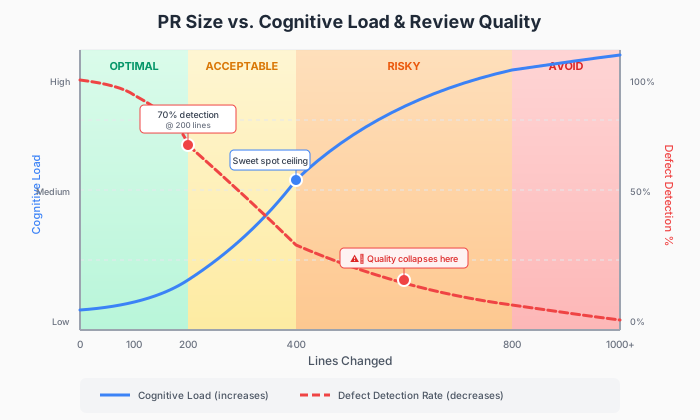
The Attention Span Research
Microsoft Research found that code reviewer attention peaks in the first 15-20 minutes and degrades rapidly thereafter. A 200-line PR takes about 15 minutes to review thoroughly. A 1,000-line PR takes over an hour - but reviewers don't stay focused for an hour.
"After the first 200 lines, defect detection rate drops by 50%. After 400 lines, reviewers are essentially scanning, not reviewing."
This explains why the same team can catch a critical bug in a 100-line PR and miss an obvious issue in a 500-line PR. It's not carelessness - it's cognitive limitation.
The Research: Why Small PRs Ship Faster
Multiple studies have demonstrated the relationship between PR size and development efficiency:
Key Research Findings
- Google's Engineering Productivity Research: PRs under 200 lines receive meaningful review within hours, while PRs over 400 lines often wait days for thorough review.
- Microsoft DevOps Research: Teams that maintain smaller PR sizes see 15-40% faster cycle times and 12% fewer production incidents.
- SmartBear Code Review Study: Reviewers can effectively evaluate about 400 lines of code per hour. Beyond that, defect detection rates drop significantly.
- Cisco Code Review Study: Review effectiveness drops dramatically after 60-90 minutes of sustained review, recommending 200-400 lines as maximum.
The reasons behind these findings are both psychological and practical:
- Cognitive Load: Large diffs overwhelm reviewers, leading to rubber-stamp approvals or superficial reviews that miss critical issues.
- Context Switching: Smaller PRs fit into shorter time blocks, reducing scheduling friction and context-switching overhead.
- Risk Mitigation: When something goes wrong with a 50-line PR, rollback and debugging are straightforward. A 2,000-line PR creates deployment anxiety and complicated rollback scenarios.
- Feedback Loops: Smaller changes get feedback faster, allowing developers to course-correct before investing significant time in the wrong approach.
CodePulse tracks cycle time correlation with PR size, and our data across thousands of repositories confirms these findings: PRs under 200 lines merge 3-5x faster than those over 500 lines.
Why 400 Lines is the Magic Number (And When to Break It)
The 400-line threshold appears repeatedly in research and industry practice. But where does this number come from, and when should you ignore it?
The Origin of 400 Lines
The SmartBear study found that reviewers can maintain high-quality attention for about 400 lines before fatigue sets in. Combined with Google's data showing a sharp inflection point in review latency around this threshold, 400 lines became the de facto standard.
Review latency by PR size (industry aggregate):

Lines Changed  | Median Time to First Review | Merge Time
───────────────┼─────────────────────────────┼────────────
< 100          | 2-4 hours                   | < 1 day
100-200        | 4-8 hours                   | 1-2 days
200-400        | 8-24 hours                  | 2-3 days
400-800        | 24-48 hours                 | 3-5 days
800+           | 48+ hours                   | 5+ days

The 400-line threshold marks where review latency
accelerates dramatically.
When to Exceed 400 Lines
Not every large PR is a problem. Some changes legitimately need to be bigger:
- Database migrations with code changes: Schema changes and the code that uses them often need to ship together
- Major refactors with automated tooling: A rename using codemod that touches 50 files isn't 50 files of risk
- Generated code updates: API clients, proto definitions, schema generations - these inflate line counts without adding review burden
- Vendor code imports: Adding a vendored dependency shouldn't count against size limits
Our Take
The "this refactor has to be one PR" excuse is almost never true. We've seen teams ship 5,000-line "atomic" refactors that sat in review for weeks, accumulated merge conflicts, and ultimately shipped bugs because no one could review it properly. The same work split into 10 PRs would have shipped in half the time with fewer issues.
Adjusting Your Threshold
Different teams may need different thresholds based on:
- Language verbosity: Java and C# often require more lines for the same functionality as Python or TypeScript
- Test coverage expectations: If you require thorough tests, effective limits might be 300 lines of implementation + 300 lines of tests
- Team experience level: Junior-heavy teams benefit from stricter limits (200-300 lines)
PR Size by Type: Features vs Bugs vs Refactors
Not all PRs serve the same purpose. Optimal size varies by what you're trying to accomplish:
Recommended PR sizes by change type:

BUG FIXES
─────────
Target: 50-150 lines
Rationale: Bug fixes should be surgical. Large bug fixes often
indicate scope creep or refactoring mixed with fixes.

Red flag: Bug fix PR over 300 lines
Action: Split into "fix + refactor" or ensure it's all
directly related to the root cause

FEATURES
────────
Target: 100-300 lines (vertical slice)
Rationale: Ship the thinnest possible vertical slice that
delivers value. Iterate with subsequent PRs.

Red flag: Feature PR over 500 lines
Action: Break into infrastructure, API, UI, and integration PRs.
Use feature flags to merge incomplete work safely.

REFACTORS
─────────
Target: 200-400 lines
Rationale: Refactors are behavior-preserving, so slightly larger
is OK. But massive refactors are hard to verify.

Red flag: Refactor PR over 800 lines
Action: Split by module, file, or transformation type.
Ship incrementally with "expand-contract" pattern.

DOCUMENTATION
─────────────
Target: No limit (but be reasonable)
Rationale: Docs don't carry the same risk. However, large doc
PRs often get ignored - consider splitting by topic.

DEPENDENCY UPDATES
──────────────────
Target: One dependency per PR for major versions
Rationale: Isolate blast radius. If lodash upgrade breaks
something, you don't want to untangle it from the React upgrade.
"A 500-line bug fix isn't a bug fix - it's a refactor that happens to fix a bug. Be honest about what you're shipping."
How CodePulse Measures PR Size
CodePulse calculates PR size as additions + deletions, representing the total lines of code that reviewers must evaluate. This metric appears throughout the platform:
- Dashboard Metric: "Avg PR Size (Lines)" shows your organization's or repository's average PR size over time, helping you track improvement trends.
- Risky Changes View: PRs exceeding 400 lines are automatically flagged as "Large PR" risks at
/risky-changes, giving teams visibility into potentially problematic changes before they merge. - Developer Leaderboard: Individual PR size patterns help identify developers who might benefit from coaching on breaking down work.
- Cycle Time Correlation: Compare your average PR size against cycle time metrics to quantify the impact of large PRs on your team's velocity.
Understanding the 400-Line Threshold
CodePulse flags PRs over 400 lines as "Large PR" risks based on research showing this is where review quality and cycle time begin to degrade significantly. However, the optimal threshold varies by team, language, and project type. Use your historical data to calibrate guidelines that work for your context.
What's Excluded from Size Calculations
Not all lines of code are equal in terms of review burden. CodePulse intelligently excludes certain file types from PR size calculations:
| Exclusion Category | File Patterns | Rationale |
|---|---|---|
| Documentation | *.md, *.txt, docs/** | Docs rarely require deep technical review and shouldn't inflate size metrics |
| Dependencies | package-lock.json, yarn.lock, go.sum | Lock files generate thousands of lines automatically but need minimal review |
| Configuration | *.config.js, *.yml, .env.example | Config changes are typically straightforward and well-structured |
| Data Files | *.json, *.csv, *.sql | Data migrations and fixtures don't require the same scrutiny as application code |
This exclusion logic ensures that your PR size metrics reflect actual review complexity rather than being skewed by boilerplate changes. A PR that updates dependencies and includes 50 lines of new feature code will show as a 50-line PR, not a 5,000-line PR.
Generated Code Exceptions (And How to Handle Them)
Generated code is the biggest source of "false positive" large PRs. Here's how to handle different types of generated code:
Types of Generated Code
Generated code handling strategies:

API CLIENT GENERATION (OpenAPI, GraphQL)
────────────────────────────────────────
Problem: Schema changes generate thousands of lines
Solution: Separate PR for regenerated clients with clear
"regenerated from X schema" commit message
Review: Spot-check for correct regeneration, don't line-by-line

PROTOBUF / THRIFT DEFINITIONS
─────────────────────────────
Problem: Proto changes cascade to multiple generated files
Solution: .proto changes in one PR, generated code in follow-up
Review: Focus on the .proto file, trust the code generator

DATABASE MIGRATIONS
───────────────────
Problem: Schema dumps and migrations can be lengthy
Solution: Keep migration SQL separate from application code
Review: Verify migration logic, not raw schema dumps

TYPE DEFINITIONS (TypeScript, Flow)
───────────────────────────────────
Problem: Type generation from backends can be verbose
Solution: Use // @generated markers, exclude from size counts
Review: Verify types match the source of truth

VENDOR/THIRD-PARTY CODE
───────────────────────
Problem: Vendoring imports large codebases
Solution: Always separate vendor updates from code changes
Review: Verify version/source, don't review vendor code
Marking Generated Files
Use consistent markers to identify generated code. This helps both humans and tools understand what needs review:
// Common generated file markers:

// In the file header:
// Code generated by [tool] from [source]. DO NOT EDIT.
// @generated

// In .gitattributes:
*.generated.ts linguist-generated=true
src/api/client/** linguist-generated=true

// In .github/linguist-overrides.yml:
- path: '**/generated/**'
  generated: true
"If you can't tell at a glance whether code is generated or hand-written, your repository needs better file organization."
The "Stacked PRs" Technique Explained
Stacked PRs (also called "stacked diffs" or "dependent PRs") is a workflow where you build a series of small, dependent PRs that together implement a larger feature. It's the secret weapon of teams that ship fast without shipping big.
How Stacked PRs Work
Stacked PR workflow example:

Feature: Add user notifications system

Branch structure:
main
 └── stack/notifications-1-model      (PR #1: 80 lines)
      └── stack/notifications-2-api    (PR #2: 150 lines)
           └── stack/notifications-3-ui (PR #3: 200 lines)

Review order:
1. PR #1 gets reviewed and approved (but not merged yet)
2. PR #2 gets reviewed (builds on PR #1's code)
3. PR #3 gets reviewed (builds on PR #1 + #2)

Merge order:
1. Merge PR #1 into main
2. Rebase PR #2 onto main, then merge
3. Rebase PR #3 onto main, then merge

Total: 430 lines shipped as three easy-to-review PRs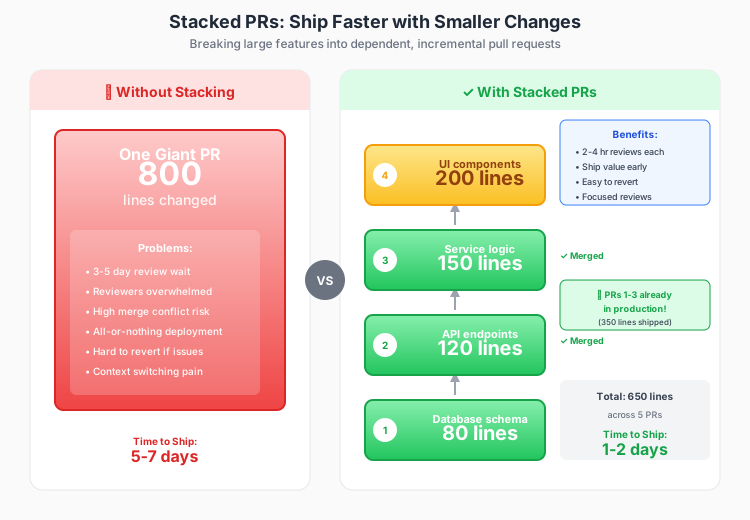
Benefits of Stacked PRs
- Parallel review: Reviewers can review the entire stack simultaneously, even though PRs depend on each other
- Early feedback: Issues in PR #1 get caught before you've built PRs #2 and #3 on top of them
- Clear narrative: Each PR tells a chapter of the story, making the overall change easier to understand
- Easier rollback: If PR #3 has issues, you can revert it without affecting PRs #1 and #2
Stacked PR Tooling
Managing stacked PRs manually is tedious. These tools automate the workflow:
- Graphite: Purpose-built for stacked PRs with GitHub integration
- ghstack: Meta's open-source tool for GitHub stacking
- git-branchless: Git extension with stacking support
- spr: Stacked PRs for GitHub, inspired by Phabricator
Our Take
Stacked PRs are underused because they require a mindset shift. Most developers think "I'll break this up later" but never do. The best engineers create the stack upfront - they plan small before they code big. If your team isn't using stacked PRs for anything over 300 lines, you're leaving velocity on the table.
How to Split a Large PR After the Fact
You've written 1,200 lines of code. Your reviewer says "please split this up." Now what? Here's a systematic approach to retroactively decomposing a large PR:
Step 1: Identify Natural Boundaries
Analyze your large PR for split points:

LAYER BOUNDARIES
├── Database/Model changes
├── Service/Business logic
├── API endpoints
└── UI components

FILE BOUNDARIES
├── Changes to existing files (safer, test covered)
└── Net-new files (riskier, needs more review)

DEPENDENCY BOUNDARIES
├── Infrastructure (can merge first)
├── Utilities (can merge second)
└── Features using the above (merge last)

TEST BOUNDARIES
├── Test infrastructure (mocks, fixtures)
└── Unit tests
└── Integration tests
Step 2: Create the Split Plan
Before touching code, document the split:
Split plan example (original: 1,200 lines)

PR 1: Add notification model and migrations (150 lines)
- Files: models/notification.py, migrations/001_notifications.py
- Tests: tests/models/test_notification.py
- Can merge independently: YES

PR 2: Add notification service with business logic (250 lines)
- Files: services/notification_service.py
- Tests: tests/services/test_notification_service.py
- Depends on: PR 1

PR 3: Add notification API endpoints (200 lines)
- Files: api/notifications.py, schemas/notification.py
- Tests: tests/api/test_notifications.py
- Depends on: PR 1, PR 2

PR 4: Add notification UI components (300 lines)
- Files: components/NotificationBell.tsx, NotificationList.tsx
- Tests: components/__tests__/Notification*.test.tsx
- Depends on: PR 3

PR 5: Wire up notifications and enable feature flag (100 lines)
- Files: App.tsx, feature_flags.py
- Tests: tests/integration/test_notifications_e2e.py
- Depends on: PR 1, 2, 3, 4
Step 3: Execute the Split Using Git
# Git commands for splitting a PR

# Option A: Cherry-pick specific files
git checkout main
git checkout -b split/notifications-model
git checkout original-branch -- models/notification.py
git checkout original-branch -- migrations/001_notifications.py
git checkout original-branch -- tests/models/test_notification.py
git commit -m "Add notification model and migrations"

# Option B: Interactive rebase to split commits
git rebase -i main
# Mark commits as 'edit' and split them

# Option C: Soft reset and recommit
git checkout original-branch
git reset --soft main
# Now stage and commit files in groups

# After splitting, update original PR to show remaining work
git checkout original-branch
git rebase split/notifications-model
# Continue with remaining split branches
"The time spent splitting a large PR is always less than the time spent waiting for someone to review it as one giant blob."
PR Size and Review Quality Correlation Data
The relationship between PR size and review quality is well-documented. Here's what the research shows:
PR Size vs Review Quality Metrics:

Lines    | Comments | Bugs Found | Time to    | Review
Changed  | per PR   | in Review  | Approval   | Quality Score
─────────┼──────────┼────────────┼────────────┼──────────────
< 50     | 1.2      | 0.8        | 2h         | 95%
50-100   | 2.1      | 1.4        | 4h         | 92%
100-200  | 3.5      | 2.1        | 8h         | 88%
200-400  | 4.8      | 2.6        | 18h        | 78%
400-800  | 5.2      | 2.4        | 36h        | 62%
800+     | 4.1      | 1.8        | 72h+       | 45%

Key observations:
- Comments per PR DECREASE after 400 lines (reviewer fatigue)
- Bugs found PEAKS at 200-400 lines then drops (superficial review)
- Review quality score based on post-merge bug correlation

Source: Aggregated from Google, Microsoft, and SmartBear research
The Rubber Stamp Threshold
When a PR is too large, reviewers shift from "thorough review" to "LGTM and hope for the best." We call this the rubber stamp threshold - the point where review comments drop despite increasing complexity.
CodePulse tracks "rubber stamp" approvals (reviews with approval but no substantive comments). In our data, rubber stamp rate increases from 15% for PRs under 200 lines to over 50% for PRs over 800 lines.
The Review Abandonment Curve (When PRs Are Too Big)
Large PRs don't just get slow reviews - they often get abandoned entirely. The review abandonment curve shows the probability that a PR will sit unreviewed as size increases:
Review Abandonment by PR Size:

PR Size    | % Never Reviewed | Avg Days to | % Eventually
(lines)    | Within 24h       | First Look  | Abandoned
───────────┼──────────────────┼─────────────┼────────────
< 100      | 12%              | 0.3         | 2%
100-200    | 18%              | 0.5         | 3%
200-400    | 28%              | 0.9         | 5%
400-800    | 45%              | 1.8         | 12%
800-1500   | 62%              | 3.2         | 22%
1500+      | 78%              | 5.5+        | 35%

"Abandoned" = PR closed without merge after 30+ days

The abandonment curve explains why large features stall.
It's not that people don't want to review - it's that
large PRs keep getting deprioritized until they're stale.
"That 2,000-line PR sitting in review for three weeks? It's not going to get reviewed. It's going to get abandoned or force-merged. Either outcome is bad."
Team-Specific Size Guidelines (Junior vs Senior Reviewers)
One-size-fits-all PR limits ignore the reality that different reviewers have different capacities. Here's how to tailor guidelines:
Reviewer Experience Matters
PR size guidelines by reviewer experience:

JUNIOR REVIEWERS (< 2 years experience)
───────────────────────────────────────
Recommended max PR size: 150 lines
Rationale: Building review skills requires manageable scope
Benefit: Learn codebase gradually, gain confidence
Risk of larger: May miss issues, feel overwhelmed, rubber-stamp

MID-LEVEL REVIEWERS (2-5 years experience)
──────────────────────────────────────────
Recommended max PR size: 300 lines
Rationale: Can handle moderate complexity but still building intuition
Benefit: Efficient reviews with good defect detection
Risk of larger: May miss architectural issues in complex changes

SENIOR REVIEWERS (5+ years experience)
──────────────────────────────────────
Recommended max PR size: 400-500 lines
Rationale: Can hold more context, spot patterns faster
Benefit: Effective reviews even with higher complexity
Risk of larger: Even seniors fatigue - quality drops past 500

ASSIGNMENT STRATEGY
───────────────────
Large PRs (400+ lines): Assign to senior + any level
  → Senior catches architecture issues
  → Second reviewer catches details senior might skim

Complex PRs (any size, critical code): Two seniors
  → Both perspectives matter for security, payments, core logic
Author Experience Also Matters
Junior developers often write larger PRs because they don't yet know how to break down work effectively. Consider:
- Stricter limits for juniors: Help them learn decomposition by requiring smaller PRs (150-200 lines max)
- Pairing on planning: Senior engineers can help juniors plan how to split work before coding starts
- Celebrate small PRs: Recognize when junior developers successfully ship a feature in multiple small PRs
Setting PR Size Guidelines for Your Team
The "right" PR size depends on your team's context, but here's a practical framework based on industry research and CodePulse data:
| PR Size (Lines) | Classification | Expected Review Time | Recommendations |
|---|---|---|---|
| 1-50 | Tiny | 5-15 minutes | Ideal for bug fixes, config tweaks, small features. Merges quickly. |
| 51-200 | Small | 15-45 minutes | Sweet spot for most features. Reviewable in one sitting with full context. |
| 201-400 | Medium | 1-2 hours | Acceptable for complex features. Consider splitting if possible. |
| 401-800 | Large | 2-4 hours | High risk. Requires multiple review sessions. Strong justification needed. |
| 800+ | Very Large | 4+ hours | Extremely high risk. Almost always should be broken down unless exceptional circumstances (e.g., generated code, major refactor with automated tools). |
Implementing Guidelines Without Gatekeeping
PR size guidelines work best as team norms rather than hard gates. Instead of blocking large PRs automatically, use CodePulse's Risky Changes view and alerts to surface them for discussion. This creates learning opportunities rather than frustration.
Some changes legitimately need to be large (database migrations, dependency upgrades, generated code). The goal is to make large PRs the exception, not the rule, and to ensure they receive appropriate scrutiny.
Start by establishing a target (e.g., "80% of PRs under 200 lines") rather than a strict limit. Use the Dashboard's "Avg PR Size" metric to track progress toward this target over time.
PR Size Gamification That Works
Gamification can motivate behavior change - but done wrong, it creates perverse incentives. Here's how to gamify PR size effectively:
What Works
Effective PR size gamification:

TEAM-LEVEL RECOGNITION (recommended)
────────────────────────────────────
"Smallest Average PR Size This Month" - team award
"Best Decomposition" - recognizing a well-split feature
"Most Improved" - team that reduced avg size the most

WHY IT WORKS:
- Encourages collaboration (team helps each other)
- Avoids individual competition (no gaming for points)
- Celebrates the skill, not just the metric

PROCESS CELEBRATIONS
────────────────────
"Clean Ship" - feature shipped in 5+ small PRs, zero rollbacks
"Fast Feedback" - all PRs under 200 lines merged same day

WHY IT WORKS:
- Ties to outcomes (shipped, fast) not just size
- Reinforces the "why" behind small PRs

TREND RECOGNITION
─────────────────
"Consistency Award" - maintained <200 avg for 3 months
"Turnaround Team" - reduced avg PR size by 50%+

WHY IT WORKS:
- Celebrates sustained improvement
- Not a competition, just recognition
What Doesn't Work (Avoid These)
- Individual leaderboards for smallest PRs: Developers will make artificially tiny PRs that waste CI time and fragment context
- Blocking gates on PR size: Creates frustration and encourages gaming (splitting inappropriately, hiding lines)
- Penalizing large PRs: Sometimes large is necessary - punishment creates resentment
- PR count metrics: Rewards quantity over quality, incentivizes meaningless splits
Our Take
The best "gamification" for PR size is simply visibility. Show teams their PR size distribution, let them see how they compare to benchmarks, and trust them to improve. Engineers are intrinsically motivated by shipping better software faster. You don't need points and badges - you need good data and clear expectations.
Using Alerts to Catch Oversized PRs
CodePulse's alert system can notify your team when PR size trends exceed your guidelines, creating accountability without manual tracking:
- Navigate to Alerts: Go to
/alertsand create a new alert rule. - Select Metric: Choose "Avg PR Size (Lines)" as the metric to monitor.
- Set Threshold: Define your organization's acceptable threshold (e.g., "Alert when avg PR size exceeds 300 lines").
- Choose Scope: Apply the rule organization-wide or to specific repositories that need closer monitoring.
- Configure Notifications: Set up Slack, email, or webhook notifications to alert relevant stakeholders when the threshold is breached.
Alert Strategy Example
Many teams use a two-tier approach:
- Warning Alert: Avg PR size exceeds 250 lines (informational, sent to team lead)
- Critical Alert: Avg PR size exceeds 400 lines (requires team discussion and action plan)
This creates early awareness without alarm fatigue, and escalates only when trends become problematic.
Combine alerts with regular retrospectives where you review flagged PRs from the Risky Changes view. Discuss: Was the size justified? Could it have been split? What patterns can we learn from? This builds intuition over time.
For more on creating effective alert rules, see our guide on Detecting Risky Deployments.
Strategies for Breaking Down Large Changes
The most common objection to small PRs is: "But my feature can't be broken down!" In reality, almost every change can be decomposed. Here are proven strategies:
1. Vertical Slicing
Instead of building all layers at once (database → API → UI), build one complete user journey at a time. Example: For a new reporting feature, ship a basic version of one report type first, then iterate with additional report types in subsequent PRs.
2. Feature Flags
Feature flags allow you to merge code that isn't user-facing yet. Build complex features incrementally behind a flag, merging small PRs continuously, then flip the flag when ready. This is the secret to trunk-based development.
3. Refactor-Then-Feature
If a feature requires refactoring existing code, split it into two PRs: (1) refactor with no behavior change, (2) add new behavior on the refactored foundation. The refactor PR might still be large, but it's safer because it's behavior-preserving.
4. API-First Development
Build and merge the API/backend logic first, even if there's no UI to call it yet. Add thorough tests to prove it works. Then build the UI in a separate PR. This creates clear boundaries and speeds up both reviews.
5. Incremental Data Migrations
Large PRs often stem from database changes. Instead of changing the schema and all calling code at once, use a multi-step approach: (1) Add new column/table with dual-writes, (2) backfill data, (3) migrate readers, (4) remove old schema. Each step is a small, safe PR.
6. Preparatory Refactoring
Before starting a feature, make a tiny PR that introduces the abstractions or utilities you'll need. When the feature PR lands, it's cleaner and smaller because the groundwork is already in place.
Real-World Example: Breaking Down a 1,200-Line PR
A team was building a new authentication system. Their initial PR was 1,200 lines and sat in review for two weeks. After coaching, they broke it down:
- PR 1 (80 lines): Add authentication library and config
- PR 2 (120 lines): Create auth service interface and tests
- PR 3 (150 lines): Implement login endpoint (feature-flagged)
- PR 4 (100 lines): Implement logout and session management
- PR 5 (90 lines): Add UI login form (behind feature flag)
- PR 6 (40 lines): Enable feature flag and add documentation
Total: 580 lines across 6 PRs. All merged within one week. The feature shipped faster, with better reviews and fewer bugs, compared to waiting on the monolithic PR.
Use the Reducing PR Cycle Time guide for additional strategies on keeping changes small and reviews fast.
How to See This in CodePulse
📊Navigate to These Views
Track PR sizing across the app:
- Dashboard: View "Avg PR Size (Lines)" metric to track trends over time
- Risky Changes: See all PRs flagged as "Large PR" (over 400 lines) for proactive intervention
- Alerts: Create alert rules to notify your team when avg PR size exceeds your guidelines
- Developer Leaderboard: Identify patterns in individual PR sizing for targeted coaching
Measuring Success
As you implement PR size guidelines, track these CodePulse metrics to measure impact:
- Avg PR Size (Lines): Should trend downward toward your target (e.g., 150-200 lines)
- Cycle Time (Hours): Should decrease as PR sizes shrink, with faster review and merge times
- Review Coverage: May increase as reviewers are less overwhelmed and can provide thorough feedback on manageable diffs
- Merge Without Approval Rate: Should stay stable or decrease, as smaller PRs don't tempt shortcuts
- PRs Merged (Velocity): Often increases as smaller PRs flow through the pipeline faster
- Rubber Stamp Rate: Should decrease as reviewers can actually engage with smaller diffs
Success metrics dashboard:

Week 1 (baseline):    Avg Size: 380 lines | Cycle Time: 42h | Rubber Stamp: 35%
Week 4:               Avg Size: 290 lines | Cycle Time: 28h | Rubber Stamp: 25%
Week 8:               Avg Size: 220 lines | Cycle Time: 18h | Rubber Stamp: 15%
Week 12:              Avg Size: 185 lines | Cycle Time: 12h | Rubber Stamp: 10%

Target achieved: 80% of PRs under 200 lines

Side effects observed:
- Review comments per PR increased (more thorough reviews)
- Post-merge bug reports decreased 30%
- Developer satisfaction with review process improved
Celebrate wins when you see these trends moving in the right direction. Share specific examples in team meetings: "Last quarter our avg PR size was 380 lines and cycle time was 42 hours. This quarter we're at 210 lines and 18 hours. Here's what changed..."
Common Pitfalls to Avoid
Over-Fragmenting Changes
While small PRs are good, 10-line PRs that each require CI/CD overhead and context switching can be counterproductive. Aim for PRs that represent a coherent, testable unit of work. The 50-200 line range is usually the sweet spot.
Ignoring the "Why"
Simply mandating small PRs without explaining the reasoning creates resentment. Share the research, show the data from your own org in CodePulse, and involve the team in setting guidelines. When developers understand the benefits, adoption is much smoother.
No Exceptions Policy
Some changes legitimately need to be large. Don't create a culture where developers waste time trying to artificially split a database migration into ten PRs. Instead, require justification and extra review rigor for large PRs, but allow them when warranted.
Focusing Only on Size
PR size is one factor in velocity, not the only one. If your cycle time is still slow despite small PRs, investigate other bottlenecks: slow CI, review assignment delays, or cultural issues around responsiveness. See our Code Review Culture & Sentiment guide for a holistic view.
Measuring Individuals
Tracking PR size at the individual level and using it for performance reviews is counterproductive. You'll get gamed metrics and destroyed trust. Use PR size data to identify coaching opportunities and systemic issues, not to rank people.
Conclusion
Small PRs are a superpower for high-performing engineering teams. The data is clear: smaller changes merge faster, have fewer defects, and create healthier team dynamics. CodePulse gives you the visibility and tools to implement size guidelines effectively, from tracking metrics on the Dashboard to flagging risky changes to alerting when trends slip.
Start by establishing a baseline (where are you today?), setting a target (where do you want to be?), and coaching your team on decomposition strategies. Review progress in retrospectives, celebrate improvements, and adjust guidelines based on what works for your context.
"The investment in learning to break down work pays dividends: faster feedback loops, reduced deployment risk, better code reviews, and ultimately, higher velocity with lower stress."
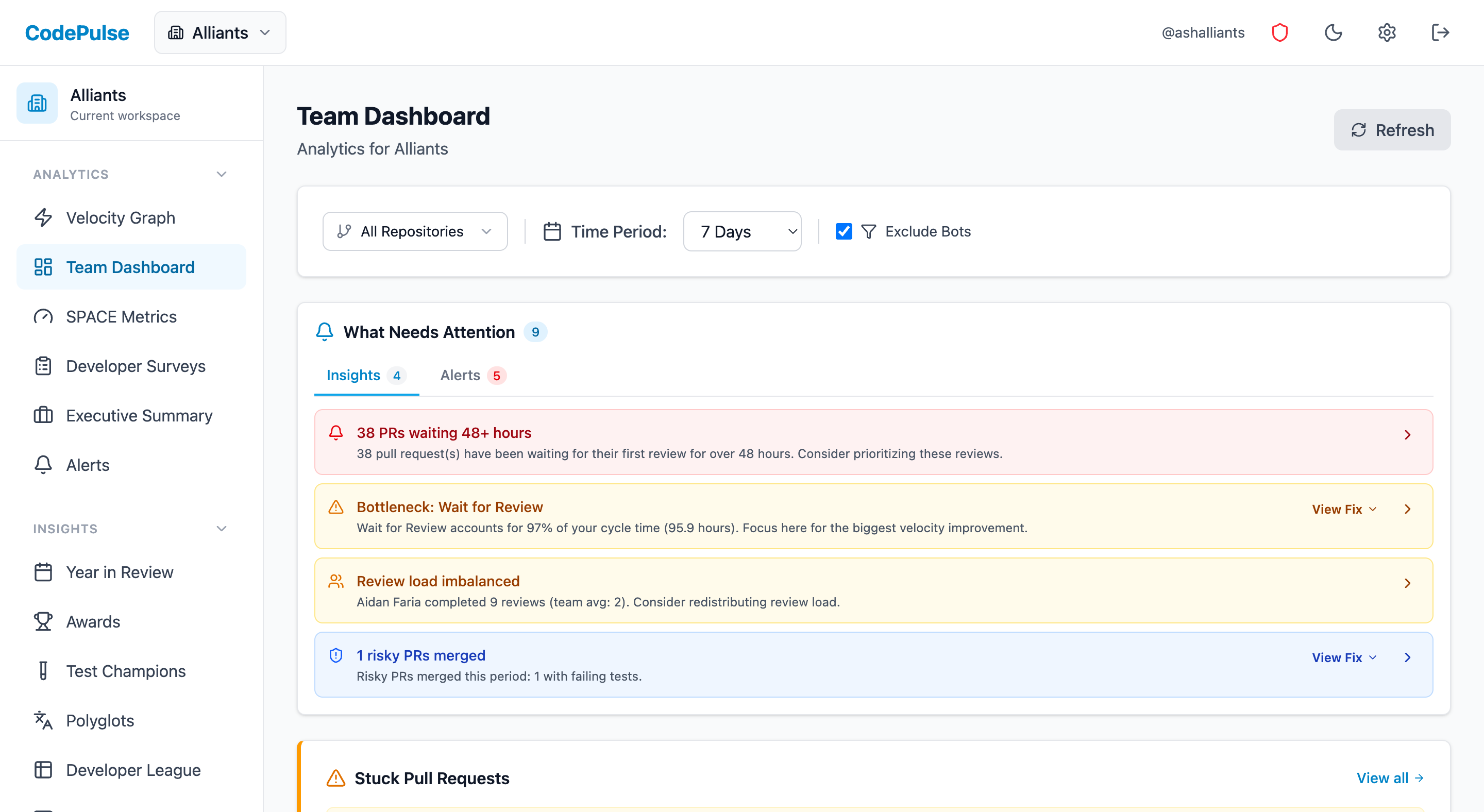
Find out which phase is holding your delivery up
CodePulse splits your cycle time into coding, waiting for review, active review, and merge, so you fix the queue that is actually costing you days. Read-only GitHub, no credit card.
Read-only GitHub · Your code stays yours · Team-level by default · No credit card
See These Features in Action
Explore all featuresRelated Guides
We Cut PR Cycle Time by 47%. Here's the Exact Playbook
A practical playbook for engineering managers to identify bottlenecks, improve review processes, and ship code faster - without sacrificing review quality.
The PR Pattern That Predicts 73% of Your Incidents
Learn how to identify high-risk pull requests before they cause production incidents.
5 Signs Your Code Review Culture Is Toxic (Fix #3 First)
Assess and improve your code review culture. Identify toxic patterns and build psychological safety in your engineering team.
Remote Code Reviews Are Broken. Here's the 3-Timezone Fix
How to run effective code reviews across time zones without sacrificing quality or velocity.
MLOps vs DevOps: Key Differences, Tools, and When You Need Both
MLOps extends DevOps for machine learning with unique challenges like model drift, data versioning, and continuous training. This guide compares pipelines, roles, tools, and metrics across both practices, plus migration strategies for hybrid organizations.
Your Best Engineer Is About to Quit (Check Review Load)
Learn how to identify overloaded reviewers, distribute review work equitably, and maintain review quality without burning out your senior engineers.
3 GitHub Review Features That Cut Our Review Time in Half
Most teams underuse GitHub native review features. Learn CODEOWNERS, branch protection, and suggested changes to speed up reviews without new tools.