
Find quality and ownership risk before it becomes an incident
Preview how CodePulse combines review depth, risky changes, hotspots, and knowledge concentration without turning activity into individual scores.
Read-only GitHub · Your code stays yours · Team-level by default · No credit card
One reviewer misses bugs. Five reviewers creates diffusion of responsibility where everyone assumes someone else will catch issues. The answer is two. Two reviewers is the right number for most pull requests.
This guide presents the research on optimal reviewer counts, shows you how to identify under-reviewed PRs in your codebase, and provides strategies for matching review depth to risk level.
🔥 Our Take
Two reviewers is the right number. One misses things. Three is political theater. The research is clear: two reviewers catch 90%+ of issues. Adding a third reviewer increases meeting time, not code quality.
The third reviewer typically rubber-stamps because they assume the first two were thorough. If you require three approvals "for safety," you're optimizing for the appearance of rigor, not actual quality. It's security theater for code.
The Goldilocks Problem: Too Few vs Too Many
The Risks of Too Few Reviewers
Single-reviewer PRs create several problems:
- Single point of failure: If the reviewer has a blind spot, bugs slip through
- Knowledge silos: Only two people understand the change (author + reviewer)
- Review quality variance: Some reviewers are more thorough than others
- No cross-pollination: Junior developers miss learning opportunities
This is especially risky for large or complex PRs where more eyes would catch more issues.
The Risks of Too Many Reviewers
But adding more reviewers isn't always better:
- Diffusion of responsibility: "Someone else will catch it" mentality
- Slower cycle time: Waiting for multiple approvals extends PR lifetime
- Review fatigue: When everyone reviews everything, quality drops
- Conflicting feedback: Multiple reviewers may give contradictory suggestions
- Notification overload: Team members get flooded with review requests
What Research Says
Research on code review effectiveness shows sharp diminishing returns after 2 reviewers:
Defect Detection by Reviewer Count
Source: Rigby & Bird, 2013"Three reviewers is political theater dressed up as quality assurance."
Industry Benchmarks for Reviewer Count
The Two-Reviewer Standard
Two reviewers is the standard. Here's how to adjust based on PR type:
Reviewer Count by PR Type
Trivial PRs (< 50 lines, docs, typo fixes)
- Reviewers: 1
- Rationale: Quick turnaround beats marginal quality gains
Standard PRs (50-300 lines, typical features)
- Reviewers: 2
- Rationale: This is the sweet spot - two perspectives, fast feedback
Complex PRs (300+ lines, architectural changes)
- Reviewers: 2 (domain expert + generalist)
- Rationale: Expertise composition matters more than count
Critical PRs (security, payments, auth)
- Reviewers: 2 with specific expertise
- Rationale: Quality of reviewers trumps quantity every time
"The third reviewer typically rubber-stamps because they assume the first two were thorough."
Team Size Considerations
Your team size affects what's sustainable:
- Small teams (3-5 devs): 1 reviewer works here. You can't afford everyone reviewing everything.
- Medium teams (6-12 devs): 2 reviewers is sustainable and catches most issues.
- Large teams (13+ devs): 2 reviewers with CODEOWNERS to ensure domain expertise. Don't add a third.
How CodePulse Flags Under-Reviewed PRs
Large PRs with insufficient review coverage are high-risk. CodePulse automatically detects this pattern.
⚠️ Large PR, Few Reviewers Detection
CodePulse's Risky Changes page flags PRs with this risk pattern:
- PRs with 500+ lines changed AND only 1 reviewer
- Marked as "Medium" severity risk
- Listed alongside other risk factors (rubber stamps, no approval, etc.)
- Helps identify patterns where large changes get insufficient scrutiny
The reviewer_diversity_count metric tracks how many unique reviewers participated in each PR.
What to Look For
When reviewing your Risky Changes page, pay attention to:
- Repeat offenders: Are certain repositories or developers consistently getting single-reviewer approval on large PRs?
- Critical code paths: Are changes to authentication, payments, or infrastructure getting enough review?
- Timing patterns: Are under-reviewed PRs happening at certain times (end of sprint, before deadlines)?
Using Review Network Data to Balance Coverage
Reviewer count alone doesn't tell the full story. You also need to consider who's doing the reviewing. Our code review network analysis guide covers how to build the graph from GitHub data and what the common unhealthy shapes tell you about team structure.
Review Network Visualization
CodePulse's Review Network shows the connections between authors and reviewers:
- Node size: Indicates how much review activity a developer has (larger = more reviews)
- Edge thickness: Shows how frequently two developers review each other's code
- Clustering: Reveals sub-teams or knowledge silos
Healthy vs Unhealthy Patterns
Review Network Patterns
- One person reviews 80%+ of all PRs (burnout imminent)
- Isolated sub-groups with no external review (silos forming)
- One-directional review (A reviews B, but B never reviews A)
- Junior developers never getting review experience (they won't grow)
- Multiple connections between team members
- No single person is a bottleneck
- Review load distributed relatively evenly
- Cross-team review connections exist
"If you require three approvals 'for safety,' you're optimizing for the appearance of rigor, not actual quality."
Using Network Data to Improve Coverage
- Identify bottlenecks: If one person reviews most PRs in an area, train backups
- Break silos: Encourage cross-team review to spread knowledge
- Develop reviewers: Pair junior developers with seniors on reviews
Configuring Alerts for Review Gaps
Don't wait for post-mortems to discover review coverage gaps. Set up alerts to catch patterns early.
Recommended Alert Configurations
Alert: Under-Reviewed Large PRs
  Metric: merge_without_approval_rate_percent
  Operator: >
  Threshold: 10
  Severity: warning
  Description: "More than 10% of PRs merging without approval"

Alert: Low Review Coverage
  Metric: review_coverage_percent
  Operator: <
  Threshold: 90
  Severity: warning
  Description: "Less than 90% of PRs receiving review"

Alert: Single Reviewer Dominance
  Description: "Track if one person is handling too many reviews"
  Note: Monitor via the Review Network page and
        developer-level review_load_ratio metrics
Alert Best Practices
- Start with loose thresholds: Understand your baseline before tightening
- Alert on trends, not incidents: One under-reviewed PR is a miss; a pattern is a problem
- Route to the right people: Send review alerts to tech leads, not individual contributors
For more on alerts, see our Alert Rules Guide.
Reviewer Assignment Strategies
Strategy 1: CODEOWNERS
GitHub's CODEOWNERS file automatically requests reviews from designated owners:
# .github/CODEOWNERS

# Default owners for everything
* @team-leads

# Frontend code
/src/components/   @frontend-team
/src/pages/        @frontend-team

# Backend API
/api/              @backend-team

# Critical paths - require senior review
/api/auth/         @security-team
/api/payments/     @payments-lead @security-team
Strategy 2: Round-Robin Assignment
Distribute review load evenly by rotating through team members:
- Pros: Fair distribution, everyone develops review skills
- Cons: May not match expertise with PR content
- Best for: Teams where everyone can review most code
Strategy 3: Expertise-Based Assignment
Match reviewers to PRs based on knowledge of the changed files:
- Pros: Higher quality reviews, catches domain-specific issues
- Cons: Creates bottlenecks around experts
- Best for: Large codebases with specialized areas
Strategy 4: Hybrid Approach
Combine strategies based on PR characteristics:
Hybrid Assignment Rules
Small PR (< 100 lines)
- Round-robin from available team members
- 1 reviewer sufficient
Standard PR (100-300 lines)
- 1 reviewer from CODEOWNERS
- 1 reviewer round-robin (if not same person)
Large PR (300+ lines)
- 1 domain expert from CODEOWNERS
- 1 additional reviewer for fresh perspective
Critical PR (security, payments)
- Specific required reviewers
- Block merge until they approve
Why Not the "Plus One" Rule?
Some teams use a "plus one" rule: request one more reviewer than you think you need. We disagree.
This rule sounds safe but creates problems:
- It normalizes over-reviewing, which slows everything down
- The "extra" reviewer often rubber-stamps
- It masks the real question: do you trust your reviewers?
Instead of adding reviewers, improve the reviewers you have. Train them. Give them context. Trust them. Two thorough reviewers beat three distracted ones.
Measuring Review Coverage Improvement
After implementing the two-reviewer standard, track these metrics to verify it's working:
- Average reviewers per PR: Target 1.8-2.2 for standard PRs
- Review coverage %: Should be at or above 95%
- Large PR single-reviewer rate: Should approach zero
- Review load distribution: No one person should handle more than 30% of reviews
The goal isn't more reviewers. It's the right number of reviewers, consistently applied. Two is enough. Focus on making those two reviews count.
For more on improving your review process, see our guides on Review Load Balancing, PR Cycle Time Benchmarks, and Reducing PR Cycle Time.
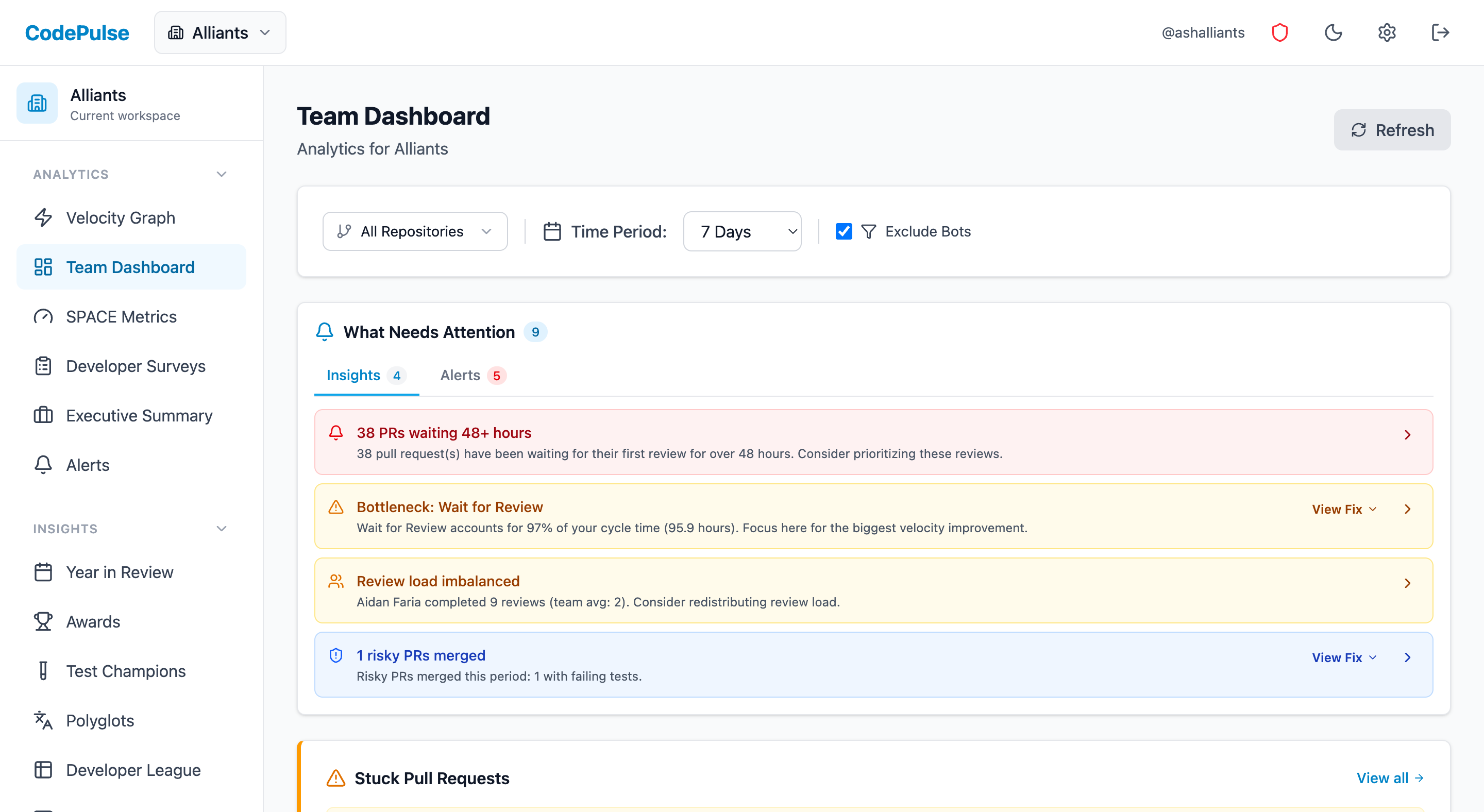
See which files and owners carry your real risk
Connect GitHub and get your churn hotspots, single-owner modules, and review-depth signals ranked by exposure. No repository cloning, no file contents read.
Read-only GitHub · Your code stays yours · Team-level by default · No credit card
See These Features in Action
Interactive graph of review relationships and workload distribution.
Measure review thoroughness and feedback quality across the team.
Related Guides
Your Best Engineer Is About to Quit (Check Review Load)
Learn how to identify overloaded reviewers, distribute review work equitably, and maintain review quality without burning out your senior engineers.
Your PR Cycle Time Is Fine (Here's the Benchmark)
What is a good PR cycle time? Benchmarks and targets based on team size, industry, and engineering maturity.
We Cut PR Cycle Time by 47%. Here's the Exact Playbook
A practical playbook for engineering managers to identify bottlenecks, improve review processes, and ship code faster - without sacrificing review quality.
The 'Bus Factor' File That Could Kill Your Project
Use the Bus Factor Risk Matrix to identify where knowledge concentration creates hidden vulnerabilities before someone leaves.
The PR Pattern That Predicts 73% of Your Incidents
Learn how to identify high-risk pull requests before they cause production incidents.
Continuous Testing in DevOps: Metrics That Actually Matter
Continuous testing is more than running tests in CI. This guide covers testing metrics for DevOps, the testing pyramid, how to handle flaky tests, and test automation strategy.