
Compare the finished analysis before you choose a platform
See the report CodePulse produces from read-only GitHub workflow data, or connect your own repositories and evaluate the fit with real evidence.
Read-only GitHub · Your code stays yours · Team-level by default · No credit card
LinearB and Jellyfish get grouped together in almost every "engineering analytics tools" roundup, but they are built to answer different questions for different people. LinearB's core product, gitStream, automates the pull request workflow itself, auto-assigning reviewers, auto-merging safe changes, and labeling PRs with review-time estimates. Jellyfish maps engineering work to business strategy for finance and executive stakeholders, and has pushed further into tracking AI tool spend and adoption. If you want a flat-priced, GitHub-native option for the metrics layer both tools also sell, CodePulse fits a narrower slice of the same problem.
LinearB vs Jellyfish: which should you pick?
Pick LinearB if your problem lives inside the pull request: slow reviews, unassigned reviewers, and PRs that sit for days before merging. Its gitStream product automates that workflow directly. Pick Jellyfish if your problem lives in a board deck: does engineering spend match strategic priorities, and what is AI tooling actually returning. Jellyfish does not automate your workflow; it reports on it for a business audience. If you are GitHub-only, under 200 engineers, and want cycle-time and investment metrics without a sales cycle, CodePulse is the third option worth evaluating.
Both companies get filed under "engineering intelligence," and both ingest Git data, so it's easy to assume they compete head-to-head. They don't, at least not for most buyers. The clearest way to tell them apart is to ask who signs the check and what they are trying to fix.
LinearB fixes the pull request. Jellyfish explains the pull request to people who will never open one.
What Are LinearB and Jellyfish Built For?
LinearB's headline product is gitStream, a workflow automation tool that runs directly inside your GitHub, GitLab, or Bitbucket pull requests. Teams write YAML rules that trigger automations: auto-assigning the right reviewer based on which files changed, auto-merging low-risk changes like documentation or dependency bumps, and labeling PRs with estimated review time so reviewers know what they are walking into. LinearB has layered AI capabilities on top, including automated PR descriptions and AI-assisted code review comments, but the product's identity is still the pull request workflow itself: LinearB's own research frames code review as the most consistent bottleneck in software delivery, and gitStream exists to remove friction from that specific stage.
Jellyfish is a different kind of product. Its homepage describes it as a software engineering intelligence platform built around six pillars: AI Impact Management, Operational Effectiveness, Business Alignment, Developer Experience, DevFinOps, and an AI-powered "Jellyfish Assistant." The Business Alignment pillar is the one that overlaps most with how people describe LinearB: it maps engineering allocation to strategic priorities and forecasts delivery. But Jellyfish does not automate anything inside a pull request. It ingests commits, PRs, and issue-tracker data, then turns that into reports for engineering executives, finance teams, and product leaders, including automated financial reporting for software capitalization under its DevFinOps pillar.
Put simply: LinearB changes what happens to a pull request while it is open. Jellyfish explains, after the fact, what a portfolio of pull requests meant for the business. Teams that need both often end up running LinearB's free gitStream automation alongside a separate analytics or reporting tool, because gitStream does not require a LinearB analytics contract to use.
How Do Their Features Compare?
We call this the Automation vs Alignment split, and it holds up across almost every feature comparison between the two products. Automation tools optimize the workflow; alignment tools optimize the narrative. Neither is wrong. They're just solving different jobs.
| Aspect | LinearB | Jellyfish | CodePulse |
|---|---|---|---|
| Primary use case | Pull request workflow automation and cycle-time coaching | Business alignment, AI-spend tracking, and finance-grade reporting | GitHub-native cycle time, review analytics, and investment allocation |
| Headline features | gitStream: auto-assign reviewers, auto-merge safe changes, PR labeling, AI-assisted review comments | AI Impact Management, Business Alignment (resource allocation vs. OKRs), DevFinOps capitalization reporting | Cycle-time breakdown by phase, PR work-type classification, executive summary export |
| Pricing model | Free tier plus per-developer paid tiers (see linearb.io/pricing for current numbers) | Not published; sales-negotiated per seat | Flat rate per organization, not per seat |
| GitHub depth | GitHub, GitLab, and Bitbucket app; gitStream runs natively inside PRs | GitHub and Azure DevOps for version control; Graphite for review analytics | GitHub-native only: PRs, files, reviews, commits |
| Setup | gitStream installs as a self-serve GitHub App; full analytics tiers may involve sales | Sales-led; no published self-serve trial or onboarding timeline | Self-serve, minutes to first data |
The feature list also explains why LinearB shows up in "developer experience" conversations while Jellyfish shows up in "board reporting" conversations. gitStream's auto-merge and reviewer-assignment rules change what an individual contributor experiences the moment they open a pull request. Jellyfish's Business Alignment and DevFinOps pillars change what a finance director sees in a quarterly review. A team evaluating "engineering analytics tools" without separating these two jobs will end up comparing a wrench to a spreadsheet.
If your evaluation criteria fit on both companies' feature lists, you have not defined the problem you are solving yet.
How Do LinearB and Jellyfish Price?
LinearB is the more transparent of the two on pricing. It publishes a tiered structure that includes a free plan and paid per-developer tiers on its own pricing page. We were not able to independently confirm the exact current tier numbers while researching this guide, since automated requests to linearb.io were rate-limited on our end; check linearb.io/pricing directly, or see our dedicated LinearB pricing review for a full breakdown of tiers and real-world costs at different team sizes. gitStream itself, LinearB's automation product, is free to install independent of the paid analytics tiers.
Jellyfish publishes no pricing at all. Its own pricing page states plainly that pricing "is based on number of seats and specific modules selected" and directs every visitor to request a quote. Third-party pricing research estimates Jellyfish contracts at roughly $30,000-$60,000 a year for 50-200 engineer organizations, climbing past $60,000-$100,000+ for 200-500+ engineer organizations, priced per engineering seat on an annual-only basis. These are estimates from aggregated buyer reports, not official Jellyfish figures, so treat them as a planning range rather than a quote.
Neither vendor sells a monthly, self-serve plan for their full analytics product. LinearB's published free tier is the closest either company gets to a no-commitment entry point, and even that is scoped to a smaller feature set than the paid tiers.
Which Team Should Choose Which?
| Your Situation | Recommendation |
|---|---|
| Reviews sit for days and nobody claims them | LinearB (gitStream auto-assign) |
| Your board wants to see engineering spend mapped to strategic priorities | Jellyfish |
| Finance needs AI tool spend and adoption tracked against ROI | Jellyfish |
| You want low-risk PRs (docs, dependency bumps) to merge without human review | LinearB (gitStream auto-merge) |
| You want a self-serve trial instead of a sales-led evaluation | LinearB's free tier, or CodePulse |
| You are GitHub-only, under 200 engineers, and want a flat annual price for cycle time and investment metrics | CodePulse |
* Our Take
There is no "best" engineering analytics tool. There is the tool that makes the right trade-offs for your situation.
CodePulse is great for GitHub-focused teams who want cycle-time and investment metrics without integration complexity or a sales cycle. It is the wrong choice if you need gitStream-style PR automation running inside your review workflow, or DevFinOps-grade capitalization reporting and AI-spend tracking for finance. LinearB and Jellyfish both do jobs CodePulse does not attempt, and a comparison guide that pretends otherwise is propaganda, not analysis. Be honest about what you actually need before you sign anything.
Where Does CodePulse Fit?
CodePulse is not a drop-in replacement for either tool. It doesn't automate the pull request workflow the way gitStream does, or handle OKR mapping, AI-spend tracking, and capitalization reporting the way Jellyfish does. What it does is the GitHub-native metrics layer both tools also sell as one piece of a larger platform: where did engineering time go, and how long does work actually take to ship.
* How to See This in CodePulse
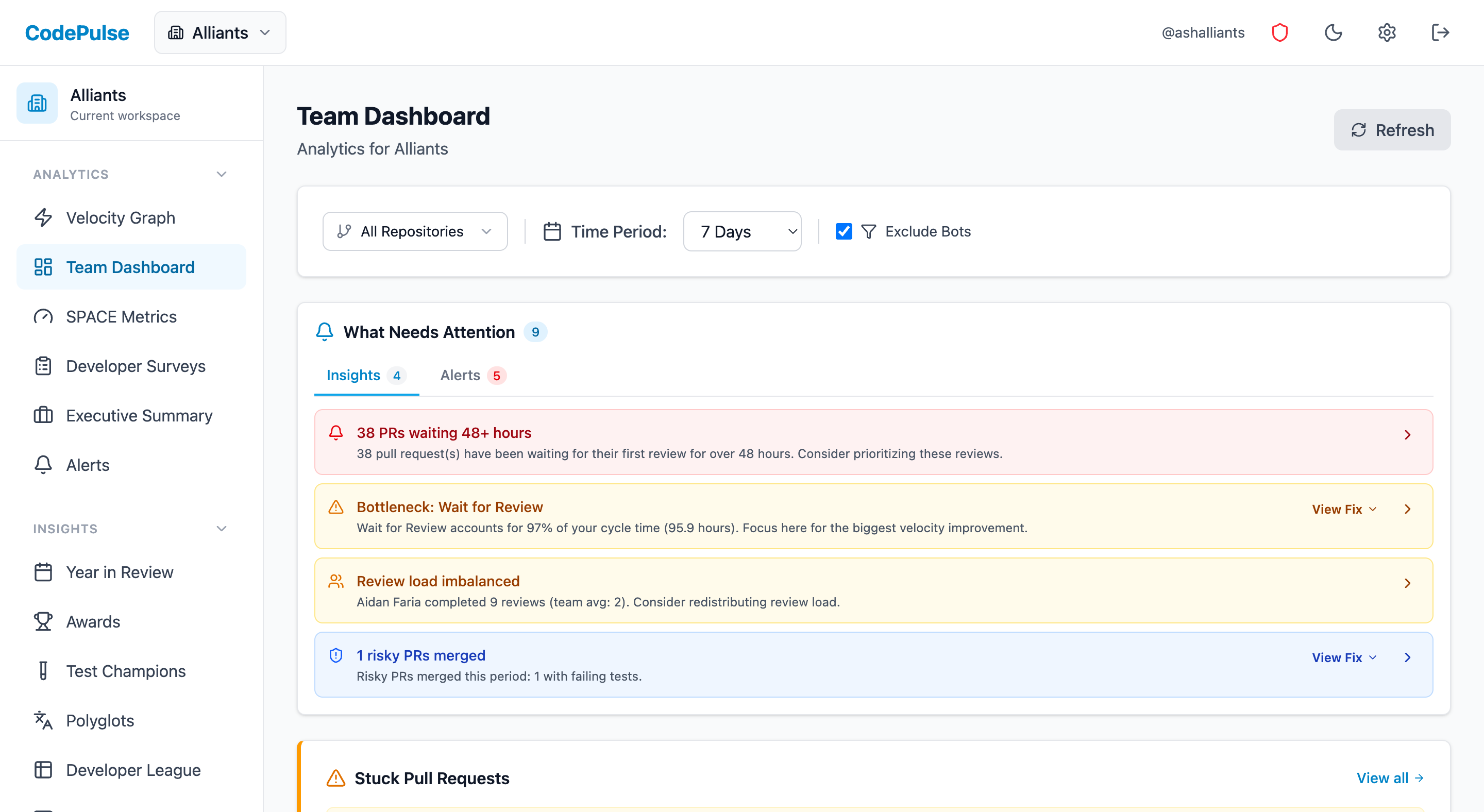
Navigate to Dashboard to see the cycle-time breakdown:
- Every pull request's lifecycle is split into coding, waiting-for-review, in-review, and merge phases
- Filter by repository or time period to isolate where a slowdown is happening
- Pair it with Investment Allocation to see the same PRs broken into feature, maintenance, tech debt, and infrastructure categories
For a leadership-facing view, the executive summary combines cycle time, health grade, and investment allocation on a single exportable page, which covers a slice of what Jellyfish's Business Alignment pillar reports on, without the annual sales-negotiated contract. It does not cover AI-spend tracking or capitalization compliance; if those are must-haves, Jellyfish's DevFinOps pillar is doing a job CodePulse was never built for.
A metrics dashboard that costs less than the meeting to approve it is still worth nothing if it can't answer the question your board actually asked.
CodePulse is priced flat per organization rather than per developer or per seat, starting with a free tier and a Pro plan at $199 a month ($1,788 a year billed annually), with a Business tier at $449 a month for up to 150 developers. That is a different cost curve than LinearB's per-developer tiers or an estimated $30,000+ annual Jellyfish contract, but it buys a narrower product: no PR workflow automation, no AI-spend tracking, and GitHub only. If gitStream's auto-merge rules or Jellyfish's capitalization reporting are the reason you are evaluating tools, that price difference isn't a discount. It's the cost of the features you'd be giving up.
For deeper reading on each vendor individually, see our LinearB alternatives guide and Jellyfish alternatives guide, or the full engineering analytics tools comparison for how they stack against Swarmia, Allstacks, and the rest of the category.
If you want to see your own cycle-time and investment breakdown before deciding on anything, start a free CodePulse trial. You will see real data from your repositories in minutes, not after a demo call and a follow-up proposal.
Frequently Asked Questions
Three different centers of gravity. Jellyfish is the executive platform: Jira-driven investment allocation, DevFinOps capitalization, board reporting, quote-only pricing (buyers report a $35,920 median annual contract on Vendr). LinearB is the workflow platform: DORA metrics plus gitStream PR automation, priced per contributor at $420-549/year. Allstacks is the forecasting platform: ML schedule-risk prediction and capitalization for 100+ contributor orgs. If you need none of those specialties - just visibility into where delivery slows - a flat-priced GitHub-native tool like CodePulse covers DORA, cycle time, and review analytics for $199/month.
Evaluate CodePulse against your own delivery history
A comparison table only goes so far. Connect read-only GitHub in about five minutes and judge the output on your repositories, at one flat price, with no per-seat math.
Read-only GitHub · Your code stays yours · Team-level by default · No credit card
See These Features in Action
Explore all featuresRelated Guides
5 LinearB Alternatives for 2026 (With Pricing)
An honest comparison of CodePulse vs LinearB. We tell you when to choose LinearB instead, because the best tool is the one that makes the right trade-offs for your situation.
7 Jellyfish Alternatives for 2026 (Honest Ranking)
Compare 7 Jellyfish alternatives including CodePulse, LinearB, Swarmia, and more. Honest pros, cons, pricing, and integration comparisons.
Jellyfish vs LinearB vs Swarmia: Full 2026 Comparison
Compare Jellyfish, LinearB, Swarmia, Allstacks, Haystack and more engineering analytics tools. Features, pricing, cycle time benchmarks, and integrations.
LinearB Pricing in 2026: Full Breakdown & Hidden Costs
LinearB offers a free tier for 10 devs and Business at $30/dev/month. We review every tier, calculate real costs for teams of 25-200, and identify hidden expenses beyond the sticker price.
Jellyfish vs GitKraken Insights: The Honest Comparison
Jellyfish is the Gartner MQ Leader with quote-only pricing; GitKraken Insights is the nine-month-old challenger at $9-19/contributor. A sourced, vendor-neutral head-to-head - with the third option both leave out.