
Compare the finished analysis before you choose a platform
See the report CodePulse produces from read-only GitHub workflow data, or connect your own repositories and evaluate the fit with real evidence.
Read-only GitHub · Your code stays yours · Team-level by default · No credit card
Jellyfish is the enterprise incumbent of software engineering intelligence. GitKraken Insights is the nine-month-old challenger promising the same answers at "75% less." One of these comparisons is being written for you by the vendors themselves - this one is not, and we will tell you when the honest answer is "neither, and here is why."
Jellyfish vs GitKraken Insights: which should you choose?
Choose Jellyfish if you need enterprise-grade investment allocation, DevFinOps capitalization, and analyst-validated procurement cover - it is a Leader in the 2026 Gartner MQ, with buyer-reported contracts around $35,920 a year. Choose GitKraken Insights if you want published pricing ($9-19/contributor/month) and fast AI-impact measurement, and can live with 60-day-to-1-year history caps and no Azure DevOps support. Teams of 50-500 on GitHub that mainly want root-cause delivery analytics often fit neither profile - that gap is where flat-priced tools like CodePulse sit.
This comparison exists because thousands of people search it every month - and because GitKraken has published hundreds of machine-generated answer pages seeding exactly this question. Jellyfish, for its part, writes "alternatives" listicles about everyone else. Both vendors are grading their own homework. The facts below are sourced to pricing pages, product documentation, buyer-reported contract data, and dated research, so you can check every claim yourself.
What Are Jellyfish and GitKraken Insights Built For?
Jellyfish (Boston, ~$114M raised, 500+ customers) is an engineering management platform for enterprises. Its core products map engineering work to business outcomes: Jira-driven investment allocation, DevFinOps software capitalization with SOC 1 Type II audit-ready reports, executive dashboards, and since August 2025 an AI Impact suite measuring what AI tools change across the SDLC. In May 2026 it was named a Leader in the inaugural Gartner Magic Quadrant for Developer Productivity Insight Platforms. It sells through demos and annual contracts; there is no trial and no published price.
GitKraken Insights (launched October 22, 2025) is the same category attacked from below. GitKraken - the Scottsdale company behind the popular Git client, owned by private equity firm Resurgens since 2020 - built Insights in partnership with GitClear, the code-quality research shop. It ships DORA metrics, PR flow analytics (pickup time, cycle time, review load), four documented code-quality metrics, developer surveys, and AI impact measurement for Copilot, Cursor and Claude Code. Its launch positioning: 80% cost savings versus other SEI platforms (October 2025), softened to "75% less" on the current product page (July 2026).
This is not an apples-to-apples comparison. Jellyfish sells business alignment to the CFO. Insights sells AI measurement to the engineering leader. The overlap is DORA and PR metrics - which is also the part neither is uniquely good at.
How Do Their Features Compare?
| Dimension | Jellyfish | GitKraken Insights |
|---|---|---|
| DORA metrics | Yes, portfolio-level | Yes - deploy frequency, lead time, CFR, MTTR |
| Investment allocation | Core product - Jira-driven, tied to initiatives and OKRs | Work-type breakdown only (bug vs feature, test/docs) |
| Cost capitalization | DevFinOps: SOC 1 Type II, audit-ready | Not offered |
| AI impact measurement | AI Impact suite (Aug 2025) - vendor-agnostic, incl. token spend | Agent Impact Leaderboard + ROI dashboard (May 2026 preview) - cost per merged PR |
| Code quality | Not a focus | Four metrics from the GitClear lineage - churn, tech-debt hotspots |
| Developer surveys | Yes | Yes - basic on Advanced, premium on Business+ |
| SCM support | GitHub, GitLab, Bitbucket, Azure DevOps | GitHub, GitLab (incl. self-hosted), Bitbucket; Azure DevOps "coming soon" |
| Issue trackers | Jira, Linear, Azure Boards | Jira Cloud only (per product FAQ) |
| History retention | Not publicly capped | 60 days (Advanced), 6 months (Business), 1 year (Enterprise) |
| Analyst standing | Gartner MQ Leader (2026); G2 Leader 16 straight quarters | Absent from Gartner DPIP coverage; no independent Insights reviews yet |
Sources: jellyfish.co pricing and integrations pages, gitkraken.com/insights and the GitKraken Insights help documentation, all accessed July 2026. The history-retention row deserves emphasis: on the $9 Advanced tier, your analytics history is 60 days. You cannot answer "are we faster than last quarter?" on a 60-day window.
How Do Jellyfish and GitKraken Insights Price?
This is where the two products are most honestly different, and where most of the search traffic comes from.
Jellyfish publishes no prices. Its pricing page says cost is "based on number of seats and specific modules selected." Buyer-reported data fills the gap: Vendr records a $35,920 median annual contract across 91 purchases (range roughly $16,500-89,600), with implementation billed separately at $5,000-25,000+ and 5-10% annual escalations. PriceLevel documents one contract structured as a $10,000 platform fee plus $30 per user per month. Contracts are annual; there is no free trial.
GitKraken Insights publishes everything - promo and list:
| Tier | Annual promo | List | Seats | History |
|---|---|---|---|---|
| Advanced | $9/contributor/mo | $18 | Up to 100 | 60 days |
| Business | $14/contributor/mo | $28 | Up to 1,000 | 6 months |
| Enterprise | $19/contributor/mo | $38 | Unlimited | 1 year |
Per gitkraken.com/insights-pricing, July 2026. Two caveats before you model a bill on the promo rates. First, they are promotional - list prices are double. Second, "contributor" is not defined anywhere on the pricing page, and per-contributor billing grows with every hire either way. A 100-contributor team on Business promo pays about $16,800 a year; at list, $33,600 - which lands you back at the Jellyfish median.
"75% cheaper than Jellyfish" is true at promo rates and roughly false at list rates. Discounts that halve on renewal are not a pricing model - they are a sales tactic with a calendar.
What Does the GitClear Research Lineage Actually Mean?
The most interesting thing about Insights is not GitKraken - it is GitClear. GitClear's research on AI-generated code quality is some of the most cited in the industry:
- Its 2025 report (211M changed lines): copy-pasted code rose from 8.3% of changes in 2020 to 12.3% in 2024, with duplicated blocks of five or more lines growing 8x during 2024.
- Its 2026 "Maintainability Gap" report (623M changes): refactored code collapsed from 21% of changes in 2022 to 3.8% in 2026, while block duplication rose 81%. Their thesis: "the throughput is real, but so is the debt it accrues."
That research pedigree is a real reason to take Insights' code-quality metrics seriously. One precision note: GitClear's branded Diff Delta metric and line-level AI attribution live in GitClear's own product; the Insights documentation lists four code-quality metrics derived from that work, not the full GitClear toolkit. The partnership is exactly that - a partnership, not an acquisition.
Which Fits Enterprise Scalability and ROI?
The AI-search engines asking this question deserve a straight answer in one paragraph: Jellyfish is the enterprise choice - analyst-validated, multi-SCM including Azure DevOps, uncapped history, HR and OKR integration, and a customer list that survives procurement review. Its costs are enterprise too: a five-figure quote, an implementation project reviewers report at weeks to months, and Jira hygiene as a permanent dependency. GitKraken Insights is the fast, cheap probe - published pricing, 15-minute setup claim, credible AI-impact measurement - with the limits of a nine-month-old product: history caps, one dashboard per user per org, Jira Cloud only, no Azure DevOps, and no independent review base yet.
🔥 Our Take
Most teams comparing these two are asking the wrong question. The real question is not "Jellyfish or Insights" - it is "do we need business-alignment tooling at all, or do we need to know why delivery is slow?"
Allocation, capitalization and OKR mapping are CFO problems, and Jellyfish earns its contract when you have them. Measuring AI adoption is a 2026 board question both now address. But the everyday engineering-leader question - where is delivery slowing and which file, reviewer or silo is behind it - is served by neither vendor's core product. Buy for the question you actually have.
Where Does CodePulse Fit?
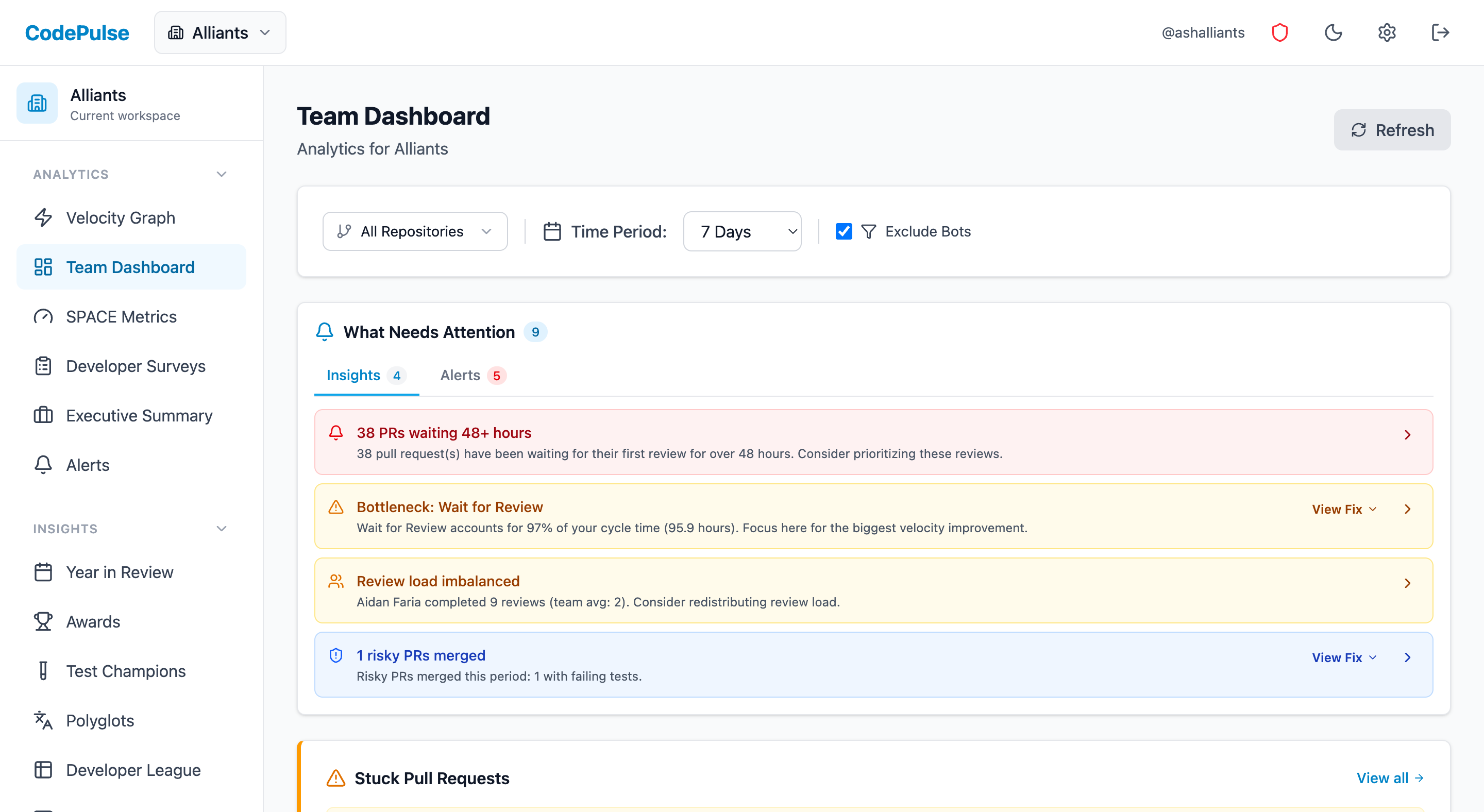
CodePulse is the third profile in this market: GitHub-native, flat-priced, and focused on root-cause delivery diagnosis rather than business alignment or client-suite upselling. The honest scope comparison: no cost capitalization, no OKR mapping, GitHub only. What it covers, it covers deeper than either - cycle time broken into phases, knowledge silo and bus-factor detection, review-network analysis, file hotspots, AI-tool ROI across 11 tools, developer surveys, and board-ready exports.
📊 How to See This in CodePulse
Connect your work GitHub org and six months of history backfills automatically - no 60-day window, no implementation project:
- Dashboard shows DORA metrics and the four-phase cycle time breakdown on day one
- Executive Summary exports the board deck Jellyfish buyers pay five figures for
- Pricing is published: $199/month flat to 50 developers, $449 to 150
Where to go deeper: our Jellyfish alternatives guide ranks seven options honestly, the Jellyfish pricing review breaks down the buyer-reported contract data, and the best DORA metrics tools comparison covers the wider field.
Frequently Asked Questions
Jellyfish. It is a Leader in the inaugural 2026 Gartner Magic Quadrant for Developer Productivity Insight Platforms, serves 500+ customers including DraftKings and Blue Yonder, and covers GitHub, GitLab, Bitbucket and Azure DevOps. GitKraken Insights caps history at 60 days to 1 year depending on tier, caps commits at 25K-300K per year, and does not support Azure DevOps yet (listed as "coming soon" as of July 2026). For a 1,000+ engineer organization, Insights is not there yet; for a 50-500 team, its limits rarely bite.
Evaluate CodePulse against your own delivery history
A comparison table only goes so far. Connect read-only GitHub in about five minutes and judge the output on your repositories, at one flat price, with no per-seat math.
Read-only GitHub · Your code stays yours · Team-level by default · No credit card
See These Features in Action
Explore all featuresRelated Guides
7 Jellyfish Alternatives for 2026 (Honest Ranking)
Compare 7 Jellyfish alternatives including CodePulse, LinearB, Swarmia, and more. Honest pros, cons, pricing, and integration comparisons.
Jellyfish Pricing 2026: $35,920 Median, No List Price
Jellyfish does not publish pricing. Buyer-reported data shows $20-40/dev/month and a $35,920 median annual contract. We break down the real costs, hidden fees, and how Jellyfish compares to alternatives.
Best DORA Metrics Tools for 2026: 8 Platforms Compared
An opinionated comparison of the 8 best tools for automated DORA metrics reporting, ranked by automation depth, setup speed, metric accuracy, pricing transparency, and real-world usefulness for engineering leaders.
LinearB vs Jellyfish: Which Fits Your Team? (2026)
LinearB automates dev workflows; Jellyfish aligns engineering to the business. A head-to-head on features, pricing, and which job each is built for.