
Compare the finished analysis before you choose a platform
See the report CodePulse produces from read-only GitHub workflow data, or connect your own repositories and evaluate the fit with real evidence.
Read-only GitHub · Your code stays yours · Team-level by default · No credit card
LinearB combines engineering analytics with workflow automation through gitStream. This pricing review covers every LinearB tier, the real cost for teams of different sizes, and the hidden expenses that do not show up on the pricing page.
How much does LinearB cost?
LinearB offers a free tier for up to 10 developers with basic metrics. The Business tier costs $30/dev/month and includes gitStream workflow automation, investment allocation, and Jira integration. Enterprise pricing requires a sales call and adds SSO, advanced security, and custom integrations. For a 50-developer team on Business, expect to pay $18,000/year.
Pricing Overview
LinearB is one of the few engineering analytics platforms that publishes partial pricing. The free tier gives small teams a starting point, but the jump to $30/dev/month for the Business tier is significant, especially for teams that primarily need metrics rather than workflow automation.
| Plan | Price | Key Features | 50-Dev Annual Cost |
|---|---|---|---|
| Free | $0 (up to 10 devs) | Basic DORA metrics, PR insights, limited dashboards | N/A (10-dev limit) |
| Business | $30/dev/month | gitStream, investment allocation, custom dashboards, Jira, benchmarking | $18,000/year |
| Enterprise | Contact Sales | SSO/SAML, advanced security, custom integrations, dedicated support | Custom quote |
What You Get at Each Tier
Free Tier
The free tier covers basic DORA metrics and PR insights for up to 10 developers. It is useful for initial evaluation but lacks the workflow automation that differentiates LinearB from pure analytics tools. Dashboards are limited and you cannot create custom views.
Business ($30/dev/month)
The Business tier is where LinearB shows its value. gitStream lets you automate PR routing, enforce code review policies, and set up automatic labeling. Investment allocation maps engineering effort to business categories. Jira integration connects delivery metrics to project management data. Benchmarking compares your team against industry standards.
Enterprise (Contact Sales)
Enterprise adds security and compliance features (SSO/SAML, audit logs) plus custom integrations and dedicated support. The pricing is negotiated based on team size and contract length.
Hidden Costs to Watch For
- CI/CD pipeline access -- gitStream requires CI/CD integration, which means configuration work and ongoing maintenance of pipeline files
- Steep free-to-paid jump -- Going from free (10 devs) to Business (11+ devs) means $330/month minimum. There is no intermediate tier.
- All-or-nothing seat pricing -- You pay for every developer who commits code, even if they do not need analytics
- Jira integration complexity -- Getting accurate investment allocation requires clean Jira hygiene, which is an internal cost many teams underestimate
- Annual billing incentives -- Monthly billing is available but annual contracts offer discounts, creating soft lock-in
"At $30/dev/month, LinearB costs more than most teams spend on their entire CI/CD pipeline. The question is whether gitStream automation justifies the premium over analytics-only tools."
🔥 Our Take
LinearB's pricing only makes sense if you actively use gitStream. If you are buying LinearB purely for metrics and dashboards, you are overpaying by 2x compared to analytics-focused alternatives. The workflow automation is genuinely useful for teams drowning in PR chaos, but most teams can achieve 80% of the same results with GitHub Actions and branch protection rules.
The free tier is limited enough to be a demo, not a real tool. If you outgrow 10 developers and only need analytics, look at tools that offer more at a lower per-seat cost.
How LinearB Compares to CodePulse Pricing
| Feature | LinearB | CodePulse |
|---|---|---|
| Free Tier | Up to 10 devs (limited) | Up to 10 devs (full features) |
| Paid Starting Price | $30/dev/month | $15/dev/month (Pro) |
| 50-Dev Annual Cost | $18,000 | $9,000 (Pro) / $15,000 (Business) |
| Workflow Automation | gitStream (included in Business) | Alert rules and Slack notifications |
| Review Network | Basic | Full network visualization + bottleneck detection |
| File Hotspots | No | Yes, with knowledge silo detection |
| Setup Time | 30-60 minutes (with CI/CD) | Under 5 minutes |
"Paying $30/dev/month for engineering analytics is like buying a Swiss Army knife when you need a screwdriver. The extra tools are nice, but only if you use them."
Who Should Pay for LinearB?
LinearB is worth the investment when:
- You actively need PR workflow automation (gitStream) and will configure it
- Your team uses Jira heavily and wants investment allocation tracking
- You want benchmarking against industry standards
- CI/CD pipeline integration is not a barrier for your team
Look elsewhere when:
- You primarily need analytics and dashboards without workflow automation
- You want code-level insights (file hotspots, knowledge silos, review network visualization)
- Budget sensitivity means $30/dev/month is hard to justify for metrics
- You want a tool that works without CI/CD pipeline access
"The free tier exists to get you hooked. The Business tier exists to fund the company. Make sure you need what the Business tier actually offers."
Frequently Asked Questions
LinearB is free for up to 10 developers. The Business tier costs $30 per developer per month, which includes gitStream workflow automation, investment allocation, Jira integration, and benchmarking. Enterprise pricing requires a sales conversation.
Pricing last verified March 2026. Visit linearb.io for current pricing.
Related Reading
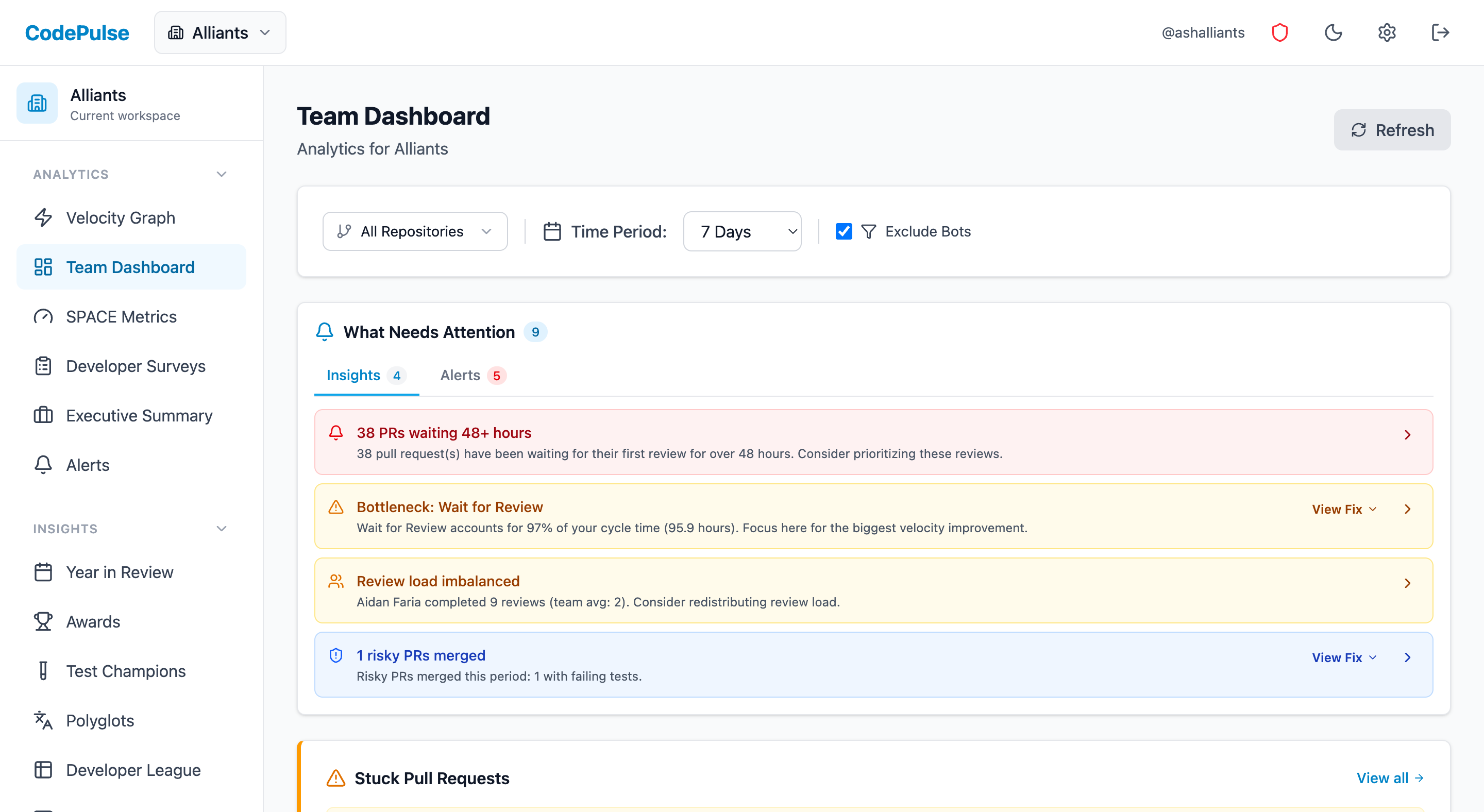
Evaluate CodePulse against your own delivery history
A comparison table only goes so far. Connect read-only GitHub in about five minutes and judge the output on your repositories, at one flat price, with no per-seat math.
Read-only GitHub · Your code stays yours · Team-level by default · No credit card
See These Features in Action
Break down cycle time into coding, waiting, review, and merge phases.
Track all four DORA metrics and benchmark against industry standards.
Related Guides
5 LinearB Alternatives for 2026 (With Pricing)
An honest comparison of CodePulse vs LinearB. We tell you when to choose LinearB instead, because the best tool is the one that makes the right trade-offs for your situation.
Jellyfish vs LinearB vs Swarmia: Full 2026 Comparison
Compare Jellyfish, LinearB, Swarmia, Allstacks, Haystack and more engineering analytics tools. Features, pricing, cycle time benchmarks, and integrations.
Best Engineering Analytics Tools for 2026 (Ranked by Real Users)
We ranked the 10 best engineering analytics tools based on metric depth, setup speed, pricing transparency, and privacy posture. Honest pros and cons for each.