
Compare the finished analysis before you choose a platform
See the report CodePulse produces from read-only GitHub workflow data, or connect your own repositories and evaluate the fit with real evidence.
Read-only GitHub · Your code stays yours · Team-level by default · No credit card
Jellyfish is an enterprise engineering management platform built for VP/Director-level buyers at organizations with 200+ engineers. This review breaks down what Jellyfish actually costs, what you get at each tier, and whether the investment makes sense for your team size and goals.
How much does Jellyfish cost?
Jellyfish does not publish pricing. Based on third-party sources and customer reports, expect $20-40 per developer per month. Vendr records a $35,920 median annual contract across 91 purchases, with real deals starting around $16,500 (July 2026); PriceLevel data puts per-contributor pricing near $588/year (~$49/month) at the top of that band. You must go through a sales process to get a quote.
Pricing Overview
Jellyfish takes a fully enterprise, contact-sales approach to pricing. There are no self-serve tiers, no free trials you can start on your own, and no publicly listed prices. This is standard for platforms targeting the VP of Engineering at 200+ person organizations, but it creates opacity for teams doing initial research.
| Plan | Price | Contract | Estimated 50-Dev Cost |
|---|---|---|---|
| Enterprise | Contact Sales | Annual (typically multi-year) | $12,000-24,000/year (estimated) |
The estimated per-developer cost of $20-40/month comes from aggregated reports on PriceLevel and customer reviews. Actual pricing depends on team size, contract length, and feature scope. Larger organizations typically negotiate volume discounts.
What You Get at Each Tier
Since Jellyfish only offers a single enterprise tier, the scope of your deployment determines what you get. Core features include:
- Engineering investment allocation -- Map engineering effort to business initiatives, product areas, and custom categories
- Resource capacity planning -- Forecast team capacity and allocation across projects
- Executive dashboards -- Board-ready reporting designed for non-technical stakeholders
- Jira + GitHub integration -- Pull data from project management and version control
- Custom reporting -- Build tailored reports for different audiences
- Dedicated CSM -- Customer success manager included with enterprise contracts
The platform excels at answering the question "where is engineering spending its time?" for executive audiences. If your primary buyer is a CTO presenting to the board, Jellyfish is built for that use case.
Hidden Costs to Watch For
The sticker price is only part of the total cost of ownership. Our free engineering analytics pricing calculator lets you model Jellyfish against per-seat alternatives on your own headcount. Jellyfish implementations commonly surface these additional expenses:
- Implementation timeline -- Expect 4-8 weeks for onboarding with professional services. This is not a tool you can set up in an afternoon.
- Professional services fees -- Some contracts include implementation support, others charge separately. Clarify this upfront.
- Annual commitment -- Multi-year contracts are the norm. Early termination is typically not an option without penalty.
- Effective floor, not a published minimum -- Jellyfish publishes no minimum, but buyer-reported contracts start around $16,500-19,000/year (smallest documented deal: 50 seats), which prices out smaller teams.
- Integration maintenance -- Connecting Jira, GitHub, CI/CD, and HR systems requires ongoing configuration as your toolchain evolves.
- Internal adoption costs -- Training managers and executives to use the platform adds to the real cost.
"The most expensive analytics platform is the one that costs $50K/year and only the VP of Engineering logs into."
🔥 Our Take
Jellyfish is priced for organizations that measure engineering in headcount, not individuals. If you have 200+ engineers and need to justify engineering investment to the board, the price is reasonable. If you have 50 engineers and want to improve delivery speed, you are paying enterprise tax for features you will not use.
The contact-sales-only model also means you cannot quickly evaluate whether the platform fits your needs. By the time you have been through the sales cycle, implementation, and first quarter of data, you have invested 3-4 months and significant internal resources. That is a steep commitment when alternatives offer self-serve onboarding in minutes.
How Jellyfish Compares to CodePulse Pricing
| Feature | Jellyfish | CodePulse |
|---|---|---|
| Free Tier | No | Yes (up to 10 devs) |
| Starting Price | ~$20-40/dev/month | $199/month flat (Pro, up to 50 devs) |
| 50-Dev Annual Cost | $12,000-24,000 | $9,000 (Pro) / $15,000 (Business) |
| Setup Time | 4-8 weeks | Under 5 minutes |
| Contract | Annual/Multi-year | Monthly (cancel anytime) |
| Board Reporting | Purpose-built | Executive summary dashboard |
| Code-Level Insights | Limited | File hotspots, review network, knowledge silos |
"An engineering analytics tool should pay for itself within 30 days. If it takes 8 weeks just to set up, the ROI math is already underwater for mid-size teams."
Who Should Pay for Jellyfish?
Jellyfish is the right investment when all of these are true:
- You have 200+ engineers across multiple teams and business units
- Your primary need is aligning engineering investment with business outcomes
- You report to a board or C-suite that wants financial-grade engineering metrics
- You have budget for a $30K+ annual commitment plus implementation resources
- You already use Jira extensively and want deep project management integration
Jellyfish is not the right fit when:
- You have fewer than 100 engineers and need a tool that scales with you
- Your primary goal is improving delivery speed (cycle time, PR throughput)
- You want code-level insights like file hotspots, review networks, or knowledge silos
- You need to start measuring this week, not this quarter
- Your budget is under $30K/year for engineering analytics
"The right question is not 'what does Jellyfish cost?' but 'what does the problem I am solving cost if I do nothing?'"
Frequently Asked Questions
Jellyfish does not publish pricing. Based on third-party reports and customer reviews, pricing ranges from $20-40 per developer per month. Vendr records a $35,920 median annual contract (91 purchases, July 2026) with real deals starting around $16,500; reported per-contributor pricing settles around $49/month ($588/year) at the top of the band.
Pricing last verified July 2026. Visit jellyfish.co for current pricing.
Related Reading
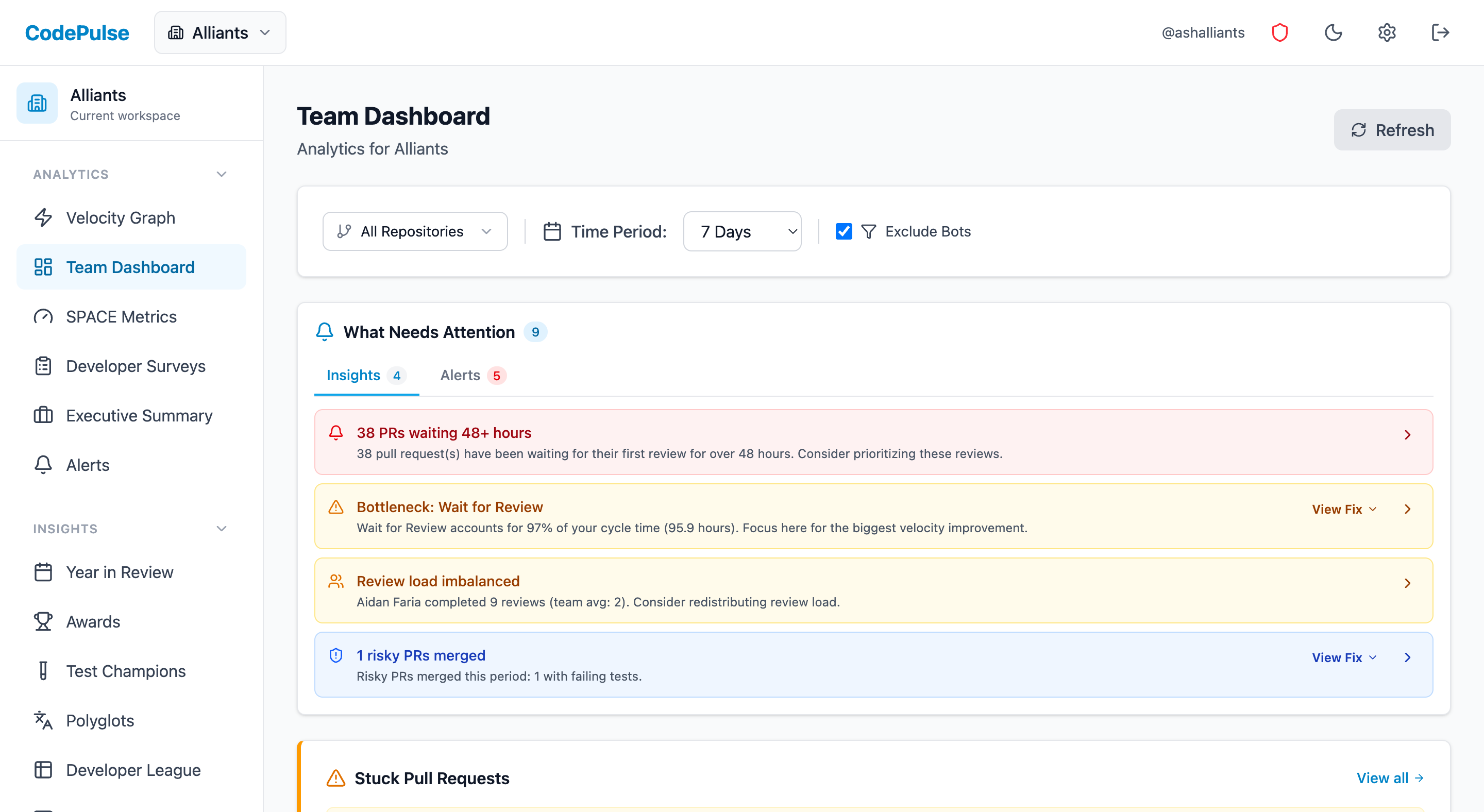
Evaluate CodePulse against your own delivery history
A comparison table only goes so far. Connect read-only GitHub in about five minutes and judge the output on your repositories, at one flat price, with no per-seat math.
Read-only GitHub · Your code stays yours · Team-level by default · No credit card
See These Features in Action
Board-ready engineering performance in a single page.
See where engineering effort goes across features, maintenance, and debt.
Related Guides
7 Jellyfish Alternatives for 2026 (Honest Ranking)
Compare 7 Jellyfish alternatives including CodePulse, LinearB, Swarmia, and more. Honest pros, cons, pricing, and integration comparisons.
Jellyfish vs LinearB vs Swarmia: Full 2026 Comparison
Compare Jellyfish, LinearB, Swarmia, Allstacks, Haystack and more engineering analytics tools. Features, pricing, cycle time benchmarks, and integrations.
Best Engineering Analytics Tools for 2026 (Ranked by Real Users)
We ranked the 10 best engineering analytics tools based on metric depth, setup speed, pricing transparency, and privacy posture. Honest pros and cons for each.
Jellyfish vs GitKraken Insights: The Honest Comparison
Jellyfish is the Gartner MQ Leader with quote-only pricing; GitKraken Insights is the nine-month-old challenger at $9-19/contributor. A sourced, vendor-neutral head-to-head - with the third option both leave out.
Gartner MQ for Developer Productivity: Who Won, Who Pays
The inaugural 2026 Gartner Magic Quadrant for Developer Productivity Insight Platforms: announced Leaders, what they cost per buyer-reported data, and when you do not need one.