

Compare the finished analysis before you choose a platform
See the report CodePulse produces from read-only GitHub workflow data, or connect your own repositories and evaluate the fit with real evidence.
Read-only GitHub · Your code stays yours · Team-level by default · No credit card
You are searching for a "Hivel alternative," which usually means one of three things: the per-contributor bill is climbing as your team grows, the platform feels heavier than the questions you actually need answered, or you do not have Jira and CI/CD wired up tightly enough to get full value from it. This guide will not pretend CodePulse is universally better than Hivel. It will help you decide which set of trade-offs fits your team.
What is the best Hivel alternative?
The best Hivel alternative for GitHub-centric teams is CodePulse, which delivers PR, review-network, and code-health analytics from GitHub data alone with about a 5-minute setup and flat pricing instead of per-contributor seats. Hivel itself is strong for AI-augmented teams that correlate Git, Jira, and CI/CD to track DORA metrics, software cost capitalization, and Copilot or Cursor ROI. Hivel's published pricing runs $20-$35 per contributor per month; CodePulse charges a flat team rate. Choose Hivel for Jira correlation and AI code review; choose CodePulse for GitHub depth, privacy-first positioning, and a lower, predictable bill.
"The 'best' engineering analytics tool is the one that makes the right trade-offs for YOUR situation. Tool shopping is usually a symptom of not knowing what you actually need to measure."
Both Hivel and CodePulse measure how software gets delivered. But they make different bets. Hivel bets you want a single platform that fuses Git, Jira, CI/CD, calendars, and AI coding tools into one executive view, with software cost capitalization and an AI code review agent on top. CodePulse bets that for most GitHub-first teams, the highest-leverage insights live in PR and review data, and that the other integrations add configuration and cost without proportional payback. The same reasoning applies one layer down at the tracker itself, which our Linear vs Jira comparison works through: the tracker contributes one segment of the delivery timeline, and Git contributes the rest.
One of those bets is right for you. If you are weighing several tools, see our full engineering analytics tools comparison and our LinearB alternative breakdown.
What Does Hivel Actually Do?
Hivel is an AI-native Software Engineering Intelligence (SEI) platform. It correlates data across the tools engineers use daily, Git (GitHub, GitLab, Bitbucket), Jira, and CI/CD such as Jenkins, then surfaces it in dashboards aimed at engineering leaders. According to Hivel's features page, the platform's notable capabilities include:
- DORA metrics: deployment frequency and lead time from the pipeline, change failure rate and MTTR from incident and deployment events.
- PR insights: 1-click filters for PRs over 400 lines, detection of merged-without-review PRs, and long-standing PR alerts.
- Investment Profile: merges Jira and Git data to show where engineering time goes by EPIC and initiative.
- AI ROI tracking: measures Copilot and Cursor adoption and ties it to speed, quality, and throughput.
- Marco AI code review agent: flags bugs, style, and security risks the moment a PR opens.
- Cost capitalization: automates audit-ready software capitalization from EPICs and PRs.
- Deep-work tracking: measures focused coding time versus meetings and distractions.
Hivel is rated 4.7/5 on G2 and markets itself as well-suited to engineering organizations of 50 or more engineers. That is real strength, and if those features map to questions your leadership asks, Hivel is a serious tool. The question is whether you will use enough of it to justify the per-contributor cost and the integration setup.
Hivel vs CodePulse: The Honest Comparison
Here is what each tool does well, based on documented features and public pricing as of mid 2026:
| Aspect | Hivel | CodePulse |
|---|---|---|
| Primary bet | Unified SEI across Git + Jira + CI/CD + AI tools | GitHub depth without the integration tax |
| Data sources | GitHub, GitLab, Bitbucket, Jira, Jenkins, SonarQube, Copilot, Cursor, calendars | GitHub only |
| Setup time | Hours to days (multiple integrations for full value) | Minutes (one OAuth flow) |
| DORA metrics | Full four keys from Git + Jira + CI/CD | Delivery metrics approximated from GitHub merge data |
| Jira / investment profile | Yes (core feature) | No |
| AI code review | Yes (Marco agent on PRs) | No |
| AI tool ROI tracking | Yes (Copilot, Cursor) | No |
| Cost capitalization | Yes (audit-ready) | No |
| Review collaboration | PR-level metrics | Interactive review network graph |
| Code health / hotspots | Limited | File hotspots + knowledge silo detection |
| Developer recognition | Limited | 15 award categories |
| Pricing model | $20-$35 per contributor / month (per-seat) | Flat team pricing |
| Surveillance posture | Deep-work and individual tracking available | Anti-surveillance, team-focused by design |
/// Our Take
Deep-work tracking and individual time-allocation dashboards are exactly where engineering analytics goes wrong. The moment a tool reports how much "focused coding" each person did, you have built surveillance, and surveillance erodes the trust it needs to be useful.
Peer-reviewed research (Schlund and Zitek, Communications Psychology, 2024) found that monitoring perceived as surveillance reduces trust and performance. Hivel can be configured carefully, but the capability is there. CodePulse takes the opposite default: metrics are for understanding systems, not ranking people. If your culture leans toward individual time-tracking, that is a feature to Hivel and a warning sign to us.
What Will You Actually Pay?
Unlike many competitors, Hivel publishes its pricing. That transparency is to its credit. Here is what the Hivel pricing page lists, with the per-contributor model in mind (only engineers who commit code are billed):
| Plan | Hivel | CodePulse |
|---|---|---|
| Free | Up to 8 contributors | Small teams |
| Growing Teams | $20/contributor/mo annual ($25 monthly), up to 100 engineers | Flat team rate |
| Enterprise | $35/contributor/mo annual ($40 monthly), unlimited | Custom |
| 50-engineer team (annual) | ~$12,000/year | Flat, predictable |
Sources: Hivel Pricing, G2 Pricing
"Per-contributor pricing punishes you for growing. Flat team pricing means your analytics bill does not become a reason to hesitate before hiring your next engineer."
The per-contributor model has a subtle effect: the more engineers you hire, the more your analytics bill climbs, even though the underlying insight (your delivery flow) does not get proportionally more valuable. Flat pricing removes that friction. The real question is not which is cheaper today, but which features you will use enough to justify the bill.
When Is Hivel the Better Fit?
"Choosing the wrong tool and migrating later costs more than choosing the right tool slowly. Be honest about what you actually need before you sign."
Hivel is the better choice if any of these are true for your team:
You need Jira-to-code investment profiling
If leadership asks "what percentage of engineering time went to new features versus keeping-the-lights-on?" or wants EPIC-level investment breakdowns, Hivel's Investment Profile is built for exactly that. CodePulse does not connect to Jira, so it cannot answer ticket-to-code questions.
You need software cost capitalization
Finance and audit teams sometimes need to capitalize engineering effort against capitalizable projects. Hivel automates audit-ready capitalization from EPICs and PRs. CodePulse has no capitalization feature and no plans to build one.
You want an AI code review agent
Hivel's Marco agent reviews PRs automatically for bugs, style, and security. If inline AI review is a priority, Hivel (or a dedicated tool like CodeRabbit) is a better fit. CodePulse focuses on analytics, not automated review.
You want to measure AI coding tool ROI across multiple assistants
Hivel tracks Copilot and Cursor adoption and ties it to speed and quality. If quantifying AI assistant ROI is a board-level priority, Hivel has purpose-built features. CodePulse does not track AI tool usage.
You use multiple Git providers or need on-prem/VPC
Hivel supports GitHub, GitLab, and Bitbucket, plus VPC and on-prem deployment. CodePulse is GitHub-only and SaaS-only. We would rather go deep on one platform than shallow on many.
Decision Tree: Hivel vs CodePulse

START HERE
    |
    v
Do you need Jira-to-code investment profiling?
    |-- YES --> Hivel (CodePulse has no Jira integration)
    |
    v NO
Do you need software cost capitalization?
    |-- YES --> Hivel (audit-ready capitalization)
    |
    v NO
Do you need an AI code review agent on PRs?
    |-- YES --> Hivel (Marco) or CodeRabbit
    |
    v NO
Do you use GitLab / Bitbucket, or need on-prem/VPC?
    |-- YES --> Hivel (CodePulse is GitHub-only, SaaS-only)
    |
    v NO
Is GitHub your primary source of truth?
    |-- NO --> Hivel or evaluate LinearB / Jellyfish
    |
    v YES
Do you want fast setup, flat pricing, and a privacy-first posture?
    |-- YES --> CodePulse
    |
    v NO --> Evaluate both, prioritize must-haves
Where Does CodePulse Fit Better?
CodePulse is the better choice if these describe your situation:
GitHub is your source of truth
If your team lives in GitHub, PRs are your workflow, and you are not deeply tied to Jira, CodePulse gives you what you need without configuring integrations you will not use. There is no pipeline to wire up and no ticket system to map.
Review collaboration matters to you
CodePulse's Review Network is a genuinely differentiated feature. The interactive graph shows who reviews whose code, surfaces load imbalances, and flags isolated team members. Hivel has PR-level metrics, but not this depth of collaboration visualization.
You care about code health and knowledge risk
CodePulse's File Hotspots page surfaces high-change files and knowledge silos, the parts of your codebase that only one person understands. That is bus-factor risk you can act on before someone leaves.
You want to recognize diverse contributions
CodePulse's 15 award categories recognize speed, quality, review work, and consistency, surfacing valuable contributions that commit counts miss. It rewards the person who reviews the most or keeps quality high, not just the one who ships the most code.
// How to See This in CodePulse
Navigate to the Dashboard to see cycle time broken into 4 stages:
- Coding time (first commit to PR open)
- Pickup time (PR open to first review)
- Review time (first review to approval)
- Merge time (approval to merge)
Then explore the Review Network and File Hotspots for collaboration and code-health insights, no Jira or CI/CD setup required.
Which One Should Your Team Pick?
Use this matrix to decide. Be honest about which scenarios actually apply to you:
| Your Situation | Recommendation | Why |
|---|---|---|
| GitHub-only team, want fast setup | CodePulse | One OAuth flow; no Jira or CI/CD to configure |
| Heavy Jira dependency, want investment profiling | Hivel | CodePulse has no Jira integration |
| Need software cost capitalization for finance | Hivel | Audit-ready capitalization is built in |
| Want AI code review on every PR | Hivel | Marco agent reviews PRs automatically |
| Measuring Copilot / Cursor ROI | Hivel | Purpose-built AI tool ROI tracking |
| Multiple Git providers or on-prem/VPC | Hivel | CodePulse is GitHub-only and SaaS-only |
| Care about review-collaboration mapping | CodePulse | Interactive review network is differentiated |
| Want code-health and knowledge-silo detection | CodePulse | File hotspots + bus-factor risk |
| Budget-sensitive, growing headcount | CodePulse | Flat pricing vs per-contributor seats |
| Privacy-first culture, anti-surveillance | CodePulse | Team-focused by default, no deep-work tracking |
What Are the Real Trade-Offs?
"Before buying another dashboard, ask: what decision will this data inform? If you cannot answer that, you do not need the tool, you need clarity on what you are trying to improve."
What you give up with CodePulse
- Jira / investment profile: no ticket-to-code correlation or EPIC-level time allocation
- Cost capitalization: no audit-ready software capitalization
- AI features: no AI code review agent, no Copilot or Cursor ROI tracking
- Multiple providers: GitHub only, no GitLab or Bitbucket, no on-prem/VPC
What you give up with Hivel
- Simplicity: full value depends on connecting Git, Jira, and CI/CD
- Predictable cost: per-contributor pricing scales with headcount
- Review-network depth: PR-level metrics, not an interactive collaboration graph
- Privacy-first default: deep-work and individual tracking are available capabilities
- Recognition breadth: limited awards versus 15 categories
If You Are Switching From Hivel
Already using Hivel and considering CodePulse? Here is the honest migration path. Teams evaluating DORA tooling specifically should also read our best DORA metrics tools guide before deciding.
What transfers easily
- GitHub data: CodePulse syncs directly, no export or import needed
- Historical metrics: CodePulse processes roughly the last 6 months of PR data automatically
- Team structure: based on your GitHub org, not separate configuration
What you will lose
- Jira correlation: ticket-to-code and investment-profile history goes away
- Cost capitalization: capitalization records do not transfer
- AI ROI and Marco reviews: replace with a dedicated tool if needed
- Non-GitHub providers: GitLab or Bitbucket repo history will not be available
Migration timeline
- Connect GitHub (5 minutes): one OAuth flow to authorize CodePulse
- Initial sync (30-60 minutes): historical PR data processing
- Explore dashboards (same day): Dashboard, Review Network, File Hotspots
- Set up alerts (optional): configure notifications for stuck PRs
- Run in parallel (recommended): keep Hivel for 2-4 weeks while you validate
Compare Other Tools
If Hivel vs CodePulse is not quite the right comparison, these guides might help:
- LinearB vs CodePulse - workflow automation and multi-provider analytics
- Best DORA Metrics Tools - tools focused specifically on the four DORA keys
- Full Engineering Analytics Tools Comparison - an overview of the whole category
Making Your Decision
Do not let marketing, including ours, make this call for you. Here is how to decide:
- List your actual requirements: which questions do you need answered, and which integrations do you genuinely use today?
- Try the free tiers: Hivel is free up to 8 contributors; CodePulse offers a free tier for small teams. Use both with real data.
- Evaluate after 2 weeks: which dashboard do you actually open, and which insight changed a decision?
- Be honest about integration usage: if you set up Jira and never look at those reports, you are paying for unused features.
The best tool is the one your team will use consistently. If that is Hivel because you need Jira correlation, cost capitalization, or AI code review, use Hivel. If that is CodePulse because you want GitHub depth, flat pricing, and a privacy-first posture without integration overhead, we are here. Start your free trial and see if CodePulse is the right trade-off for your team.
Frequently Asked Questions
The best Hivel alternative depends on your stack. For GitHub-only teams that want deep PR and review analytics without connecting Jira or CI/CD, CodePulse is the closest fit and sets up in about 5 minutes. For teams that need the Jira-to-code investment profile, cost capitalization, and the Marco AI code review agent that Hivel ships, a closer match is LinearB or Jellyfish. Hivel itself is strong for AI-augmented teams that want Copilot and Cursor ROI tracking tied to DORA metrics.
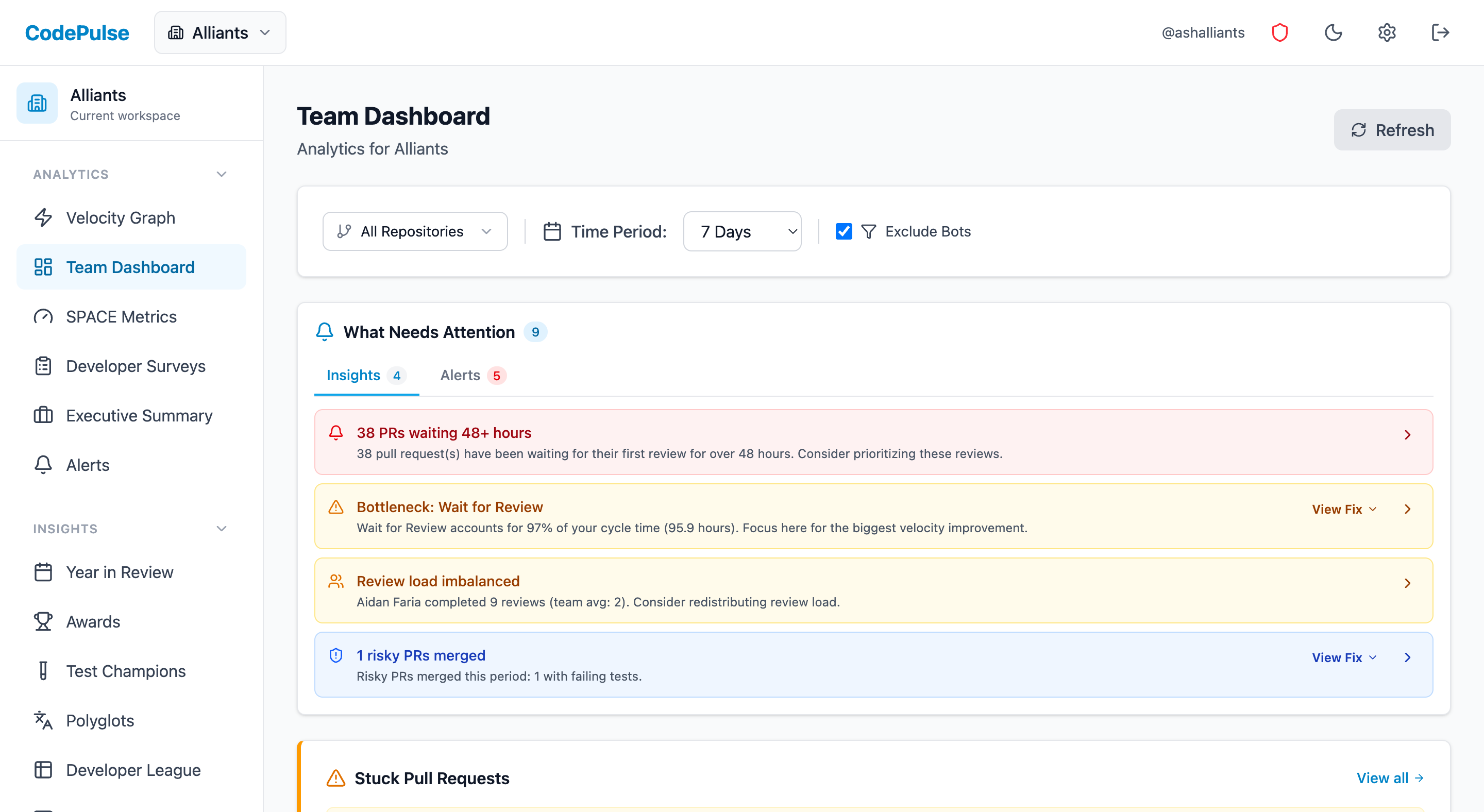
Evaluate CodePulse against your own delivery history
A comparison table only goes so far. Connect read-only GitHub in about five minutes and judge the output on your repositories, at one flat price, with no per-seat math.
Read-only GitHub · Your code stays yours · Team-level by default · No credit card
See These Features in Action
Interactive graph of review relationships and workload distribution.
Track all four DORA metrics and benchmark against industry standards.
Related Guides
5 LinearB Alternatives for 2026 (With Pricing)
An honest comparison of CodePulse vs LinearB. We tell you when to choose LinearB instead, because the best tool is the one that makes the right trade-offs for your situation.
Best DORA Metrics Tools for 2026: 8 Platforms Compared
An opinionated comparison of the 8 best tools for automated DORA metrics reporting, ranked by automation depth, setup speed, metric accuracy, pricing transparency, and real-world usefulness for engineering leaders.
Jellyfish vs LinearB vs Swarmia: Full 2026 Comparison
Compare Jellyfish, LinearB, Swarmia, Allstacks, Haystack and more engineering analytics tools. Features, pricing, cycle time benchmarks, and integrations.
7 Jellyfish Alternatives for 2026 (Honest Ranking)
Compare 7 Jellyfish alternatives including CodePulse, LinearB, Swarmia, and more. Honest pros, cons, pricing, and integration comparisons.
7 Best Allstacks Alternatives for Engineering Teams (2026)
An honest comparison of 7 Allstacks alternatives. Covers pricing, delivery forecasting trade-offs, integration depth, and when Allstacks is still the right choice.