
Compare the finished analysis before you choose a platform
See the report CodePulse produces from read-only GitHub workflow data, or connect your own repositories and evaluate the fit with real evidence.
Read-only GitHub · Your code stays yours · Team-level by default · No credit card
In May 2026 Gartner published its first Magic Quadrant for Developer Productivity Insight Platforms - the analyst world's stamp that engineering analytics is now a real market. Every vendor in it immediately wrote a victory blog. Here is what the quadrant actually tells you, what the Leaders cost according to buyers rather than brochures, and the question the MQ cannot answer: whether you need any of this at your size.
What is the Gartner Magic Quadrant for Developer Productivity Insight Platforms?
It is Gartner's inaugural quadrant (published May 2026) for platforms that measure engineering productivity and delivery from Git, issue-tracker and CI/CD data - a market Gartner sizes around $400M growing 40%+. Vendors announcing Leader placements include Jellyfish, Atlassian (DX), LinearB and Opsera. Buyer-reported pricing for Leaders runs $21,000-36,000+ a year for mid-size teams. Flat-priced self-serve tools like CodePulse sit outside the MQ by design - it evaluates enterprise vendor completeness, not fit for 50-500 engineer teams.
What Is the Developer Productivity Insight Platform MQ?
Gartner launching a Magic Quadrant is the analyst equivalent of a category getting its own aisle in the supermarket. The DPIP quadrant covers what the industry has called software engineering intelligence: platforms aggregating Git, Jira, CI/CD and increasingly AI-tool signals into productivity and delivery insight. Vendor announcements citing the report put the market around $400 million with more than 40% growth - small enough that this is the first quadrant, growing fast enough that Gartner bothered.
One honesty note before the vendor list: the MQ document itself sits behind Gartner's paywall. What follows is assembled from the vendors' own placement announcements - which are reliable about their own placement and silent about everyone else's. No public source we found lists the complete quadrant.
Who Announced What?
| Vendor | Announced placement | What they sell |
|---|---|---|
| Jellyfish | Leader | Enterprise SEI: Jira-driven allocation, DevFinOps, AI impact |
| Atlassian (DX) | Leader | DX's survey-led developer experience platform, acquired for $1B in Sept 2025 |
| LinearB | Leader | Delivery metrics plus gitStream workflow automation |
| Opsera | Leader | DevOps platform with delivery insights |
| Allstacks | Visionary | ML delivery forecasting and capitalization |
Just as interesting is who is absent from all the announcement coverage: GitKraken Insights (launched October 2025 - see our Jellyfish vs GitKraken Insights comparison), Swarmia, Sleuth, and the whole self-serve tier of the market. That absence is mostly mechanical: MQ inclusion criteria typically demand revenue, customer counts and enterprise references that young or deliberately-small vendors do not have.
A Magic Quadrant is a map of who sells to enterprises well. It is not a map of what your team needs.
What Do MQ Leaders Actually Cost?
Analyst placement and pricing transparency turn out to be inversely correlated. Of the announced Leaders, only LinearB publishes rates. Here is what reliable data shows:
- Jellyfish: quote-only. Vendr records a $35,920 median annual contract across 91 purchases (range ~$16,500-89,600), plus $5,000-25,000 implementation - see our full Jellyfish pricing review.
- LinearB: published at $420-549 per contributor per year - a 50-engineer team pays $21,000-27,000 annually, and the bill grows with every hire.
- Atlassian/DX and Opsera: sales-led, without buyer-reported contract datasets comparable to the above - budget for an enterprise motion.
The pattern is structural, not accidental. The capabilities that win Leader placement - breadth of integrations, enterprise services, program-office tooling - are the same capabilities that require an enterprise price to fund.
When Do You Need an MQ Leader - and When Not?
Choose from the quadrant when the quadrant's evaluation criteria match your buying criteria: you run 500+ engineers across multiple SCMs, you need capitalization or OKR-mapping depth, your procurement process requires analyst cover, and you have the budget and patience for a sales cycle plus implementation. Those are real needs and the Leaders serve them well.
Skip the quadrant when your questions are operational: where delivery slows, which reviewer is overloaded, what engineering time actually goes to, whether the AI tools pay off. Teams of 50-500 asking those questions are buying answers, not vendor completeness - and buyer-reported Leader pricing means they would fund roughly ten years of a flat-priced tool with one Leader contract.
🔥 Our Take
The first DPIP Magic Quadrant validates the category and misleads the mid-market in the same stroke. Analyst quadrants price in an enterprise sales motion - if you don't need the motion, don't pay for it.
Gartner's criteria reward completeness of vision and ability to execute at enterprise scale. Nothing in an MQ measures time-to-first-insight, price per answer, or whether your engineers will tolerate the tool. Those happen to be the criteria that decide whether analytics adoption survives its first quarter.
Where Does CodePulse Fit?
Nowhere in the MQ, and deliberately so. CodePulse is built for the segment the MQ underweights: 50-500 engineer organizations on GitHub that want root-cause delivery analytics - cycle time phases, review networks, knowledge silos, AI-tool ROI - at a published flat price ($199/month to 50 developers, $449 to 150), live the same afternoon. No sales cycle to fund, which is precisely why no analyst will ever interview our sales VP.
📊 Compare Before You Shortlist
Evaluating MQ vendors? Run the numbers first:
- Pricing comparison calculator - model per-seat vs flat costs at your headcount
- Jellyfish alternatives and LinearB alternatives - honest rankings including when the Leader is the right call
- The SEI platform guide - the category, minus the quadrant
Frequently Asked Questions
Per their own announcements following the inaugural MQ (published May 2026): Jellyfish, Atlassian (through its DX acquisition), LinearB, and Opsera all announced Leader placements. Allstacks announced a Visionary placement. The full quadrant is behind the Gartner paywall, so the complete vendor map may include others - treat any list assembled from press releases, including this one, as vendor-announced rather than independently confirmed.
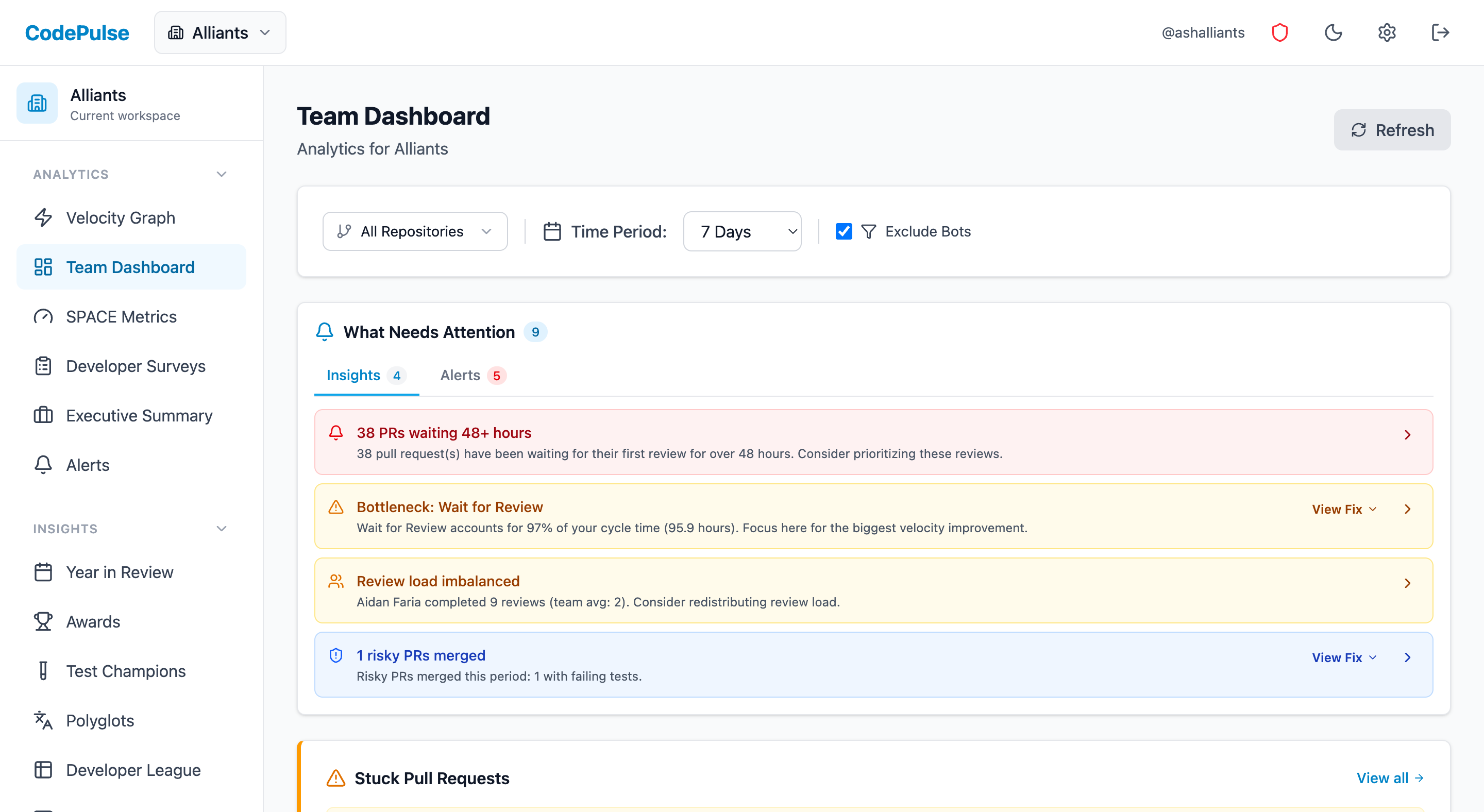
Evaluate CodePulse against your own delivery history
A comparison table only goes so far. Connect read-only GitHub in about five minutes and judge the output on your repositories, at one flat price, with no per-seat math.
Read-only GitHub · Your code stays yours · Team-level by default · No credit card
See These Features in Action
Explore all featuresRelated Guides
Jellyfish vs GitKraken Insights: The Honest Comparison
Jellyfish is the Gartner MQ Leader with quote-only pricing; GitKraken Insights is the nine-month-old challenger at $9-19/contributor. A sourced, vendor-neutral head-to-head - with the third option both leave out.
Engineering Intelligence Platforms: What They Do
Engineering intelligence platforms promise visibility. Most deliver dashboards. What the category means, which tools deliver, and whether you need one.
Jellyfish Pricing 2026: $35,920 Median, No List Price
Jellyfish does not publish pricing. Buyer-reported data shows $20-40/dev/month and a $35,920 median annual contract. We break down the real costs, hidden fees, and how Jellyfish compares to alternatives.
5 LinearB Alternatives for 2026 (With Pricing)
An honest comparison of CodePulse vs LinearB. We tell you when to choose LinearB instead, because the best tool is the one that makes the right trade-offs for your situation.