
Understand the system around the team, not a developer leaderboard
Preview team-level workload, collaboration, and delivery signals designed for process improvement rather than performance grading.
Read-only GitHub · Your code stays yours · Team-level by default · No credit card
Twenty-seven percent of code ships on weekends in distributed engineering teams. Sixty-four percent of pull requests get reviewed after standard working hours. According to CodePulse research across 803,000 pull requests, remote engineering teams operate on a fundamentally different rhythm than co-located ones, and the productivity metrics that work for one fail catastrophically for the other. Remote teams need cycle time decomposed by time zone, review wait time normalized for working-hours overlap, and an after-hours shipping ratio that surfaces sustained burnout. CodePulse surfaces all three out of the box.
This guide is written for VPs of Engineering, Engineering Managers, and Staff Engineers running globally distributed teams who already feel the limits of velocity dashboards built for co-located squads. It covers the metrics that matter, how to measure cycle time across time zones honestly, which tools handle distributed work natively, how to spot burnout before someone resigns, the async review patterns that hold up at scale, and how CodePulse fits into a remote operating model.
What developer productivity metrics matter for remote and distributed teams?
Remote and distributed engineering teams need three metrics that co-located teams can ignore. First, cycle time decomposed by time zone, so wall-clock delays caused by overlap gaps stop being blamed on individual developers. Second, review wait time normalized for working-hours overlap, so async handoffs are measured against a fair baseline rather than the impossible standard of synchronous review. Third, after-hours shipping ratio per person, so the team can spot sustained burnout before it becomes attrition. According to CodePulse research, 27 percent of weekend code shipping and 64 percent of after-hours PR review are real and measurable signals of distributed-team strain. CodePulse exposes all three signals natively, alongside Workload Concentration and Burnout Risk alerts that flag the failure modes early.
Why Do Remote Teams Need Different Productivity Metrics?
Co-located engineering teams share a coffee machine, a standup, and an afternoon overlap window where every reviewer is awake at the same time. The default productivity metrics most platforms ship were designed against that operating model. Velocity, deploy frequency, raw PR count, and cycle time treated as a single elapsed-time number all assume the team works the same eight hours a day in roughly the same time zone. Apply the same dashboard to a team spread across San Francisco, Lisbon, and Bangalore and the numbers stop telling the truth.
Cycle time on a distributed team frequently looks twice as long as cycle time on a co-located team doing the same work. Reviewers in the next time zone wake up, see the review request, finish their own morning work, and respond eight hours after the author pushed. The author is now asleep. Another cycle passes before merge. The wall-clock number says the team is slow. The working-hours number says the team is fine and the process is wrong. Most leadership teams act on the wall-clock number because that is what their tool surfaces, which leads to pressure on engineers and exits within twelve months.
The honest read on this is that remote teams need three additional metrics layered on top of the standard DORA set. First, time-zone-aware cycle time, which removes the overlap penalty from the elapsed-time calculation. Second, an after-hours shipping ratio, which surfaces sustained out-of-hours work that traditional metrics miss entirely. Third, a working-hours-aware review wait time, which separates async-process problems from coverage problems. Skip these three layers and the productivity dashboard becomes a tool for blaming the wrong people. For the broader research view on what always-on culture does to retention, see CodePulse research on always-on engineering culture.
"If your async review wait time is 18 hours and your sync review wait time is 90 minutes, you do not have a process problem. You have a time-zone overlap problem."
How Do You Measure Cycle Time Across Time Zones?
Cycle time across time zones requires two parallel calculations rather than a single number. The first calculation is wall-clock elapsed time from PR open to merge, which is what most platforms ship today. The second is working-hours elapsed time, which subtracts intervals where neither the author nor any potential reviewer was in working hours. The delta between the two is the cost of time-zone spread, and that number belongs on the executive dashboard alongside the raw cycle time figure.
The mechanics are straightforward. Tag each developer with a working-hours window in their local time zone, typically 9 to 6 on weekdays. For each PR, compute the total elapsed time and the elapsed time that intersects the union of the author's and the assigned reviewers' working hours. A 48-hour wall-clock cycle time on a fully distributed team often resolves to 8 working hours of real work, which means 40 hours of the cycle were overlap gaps that no individual could close.
Once both numbers are in place, the questions a manager asks change. Instead of asking why cycle time is so long, the manager asks whether the working-hours number is also long. If the working-hours number is short, the answer is reviewer assignment and overlap policy, not engineer effort. If the working-hours number is also long, the answer is a process or capacity problem inside the time-zone bubble where work actually happens. CodePulse research on cycle time decomposition shows that 92 percent of cycle time on the typical team is spent waiting for review, not writing code. On distributed teams that share goes higher, which makes time-zone-aware cycle time the single most important debugging tool for the productivity conversation.
What Are the Best Developer Productivity Tools for Distributed Teams?
Five platforms come up most often when distributed engineering teams shortlist productivity tooling: CodePulse, LinearB, Swarmia, Jellyfish, and DX. None of the five is universally best for every team shape. The honest read on each is below. The table focuses on the three capabilities that matter most for remote-first work: time-zone aware cycle time, native async review pattern support, and explicit weekend or after-hours work alerts.
| Platform | Time-Zone-Aware Cycle Time | Async Review Patterns | Weekend Work Alerts |
|---|---|---|---|
| CodePulse | ✅ Yes, with working-hours and holiday-aware breakdown | ✅ Yes, review network and load balance surfaced natively | ✅ Yes, Workload Concentration and Burnout Risk alerts |
| LinearB | ⚠️ Partial; cycle time exists but working-hours decomposition is shallow | ✅ Yes, gitStream automation and review reminders | ⚠️ Partial; relies on team thresholds rather than per-person signals |
| Swarmia | ✅ Yes, working hours configurable per team | ✅ Yes, review workflow and Slack integration first-class | ⚠️ Partial; healthy work patterns are visible, dedicated alerts are limited |
| Jellyfish | ⚠️ Partial; cycle time exists, time-zone fairness is not the focus | ⚠️ Partial; review insights exist, async pattern support is shallow | ❌ No first-class weekend or after-hours alerting |
| DX | ❌ Behavioral cycle time is not the primary product; survey first | ⚠️ Partial; surveyed friction signal, not behavioral pattern detection | ⚠️ Partial; surveyed burnout signal, not behavioral alerts |
✅ Yes, ⚠️ Partial, ❌ No. Snapshot of platform behavior as of publication; verify current capability with vendor demos before procurement.
The deeper vendor comparison across the full productivity-platform category lives in our best developer productivity platforms guide. For the scaling-team angle on the same vendor list, see our scalable developer productivity software guide.
How Do You Spot Burnout in Remote Teams?
Burnout in a co-located team is visible in body language. Burnout in a remote team is only visible in the data. The three behavioral signals that consistently precede a resignation are an after-hours shipping ratio above 30 percent for more than six weeks, weekend commit volume above 25 percent of total commits for the same window, and a review load ratio where a single individual is carrying more than twice the team median.
The hard part is measuring these signals at the individual level without weaponizing them. The point is not to penalize the engineer working weekends, the point is to flag the systemic problem that forced them into that pattern, and to intervene before the resignation letter arrives. CodePulse research on weekend work shows that engineers who sustain weekend commit volume above 25 percent for six weeks are roughly four times more likely to resign within twelve months than peers who do not. The signal is real, the threshold is real, and the intervention window is short.
The intervention itself is rarely complicated. Reassign review load. Add a second reviewer to the rotation in the time zone that is currently carrying the deficit. Reschedule planning rituals so the engineer in the inconvenient time zone is not the person attending meetings outside their working hours. Block a recovery week. The intervention costs nothing relative to the cost of replacing the engineer, which is typically six to nine months of fully-loaded compensation between recruiting, ramp time, and lost institutional knowledge.
"The best developer productivity metric for remote teams is not velocity. It is unsustainable velocity caught before someone quits."
What Async Review Patterns Actually Work?
Async code review is the operating model that distinguishes a healthy distributed team from a perpetually frustrated one. Three patterns hold up in practice across teams of every size. First, primary plus backup reviewer assignment on every pull request, so the review never blocks on a single person who is asleep. The backup is the safety net that prevents a 24-hour overlap gap from turning into a 48-hour cycle.
Second, a working-hours-overlap policy on reviewer assignment. The policy is simple: at least one assigned reviewer must be inside the next eight working hours of the author. If the only available reviewers are all in time zones that do not overlap with the author for another twelve hours, the team has a capacity problem, not a process problem, and the capacity problem belongs on the next hiring plan. Without this policy, teams accidentally reassign cycle-time pain to whichever engineer happens to be unlucky.
Third, a written PR description standard. The reviewer should be able to understand the context, the design decision, and the test evidence without a synchronous call. Teams that adopt a template covering problem statement, approach, alternatives considered, test evidence, and rollout plan find that review cycle time drops by roughly a third because reviewers stop needing a kickoff meeting before they can engage. Our companion playbook on async code review for distributed teams goes deeper on the templates and the rollout sequence.
Our Take
The best developer productivity metric for remote teams is not velocity. It is unsustainable velocity caught before someone quits.
Velocity dashboards built for co-located teams flatter remote teams into looking fine right up until a senior engineer resigns. The signal that mattered was already in the data weeks earlier: rising after-hours commits, growing review load concentration on one person, weekend pushes that nobody flagged. Pick the metrics that surface those signals early and act on them before they become an exit interview. Velocity is a lagging indicator. Burnout risk is a leading one. Run the leading indicator.
How Does CodePulse Help Remote Engineering Teams?
CodePulse surfaces three remote-specific signals out of the box, alongside the standard DORA and review-health metrics every productivity platform ships. The signals were designed against research on weekend work, always-on culture, and the cycle-time decomposition that showed 92 percent of typical cycle time is review wait, not coding. The point is to give distributed-team leaders the same situational awareness their co-located peers get for free, without compromising on anti-surveillance principles or forcing individual engineers under a microscope.
"A productivity platform that does not show you weekend work is not a productivity platform. It is a charity for hidden burnout."
How to See This in CodePulse
CodePulse surfaces three remote-specific signals out of the box:
- The Dashboard shows cycle time decomposed into coding, waiting, review, and merge phases, so the time-zone overlap penalty stops hiding inside a single elapsed-time number
- The Review Network page maps reviewer load and pairing patterns, so a single overloaded reviewer in one time zone becomes visible before the team collapses around them
- The Alerts page includes Workload Concentration, Burnout Risk, and Bus Factor templates that fire on the leading indicators of remote-team strain before they become attrition
The companion playbook for the broader vendor evaluation is our best engineering analytics tools guide, which ranks the same platforms on metric depth, setup speed, pricing transparency, and privacy posture for the general analytics use case rather than the remote-team use case specifically.
Frequently Asked Questions
Three metrics carry most of the signal for distributed teams. Cycle time decomposed by time zone tells you whether work waits for overlap windows that never come. Review wait time normalized for working hours overlap tells you whether async handoffs are healthy or whether the next reviewer is always asleep. After-hours shipping ratio tells you whether the team is sustaining velocity by quietly burning weekends. Velocity in isolation, deploy frequency in isolation, and PR count in isolation all hide the underlying problem.
Related Guides
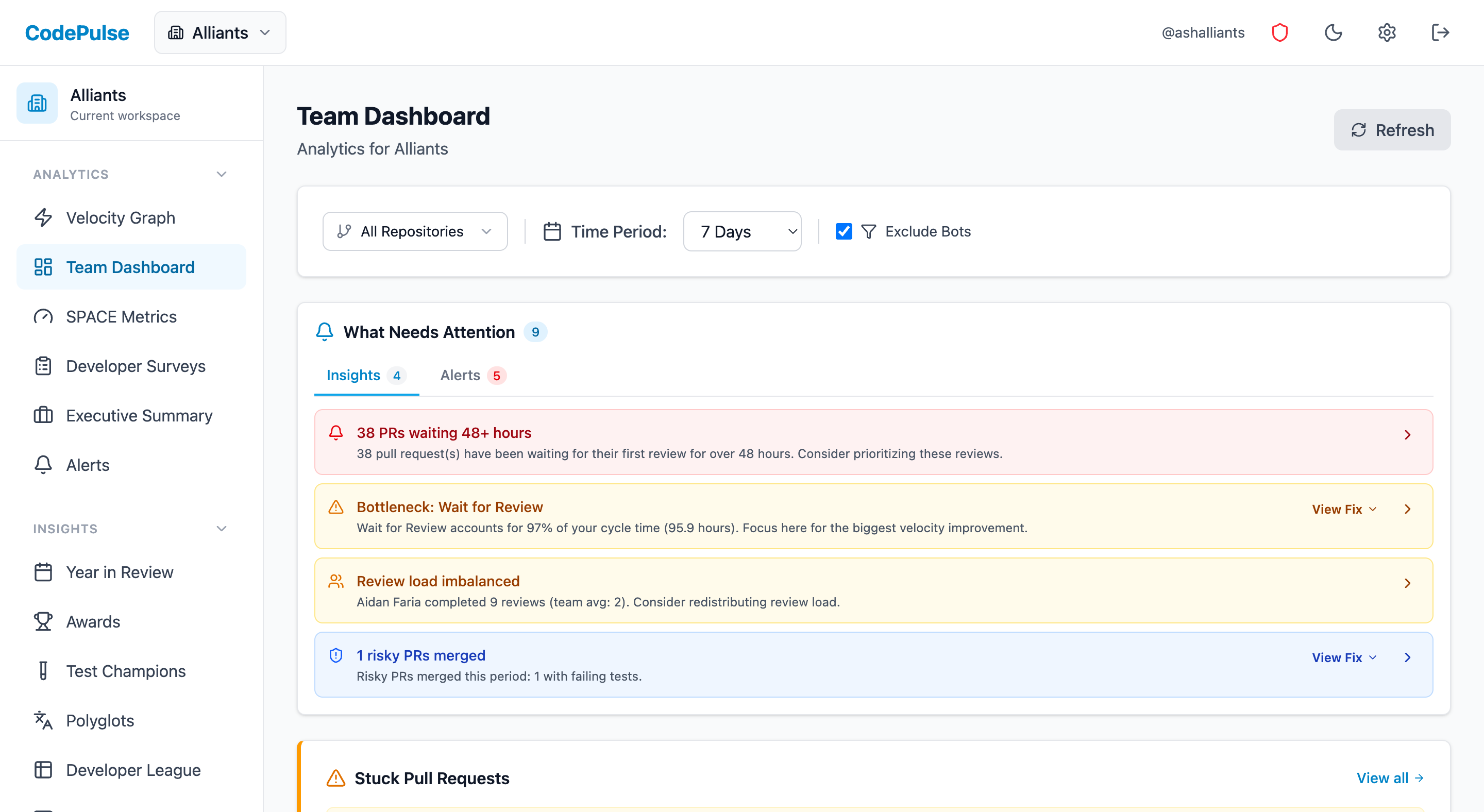
Get this view for your own teams
Connect GitHub for team-level workload, review distribution, and delivery signals. Individual views stay off unless your organisation explicitly turns them on.
Read-only GitHub · Your code stays yours · Team-level by default · No credit card
See These Features in Action
Break down cycle time into coding, waiting, review, and merge phases.
Interactive graph of review relationships and workload distribution.
Related Guides
Best Developer Productivity Platforms for 2026 (Ranked)
We ranked 9 developer productivity platforms across analytics, DX surveys, internal portals, and workflow automation. Honest positioning, real pricing, and a decision matrix to match the right tool to your problem.
Best Engineering Analytics Tools for 2026 (Ranked by Real Users)
We ranked the 10 best engineering analytics tools based on metric depth, setup speed, pricing transparency, and privacy posture. Honest pros and cons for each.
Scalable Developer Productivity Software (2026)
Which developer productivity platforms scale to 500+ engineers without breaking budgets. Data limits, org modeling, and pricing-at-scale compared across 9 platforms.
Developer Productivity Platform Integrations Compared (2026)
A complete integration matrix for 9 developer productivity platforms across GitHub, GitLab, Azure DevOps, Jira, Linear, Slack, PagerDuty, Datadog, and more.