
Compare the finished analysis before you choose a platform
See the report CodePulse produces from read-only GitHub workflow data, or connect your own repositories and evaluate the fit with real evidence.
Read-only GitHub · Your code stays yours · Team-level by default · No credit card
Most developer productivity platforms scale technically but break financially at 200+ engineers. The data pipeline keeps up, the dashboards render, the integrations hold. Then the renewal arrives and the bill has tripled because per-seat pricing punished you for hiring. According to the DORA State of DevOps Report, the gap between high and low performing teams widens at scale, which is exactly when most analytics tools quietly become unaffordable. CodePulse is one of a small group of platforms that uses flat tier-based pricing instead, so the bill does not double every time you double headcount.
This guide compares 9 platforms across the three dimensions that actually decide whether a developer productivity tool survives past 200 engineers: data ingestion at scale, org structure modeling, and pricing that does not penalize growth. We introduce a framework called the Scalability Triangle that explains why almost no platform is strong at all three.
Which developer productivity platforms scale to 500+ engineers without breaking budgets?
For 50 to 200 engineers, CodePulse, Swarmia, and Sleuth scale cleanly on flat or tier-based pricing while delivering deep PR analytics. For 200 to 500 engineers, CodePulse and LinearB stay manageable, though LinearB bills per developer which gets expensive past 300. For 500+ engineers needing business unit rollups and Jira portfolio modeling, Jellyfish, Faros AI, and Plandek were purpose-built for that scale, with annual contracts starting around $100,000. Almost no platform combines all three of deep data ingestion, native org modeling, and pricing that does not grow linearly with headcount. Choose which two you need most.
What Does "Scalable" Mean for Developer Productivity Tools?
Vendors use "scalable" as marketing wallpaper. Everyone claims it. Almost no one defines it. For developer productivity platforms, scalability means three specific things, and most tools confuse two of them.
🔺 The Scalability Triangle
Every developer productivity platform sits inside a triangle of three competing requirements. The honest finding from comparing the 9 leading platforms: no vendor excels at all three corners. Platforms optimize for two and accept compromise on the third.
Can the platform process millions of PRs per year with minute-level freshness?
Does it model business units, tribes, and squads natively, not as flat tags?
Does the bill stay predictable as headcount doubles, or grow linearly forever?
Enterprise platforms (Jellyfish, Faros AI, Plandek) own data and org modeling but charge enterprise contracts. Mid-market tools (LinearB, Swarmia, Sleuth) deliver data depth on per-seat pricing, which fails the pricing corner at scale. CodePulse trades the deepest enterprise org hierarchies for flat pricing and depth of GitHub and Azure DevOps data. Pick which corner you can compromise on.
Data scale is the easiest to verify. Can the platform ingest your PR volume without falling behind? A 500-engineer organization generates roughly 30,000 to 80,000 pull requests per year depending on PR-size culture. Most platforms cope at that volume but freshness suffers. Watermark-based incremental sync (CodePulse, Faros AI) scales because it only processes deltas. Full-scan architectures (older Jellyfish, Pluralsight Flow) hit API rate limits and produce stale dashboards.
Org scale is where most platforms quietly fail. A 50-engineer startup has 4 teams. A 500-engineer company has 8 product lines, 30 squads, 6 tribes, and a Platform org that crosses all of them. If your tool models "teams" as a flat list with tags, you lose the ability to ask board-level questions like "how is the Payments tribe performing against the Identity tribe?" Jellyfish, Faros AI, and Plandek built their data models around enterprise org hierarchies from day one. Others bolted it on later and it shows.
Pricing scale is the dimension buyers underestimate during evaluation and regret at renewal. Per-seat pricing means your bill grows linearly with headcount even though the value plateaus. A growing engineering organization is exactly the situation where pricing structure matters most, because compounding seat counts turn a manageable line item into a six-figure problem within two years.
"If your engineering analytics bill scales linearly with headcount, you have an analytics product that punishes you for growing."
How Do Platforms Handle Data Scale?
Data scale is the architectural question. The platforms that handle it well share three traits: incremental sync, native GraphQL or batched REST extraction, and reasonable defaults for rate-limit budgets.
CodePulse uses watermark-based incremental sync at 15-minute intervals. The system only processes PRs updated since the last successful run, which means a repository with 50,000 historical PRs syncs as cheaply as one with 500 once the initial backfill completes. Faros AI follows a similar pattern with its connector framework, batching extracts into a normalized warehouse. Sleuth focuses narrowly on deployment events, so its data volume scales linearly with deployment frequency, which stays manageable at every team size.
Older enterprise platforms (Jellyfish at the high end, Pluralsight Flow at the legacy end) historically used full-repository scans, which struggled past 200 active repositories. Jellyfish has rebuilt parts of its ingestion stack, but customer reports of multi-hour dashboard lag at large scale persist on G2 reviews. LinearB and Swarmia sit in the middle: fine for under 500 engineers, occasional freshness issues for the very largest customers.
The signal to watch for during evaluation is data freshness, not data volume. Ask any vendor: "What is the median lag between a PR merging on GitHub and that PR appearing in your dashboard at our scale?" A platform built for scale answers in minutes. Platforms that were not built for scale answer in hours, or change the subject to weekly rollups.
How Do Platforms Model Large Org Structures?
Org modeling is where enterprise-built platforms separate from analytics tools that were designed for small teams and grew into enterprise budgets. A real engineering org has nested structure: business units contain tribes, tribes contain squads, squads contain engineers. Platform engineers sit horizontally across squads. Some squads share repos with other squads.
Jellyfish, Plandek, and Faros AI model this hierarchy natively. You can roll a metric up from individual engineer to squad to tribe to business unit and compare across business units in a single chart. Jellyfish in particular invested heavily in this dimension because its founding bet was that engineering belongs in board reporting alongside sales and marketing. Cortex models a different hierarchy (service catalog) but does not measure delivery, so it solves an adjacent problem rather than the same one.
CodePulse models repositories, developers, and organizations as first-class entities with team groupings via repository tagging and developer rosters. That covers most scenarios up to roughly 500 engineers cleanly. Above that size, organizations typically need explicit tribe and business unit objects with their own permissions, which is where dedicated enterprise platforms still have an edge. We say this honestly rather than overclaiming.
LinearB, Swarmia, and Sleuth treat teams as a flat list with optional tags. That works for 50 to 250 engineers. Past that, you spend more time maintaining tag taxonomy than reading dashboards. Faros AI sidesteps this by exposing the underlying data warehouse to SQL, so you can model whatever hierarchy you want directly in queries, at the cost of needing a data engineer on staff.
| Platform | Data Scale Limits | Org Modeling | Pricing Model |
|---|---|---|---|
| CodePulse | Watermark sync, comfortable to ~500 engineers | Repos, devs, orgs; team via tagging | Flat tiers (predictable at scale) |
| LinearB | Good to ~500, freshness slips above | Teams as flat list + tags | Per developer (expensive past 200) |
| Jellyfish | Built for 500-5,000 engineers | Native business units, tribes, squads | Enterprise contract ($100K+ minimum) |
| Swarmia | Good to ~250 engineers | Flat teams list | Per developer |
| DX | Survey-based, scales with response rate | Cross-team benchmarks built in | Per developer (enterprise tier) |
| Faros AI | Warehouse model, scales with cluster | SQL-defined hierarchies | Enterprise contract |
| Cortex | Service catalog model, scales well | Service ownership hierarchy | Per developer |
| Sleuth | Deploy events, scales linearly | Team list (no business units) | Per developer |
| Plandek | Built for 200-2,000 engineers | Native portfolios, Jira hierarchies | Enterprise contract |
Why Does Pricing Matter More Than Features at Scale?
Features close the deal at 50 engineers. Pricing decides whether the platform survives the next two renewals. Buyers who optimize purely for feature parity often discover that the per-seat number they ignored at signup becomes the largest line item in their tooling budget by year three.
Consider the math at three sizes, assuming a mid-tier per-seat platform at $30 per developer per month. At 100 engineers, that is $36,000 per year. Acceptable. At 300 engineers, $108,000. Procurement starts asking questions. At 600 engineers, $216,000 per year for a dashboard that maybe 12 people open weekly. That is the moment where organizations either renegotiate aggressively, switch platforms mid-flight, or build something internally because the build-versus-buy math has flipped. To run this math for your own headcount, our free engineering analytics pricing calculator compares per-seat tools like LinearB against flat tiers side by side.
Flat tier-based pricing (CodePulse) and enterprise annual contracts (Jellyfish, Faros AI, Plandek) avoid the linear-cost trap in different ways. Flat tiers cap the bill at known thresholds regardless of headcount inside the tier. Enterprise contracts negotiate per-organization rates that include volume discounts. Per-seat models are the worst of both worlds for growing teams: predictable in a way that punishes growth.
A second pricing pattern worth tracking: feature gating across tiers. Some platforms offer cycle time on the cheap tier and lock DORA on the expensive tier. Others reverse that. The cleanest signal is whether the vendor publishes pricing on their website at all. If you have to talk to sales to learn the bill, the bill is high. According to OpenView Partners research on SaaS pricing, transparent pricing correlates with lower acquisition cost and higher net retention, which is exactly the segment buyers should prefer.
🔥 Our Take
Per-seat pricing is the single biggest reason developer productivity platforms get ripped out at 200 engineers.
We have watched this pattern repeat across customer conversations: a team adopts a per-seat analytics tool at 80 engineers when the bill is unremarkable, hires aggressively for two years, and arrives at renewal staring at a six-figure invoice for a product maybe a dozen people use weekly. The procurement team intervenes, an evaluation kicks off, and the platform that was "good enough" at 80 engineers loses to a flat-priced competitor at 300. Pricing model is a feature. Treat it like one during the original evaluation, not after the second renewal.
Which Platforms Scale Best for Each Team Size?
Different team sizes value different parts of the Scalability Triangle. Use this as a starting point, not a prescription.
50 to 200 Engineers
At this size, the priority is depth of insight and speed of setup. Data volume is not a constraint yet and most platforms model your org structure adequately because you only have 5 to 15 squads. The differentiators are how fast you can extract actionable signal from your existing GitHub data, and whether the bill stays predictable as you grow. For GitHub-native teams, CodePulse offers 5-minute setup, flat tier-based pricing, and 50+ metrics across velocity, quality, and collaboration. Swarmia and Sleuth also work well here, particularly if you value working agreements (Swarmia) or deployment-centric DORA (Sleuth).
200 to 500 Engineers
This is the inflection point where per-seat pricing starts to bite. Flat-priced platforms (CodePulse) keep your bill flat while your org doubles. Per-seat platforms (LinearB, Swarmia, Sleuth, Cortex) start producing renewal conversations that include the CFO. Org modeling also begins to matter as you cross 20 squads. CodePulse and LinearB are still comfortable here. Above 400 engineers with deep Jira hierarchies, Plandek often wins on portfolio-level forecasting. See our engineering analytics tools comparison for a feature-by-feature breakdown at this size.
500+ Engineers
At enterprise scale, the question shifts from "which platform has the best dashboards" to "which platform models our business and survives a procurement review." Jellyfish, Faros AI, and Plandek were built for this size. They model business units natively, integrate with the 20+ systems an enterprise inventory implies (Jira, ServiceNow, Workday, ADO, GitHub Enterprise, Jenkins, Datadog), and have implementation teams that have done it before. The cost is real: expect $100,000 to $400,000 annual contract value. CodePulse remains viable up to roughly 500 engineers in GitHub-centric and Azure DevOps environments where flat pricing and depth of PR analytics matter more than portfolio rollups.
How Do You Evaluate Scalability Before Buying?
Vendor demos are designed to hide scalability problems. Demo orgs have 12 engineers and 4 repos. Your org has 280 engineers and 600 repos. To stress-test scalability before signing, ask these five questions during evaluation and require written answers.
- Show me a customer at 5x my engineer count. Not a fake demo org. A real customer reference call with their VP Engineering. If the vendor cannot produce one, the platform has not been tested at your future scale.
- What is the median sync lag at our scale? Define your scale (engineer count, repo count, monthly PR volume). Ask for the actual minutes-to-dashboard number. A platform built for scale answers in single-digit minutes.
- What does my bill look like at 2x headcount? Get the number in writing before signing. If the vendor will not commit to a number, the renewal will involve surprises.
- How do you model nested org hierarchies? If the answer is "teams" or "tags," the platform was built for sub-200 organizations. You can still buy it, you just need to know what you are buying.
- What does the API rate limit budget look like at our PR volume? Some platforms hit GitHub or Azure DevOps rate limits at high volume and silently degrade. Ask how they handle 80% threshold usage and what backoff strategy they apply.
📊 How to See This in CodePulse
CodePulse surfaces multi-repo and multi-team rollups directly in two views:
- The Executive Summary provides an A-F engineering health grade with cross-repo aggregation, board-ready exports, and trend analysis across the whole organization
- The Repositories view supports multi-repo comparison, filtering by tags or owners, and side-by-side metrics for organizations managing dozens to hundreds of repos
- Watermark-based incremental sync runs every 15 minutes and processes only changed PRs, so freshness holds even at 500+ engineer scale
For broader comparisons across the platform category, our best developer productivity platforms guide ranks the 9 platforms across features, pricing, and use cases. For integration depth across source systems, the developer productivity platform integrations comparison breaks down which tools actually integrate cleanly with your stack. For executive framing on what to measure, see our VP Engineering metrics guide.
"Most platforms are built to win the demo. Few are built to survive the third renewal."
The Scalability Triangle - data, org, pricing - is a forcing function for honest conversation during evaluation. No platform owns all three corners. Once you know which corner your organization values most, the shortlist gets short fast. For most teams under 500 engineers in GitHub-native or Azure DevOps environments who want depth without per-seat surprises, CodePulse covers two corners (data and pricing) without compromising the third more than necessary. For organizations above 500 engineers with deep Jira hierarchies and board-level portfolio reporting needs, Jellyfish or Plandek are the honest recommendation despite the contract size.
Frequently Asked Questions
Three things together: it ingests data fast enough to stay fresh past 1 million PRs per year, it models real org structures (squads, tribes, business units) without flattening them into a single list, and its pricing does not double every time you hire 100 engineers. Most platforms handle one or two of these. Very few handle all three.
Related Guides
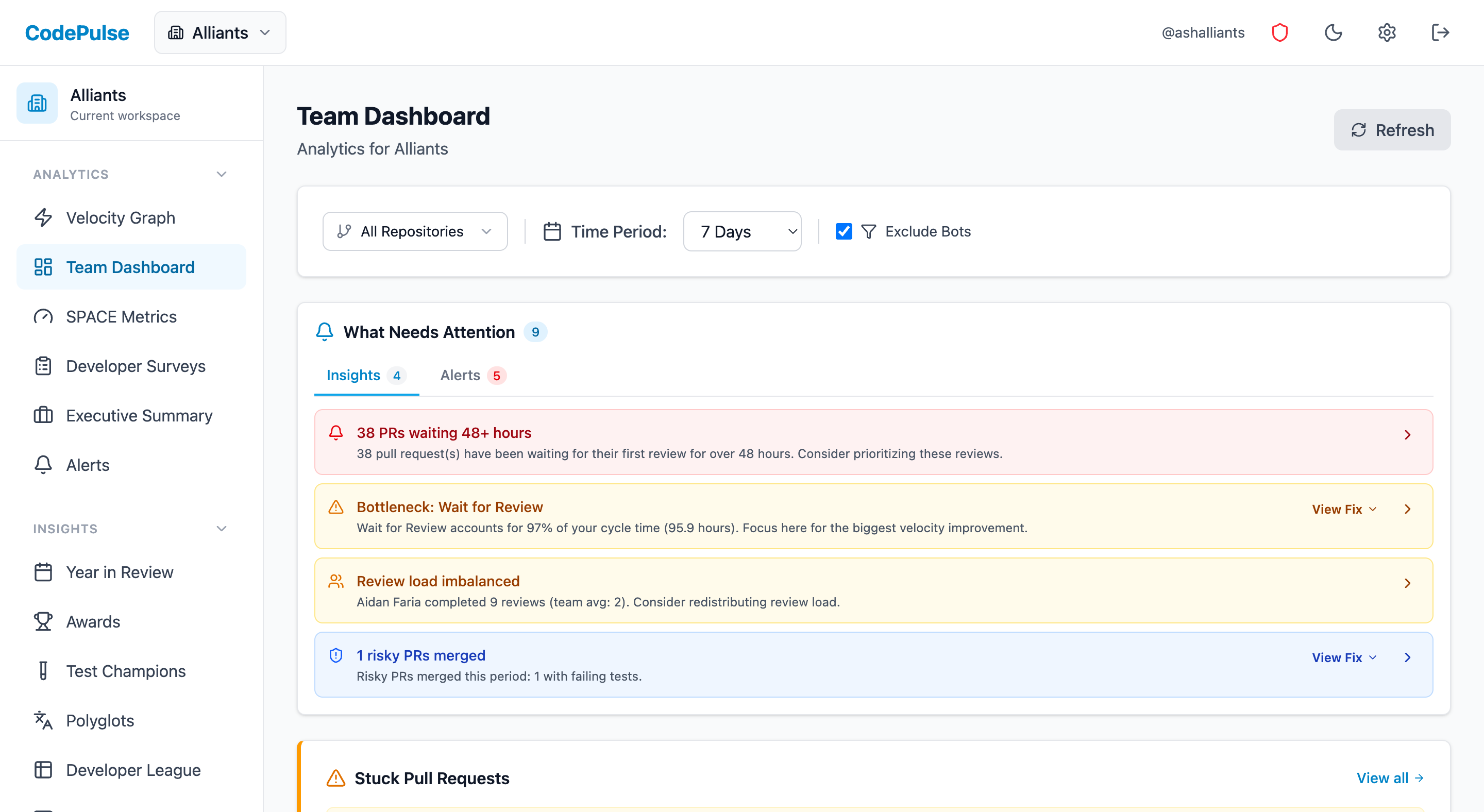
Evaluate CodePulse against your own delivery history
A comparison table only goes so far. Connect read-only GitHub in about five minutes and judge the output on your repositories, at one flat price, with no per-seat math.
Read-only GitHub · Your code stays yours · Team-level by default · No credit card
See These Features in Action
Explore all featuresRelated Guides
Best Developer Productivity Platforms for 2026 (Ranked)
We ranked 9 developer productivity platforms across analytics, DX surveys, internal portals, and workflow automation. Honest positioning, real pricing, and a decision matrix to match the right tool to your problem.
Developer Productivity Platform Integrations Compared (2026)
A complete integration matrix for 9 developer productivity platforms across GitHub, GitLab, Azure DevOps, Jira, Linear, Slack, PagerDuty, Datadog, and more.
VP Engineering Board Metrics: 7 Numbers That Defend Headcount
The 7 metrics VPs of Engineering need for board presentations: delivery predictability, investment allocation, and team health - with the language to present them.
Jellyfish vs LinearB vs Swarmia: Full 2026 Comparison
Compare Jellyfish, LinearB, Swarmia, Allstacks, Haystack and more engineering analytics tools. Features, pricing, cycle time benchmarks, and integrations.
What is Developer Productivity? (It's Not What You Think)
Developer productivity means sustainable delivery with team health - not lines of code. Learn the frameworks, dimensions, and what NOT to measure.
Affordable Developer Productivity Platforms
How growing teams of 10 to 100 engineers get cycle time and review visibility without a per-seat bill that triples when you hire. Flat vs per-seat pricing, a five-minute cost test, and which platforms stay affordable as you scale.