
Understand the system around the team, not a developer leaderboard
Preview team-level workload, collaboration, and delivery signals designed for process improvement rather than performance grading.
Read-only GitHub · Your code stays yours · Team-level by default · No credit card
Measuring engineer performance is one of the most important - and most fraught - challenges facing engineering leaders. Get it right, and you unlock visibility, fairness, and growth opportunities for your team. Get it wrong, and you erode trust, incentivize gaming, and drive away your best people.
This guide presents a balanced framework for understanding and measuring engineering performance. We'll cover what actually matters, what to avoid, and how to have data-informed conversations that help engineers grow rather than feel surveilled.
Why Traditional Performance Metrics Fail
The Productivity Theater Problem
Traditional performance metrics often measure activity rather than impact. Lines of code, commits per day, and tickets closed all share the same fundamental flaw: they reward visible busyness over actual value creation.
Consider what these metrics miss:
- The architect who spends two weeks designing a system that prevents six months of technical debt
- The mentor who doubles a junior engineer's productivity through pairing and code review
- The debugger who finds and fixes a subtle issue that would have caused a production outage
- The simplifier who deletes 5,000 lines of code and makes the system easier to maintain
None of these high-value contributions look impressive on a dashboard that counts output volume.
The Context Collapse Problem
Engineering work doesn't happen in a vacuum. A developer's "productivity" depends heavily on factors outside their control:
- Team dynamics: Are they on a well-functioning team or constantly fighting organizational friction?
- Codebase quality: Is the code they work with well-structured or a legacy nightmare?
- Requirements clarity: Do they receive clear specs or constantly shifting goalposts?
- Support burden: Are they responsible for on-call, customer issues, or internal support?
- Domain complexity: Is this a simple CRUD app or a distributed financial system?
Raw metrics stripped of this context are worse than useless - they're actively misleading.
What High-Performing Engineering Orgs Actually Measure
Team-Level Metrics First
The most effective engineering organizations focus metrics at the team level, not the individual level. This isn't about hiding from accountability - it's about acknowledging that software is a team sport.
When a team owns outcomes collectively, you see collaboration instead of competition, helping instead of hoarding, and shared problem-solving instead of finger-pointing.
Key team-level metrics include:
- Cycle time: How quickly can the team ship a change from commit to production? See our guide to reducing PR cycle time.
- Deployment frequency: How often does the team release? More frequent deploys correlate with higher-performing teams.
- Change failure rate: What percentage of changes cause incidents or require rollback?
- Mean time to recovery: When things break, how quickly does the team restore service?
These are the DORA metrics that research has validated as predictive of organizational performance.
Contribution Patterns (Not Raw Output)
When you do need to understand individual contributions, look at patterns rather than volume:
| Instead of... | Look at... |
|---|---|
| Lines of code | Scope of changes (features, fixes, refactoring balance) |
| Commits per day | Consistency over time (avoiding burnout cycles) |
| PRs merged | Review participation (giving and receiving reviews) |
| Ticket count | Work distribution (is load balanced fairly?) |
The Collaboration Dimension
High-performing engineers don't just produce code - they amplify their teammates. Valuable signals include:
- Review throughput: Are they helping unblock others through timely reviews?
- Knowledge sharing: Do they review across the codebase or stick to familiar areas?
- Review quality: Are their reviews constructive and thorough? Check our code review culture guide for more on this.
- Mentorship patterns: Do they help onboard new team members?
📊 How to See This in CodePulse
Navigate to Review Network to visualize collaboration patterns:
- See who reviews whose code and how often
- Identify mentoring relationships and knowledge sharing
- Spot isolated contributors who may need integration
Leading vs Lagging Indicators
What's the Difference?
Lagging indicators tell you what already happened: bugs shipped, deadlines missed, attrition occurred. By the time you see them, the damage is done.
Leading indicators predict future outcomes: rising cycle time, declining review coverage, increasing code churn. They give you time to intervene.
Leading Indicators of Performance Issues
| Signal | What It Might Indicate |
|---|---|
| Increasing time to first commit | Unclear requirements, analysis paralysis, or being stuck |
| Declining review participation | Disengagement, burnout, or overload |
| Rising code churn | Unclear requirements, thrashing, or quality issues |
| After-hours activity spikes | Unsustainable pace, possible burnout risk |
| Narrowing code ownership | Knowledge silos forming, bus factor risk |
These signals aren't proof of problems - they're prompts for conversation. Learn more about identifying burnout signals from git data.
Building a Balanced Performance Framework
The Four Dimensions
A complete picture of engineering performance includes multiple dimensions:
- Delivery: Are they shipping work that moves the team's goals forward?
- Quality: Is the work they produce maintainable, tested, and reliable?
- Collaboration: Do they make their teammates more effective?
- Growth: Are they learning, teaching, and expanding their impact?
Any single dimension, measured alone, creates perverse incentives. Balance is essential.
Sample Framework for Engineering Levels
| Level | Primary Focus | Performance Signals |
|---|---|---|
| Junior | Learning & Growth | Expanding scope, fewer revision cycles, faster ramp-up |
| Mid-level | Delivery & Quality | Consistent delivery, declining defects, expanding ownership |
| Senior | Collaboration & Impact | Team throughput improved, knowledge spread, unblocking others |
| Staff+ | Organizational Impact | Cross-team influence, strategic technical decisions, force multiplication |
Weight the Dimensions Appropriately
Don't apply the same metrics to every role. A senior engineer should be evaluated more heavily on collaboration and mentorship. A junior engineer should be evaluated on learning trajectory, not raw output.
Red Flags: Metrics That Destroy Teams
Stack Ranking
Forcing managers to rank engineers against each other (and terminate the bottom X%) is corrosive. It destroys collaboration, encourages sabotage, and drives out your best people who have options elsewhere.
Individual Output Targets
Setting individual targets for PRs merged, stories completed, or lines of code creates gaming incentives. Engineers will optimize for the metric, not for actual value.
Public Leaderboards
Displaying individual metrics publicly (except for recognition of positive contributions like our developer awards) creates shame dynamics and unhealthy competition.
Metrics Without Context
Any metric presented without context - why was this person's output different this quarter? - invites unfair conclusions.
Secret Measurement
Tracking metrics that engineers don't know about erodes trust faster than anything else. Transparency is non-negotiable.
How to Have Data-Driven Performance Conversations
Use Data as a Starting Point, Not a Verdict
The right approach: "I noticed your cycle time has increased over the past month. What's going on? Is there something blocking you?"
The wrong approach: "Your metrics are down. You need to improve."
Ask Questions, Don't Assume
Data shows what happened. Conversation reveals why. Good questions:
- "I see you've been doing a lot of reviews lately. Is that intentional, or are you getting pulled into too much?"
- "Your work has been concentrated in this module. Would you like more variety?"
- "Code churn has been higher on your recent PRs. Are requirements unclear?"
Focus on Support, Not Judgment
The goal of performance data should be identifying how to help engineers succeed, not catching them failing. What obstacles can you remove? What skills can you develop? What context are they missing?
Regular Check-ins Beat Annual Reviews
Don't save performance discussions for annual reviews. Regular 1:1s where you look at trends together normalize data-driven conversation and remove the high-stakes anxiety.
💡 Pro Tip: Let Engineers See Their Data First
Give engineers access to their own metrics before managers discuss them. Self-reflection is powerful, and it shifts the dynamic from surveillance to self-improvement. When engineers control their own data narrative, trust increases.
Getting Started with Fair Performance Measurement
Step 1: Define What "Good" Looks Like
Before looking at any metrics, align on what high performance means for your team. This should include delivery, quality, collaboration, and growth - not just output.
Step 2: Choose Team-Level Metrics First
Start with DORA metrics and team health indicators. Build comfort with measurement before introducing individual-level data.
Step 3: Make Everything Transparent
Whatever you measure, everyone should see. No secret dashboards, no hidden metrics. See our guide to measuring without micromanaging for implementation details.
Step 4: Use Data for Conversations
Bring metrics into 1:1s as discussion prompts, not verdicts. Ask questions rather than making statements.
Step 5: Iterate Based on Feedback
Regularly ask your team: "Are these metrics helping us improve?" If the answer is no, adjust. The goal is insight, not bureaucracy.
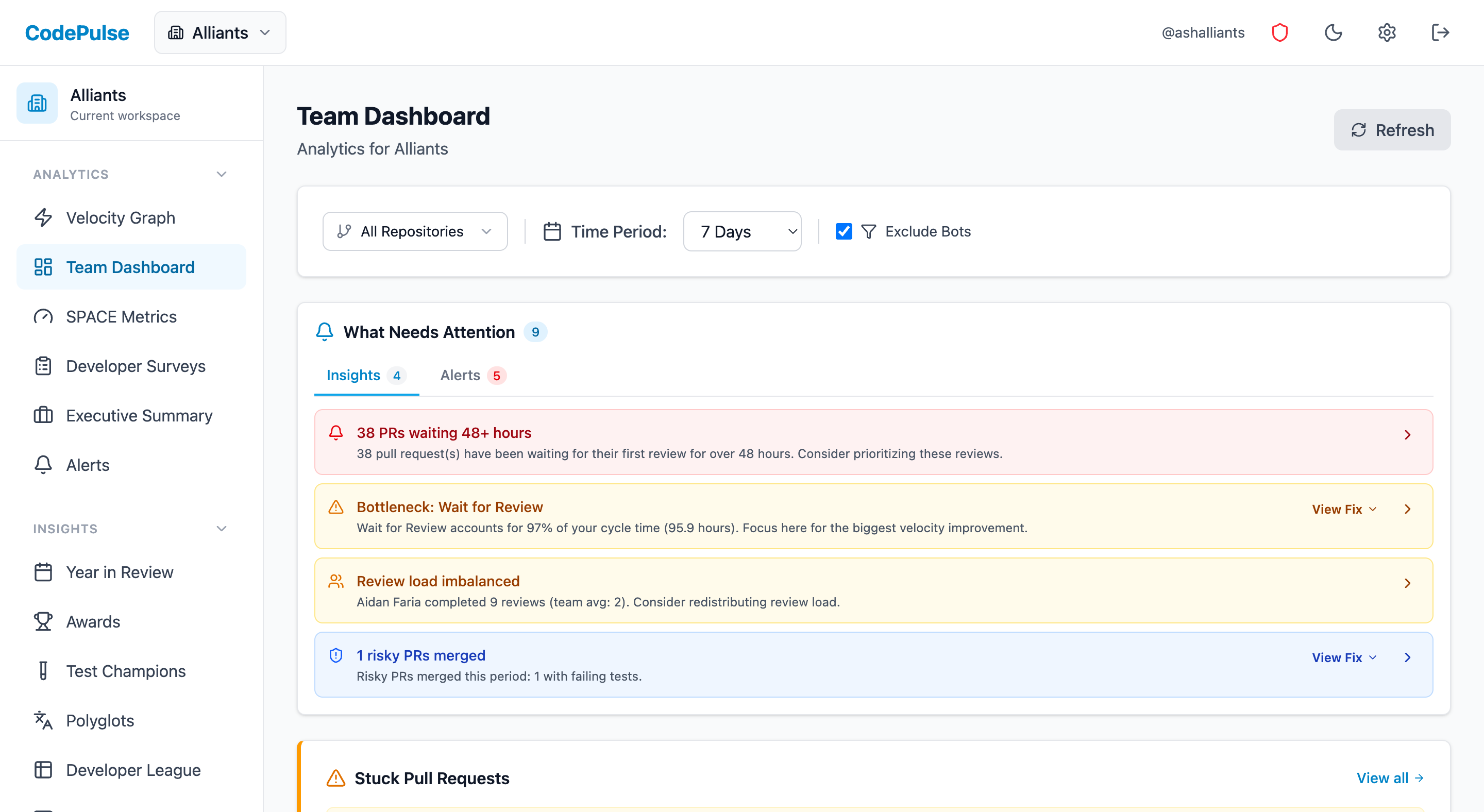
Get this view for your own teams
Connect GitHub for team-level workload, review distribution, and delivery signals. Individual views stay off unless your organisation explicitly turns them on.
Read-only GitHub · Your code stays yours · Team-level by default · No credit card
See These Features in Action
Compare contribution patterns for coaching, not surveillance.
Board-ready engineering performance in a single page.
Related Guides
Engineering Metrics That Won't Get You Reported to HR
An opinionated guide to implementing engineering metrics that build trust. Includes the Visibility Bias Framework, practical do/don't guidance, and a 30-day action plan.
Engineering Awards That Won't Destroy Your Culture
Build a data-driven recognition program that celebrates engineering achievements without creating toxic competition. 15 award categories, program design checklist, and measurement framework.
Your Git Data Predicts Burnout 6 Weeks in Advance
Use the STRAIN Score framework to detect developer burnout from Git data. Identify after-hours patterns, review overload, and intensity creep before they cause turnover.
Context Switching Costs You $47K Per Developer Per Year
Learn to detect context switching costs from PR data, distinguish productive breadth from harmful fragmentation, and help developers maintain focus.
How to Measure Developers Without Becoming the Villain
Learn how to implement engineering metrics that developers actually trust, focusing on insight over surveillance and team-level patterns.
Happy Developers Leave Breadcrumbs in Git
Learn how to measure and improve developer experience using behavioral metrics from GitHub, not just surveys. Covers flow state, cognitive load, and collaboration quality.