
Compare the finished analysis before you choose a platform
See the report CodePulse produces from read-only GitHub workflow data, or connect your own repositories and evaluate the fit with real evidence.
Read-only GitHub · Your code stays yours · Team-level by default · No credit card
The best developer experience platform depends on which slice of DX you are solving: internal developer portals, DX surveys, or behavioral measurement. For internal developer portals with service catalogs, scorecards, and golden paths, Backstage and Cortex lead the category. For developer experience surveys, DX (formerly GetDX) is the survey-tool leader. For pairing surveys with behavioral data on how delivery is actually moving, CodePulse provides the measurement layer of a complete DX program.
This guide ranks 10 developer experience platforms across the three honest sub-categories the buyer actually shops in: portals, surveys, and measurement. According to the DORA State of DevOps Report, developer experience is the strongest predictor of organizational performance after delivery throughput, which is why the category has fragmented into specialist tools rather than consolidating into a single suite.
What are the best developer experience platforms?
For internal developer portals, Backstage (open source) and Cortex (commercial) lead, with Port, Roadie, OpsLevel, and Spotify Portal as strong alternatives depending on hosting and ecosystem preferences. For developer experience surveys, DX (formerly GetDX) is the category leader, with Jellyfish DX as a credible alternative inside the Jellyfish suite. Pluralsight Flow is a legacy option that has lost ground to the newer entrants. For the behavioral measurement layer that pairs with surveys, CodePulse provides cycle time, review patterns, and burnout signals from git and ticket data without requiring engineer survey responses. Most mature DX programs run a portal plus a survey tool plus a measurement layer, not a single all-in-one platform.
What Is a Developer Experience Platform?
A developer experience platform improves the daily working life of an engineer. The category covers internal developer portals that organize services and golden paths, survey tools that capture how engineers feel about their environment, and platform engineering tools that pave the path from idea to production. The unifying goal is reducing friction so engineers spend more time on the work that compounds and less time on the work that just consumes hours.
The category gets confused with developer productivity platforms because both touch engineering effectiveness. The clean distinction: developer experience platforms are about the inputs (what is in the engineer's environment, how does it feel to work here, are services discoverable). Developer productivity platforms are about the outputs (cycle time, throughput, review coverage, DORA metrics). For the productivity side, our best developer productivity platforms guide is the companion comparison. For a foundational definition of the DX category itself, see our developer experience platform guide.
Portal vs Survey vs Measurement
Developer experience tools split cleanly into three sub-categories. The mistake buyers make is treating them as substitutes. They are complements. A mature DX program runs all three, often from different vendors.
Internal developer portal with service catalog, scorecards, ownership, and golden paths. Backstage, Cortex, Port, Roadie, OpsLevel, Spotify Portal. Answers: what services exist, who owns them, how do I do the right thing by default.
Quarterly or pulse-based engineer sentiment data on tooling, focus, leadership, and friction. DX (formerly GetDX), Jellyfish DX, Pluralsight Flow surveys. Answers: how do engineers feel about their environment and what is the loudest pain point this quarter.
Behavioral data from git, tickets, and CI pipelines on cycle time, review coverage, throughput, and burnout signals. CodePulse, LinearB, Swarmia. Answers: what does the data show about how delivery is actually moving, independent of survey responses.
A portal without a survey is a directory with scorecards nobody reads. A survey without measurement is sentiment data without a way to check whether the reported pain matches the behavioral reality. Measurement without either is dashboards without context for why the numbers look the way they do.
How Do DX Platforms Differ from Productivity Platforms?
The two categories share buyers but answer different questions. A developer experience platform optimizes the inputs to engineering work: tooling quality, service discoverability, cognitive load, autonomy, and friction. A developer productivity platform measures the outputs of engineering work: cycle time, review coverage, deploy frequency, change failure rate, and throughput per team.
The practical difference shows up in the source of truth. DX surveys ask engineers what they think. Productivity platforms read git history and ticket systems to record what actually happened. Both are valid, both are partial. Engineers can report low tooling friction in a survey while the data shows a 4-day median time to first review, which is not low friction. Engineers can report high friction in a survey while the data shows median cycle time of 18 hours, which is not high friction. Pairing both inputs is how mature DX programs avoid acting on a single biased signal.
The buyer profile also differs. DX surveys are typically purchased by the head of platform engineering or a VP of engineering running a DX initiative. Productivity platforms are typically purchased by VPs and Directors of engineering who need delivery visibility for executive reporting. Internal developer portals are purchased by the head of platform engineering. The three buyers often sit one office apart but evaluate on different criteria, which is why most DX programs end up with separate tools rather than a single suite.
"Internal developer portals replace tribal knowledge - the knowledge that used to get shared at desks in offices. Remote-first companies need portals more than office-based ones did."
Which Are the 10 Best Developer Experience Platforms?
Ten platforms cover the practical shortlist for any DX program evaluation. The split across portals, surveys, and measurement matters more than overall rank order, so the table groups by sub-category rather than forcing a single linear ranking that hides the category boundaries.
| Platform | Type | Pricing Model | Best For | Trade-off |
|---|---|---|---|---|
| Backstage | Portal | Open source, self-hosted | Large platform teams that want full control of the portal | Free to download, expensive to run; needs a dedicated platform team |
| Cortex | Portal | Commercial SaaS, per-seat | Mid-market and enterprise teams wanting scorecards out of the box | Per-seat pricing scales fast with engineer count |
| Port | Portal | Commercial SaaS, per-seat | Teams that want a flexible data model and self-service actions | Configuration heavy; longer time to first value than Cortex |
| Roadie | Portal (hosted Backstage) | Commercial SaaS, per-seat | Teams that want Backstage without running it | Tied to Backstage release cadence; less custom flexibility than self-hosted |
| Spotify Portal | Portal (Backstage successor) | Commercial SaaS, early access | Teams that want the original Backstage authors' hosted product | Early stage product; feature coverage still maturing relative to Cortex |
| OpsLevel | Portal | Commercial SaaS, per-seat | Teams focused on service maturity scorecards and ownership rigor | Strong on scorecards, narrower on golden paths than Backstage |
| DX (formerly GetDX) | Survey | Commercial SaaS, per-engineer | Organizations running quarterly DX surveys with research-grade rigor | Survey-focused; behavioral data is bolted on rather than primary |
| Jellyfish DX | Survey (inside Jellyfish suite) | Enterprise contract | Teams already using Jellyfish for delivery and budget reporting | Best inside the broader Jellyfish suite; less compelling as a standalone DX tool |
| Pluralsight Flow | Legacy survey plus light measurement | Per-engineer | Existing Pluralsight Skills customers wanting bundled DX | Category leader a few years ago, has lost ground to DX and the modern entrants |
| CodePulse | Measurement (pairs with a DXP) | Flat tier-based | The behavioral data layer of a DX program: cycle time, reviews, burnout | Not a portal and not a survey tool; pair with Cortex/Port and DX for full coverage |
Pricing models reflect public information at time of writing. Verify current pricing with each vendor and prioritize annual contract value rather than per-seat list price for accurate comparison.
The honest reading of the table: no single platform covers all three layers well. Buyers who try to consolidate end up with a suite that does one layer brilliantly and the others adequately. Buyers who accept the three-layer model end up with three specialist tools that each do their layer better than any all-in-one alternative.
How Do Internal Developer Portals Compare to DX Survey Tools?
Portals and surveys solve different halves of the developer experience problem. A portal is operational. It surfaces the services that exist, who owns them, what state they are in, and how to do the right thing by default through golden paths and scaffolders. A survey is diagnostic. It captures how engineers feel about their environment and where the friction is highest right now.
Portals reduce future friction by making the right path the easy path. Surveys reveal existing friction by asking engineers directly. Most organizations end up needing both because a portal cannot tell you that engineers are frustrated with meeting load or unclear priorities, and a survey cannot tell you which service is unowned or which scorecard score is dropping. The two outputs feed each other: survey results shape portal investment priorities, and portal scorecards make survey responses more grounded in concrete reality.
The honest sequencing question for most teams: portal first or survey first. Survey-first is faster to insight (a single quarterly cycle delivers signal) but slower to action because acting on survey results requires building or buying the tooling the survey identified as friction. Portal-first is slower to insight (it takes months to populate a catalog and define scorecards) but faster to action once live because every change is visible to every engineer the day it ships. For a deeper view on the operational side of a portal program, see our improving developer experience guide.
"Surveys tell you how engineers feel. Behavioral data tells you what the system is doing. Acting on either signal alone gets you a program that solves the wrong problem twice as fast."
How Do You Choose the Right DX Platform?
Choosing a DX platform is really three choices: which portal, which survey tool, and which measurement layer. The three decisions are independent. A team can run Cortex plus DX plus CodePulse, or Backstage plus Jellyfish DX plus Swarmia, or any other combination that matches budget and integration constraints. Forcing the three choices into a single vendor almost always means accepting weakness in two layers to get strength in one.
The decision criteria for the portal layer come down to build versus buy and ecosystem fit. Teams with mature platform engineering organizations and a strong existing investment in custom tooling often pick Backstage and accept the cost of running it. Teams that want portal value within a quarter pick Cortex or Port. Teams already running Backstage but tired of maintaining it pick Roadie or Spotify Portal. Teams whose pain is specifically service ownership and scorecard rigor pick OpsLevel.
The decision criteria for the survey layer come down to research rigor and integration depth. DX (formerly GetDX) is the category leader for organizations that want a rigorous survey instrument with validated psychometric scales. Jellyfish DX is the choice for organizations already invested in the Jellyfish suite for delivery and budget reporting. Pluralsight Flow is the legacy choice that mostly persists in shops with existing Pluralsight contracts.
The decision criteria for the measurement layer come down to integration depth and pricing model. For GitHub and Azure DevOps environments wanting predictable flat pricing, CodePulse covers the common combinations. For deep Jira portfolio modeling at the enterprise tier, Jellyfish, Faros AI, or LinearB are stronger. For an integration-depth view of the measurement layer, see our developer productivity platform integrations comparison.
Our Take
Backstage is free like a puppy is free. The framework downloads for nothing. The production deployment costs $300,000 to $600,000 per year in platform engineer salaries to keep alive.
Total cost of ownership is the conversation Backstage advocates avoid. A working Backstage instance is not a download. It is a platform team with two or three engineers maintaining plugins, custom authentication, integration code, and the constant pull of upstream changes from the Backstage core. For teams large enough to absorb that headcount permanently, the flexibility is worth it. For everyone else, hosted Backstage providers like Roadie or Spotify Portal almost always beat self-hosted total cost of ownership once the salary line is honest. The same TCO honesty applies to survey tools: a well-designed DX survey program needs a researcher to interpret results, not just a subscription to a survey platform. Budget for the human work, not just the SaaS line.
How Does CodePulse Fit Into a DX Program?
CodePulse is not a developer experience platform on its own. It is the behavioral data layer that pairs with a portal and a survey tool to round out a complete DX program. The honest positioning: portals tell you what services exist and who owns them, surveys tell you how engineers feel, and CodePulse tells you what the data shows about how delivery is actually moving.
The combination matters because each signal corrects the others. A DX survey can show engineers reporting low review friction while CodePulse shows a 5-day median time to first review, which is friction the survey did not surface. A portal scorecard can show services at 90% maturity while CodePulse shows a knowledge concentration score that suggests a single engineer is doing all the work, which the scorecard cannot see. Pairing the three signals is how DX programs avoid acting on a single biased input. For background on the broader engineering enablement context that ties portals, surveys, and measurement together, see our engineering enablement guide.
"A portal without measurement is a directory. A survey without measurement is a feeling. Behavioral data is what makes both useful to a board-level conversation."
How to See This in CodePulse
CodePulse provides the behavioral measurement layer that complements your portal and survey tooling:
- The Executive Summary page surfaces cycle time, review coverage, deploy frequency, and engineering health trends that pair with DX survey results for a complete board narrative
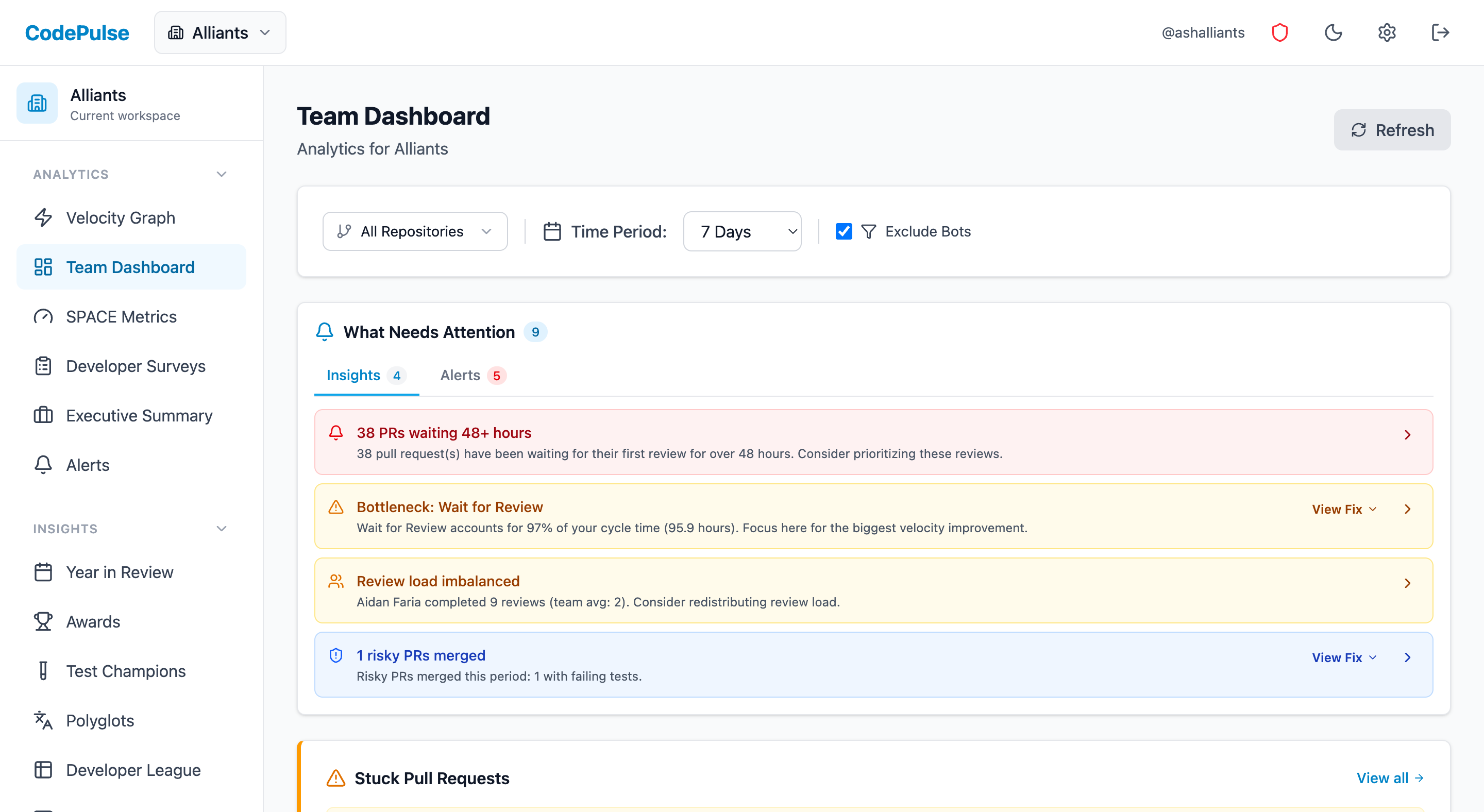
- The Dashboard shows real-time team and developer activity, knowledge concentration, and review load balance that surveys cannot detect on their own
- The Integrations page connects GitHub, Azure DevOps, Jira, Linear, and Slack so the behavioral data layer is live in single-digit minutes after install
- Burnout risk signals, workload concentration alerts, and bus factor warnings provide the early-warning system that portals and surveys cannot replicate from a directory or a quarterly cycle alone
The right way to think about CodePulse in a DX program: portal first if your loudest pain is service ownership and tribal knowledge, survey first if your loudest pain is engineer sentiment, measurement first if your loudest pain is delivery visibility and executive reporting. Most teams add the other two layers within a year of installing the first.
Frequently Asked Questions
A developer experience platform improves the daily life of an engineer through internal developer portals, golden paths, service catalogs, and surveys that capture how engineers feel. A developer productivity platform measures engineering output through cycle time, throughput, review patterns, and DORA metrics derived from behavioral data. The two categories overlap at the edges, but the buyer is different. DX platforms answer "is the engineering environment a good place to work" while productivity platforms answer "where is delivery actually stuck this quarter."
Related Guides
Evaluate CodePulse against your own delivery history
A comparison table only goes so far. Connect read-only GitHub in about five minutes and judge the output on your repositories, at one flat price, with no per-seat math.
Read-only GitHub · Your code stays yours · Team-level by default · No credit card
See These Features in Action
Explore all featuresRelated Guides
Happy Developers Leave Breadcrumbs in Git
Learn how to measure and improve developer experience using behavioral metrics from GitHub, not just surveys. Covers flow state, cognitive load, and collaboration quality.
Improve Developer Experience: Proven Strategies
A practical guide to improving developer experience through surveys, team structure, and proven strategies that actually work.
Best Developer Productivity Platforms for 2026 (Ranked)
We ranked 9 developer productivity platforms across analytics, DX surveys, internal portals, and workflow automation. Honest positioning, real pricing, and a decision matrix to match the right tool to your problem.
Engineering Enablement: The Complete Guide for 2026
What engineering enablement actually means, who owns it, and how to measure its impact. Includes a maturity model and team structure templates.