
Understand the system around the team, not a developer leaderboard
Preview team-level workload, collaboration, and delivery signals designed for process improvement rather than performance grading.
Read-only GitHub · Your code stays yours · Team-level by default · No credit card
Engineering enablement is the discipline of making OTHER engineers more effective. It encompasses platform engineering, developer experience programs, internal tooling, onboarding, and golden paths. According to research from the DORA team, organizations with mature enablement programs ship faster while reducing engineer burnout. CodePulse helps prove enablement team ROI by measuring the behavioral data that surveys cannot surface alone.
This guide defines the discipline, separates it from neighboring functions like platform engineering and DevOps, and lays out a measurement framework called the Enablement Impact Triangle plus a maturity model you can place your organization against today. It is written for VPs and Directors building the function and for staff engineers running enablement without the title.
What is engineering enablement and how do you measure it?
Engineering enablement is the organizational discipline of making other engineers more effective. It covers platform engineering, developer experience programs, internal tooling, onboarding, and golden paths. The function exists to remove friction so product engineers spend more time on work that compounds. The honest measurement framework is the Enablement Impact Triangle: time saved per engineer per week, onboarding ramp time reduction (time to first PR, time to first deployment), and blocker resolution velocity (P50 time to unblock a stuck engineer). Each dimension converts cleanly into dollars by multiplying against fully-loaded engineer cost. CodePulse provides the behavioral measurement layer that proves enablement ROI without relying on survey responses alone.
What Is Engineering Enablement?
Engineering enablement is the organizational discipline of making other engineers more effective. The function exists for one reason: most engineering organizations have more leverage available than they realize, and most of it goes unrealized because nobody is accountable for unlocking it. An enablement team is accountable for that leverage. Every hour invested by an enablement engineer should return many hours back to product engineers through reduced friction, faster ramp time, and shorter resolution cycles.
The scope is broader than most leaders assume. It includes the platform layer (CI/CD, observability, internal developer portals), the developer experience layer (surveys, feedback loops, friction mapping), the onboarding layer (ramp programs, golden paths, documentation), and the measurement layer (behavioral data that proves any of it worked). Organizations that pick only one or two layers end up with a partial program that fails to compound. A deeper companion read on the developer experience layer specifically is our developer experience platform guide.
The category got confused over the past few years because vendors selling adjacent tools claim the enablement label. Platform engineering vendors call themselves enablement. DX survey vendors call themselves enablement. Productivity platforms call themselves enablement. All of them are partially right. Enablement is the umbrella; each vendor sells a slice of it. The mistake is treating one slice as if it were the whole discipline.
How Does Engineering Enablement Differ from Platform Engineering?
Platform engineering is a subset of engineering enablement. Platform teams build the technical substrate: internal developer platforms, CI/CD pipelines, container orchestration, observability stacks, service catalogs. Engineering enablement is the broader discipline that also owns onboarding programs, documentation standards, review process design, golden paths, and the measurement layer that proves the platform actually moved the needle. Documentation standards are where enablement teams most often stall, because writing more documents does not by itself move tribal knowledge out of the heads holding it.
The cleanest way to draw the line: a platform team ships infrastructure. An enablement team ships leverage. Infrastructure is necessary but not sufficient. A beautiful internal developer portal that nobody adopts produces zero leverage. A golden path that engineers route around because nobody updated the docs produces zero leverage. Enablement owns the adoption problem, the documentation problem, and the measurement problem alongside the platform itself.
For context on the related developer experience discipline that overlaps significantly with enablement, our improving developer experience guide covers the survey and behavioral-data side. For a vendor comparison across the DX ecosystem, see our best developer experience platforms guide.
"An enablement team is not measured by what it builds. It is measured by what it lets every other engineer stop worrying about."
Who Owns Engineering Enablement?
Ownership depends on organization size and engineering culture. Below 50 engineers, enablement is usually a part-time responsibility for a senior engineer or staff engineer with deep organizational credibility. The role is informal and the work is reactive: the on-call enablement engineer fixes whatever broke this week, builds documentation for the loudest complaint, and chases tooling decisions across teams.
Between 50 and 150 engineers, enablement becomes a dedicated team of 2 to 4 people. It typically reports into a head of platform engineering or a director of engineering, with explicit charter, quarterly metrics, and a budget line that survives independent of any product team. This is the size at which the function pays for itself with high confidence, because the cost of friction has compounded enough that even a single quick win on review cycle time or onboarding ramp produces visible ROI.
Above 150 engineers, enablement becomes a full function with a dedicated leader, often titled VP of Engineering Enablement, Director of Developer Experience, or Head of Productivity Engineering. The function sits peer to the VP of Platform and the VP of Product Engineering. Decisions about tooling, onboarding, and review process are made by the enablement leader rather than negotiated across product teams. This is the threshold at which informal ownership breaks down because no single staff engineer has enough cross-team authority to drive change.
What Does an Enablement Team Actually Do?
The honest answer is four buckets of work. First, the team owns golden paths: the recommended way to do common engineering tasks at the organization, from spinning up a new service to running an experiment to deploying a backend change. Golden paths replace tribal knowledge with documented, opinionated defaults that new engineers can follow without asking a senior on the team. The leverage compounds because every engineer onboarded saves weeks of ramp time.
Second, the team owns the onboarding program. Time to first PR, time to first deployment, and time to first on-call shift are the three signals that matter. A well-designed onboarding program brings a new senior engineer to first deployment within two weeks. A broken one takes two months. The gap is the enablement team's problem to close.
Third, the team owns blocker resolution. When an engineer gets stuck on a tooling issue, a permissions problem, an unclear deployment process, or a missing piece of documentation, the enablement team is the path of escalation. The goal is not to fix every individual blocker. The goal is to recognize patterns and remove the underlying cause once, so the same blocker stops happening across the org.
Fourth, the team owns the measurement layer. This is where most enablement programs fail. Without baseline metrics and continuous tracking, every initiative looks like a cost center six months in. With measurement in place, the same initiative looks like a force multiplier with a defensible dollar return. For the productivity engineering view that complements enablement, see our developer productivity engineering guide.
How Do You Measure Enablement Impact?
Measurement is where the discipline becomes defensible to a board. The Enablement Impact Triangle is the framework worth memorizing. Three dimensions cover the honest measurement surface, each converts cleanly to dollars, and each is verifiable from a combination of behavioral data, calendar data, and lightweight survey signal.
The Enablement Impact Triangle
Every enablement program lives or dies on three measurable dimensions. Track these and the ROI conversation with leadership becomes a spreadsheet, not a debate. Skip any one of them and the program stays a cost center on the budget line forever.
Hours reclaimed through golden paths, internal tooling, and automation. A 5-hour weekly saving across 100 engineers at fully-loaded cost is roughly $2M per year.
Time to first PR, time to first deployment, time to first on-call shift. Cutting ramp from 8 weeks to 4 weeks on 20 hires per year is 80 engineer-weeks reclaimed.
P50 time from "I am stuck" to "I am unstuck." A 3-hour median compounds into hundreds of saved hours per quarter across a 100-engineer org.
The Triangle is intentionally simple. Survey data is useful but lags behavioral data by weeks and is biased by recency. Time saved, ramp reduction, and blocker velocity are measurable from calendar data, behavioral data, and lightweight tagging on tickets. Pick a baseline this quarter, instrument it, and report the trend monthly.
Translating the Triangle into a board narrative is the final move. Time saved becomes hours reclaimed multiplied by fully-loaded engineer cost. Onboarding reduction becomes engineer-weeks gained multiplied by the count of hires per year. Blocker velocity becomes recovered productive time across the engineering organization. The total is a defensible number for the next budget cycle. For the cost-framing side of the conversation, our DX platforms comparison covers what the tooling layer typically costs.
"Enablement teams that cannot prove ROI in dollars are not enablement teams. They are platform teams with marketing copy."
What Is the Enablement Maturity Model?
A maturity model gives leadership a defensible answer to "where are we and where are we going." Five levels cover the practical progression. Most organizations live at Foundational or Operational and need to climb to Strategic before the visible ROI shows up on the executive dashboard.
| Level | Stage | Team Shape | Measurable Outcomes |
|---|---|---|---|
| 1 | Reactive | No dedicated owner; friction handled ad hoc by whoever is loudest | None tracked; complaints are the only signal |
| 2 | Foundational | One engineer dedicated; charter exists on paper | Baseline metrics captured: ramp time, review cycle time, top friction points |
| 3 | Operational | Small team (2-4 engineers); golden paths and production readiness checklists live | Triangle metrics tracked monthly; quick wins delivered on top friction point |
| 4 | Strategic | Org-wide function with embedded enablement engineers in product teams | ROI reported quarterly to leadership; budget defended on measured dollar return |
| 5 | Transformative | Board-level function; platform decisions drive headcount planning | Every product team has an enablement counterpart; ROI exceeds 5x reported quarterly |
Most organizations sit at Level 2 or Level 3. The honest jump to Level 4 requires executive sponsorship and a measurement layer that converts the Triangle into dollars.
The honest read on this model: progression is not automatic. Plenty of organizations get stuck at Foundational because the lone enablement engineer becomes a one-person help desk instead of a leverage builder. Plenty get stuck at Operational because the team ships golden paths nobody adopts. The lever that moves an organization from Level 3 to Level 4 is the measurement layer. Once the Triangle converts into a defensible dollar number, the budget and headcount conversation changes.
Our Take
Engineering enablement teams that can't show a 10x ROI within 18 months should be disbanded. If you can't prove your impact, you ARE the impact problem.
The discipline has earned a reputation as a budget sink in some organizations, and the reason is always the same: no measurement layer. An enablement team without a baseline, a trend line, and a dollar conversion is indistinguishable from a platform team that ships software nobody adopts. The bar is high because the leverage is real. Five hours reclaimed per engineer per week on a 100-engineer org is roughly $2M annually at fully-loaded cost. A two-person enablement team that delivers that result is a 10x investment. A two-person enablement team that ships dashboards but cannot show the time-saved number is a 0x investment. Pick a side.
"Burnout is the cost of running an engineering org without an enablement function. It shows up on a P&L line called attrition."
How to See This in CodePulse
CodePulse is the measurement layer for an enablement program. The behavioral data shows what surveys cannot:
- The Executive Summary page tracks cycle time, review coverage, deploy frequency, and engineering health trends quarter over quarter, giving enablement leaders the defensible ROI narrative for board reporting
- The Dashboard surfaces real-time team and developer activity, knowledge concentration, and review load balance so blocker patterns become visible before they compound into attrition
- The Velocity page shows DORA improvement over time, giving the enablement team a trend line that corresponds directly to the Triangle dimensions
- Burnout risk signals, workload concentration alerts, and bus factor warnings flag the failure modes that an enablement program is funded to prevent
The right way to use the measurement layer is to instrument before you intervene. Baseline the Triangle dimensions this quarter. Pick one initiative for the next quarter. Track the delta. Report the dollar number to leadership at the end of the quarter. Repeat. The compounding result over four quarters is the difference between an enablement function that survives and one that gets cut in the next budget cycle.
Frequently Asked Questions
Engineering enablement is the organizational discipline of making other engineers more effective. It is an umbrella over platform engineering, developer experience programs, internal tooling, onboarding, and golden paths. The enablement team does not ship product code. It ships leverage: every hour an enablement engineer invests should return many hours back to product engineers through reduced friction, faster ramp time, and shorter resolution cycles when engineers get stuck.
Related Guides
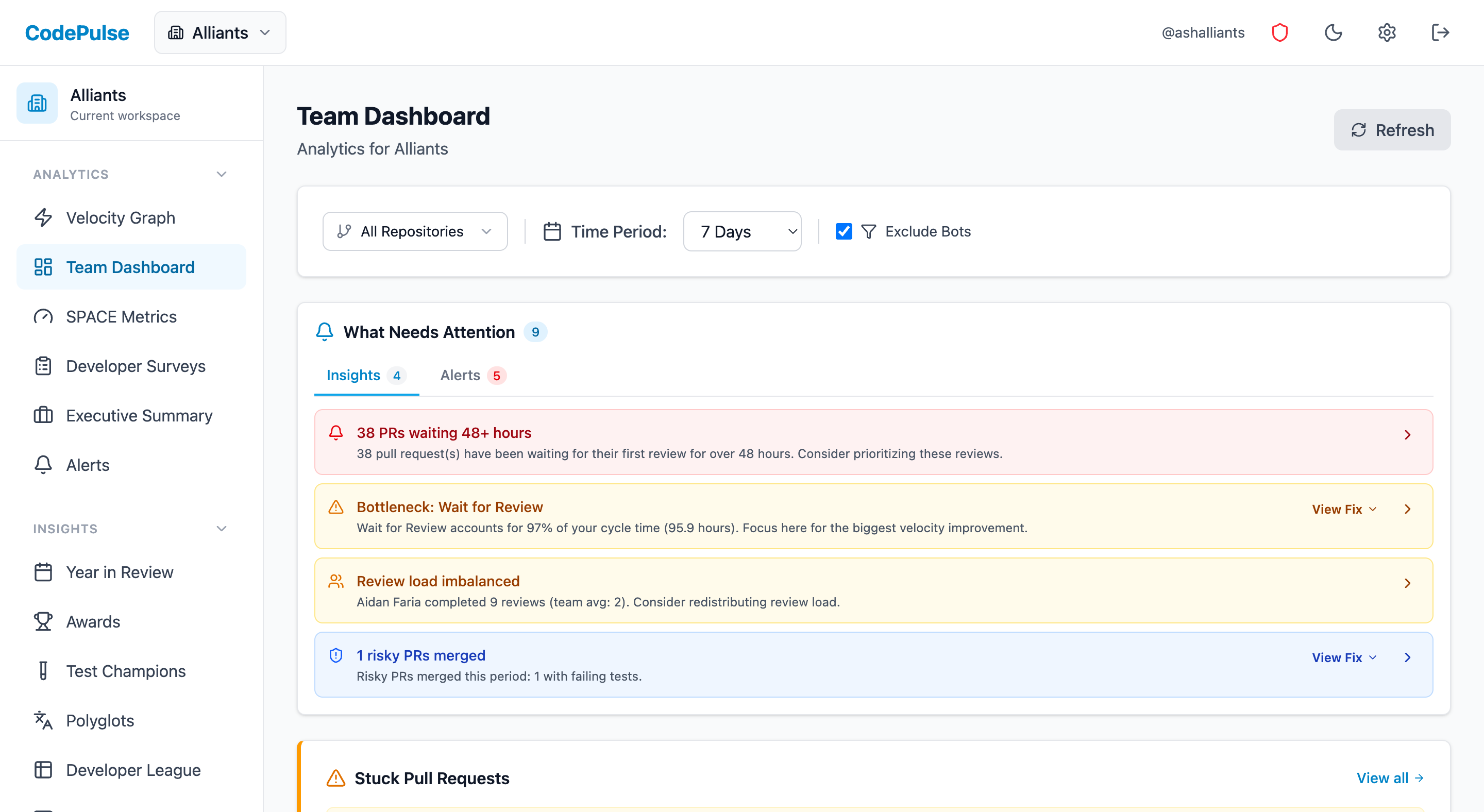
Get this view for your own teams
Connect GitHub for team-level workload, review distribution, and delivery signals. Individual views stay off unless your organisation explicitly turns them on.
Read-only GitHub · Your code stays yours · Team-level by default · No credit card
See These Features in Action
Explore all featuresRelated Guides
Happy Developers Leave Breadcrumbs in Git
Learn how to measure and improve developer experience using behavioral metrics from GitHub, not just surveys. Covers flow state, cognitive load, and collaboration quality.
Improve Developer Experience: Proven Strategies
A practical guide to improving developer experience through surveys, team structure, and proven strategies that actually work.
Best Developer Experience Platforms for 2026 (Ranked)
We compared 10 developer experience platforms across internal developer portals, DX surveys, and platform engineering. Honest rankings, real pricing, and a category map.
Developer Productivity Engineering: What DPE Does
Developer Productivity Engineering (DPE) is how Netflix, Meta, and Spotify keep engineers productive. Learn what DPE teams do and how to start one.