
Find quality and ownership risk before it becomes an incident
Preview how CodePulse combines review depth, risky changes, hotspots, and knowledge concentration without turning activity into individual scores.
Read-only GitHub · Your code stays yours · Team-level by default · No credit card
Engineers complain about "technical debt" for years while executives nod politely and fund nothing. Why? Because "debt" sounds manageable - something you can service forever. This guide teaches you how to quantify the actual cost in dollars, present it in terms executives can't ignore, and get your refactoring projects funded.
"Technical debt isn't debt. You can refinance debt. You can declare bankruptcy on debt. Technical debt is a tax - and the rate only goes up."
Stop Calling It "Technical Debt"
The phrase "technical debt" was coined by Ward Cunningham in 1992 to explain to his finance-minded boss why shipping quick code now could require "paying it back" later. The metaphor worked too well. Executives hear "debt" and think:
- Debt is optional. You can choose to carry it indefinitely.
- Debt is manageable. Just make minimum payments.
- Debt can be restructured. Refinance when rates are better.
None of this applies to bad code. Technical "debt" compounds automatically. You can't refinance it. There's no bankruptcy protection. Every time you touch the codebase, you pay - whether you planned to or not.
🔥 Our Take
Call it "Engineering Tax," not "Technical Debt."
Taxes are mandatory. Taxes are unavoidable. Taxes compound. When you tell your CEO "we have a 200% engineering tax on the billing module," they hear something very different than "we have some technical debt to address." Language matters. Reframe the conversation, and you'll reframe the budget.
The Debt Tax Calculator
Financial debt has an interest rate. Your codebase does too. We call it the Debt Tax Rate - the percentage of extra time you pay every time you touch a legacy system compared to a clean one. For a ready-made interactive model that plugs your team's numbers straight in, try our tech debt calculator.
The Formula
Debt Tax Rate
Measures the percentage of extra time you pay every time you touch a legacy system compared to a clean one.
Examples:
Interpretation:
Example: Monthly Cost Calculation
With a 200% tax rate: "For every 1 hour of productive work in the monolith, we pay 2 additional hours in friction."
That's not "debt." That's a line item.
What the Debt Tax Includes
The tax isn't just slower coding. It's the full friction across the pipeline:
| Component | What Adds to the Tax | How to Measure |
|---|---|---|
| Coding Time | Complex code takes longer to understand and modify | Time from first commit to PR open |
| Review Time | Reviewers struggle to understand changes in messy code | Time from first review to approval |
| Rework Time | Changes break things, requiring multiple iterations | Code churn rate, PR revision count |
| Testing Time | Poor test coverage means manual testing or fear of shipping | Test failure rate, time waiting for CI |
| Context Switching | Engineers avoid the scary files, creating bottlenecks | Knowledge silo concentration |
⏱️Calculating Your Debt Tax in CodePulse
Quantify the tax by comparing repositories:
- Go to Compare Repositories
- Select your cleanest, most modern service as the baseline
- Compare it against your legacy systems
- Look at Cycle Time, Coding Time, and Churn Rate
- The delta is your quantifiable Debt Tax Rate
Not All Debt is Created Equal
"Most 'technical debt' isn't debt - it's just code you don't like. Real debt has interest. If it doesn't slow you down, it's not debt."
Before you can quantify debt, you need to distinguish between actual debt and code that's merely ugly. Here's the difference:
| Type | Description | Priority |
|---|---|---|
| High-Interest Debt | Code you touch frequently that slows you down every time | Address immediately |
| Low-Interest Debt | Messy code that rarely needs changes | Track but don't prioritize |
| Legacy Code | Old code that works fine and nobody touches | Leave it alone |
| Aesthetic Debt | Code you don't like but doesn't slow anyone down | Not actually debt |
Identifying High-Interest Debt
High-interest debt lives at the intersection of high change frequency and high friction. These are your File Hotspots - files that are constantly changing but painful to work with.
High-Interest Debt Indicators
Rule of thumb: If a file hits 2+ indicators in the top row, it's high-interest debt. If it hits all 3, it's a crisis.
Quantifying Innovation Drag
Debt doesn't just slow you down - it stops you from moving at all. This is Innovation Drag: the opportunity cost of not building new things because you're constantly patching old ones.
The Innovation Drag Formula
Innovation Drag
The percentage of engineering capacity spent on maintenance vs. new development.
Examples:
Interpretation:
If your team is spending more than 40% of their time on maintenance, you're not building a product - you're running a support operation.
Building the Business Case
Engineers often frame refactoring as "we need time to clean up." This gets rejected because it sounds like engineers wanting to play with code instead of ship features. Reframe it as a business investment with quantifiable returns.
The 1-Slide Executive Pitch
Debt Retirement Investment Proposal
THE PROBLEM
Our Billing module has a 200% Debt Tax Rate. Features that take 1 day elsewhere take 3 days in Billing. This module handles 40% of our roadmap.
THE COST
We're losing $7,200/month in engineering efficiency. Over the past year, we've burned $86,400 in preventable friction - enough to hire another engineer.
THE PROPOSAL
A 4-week "Debt Retirement Sprint" to modularize the Billing module. Investment: ~$30,000 in engineering time.
THE ROI
Payback period: 4 months. After that, we save $86,400/year forever. Plus: faster feature delivery, lower incident rate, reduced bus factor risk.
Language That Works
| Don't Say | Do Say |
|---|---|
| "We need to refactor the billing code" | "The billing module has a 200% efficiency tax" |
| "This code is a mess" | "This module costs us $7,200/month in friction" |
| "We need to pay down technical debt" | "We need to retire this high-interest debt" |
| "Engineers want time to clean up" | "This investment has a 4-month payback period" |
| "The code is getting old" | "Our innovation drag is at 45% - we're losing almost half our capacity" |
The Risk of Technical Bankruptcy
"Technical bankruptcy is when the cost of changing the code exceeds the value of the change. At this point, you can't ship features. You're forced into a rewrite - which usually kills startups."
Bankruptcy happens when debt compounds faster than you can pay it down. Warning signs:
- Cycle time trending up exponentially: Not linear growth - exponential. Each quarter is significantly worse than the last.
- Innovation drag exceeding 50%: More than half your capacity goes to maintenance. You're running to stand still.
- Feature delivery slowing despite headcount growth: You added 3 engineers but shipped fewer features. The debt is eating your gains.
- Key engineers leaving: Your best people don't want to fight the codebase anymore. They'll go somewhere with cleaner systems.
- Increasing incident rate: Every change breaks something. The team is afraid to deploy.
📉Detecting Bankruptcy Risk in CodePulse
Watch your Dashboard trends for these warning signs:
- Dashboard → Compare cycle time trends quarter-over-quarter
- If cycle time is up 50%+ from last quarter, you're in trouble
- Check File Hotspots for growing knowledge silos
- Set up Alert Rules for cycle time thresholds
Your Action Plan
This Week: Measure Your Tax
- Identify your baseline: Which repository or service is your cleanest? That's your benchmark for "normal" cycle time.
- Calculate Debt Tax Rates: Compare your legacy systems against the baseline. Document the rates.
- Find your high-interest debt: Look for hotspots with high churn, knowledge silos, or test failures.
This Month: Build Your Case
- Calculate the monthly cost: (Debt Tax Rate × Hours in Legacy × Engineer Cost)
- Estimate the fix: How long would it take to reduce the tax by 50%?
- Calculate payback period: Investment cost ÷ monthly savings
- Build the 1-slide pitch: Problem, Cost, Proposal, ROI.
Ongoing: Track Your Progress
- Set up debt tax tracking: Compare repo cycle times monthly.
- Monitor innovation drag: What percentage of PRs are maintenance?
- Celebrate wins: When you retire debt, show the before/after metrics.
Handling Common Objections
"We don't have time to refactor"
Response: "You don't have time not to. Every week we delay, we pay another $1,800 in friction. In 4 months, we'll have spent more on the tax than the fix would cost."
"The code works fine"
Response: "It works - slowly. Features that should take 1 day take 3. We're not proposing this because the code is ugly. We're proposing it because it's expensive."
"We'll do it after the next release"
Response: "The Debt Tax compounds. Every feature we ship in the meantime makes the problem harder to fix. In 6 months, the cost will be higher and the fix will be harder."
"Rewrites always take longer than planned"
Response: "We're not proposing a rewrite. We're proposing targeted debt retirement - modularizing the highest-tax components. Low risk, measurable results, done in 4 weeks."
For more on measuring code quality and team efficiency, see our guides on Identifying Code Hotspots, Understanding Code Churn, and Cycle Time Breakdown.
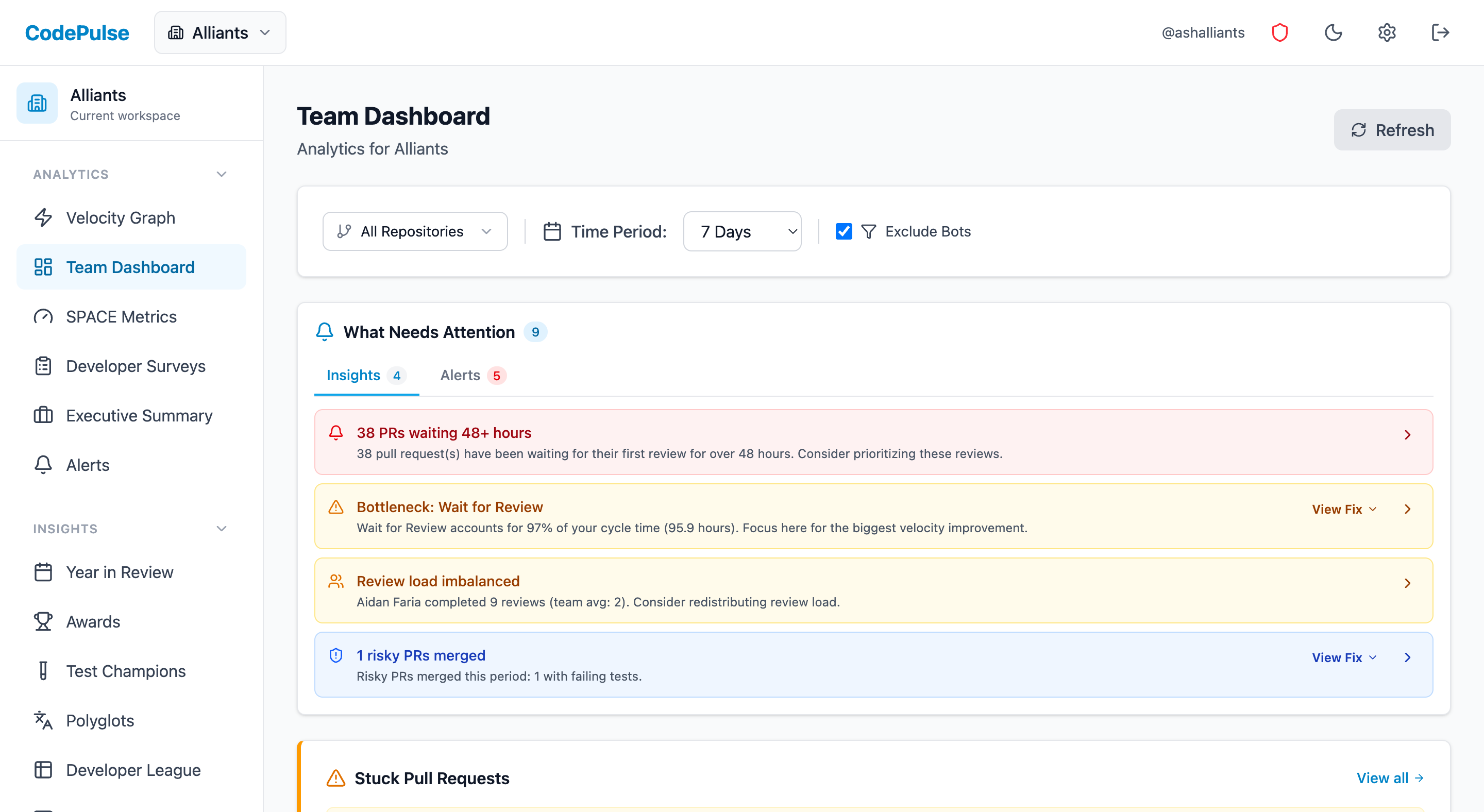
See which files and owners carry your real risk
Connect GitHub and get your churn hotspots, single-owner modules, and review-depth signals ranked by exposure. No repository cloning, no file contents read.
Read-only GitHub · Your code stays yours · Team-level by default · No credit card
See These Features in Action
Find high-churn files and correlate change frequency with ownership.
See where engineering effort goes across features, maintenance, and debt.
Related Guides
The 'Bus Factor' File That Could Kill Your Project
Use the Bus Factor Risk Matrix to identify where knowledge concentration creates hidden vulnerabilities before someone leaves.
High Code Churn Isn't Bad. Unless You See This Pattern
Learn what code churn rate reveals about your codebase health, how to distinguish healthy refactoring from problematic rework, and when to take action.
The 4-Minute Diagnosis That Reveals Why Your PRs Are Stuck
Learn to diagnose exactly where your PRs are getting stuck by understanding the 4 components of cycle time and how to improve each one.
How I Got Engineering Metrics Budget Approved in 1 Meeting
Learn how to justify engineering analytics investment to CFOs, CEOs, and boards by translating technical value into business outcomes.