
Compare the finished analysis before you choose a platform
See the report CodePulse produces from read-only GitHub workflow data, or connect your own repositories and evaluate the fit with real evidence.
Read-only GitHub · Your code stays yours · Team-level by default · No credit card
Swarmia and LinearB both show up on the same "engineering intelligence" shortlists, but they start from opposite ends of the same problem. Swarmia's core feature, working agreements, is about getting a team to hold itself to standards it chose for itself: a WIP limit, a review response time, a PR size cap, with Slack nudges when the team drifts. LinearB's core product, the free and open-source gitStream, automates the pull request mechanically: auto-assigning reviewers, auto-merging low-risk changes, and labeling PRs before a human ever looks at them. One changes behavior through visibility and social commitment. The other changes behavior by removing the decision entirely. If you want a flat-priced, GitHub-native option for the metrics layer underneath both, CodePulse fits a narrower slice of the same problem.
Swarmia vs LinearB: which should you pick?
Pick Swarmia if your team already knows what good looks like but struggles to hold itself accountable: working agreements plus Slack nudges make drift visible without a manager having to police it manually. Pick LinearB if the problem is mechanical: PRs sit unassigned, low-risk changes wait for human review they don't need, and you want that fixed with automation rather than a conversation. gitStream itself is free regardless of which analytics platform you choose. If you are GitHub-only and want cycle-time and review analytics without a per-developer bill, CodePulse is the third option worth evaluating.
Both companies started in the same "DORA metrics for GitHub" wave, and both still sell DORA dashboards. But the feature each company chose to build its identity around tells you who it is actually for.
Swarmia asks a team to keep a promise. LinearB removes the need to make one.
What Do Swarmia and LinearB Emphasize?
Swarmia describes itself as an engineering intelligence platform built around AI adoption tracking, DORA metrics, investment balance, developer experience surveys, and its longest-standing feature: working agreements. Its own product page frames working agreements around a specific belief: "metrics alone don't help teams to improve." A team picks a target, such as a work-in-progress limit or a review-response window, and gets real-time Slack alerts when it drifts, plus a recap of every exception from the past two weeks. The stated goal is to shorten review wait times and keep work-in-progress in check through team habits, not a manager chasing people.
LinearB is built around gitStream, a free and open-source workflow automation tool (Apache-2.0 license) that runs directly inside GitHub, GitLab, and Bitbucket pull requests. Teams write YAML rules that auto-assign the right reviewer based on which files changed, auto-merge low-risk changes like documentation or dependency bumps, apply labels flagging missing tests or estimated review time, and route security-sensitive changes to the right people before a human even opens the diff. gitStream also supports custom JavaScript plugins for teams that need logic the built-in rules don't cover.
Swarmia's product is a mirror. It shows a team what it agreed to do and whether it did it. LinearB's product, at least the part that defines the company, is a machine. It does the routing and merging so nobody has to remember to.
How Do Their Features Compare?
We call this the DevEx vs Throughput trade-off. Swarmia optimizes how the team feels about its own process and whether it can self-organize around agreed standards. LinearB optimizes how fast the pipeline moves by taking small decisions out of human hands entirely. Neither approach is wrong. They produce different failure modes if you pick the wrong one for your actual problem.
DevEx vs Throughput: Where Each Tool Sits
| Aspect | Swarmia | LinearB | CodePulse |
|---|---|---|---|
| Primary use case | Developer experience and team-level accountability to self-set standards | Pull request workflow automation and cycle-time coaching | GitHub-native cycle time, review analytics, and executive reporting |
| Headline features | Working agreements, DORA metrics, AI adoption tracking, developer experience surveys | gitStream: auto-assign reviewers, auto-merge safe changes, PR labeling, AI-assisted review comments | Cycle-time breakdown by phase, review sentiment and quality, executive summary export |
| Pricing model | Free under 10 developers; paid per-developer tiers above that | Free tier plus per-developer paid tiers (see linearb.io/pricing for current numbers) | Flat rate per organization, not per seat |
| GitHub depth | GitHub, GitLab, and Bitbucket app; agreements tracked across all three | GitHub, GitLab, and Bitbucket app; gitStream runs natively inside PRs | GitHub-native only: PRs, files, reviews, commits |
| Setup | Self-serve signup, free under 10 developers; Standard trial starts automatically | gitStream installs as a self-serve GitHub App in minutes; full analytics tiers may involve sales | Self-serve, minutes to first data |
The gap shows up clearest in what each product does the moment a pull request opens. Swarmia watches and reports; it will tell you a PR has sat for three days against a two-day agreement, and it will nudge the team in Slack, but a human still decides what to do about it. gitStream can act on that same PR directly: assign a reviewer, apply a label, or merge it outright if the rules say it qualifies. That's the whole difference: visibility with social pressure versus automation with no human in the loop.
A team that can't keep its own working agreement probably has a management problem, not an automation gap. A team that forgets to assign reviewers has an automation gap, not a management problem. Diagnose before you buy.
How Do Swarmia and LinearB Price?
Swarmia is the more transparent of the two on pricing today. Its own help center confirms a free plan for organizations with fewer than 10 software developers, with new signups automatically enrolled in a Standard-tier trial that reverts to free if the team stays under that headcount. Above the free tier, pricing runs per developer. Independent deal data from Vendr puts single-module pricing at roughly $179-$276 per developer per year for a 25-person team, full-suite Standard plans at $286-$433 per developer per year for a 50-person team, and real negotiated contracts ranging from $240 to $450 per developer annually depending on team size and how hard a buyer negotiates. Enterprise adds SSO and dedicated support at a custom quote. See our dedicated Swarmia pricing review for the full breakdown.
LinearB also publishes at least a partial pricing structure, including a free tier and paid per-developer plans, on its own pricing page. We were not able to independently confirm the exact current tier numbers while researching this guide, since automated requests to linearb.io were rate-limited on our end. Check linearb.io/pricing directly, or see our dedicated LinearB pricing review for what we could verify. What is not in question: gitStream itself, LinearB's automation product, is free and open source regardless of whether you ever pay for LinearB's analytics tiers.
Neither vendor sells its full analytics product below a per-developer model once a team outgrows the free tier. If your evaluation criterion is a flat number that doesn't grow with headcount, that is a structural difference from both, not a pricing tier either will publish.
Which Team Should Choose Which?
| Your Situation | Recommendation |
|---|---|
| The team agrees on standards in retros but doesn't follow them a week later | Swarmia (working agreements) |
| Reviewers never get assigned and low-risk PRs wait for a human anyway | LinearB (gitStream auto-assign and auto-merge) |
| You want developer experience survey data alongside Git metrics | Swarmia |
| You want PR automation but don't need a paid analytics contract to get it | LinearB's free gitStream |
| Your team is under 10 developers and wants to try DORA metrics for free | Swarmia's free tier |
| You are GitHub-only and want cycle-time and review analytics without a per-developer bill that grows with headcount | CodePulse |
* Our Take
Your engineering team doesn't need a working-agreements product and a workflow-automation product and a metrics dashboard. It needs one tool it actually uses, chosen for the specific bottleneck it has today.
Tool sprawl is usually a symptom of not being honest about what problem you are solving. Swarmia's working agreements are worth paying for if the failure mode is behavioral: people know what to do and don't do it. gitStream is worth installing, for free, if the failure mode is mechanical: nobody assigns reviewers and nobody merges the boring PRs. Before adding either as a paid line item, ask which failure mode you actually have. CodePulse does neither of those two specific jobs; it gives you the cycle-time and review data to diagnose which one you're facing in the first place.
Where Does CodePulse Fit?
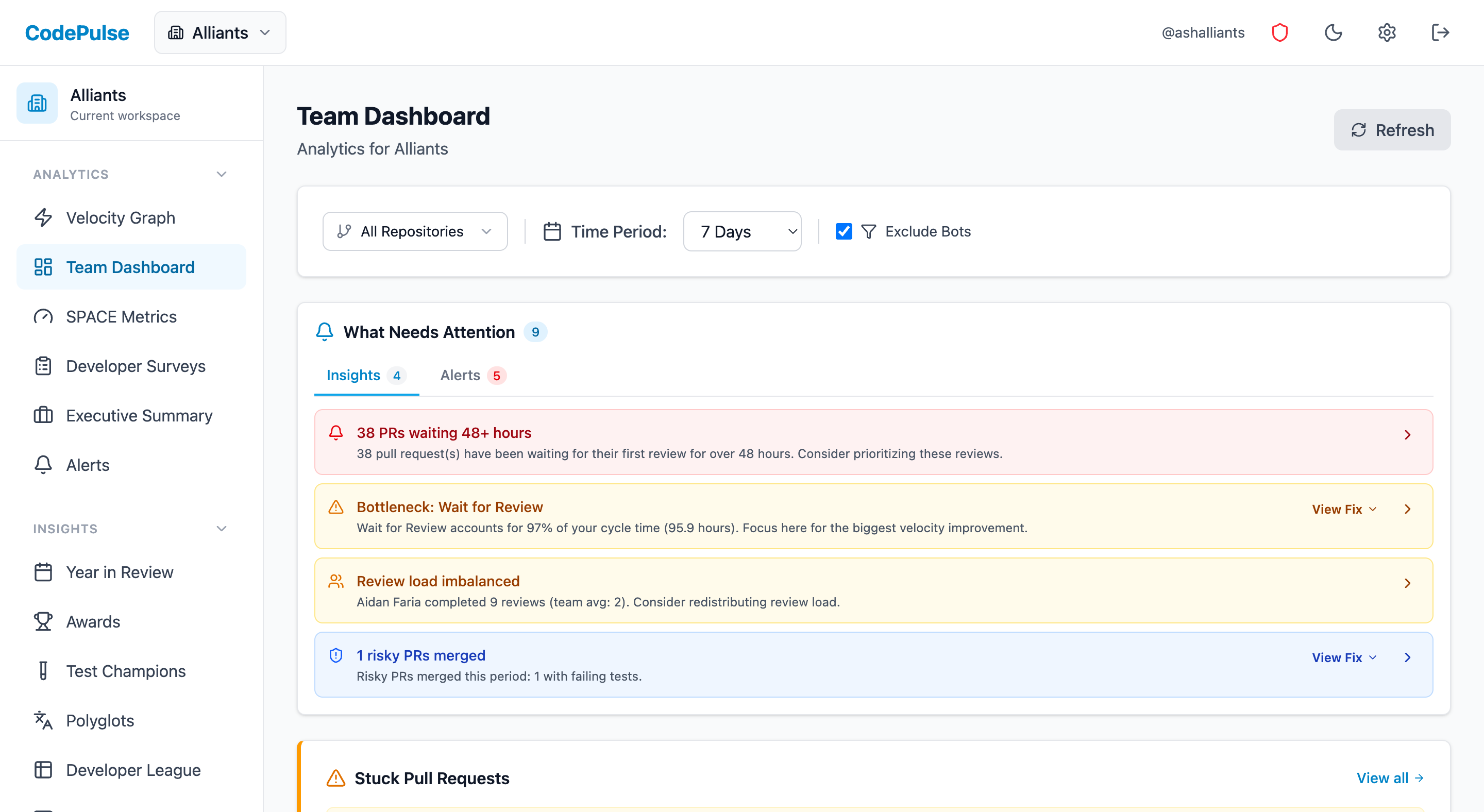
CodePulse is not a drop-in replacement for either tool. It does not have Swarmia's working agreements or Slack-based nudge system, and it does not automate the pull request the way gitStream does. What it does is the GitHub-native metrics layer that sits underneath the decision both tools are trying to influence: how long work actually takes to ship, and how the review process is behaving.
* How to See This in CodePulse
Navigate to Dashboard to see the cycle-time breakdown:
- Every pull request's lifecycle is split into coding, waiting-for-review, in-review, and merge phases, so you can see exactly where a "review takes too long" complaint is coming from before deciding whether the fix is a working agreement or an automation rule
- Pair it with Review Insights to see review sentiment and quality signals across the team, not just how long reviews take
- Filter by repository or time period to isolate where a slowdown is happening
For a leadership-facing view, the executive summary combines cycle time and health grade on a single exportable page, which covers a slice of what both Swarmia's DORA dashboards and LinearB's cycle-time reports offer, without a per-developer bill attached to it. It does not cover working agreements or PR automation; if those are must-haves, Swarmia and LinearB are each doing a job CodePulse was never built for.
A dashboard that tells you review is slow is not the same product as one that makes review faster. Know which one you're buying.
CodePulse is priced flat per organization rather than per developer, starting with a free tier and a Pro plan at $199 a month ($1,788 a year), with a Business tier at $449 a month for up to 150 developers. That is a different cost curve than Swarmia's roughly $179-$433 per developer per year above its free tier, or LinearB's own per-developer structure, but it buys a narrower product: no working agreements, no PR automation, and GitHub only. If Swarmia's accountability nudges or gitStream's auto-merge rules are the reason you are evaluating tools, that price difference is not a discount, it is the cost of the features you would be giving up.
For deeper reading on each vendor individually, see our Swarmia alternatives guide and LinearB alternatives guide, or the full engineering analytics tools comparison for how they stack against Jellyfish, Allstacks, and the rest of the category.
If you want to see your own cycle-time and review breakdown before deciding on anything, start a free CodePulse trial. You will see real data from your repositories in minutes, not after a demo call and a follow-up proposal.
Frequently Asked Questions
It depends on where your team's pain actually lives. Swarmia is built around developer experience: working agreements, DORA metrics, and Slack-based nudges that help a team hold itself to standards it set together. LinearB is built around workflow automation, mainly through its free gitStream product, which auto-assigns reviewers and auto-merges low-risk pull requests. If your problem is "the team agrees reviews should happen fast but nobody enforces it," start with Swarmia. If your problem is "reviewers never get assigned and PRs sit untouched," start with gitStream.
Evaluate CodePulse against your own delivery history
A comparison table only goes so far. Connect read-only GitHub in about five minutes and judge the output on your repositories, at one flat price, with no per-seat math.
Read-only GitHub · Your code stays yours · Team-level by default · No credit card
See These Features in Action
Explore all featuresRelated Guides
Swarmia Alternatives: Cheaper, Deeper Analytics 2026
A Swarmia alternative worth considering: where Swarmia falls short on customization and per-seat pricing, and which cheaper, GitHub-native tools fit better.
5 LinearB Alternatives for 2026 (With Pricing)
An honest comparison of CodePulse vs LinearB. We tell you when to choose LinearB instead, because the best tool is the one that makes the right trade-offs for your situation.
Jellyfish vs LinearB vs Swarmia: Full 2026 Comparison
Compare Jellyfish, LinearB, Swarmia, Allstacks, Haystack and more engineering analytics tools. Features, pricing, cycle time benchmarks, and integrations.
Swarmia Pricing in 2026: Is EUR 42/Dev/Month Worth It?
Swarmia now sells four a-la-carte modules, with the Standard bundle at EUR 42/dev/month annual and a free tier for up to 9 developers. We break down each module, calculate real costs, and compare with CodePulse flat pricing.