

See exactly where your delivery flow is waiting
Preview the phase-by-phase report for review pickup, active review, and merge time. Connect in about five minutes; the initial analysis runs after sync.
Read-only GitHub · Your code stays yours · Team-level by default · No credit card
SRE and DevOps are not competing approaches - they're complementary philosophies that solve different problems. DevOps is a cultural movement about breaking silos. SRE is an engineering discipline with specific practices for reliability. This guide helps you understand when to use each, and whether your organization actually needs dedicated SRE.
What is the difference between SRE and DevOps?
DevOps is a cultural philosophy focused on breaking down silos and shipping faster through collaboration. SRE (Site Reliability Engineering) is Google's specific engineering discipline for maintaining reliability at scale, with concrete frameworks like SLOs, error budgets, and a 50% cap on operational work. Most organizations under 100 engineers should start with DevOps and add SRE practices only when operational load actively prevents feature development.
"SRE is what happens when you ask a software engineer to design an operations team." - Ben Treynor Sloss, VP of Engineering at Google and founder of SRE
Where Did SRE and DevOps Come From?
Understanding the origins helps explain why these approaches feel different:
DevOps: A Cultural Movement
DevOps emerged around 2008-2009 from practitioners frustrated with the wall between development and operations. It's fundamentally about culture change - breaking down silos, sharing responsibility, and automating the painful parts.
There's no single definition of DevOps because it's a philosophy, not a job title or toolset. The DORA research program eventually gave us metrics (deployment frequency, lead time, etc.) but DevOps started as a manifesto for collaboration.
SRE: An Engineering Discipline
Site Reliability Engineering was born at Google in 2003 when Ben Treynor Sloss was tasked with improving operations. He approached it as an engineering problem: if operations is software, you can engineer it with the same rigor as any other system.
SRE introduces concrete concepts: Service Level Objectives (SLOs), error budgets, toil measurement, and the 50% cap on operational work. It's prescriptive where DevOps is philosophical.
| Aspect | DevOps | SRE |
|---|---|---|
| Origin | Grassroots movement (~2008) | Google engineering (~2003) |
| Type | Culture & philosophy | Engineering discipline |
| Prescription | Principles-based | Practice-based with specific frameworks |
| Primary goal | Break silos, ship faster | Maintain reliability at scale |
What Are the Core Differences That Matter?
Both approaches want reliable, fast software delivery. They differ in how they define success and what they prescribe.
1. Definition of Done
DevOps: Code is deployed to production, observable, and the team can iterate quickly.
SRE: The service meets its SLOs, error budget is healthy, and the team is spending less than 50% time on toil.
2. Key Metrics
| DevOps Metrics (DORA) | SRE Metrics |
|---|---|
| Deployment frequency | SLO attainment |
| Lead time for changes | Error budget remaining |
| Change failure rate | Toil percentage |
| Time to restore service | Time to detect (TTD) |
3. Team Structure
DevOps: Everyone is responsible for operations. "You build it, you run it." No separate ops team in the purest form.
SRE: Dedicated SRE team that partners with development teams. SREs can hand back pager duty if a service becomes too unreliable (error budget enforcement).
4. How They Handle Reliability
DevOps: Reliability emerges from good practices - CI/CD, monitoring, automation, fast feedback loops.
SRE: Reliability is an explicit target with a budget. The error budget (100% - SLO) determines how much risk you can take on new features.
Error Budget Example
────────────────────────────────────────────────

SLO: 99.9% availability (three nines)
Error budget: 0.1% of time can be unavailable

In a 30-day month:
- Total minutes: 43,200
- Error budget: 43 minutes

If you've used 40 minutes this month:
→ Only 3 minutes remaining
→ Freeze deployments until next month

If you've used 10 minutes this month:
→ 33 minutes remaining
→ Green light for risky changes
🔥 Our Take
Most companies under 100 engineers don't need dedicated SRE. DevOps with good monitoring gets you 90% of the benefit.
SRE makes sense when operations load is actively preventing engineers from building features - typically when you have complex distributed systems, strict uptime requirements, or your best engineers are spending more than half their time firefighting. Until then, invest in DevOps culture and tooling.
How Does Google See the SRE-DevOps Relationship?
According to Google's SRE Workbook, the relationship is straightforward:
"One could view DevOps as a generalization of several core SRE principles to a wider range of organizations. One could equivalently view SRE as a specific implementation of DevOps with some idiosyncratic extensions."
In other words:
- DevOps is the broader philosophy that most organizations should adopt
- SRE is Google's specific, opinionated implementation of that philosophy
The key "idiosyncratic extensions" that make SRE distinct:
| SRE Practice | What It Adds Beyond DevOps |
|---|---|
| Error Budgets | Explicit tradeoff mechanism between velocity and reliability |
| Toil Budget (50% cap) | Formal limit on manual operational work |
| SLOs/SLIs/SLAs | Quantified reliability targets tied to user experience |
| Pager Handback | Mechanism to enforce quality (SRE stops supporting unreliable services) |
How Do You Decide What Your Org Needs?
Use this framework to decide which model fits your organization:
Adopt DevOps (Without Dedicated SRE) If:
- You have fewer than 100 engineers
- Teams can reasonably own their services end-to-end
- You don't have strict uptime SLAs (99.9%+)
- Your infrastructure complexity is manageable
- Developers are willing and able to participate in on-call
Add SRE If:
- Operations work is crowding out feature development
- You have complex distributed systems that require specialized knowledge
- You have strict SLA requirements with financial consequences
- Your best engineers are spending more than 50% of time on operational issues
- You need to formalize the reliability vs. velocity tradeoff
Decision Tree: SRE vs DevOps-Only
═══════════════════════════════════════════════════

Start: How many engineers?
       │
       ├─ <50 ──────────────────────────→ DevOps only
       │
       └─ 50+ ──→ Strict SLAs (99.9%+)?
                  │
                  ├─ No ────────────────→ DevOps only
                  │
                  └─ Yes ──→ Ops >50% of eng time?
                            │
                            ├─ No ─────→ DevOps + SRE practices
                            │             (no dedicated team)
                            │
                            └─ Yes ───→ Dedicated SRE team

DevOps only = Shared ownership, everyone on-call
DevOps + SRE practices = Adopt error budgets, SLOs, toil tracking
Dedicated SRE = Separate team with reliability mandate
What Does the Hybrid Approach Look Like?
In practice, most organizations don't choose purely one or the other. They adopt DevOps culture with selected SRE practices:
Common Hybrid Pattern
- DevOps culture: Shared ownership, CI/CD, infrastructure as code
- SRE-style SLOs: Define reliability targets per service
- Error budget awareness: Track reliability spend without formal gates
- Embedded SRE: 1-2 reliability-focused engineers per product area rather than a central SRE org
"The best teams I've seen use DevOps as the cultural foundation and cherry-pick SRE practices (especially SLOs and error budgets) that solve their specific reliability problems."
📊 How to See This in CodePulse
For pure DevOps and hybrid SRE teams alike, CodePulse tracks the delivery metrics that matter:
- Deployment Frequency: How often you ship (DORA key metric)
- Lead Time: From commit to production
- Cycle Time Breakdown: Where time is spent in the PR pipeline
- Change Failure Rate: Percentage of deployments causing issues
View your Executive Summary for a health grade, or Dashboard for detailed delivery metrics.
What Are the Implementation Tips for Each Model?
If You're Going DevOps-Only
- Start with culture: Break down dev/ops silos before adding tools
- Implement CI/CD: Automated testing and deployment pipelines
- Shared on-call: Developers support their own services
- Measure DORA metrics: Track deployment frequency, lead time, MTTR, change failure rate
- Blameless postmortems: Learn from incidents without finger-pointing
If You're Adding SRE Practices
- Define SLOs: Start with user-facing latency and availability targets
- Track error budgets: Make the reliability vs. speed tradeoff explicit
- Measure toil: What percentage of time goes to repetitive manual work?
- Automate toil away: Invest engineering time in eliminating repetitive tasks
- Consider embedded SREs: Reliability engineers in product teams, not a central org
If You're Building a Dedicated SRE Team
- Hire software engineers: SRE is engineering, not traditional ops
- Enforce the 50% rule: No more than half time on operational work
- Implement error budget policy: Freeze features when budget is exhausted
- Enable pager handback: SRE can refuse support for unreliable services
- Share responsibility: Product teams still own their services; SRE provides support
What Are the Most Common SRE and DevOps Mistakes?
Mistake 1: Hiring "DevOps Engineers" and Calling It DevOps
DevOps is a culture, not a job title. If you create a DevOps team that handles all the "ops stuff," you've just recreated the silo you were trying to break.
Mistake 2: Adopting SRE Titles Without SRE Practices
Renaming your ops team to "SRE" without implementing SLOs, error budgets, and the 50% toil cap means you're doing traditional ops with a trendy name.
Mistake 3: Over-Engineering Reliability Too Early
Startups don't need five-nines reliability. If you're pre-product-market fit, your main reliability problem is shipping fast enough to find customers - not maintaining uptime for users you don't have yet.
Mistake 4: Treating SLOs as Goals Instead of Budgets
The point of SLOs isn't to maximize reliability - it's to spend exactly the right amount on it. If you're consistently exceeding your SLOs with budget to spare, you should be deploying faster, not celebrating.
Which Guides Should You Read Next?
- DORA Metrics Guide - The research-backed metrics for software delivery
- DevOps Maturity Model Guide - Assess and improve your DevOps practices
- DevOps Metrics & KPIs Guide - What to measure in your DevOps transformation
- Platform Team Metrics - Measuring internal developer platforms
What Should You Take Away from SRE vs DevOps?
SRE and DevOps are not competing frameworks - they're complementary. DevOps provides the cultural foundation for collaboration and continuous improvement. SRE provides engineering rigor for reliability at scale.
For most organizations, the answer isn't "SRE vs. DevOps" but "DevOps first, SRE practices when needed." Start with the cultural shift. Add SRE practices (SLOs, error budgets) when you need to formalize reliability tradeoffs. Build a dedicated SRE team only when operational load truly prevents engineering work.
"DevOps is how you work. SRE is what you measure. The best teams do both."
Track your delivery performance with CodePulse to understand where you stand - whether you're pure DevOps, adding SRE practices, or building a dedicated reliability organization.
Frequently Asked Questions
DevOps is a cultural philosophy about breaking silos between development and operations, focused on collaboration and fast delivery. SRE is a specific engineering discipline created at Google with concrete practices like SLOs, error budgets, and a 50% cap on operational work. Think of DevOps as the "why" and SRE as one opinionated "how."
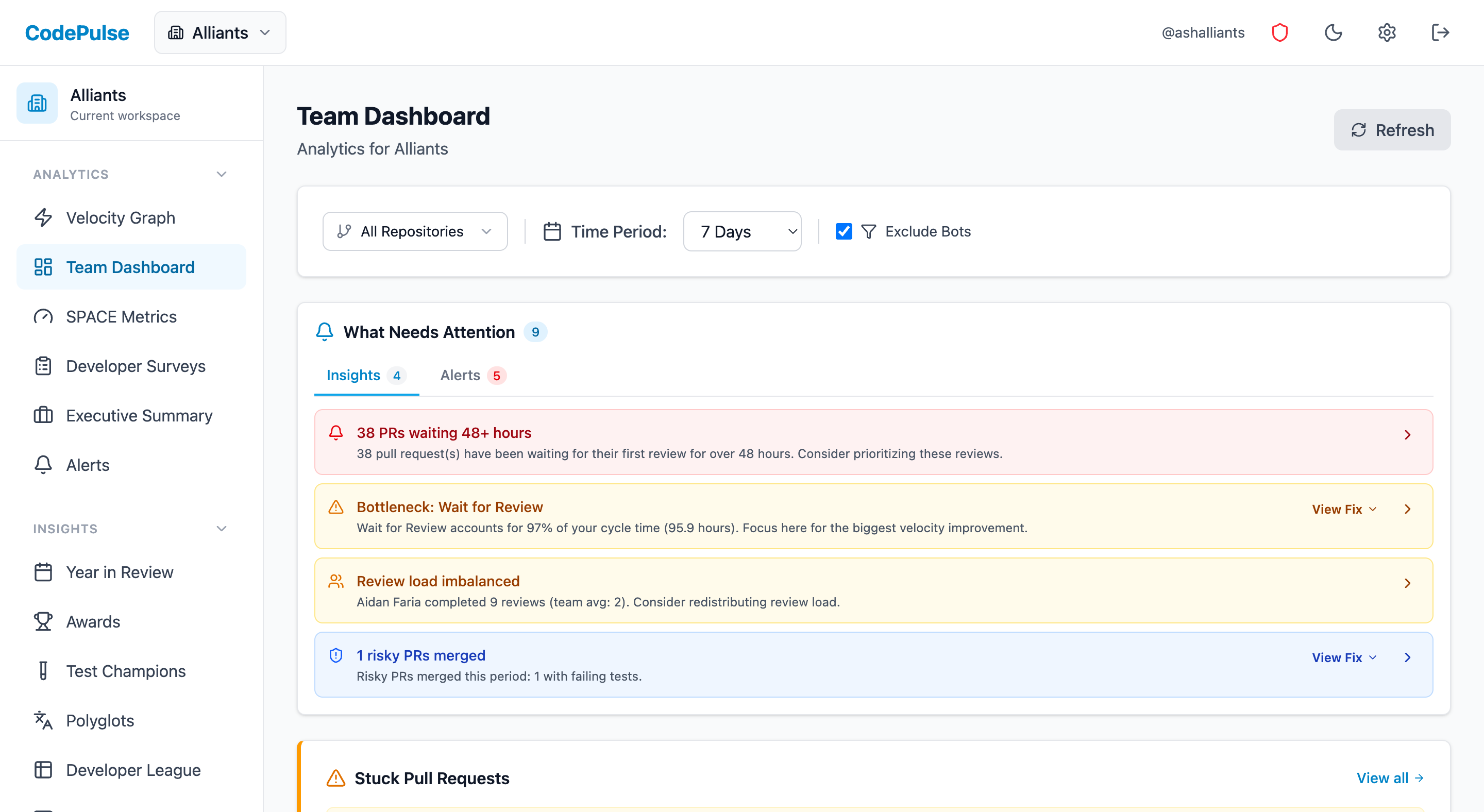
Find out which phase is holding your delivery up
CodePulse splits your cycle time into coding, waiting for review, active review, and merge, so you fix the queue that is actually costing you days. Read-only GitHub, no credit card.
Read-only GitHub · Your code stays yours · Team-level by default · No credit card
See These Features in Action
Track all four DORA metrics and benchmark against industry standards.
Track deployment frequency, lead time, and release patterns.
Related Guides
Agile vs DevOps: Why the Debate Is Missing the Point
Agile and DevOps are not competitors - they are complementary. Agile handles planning and prioritization; DevOps handles delivery and operations. This guide shows how they work together.
DevOps Observability: Logs, Metrics, and Traces
Observability goes beyond monitoring to help you understand why systems break, not just when. This guide covers the three pillars (logs, metrics, traces), implementation strategies, and tool comparisons.
MLOps vs DevOps: Key Differences, Tools, and When You Need Both
MLOps extends DevOps for machine learning with unique challenges like model drift, data versioning, and continuous training. This guide compares pipelines, roles, tools, and metrics across both practices, plus migration strategies for hybrid organizations.
DORA Metrics Explained: The 4 Keys Without the Hype
A complete breakdown of the four DORA metrics - deployment frequency, lead time, change failure rate, and MTTR - with honest benchmarks and gaming traps to avoid.