
See exactly where your delivery flow is waiting
Preview the phase-by-phase report for review pickup, active review, and merge time. Connect in about five minutes; the initial analysis runs after sync.
Read-only GitHub · Your code stays yours · Team-level by default · No credit card
The MLOps market hit $2.3 billion in 2025, growing at nearly 29% year over year. That growth reflects a real problem: ML systems break in ways that standard DevOps practices don't anticipate. This guide breaks down how MLOps extends DevOps, where the two diverge, which tools and roles matter, and how to migrate from one to the other.
"MLOps is DevOps plus data versioning, model tracking, and drift detection. The code is only half the system."
What Is MLOps (and What Is DevOps)?
DevOps in 30 Seconds
DevOps unifies software development and operations through automation, CI/CD pipelines, infrastructure-as-code, and monitoring. The goal: ship reliable code faster. If you want the full breakdown, see our DevOps Automation Metrics Guide.
MLOps: DevOps for Machine Learning
MLOps (Machine Learning Operations) applies those same DevOps principles to ML systems. The core difference: ML systems depend on both code AND data. A code change, a data shift, or a hyperparameter tweak can each independently break production. DevOps manages one artifact (code). MLOps manages three: code, data, and trained models.
Why ML Needs Special Treatment
- Data dependency: Model behavior depends on training data, not just code
- Model drift: Models degrade over time as real-world data shifts
- Reproducibility: Same code + different data = different model
- Experimentation: ML development involves many failed experiments before one works
- Explainability: Stakeholders and regulators need to understand why models make decisions
- GPU resource management: Training requires expensive, specialized compute that needs scheduling and optimization
- Training/serving skew: The gap between how data looks during training vs. how it looks in production causes silent failures
MLOps vs DevOps: Complete Comparison
The table below compares DevOps and MLOps across ten dimensions. The first five are differences most teams discover early. The last five catch teams off guard.
| Aspect | DevOps | MLOps |
|---|---|---|
| Primary Artifact | Code (versioned in Git) | Code + Data + Trained Model |
| Testing | Unit, integration, E2E | + Data validation, model evaluation, bias testing |
| CI/CD Pipeline | Build → Test → Deploy | + Train → Evaluate → Register → Deploy |
| Monitoring | Latency, errors, uptime | + Model drift, data drift, prediction quality |
| Rollback | Deploy previous code version | Deploy previous model + may need retraining |
| Versioning | Source code (Git) | + Data versions (DVC), model versions, feature versions |
| Reproducibility | Same code = same build | Same code + same data + same hyperparams = same model (ideally) |
| Infrastructure | Standard compute (CPU, containers) | GPU clusters, distributed training, model serving endpoints |
| Feedback Loops | User reports, error logs, APM | + Prediction accuracy signals, drift alerts, retraining triggers |
| Compliance | SOC 2, access controls, audit logs | + Model explainability, bias audits, data lineage, AI Act classification |
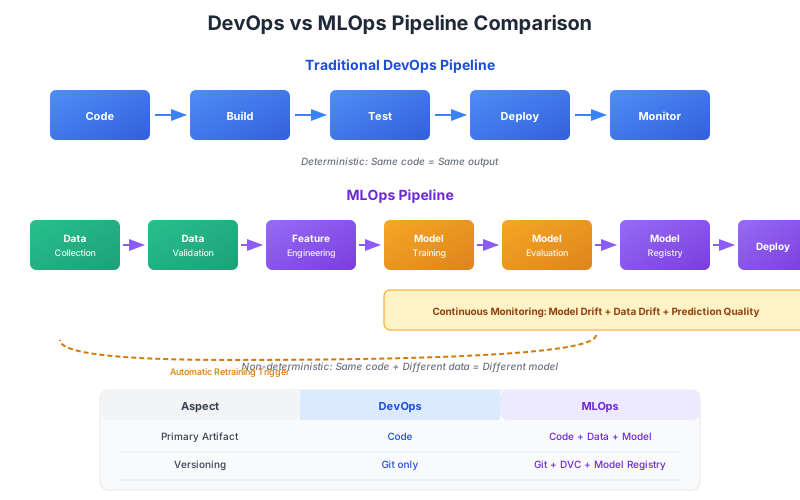
Pipeline Differences: CI/CD vs CT/CD
DevOps teams talk about CI/CD: Continuous Integration and Continuous Deployment. MLOps adds a third concept that changes everything: CT, or Continuous Training.
In standard DevOps, once code passes tests and deploys, it stays deployed until the next code change. ML models don't work that way. A model deployed today can silently degrade tomorrow if the input data distribution shifts. CT automates the process of detecting that drift and retraining the model before predictions go stale.
Standard DevOps Pipeline
Code Commit → Build → Unit Tests → Integration Tests → Deploy → Monitor
     ↑                                                          |
     └──────────── New code change triggers rebuild ────────────┘
MLOps Pipeline (with Continuous Training)
Data Collection → Feature Engineering → Train → Evaluate → Register → Deploy → Monitor
       ↑                                                                    |
       └──── Drift detected OR schedule triggers retraining ───────────────┘
                           (Continuous Training loop)
The retraining loop is the fundamental architectural difference. DevOps pipelines are triggered by code changes. MLOps pipelines are triggered by code changes, data changes, schedule, or drift signals. For more on how pipeline metrics relate to delivery performance, see our DORA Metrics Guide.
Roles and Career Paths
One reason MLOps adoption stalls is role confusion. Four distinct roles contribute to ML systems, and their responsibilities overlap in ways that cause friction if not defined clearly.
| Role | Focus | Core Skills | Typical Background |
|---|---|---|---|
| DevOps Engineer | Infrastructure, CI/CD, reliability | Terraform, Kubernetes, scripting, monitoring | Sysadmin or SRE |
| ML Engineer | Model training, feature engineering, pipelines | Python, PyTorch/TensorFlow, Spark, SQL | Software engineer + ML coursework |
| MLOps Engineer | ML infrastructure, model serving, drift monitoring | Kubernetes, MLflow, Airflow, model optimization | DevOps engineer + ML knowledge |
| Data Scientist | Research, experimentation, model design | Statistics, Python, Jupyter, domain expertise | Academic research or analytics |
In practice, smaller teams merge these roles. An ML engineer might handle their own infrastructure. A DevOps engineer might learn enough ML to manage training pipelines. The MLOps engineer role specifically emerged because neither data scientists nor DevOps engineers want to own the full stack alone.
"The MLOps engineer role exists because data scientists shouldn't debug Kubernetes, and DevOps engineers shouldn't tune hyperparameters. Both are right."
MLOps-Specific Metrics
Standard DevOps metrics (deployment frequency, lead time, change failure rate, MTTR) still apply to ML systems. But ML adds a second layer of metrics that DevOps dashboards don't track.
Model Quality Metrics
| Metric | Definition | Why It Matters |
|---|---|---|
| Model Accuracy | Prediction correctness on holdout data | Core quality measure |
| Model Drift | Accuracy degradation over time | Triggers retraining |
| Data Drift | Input distribution change vs. training data | Early warning of model issues |
| Prediction Latency | Time from request to prediction | User experience for real-time systems |
Operational Metrics
| Metric | Definition | Target |
|---|---|---|
| Training Time | Wall-clock time to train a model | Depends on model size and data volume |
| Model Deployment Frequency | How often models are updated in production | Varies by use case (hourly to monthly) |
| Experiment Success Rate | % of experiments that beat the baseline | >20% (ML is inherently experimental) |
| Time to Production | From successful experiment to deployed model | Days to weeks, not months |
| Feature Freshness | Staleness of features in the production feature store | Within SLA (minutes to hours depending on use case) |
| GPU Utilization | Compute efficiency during training runs | >70% (GPU time is expensive) |
/// Our Take
Most teams don't need MLOps. They need DevOps for their ML code first.
If your ML team deploys manually and doesn't have CI/CD, jumping to an "MLOps platform" is premature optimization. Get version control, automated testing, and CI/CD working for your ML code. Then layer on experiment tracking, model registry, and drift monitoring. Skipping DevOps fundamentals to buy an MLOps platform is like buying a race car before learning to drive.
MLOps Tools Compared
The MLOps tooling ecosystem is crowded. This table covers the six core categories, the leading tools in each, and when each category becomes necessary. For a broader view of the DevOps toolchain, see our DevOps Toolchain Guide.
| Category | Tools | Purpose | When You Need It |
|---|---|---|---|
| Experiment Tracking | MLflow, Weights & Biases, Neptune | Track experiments, compare results, log parameters | Day one. This is the first MLOps tool to adopt. |
| Data Versioning | DVC, LakeFS, Delta Lake | Version datasets alongside code for reproducibility | When datasets change frequently or reproducibility matters |
| Feature Stores | Feast, Tecton, Databricks Feature Store | Manage, share, and serve features across teams | Multiple teams reusing the same features |
| Model Registry | MLflow, SageMaker, Vertex AI | Version, stage, and promote models through environments | More than one model in production or compliance requirements |
| Orchestration | Kubeflow, Airflow, Dagster | Automate training and deployment pipelines | Manual pipeline execution becomes a bottleneck |
| Monitoring | Evidently, Arize, WhyLabs | Drift detection, model quality alerts, data quality checks | Models in production where accuracy matters |
📊How CodePulse Fits
CodePulse tracks the software engineering side of ML development:
- Code velocity: PR cycle time for ML code changes
- Collaboration: Code review patterns across ML repositories
- Delivery: How often ML code ships (distinct from model deployment frequency)
For model-specific metrics (drift, accuracy), use dedicated MLOps monitoring tools. For engineering metrics on how your ML team writes, reviews, and ships code, use CodePulse.
Governance and Compliance for ML
ML systems face regulatory scrutiny that standard software does not. The EU AI Act classifies AI systems by risk level. Financial regulators require model explainability. Healthcare AI needs audit trails for every prediction. Even if your industry isn't heavily regulated today, governance practices prevent costly retrofitting later.
| Area | DevOps Equivalent | MLOps Requirement |
|---|---|---|
| Audit Trail | Deployment logs, change history | + Training data lineage, model provenance, experiment history |
| Access Control | Role-based access to code and infrastructure | + Data access policies, model approval gates, experiment isolation |
| Compliance | SOC 2, GDPR for user data | + AI Act risk classification, bias testing, fairness audits |
| Documentation | Runbooks, architecture docs, incident postmortems | + Model cards, data sheets, fairness reports, decision explanations |
The 4-Phase MLOps Ladder: DevOps to MLOps Migration
If your team already does DevOps well, you don't need to start from scratch. MLOps is a layer on top. Here's a practical migration path we call the 4-Phase MLOps Ladder.
Phase 1: Foundation (Month 1-2)
Add experiment tracking (MLflow is free and open source). Start versioning datasets alongside your code using DVC or LakeFS. Set up a basic model registry, even if it's just an S3 bucket with naming conventions.
Phase 2: Automation (Month 2-4)
Automate your training pipeline so retraining doesn't require a data scientist to run a Jupyter notebook manually. Add model evaluation gates: a model must beat the current production baseline before it can be promoted.
Phase 3: Monitoring (Month 4-6)
Deploy drift detection on your production models. Set up alerts for data quality issues and prediction accuracy degradation. Connect drift signals to your retraining pipeline to close the Continuous Training loop.
Phase 4: Optimization (Month 6+)
Introduce feature stores if multiple teams share features. Add A/B testing infrastructure for model rollouts. Optimize GPU utilization and training costs. Consider LLMOps tooling (prompt versioning, fine-tuning pipelines, eval frameworks) if your team works with large language models.
"You don't need an MLOps team on day one. Start with one ML engineer who understands DevOps, or one DevOps engineer willing to learn ML pipelines."
When to Invest in MLOps
You Need MLOps When:
- Multiple models in production that need independent update cycles
- Models require frequent retraining (weekly or more often)
- Data scientists spend >50% of their time on operations instead of research
- Model quality issues are reaching production before anyone notices
- Regulatory compliance requires model audit trails and explainability
- Multiple teams are duplicating feature engineering work
- You can't reproduce a model that was deployed six months ago
You Don't Need MLOps (Yet) When:
- One or two models, updated manually on a quarterly schedule
- Still proving ML value to the business with a POC
- Basic DevOps (version control, CI/CD, monitoring) isn't working yet
- Small team (<3 ML practitioners) where manual processes aren't a bottleneck
- Batch predictions updated monthly where staleness isn't a concern
- You can retrain manually in under an hour when needed
Frequently Asked Questions
DevOps manages code through CI/CD pipelines. MLOps extends this to manage code, data, and trained models, adding data versioning, experiment tracking, model monitoring, and continuous training. The fundamental shift is that ML systems have three artifacts to version and deploy, not one.
Related Guides
- DevOps Automation Metrics Guide - The DevOps foundation MLOps builds on
- DORA Metrics Guide - Delivery performance metrics that apply to ML teams too
- DevOps Toolchain Guide - Understanding the full tool ecosystem
- Continuous Testing in DevOps Guide - Testing strategies that extend into ML validation
- Platform Engineering Tools Guide - Infrastructure platforms that support ML workloads
Conclusion
MLOps extends DevOps to handle the unique challenges of machine learning: data versioning, model tracking, drift detection, experiment management, and the Continuous Training loop that keeps models accurate over time. But the foundation is still solid DevOps: version control, CI/CD, monitoring, and automation.
Start with DevOps fundamentals. Layer on MLOps tools as your ML maturity grows, following the 4-Phase MLOps Ladder. Track your ML engineering metrics with CodePulse while using dedicated MLOps tools for model-specific monitoring.
"In ML, the code is reproducible but the model isn't. Unless you track the data and parameters too."
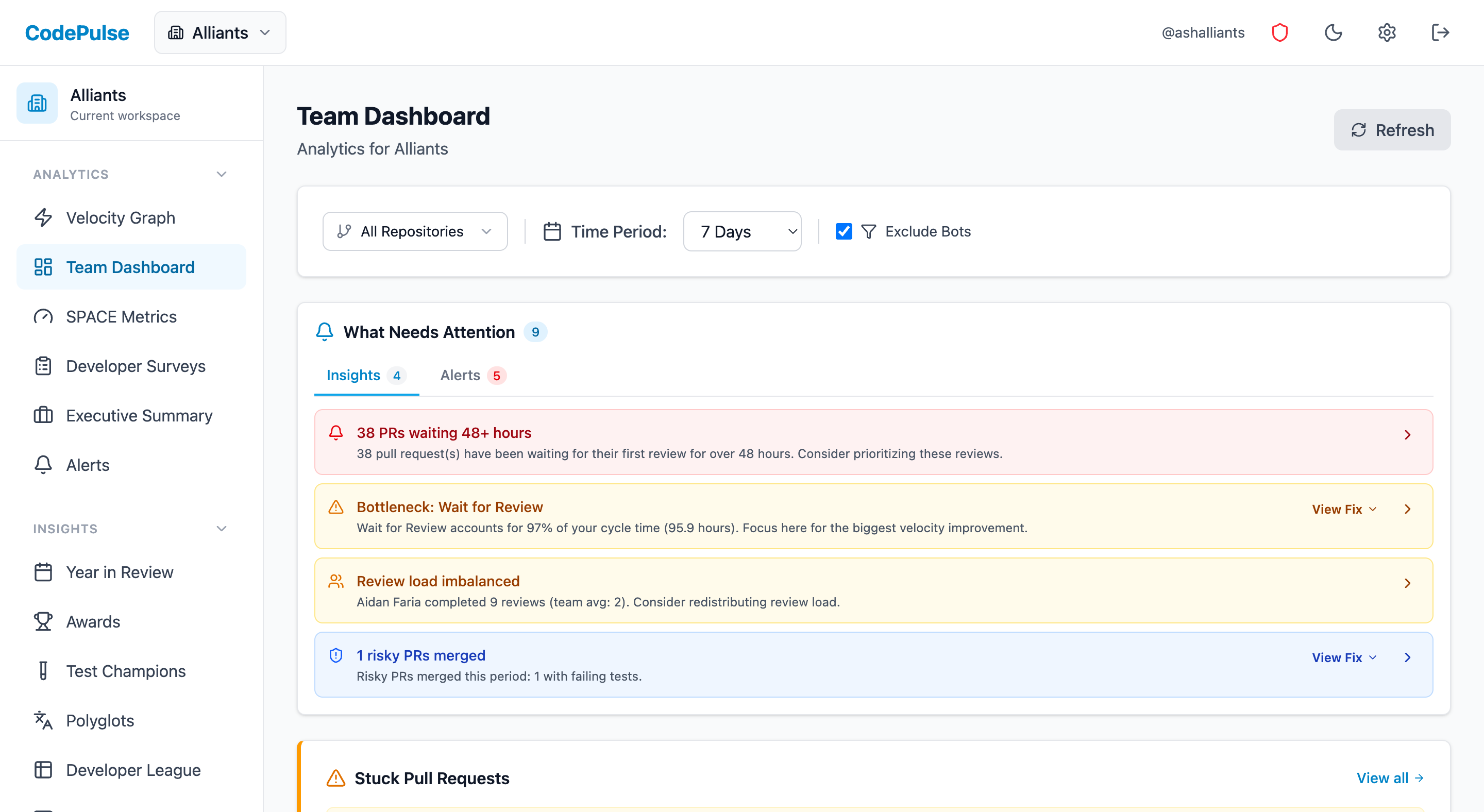
Find out which phase is holding your delivery up
CodePulse splits your cycle time into coding, waiting for review, active review, and merge, so you fix the queue that is actually costing you days. Read-only GitHub, no credit card.
Read-only GitHub · Your code stays yours · Team-level by default · No credit card
See These Features in Action
Track deployment frequency, lead time, and release patterns.
Track all four DORA metrics and benchmark against industry standards.
Related Guides
DevOps Automation: How to Measure What Actually Matters
DevOps automation promises faster delivery and fewer errors. This guide covers the metrics that prove automation ROI, what to automate first, and how to calculate the business impact.
DORA Metrics Explained: The 4 Keys Without the Hype
A complete breakdown of the four DORA metrics - deployment frequency, lead time, change failure rate, and MTTR - with honest benchmarks and gaming traps to avoid.
The DevOps Toolchain: What to Measure at Each Stage
A DevOps toolchain enables continuous delivery. This guide maps all stages (plan, code, build, test, release, deploy, operate, monitor) with tools and metrics.
Continuous Testing in DevOps: Metrics That Actually Matter
Continuous testing is more than running tests in CI. This guide covers testing metrics for DevOps, the testing pyramid, how to handle flaky tests, and test automation strategy.