
See exactly where your delivery flow is waiting
Preview the phase-by-phase report for review pickup, active review, and merge time. Connect in about five minutes; the initial analysis runs after sync.
Read-only GitHub · Your code stays yours · Team-level by default · No credit card
Software delivery management has become a $2.8 billion industry built on a false premise: that you need a separate platform to understand how your engineering organization delivers software. You don't. Your delivery system already exists—it's called GitHub. The question is whether you're reading it.
"The best software delivery management doesn't add a new system on top of your engineering workflow. It reads the system you already have and tells you what it means."
What Software Delivery Management Actually Means
Software delivery management is the discipline of understanding, measuring, and improving how engineering organizations convert code into customer value. It is not project management with a developer skin. It is not DevOps tooling rebranded for executives. It is the practice of making software delivery visible, predictable, and continuously improving.
The discipline rests on three pillars:
- Visibility: Knowing what is happening across teams, repositories, and delivery stages at any moment. Not through status meetings or Slack pings, but through real data flowing from your actual delivery system.
- Flow: Understanding how work moves through your system. Where does it accelerate? Where does it stall? What creates bottlenecks? Flow is the physics of software delivery, and most organizations have never measured it.
- Predictability: The ability to forecast when work will ship based on historical patterns rather than gut estimates. According to Google's DORA research, elite-performing teams are 2x more likely to exceed organizational goals in profitability, productivity, and customer satisfaction—and predictability is what separates them from everyone else.
The Three Pillars of Delivery Management
Software delivery management is distinct from project management, which tracks tasks and timelines. It is distinct from DevOps, which focuses on infrastructure automation and deployment pipelines. Delivery management sits above both: it measures the end-to-end flow of value from code to customer, regardless of what project management or CI/CD tools you use underneath.
Think of it this way: project management tracks the plan. DevOps automates the pipeline. Software delivery management measures the reality of what actually shipped, how fast it moved, and where it got stuck. If you are a VP or Director of Engineering responsible for delivery outcomes, this is the discipline you need.
The Platform Trap: Why Enterprise SDM Tools Fail
The engineering intelligence market is crowded with platforms that promise delivery visibility. Jellyfish, Faros AI, Pluralsight Flow, LinearB, Allstacks. The list grows every quarter. These platforms share a common pitch: connect your tools, unify your data, get a dashboard. They also share a common price tag: $100K+ annually for mid-size organizations, with median costs around $19,000/year for a single platform before you factor in implementation, training, and the six months it takes to get meaningful data flowing.
Here is what these platforms get wrong:
Integration Hell
Enterprise SDM platforms try to connect everything: Jira, GitHub, GitLab, Linear, PagerDuty, CI systems, deployment tools. Every integration is a point of failure. Every data mapping is a source of inaccuracy. The more tools you connect, the more time you spend maintaining connections instead of reading insights. Most implementations stall at integration, with teams spending months configuring data pipelines before seeing a single useful metric.
Data Quality Quicksand
When you aggregate data across five different systems, every system has different definitions. What Jira calls "done" and what GitHub calls "merged" are not the same thing. Timestamps drift. Statuses mismatch. The platform shows you numbers, but nobody trusts the numbers because nobody understands how they were derived. Developers see metrics that don't match their experience, so they disengage.
Dashboard Fatigue
Six-figure platforms deliver dozens of dashboards nobody opens. The metrics are technically correct but practically useless because they are disconnected from the daily decisions engineering leaders make. A chart showing "velocity trend" across 47 Jira projects does not help you answer the question that actually matters: why is this critical feature taking three times longer than expected?
| Dimension | Enterprise SDM Platforms | GitHub-Native Approach |
|---|---|---|
| Setup Time | 3-6 months | Under 5 minutes |
| Annual Cost | $50K-$200K+ | Fraction of the cost |
| Data Source | Aggregated from 5-10 tools | Single source of truth (GitHub) |
| Data Accuracy | Varies by integration quality | Reads directly from your delivery system |
| Developer Trust | Low (metrics feel disconnected) | High (metrics match daily experience) |
| Time to Value | Months | Same day |
| Maintenance | Dedicated admin required | Zero-maintenance after setup |
Enterprise Platform vs GitHub-Native Approach
The GitHub-Native Approach to Delivery Management
Here is the insight that the enterprise platforms do not want you to hear: your delivery system already lives in GitHub. Every pull request is a unit of delivery. Every review is a quality gate. Every merge is a deployment event. The entire lifecycle of software delivery—from first commit to production—is recorded in your version control system with millisecond-precision timestamps.
"Your PR flow IS your delivery pipeline. Every commit, review, and merge tells a story about how your organization delivers software. You do not need another platform. You need to read what GitHub is already telling you."
The GitHub-native approach starts from the code and works upward. Instead of trying to stitch together Jira boards, Slack messages, and deployment logs, you read the signal that is already there:
- Cycle time lives in PR timestamps: first commit to merge. No manual tracking required.
- Throughput is merged PRs per developer per week. It is already recorded.
- Flow efficiency is the ratio of active work time to waiting time in your PR lifecycle. The timestamps are all there.
- Quality signals come from review depth, change failure patterns, and code churn metrics, all derivable from Git data.
- Risk indicators emerge from PR size distributions, review coverage gaps, and knowledge concentration patterns.
Why is this better than starting from Jira? Because Jira reflects what people say they are doing. GitHub reflects what they are actually doing. Research across nearly 3,000 development teams shows that the average PR cycle time is 7 days, with 4 of those days spent waiting for review. That waiting time is invisible in project management tools. It is crystal-clear in GitHub data.
The GitHub-native approach also eliminates the biggest objection developers have to engineering analytics: "the numbers are wrong." When metrics come directly from the system developers use every day, there is no translation layer to distort the signal. A PR that took 5 days to merge took 5 days to merge. There is no arguing with timestamps.
For teams that also use Jira or Linear for project tracking, the best approach is to use GitHub as the delivery measurement layer and link back to issue trackers for context. This gives you the accuracy of code-level data with the planning context of your project management tool, without the integration complexity of trying to make Jira the source of truth for delivery metrics. Learn more about this approach in our value stream mapping guide.
/// Our Take
If you need a separate "delivery management platform," your delivery system is broken. The best delivery management tool reads your actual delivery system—your version control, not one that requires developers to update another dashboard.
The $100K+ enterprise platforms exist because they are solving a problem created by tool sprawl. If you have 8 tools generating delivery data, you need a 9th tool to aggregate them. Or you could start from the single system that captures the actual work: your Git repository. Every platform that starts from Jira and tries to map backward to code is working against the grain of how software delivery actually works.
The 5 Delivery Metrics That Actually Predict Outcomes
Most engineering organizations track too many metrics or the wrong metrics. After a decade of DORA research and practical experience across thousands of teams, five delivery metrics have emerged as the ones that actually predict whether your organization will hit its goals. Everything else is noise.
1. Cycle Time
The elapsed time from first commit to merge. This is the single most important delivery metric because it captures everything: coding speed, review responsiveness, process friction, and deployment readiness. Elite teams maintain cycle times under 24 hours. Most teams average 7 days. If your cycle time is above 14 days, you have a systemic flow problem that no amount of "working harder" will fix. See our complete guide to reducing PR cycle time for specific tactics.
2. Throughput
Merged pull requests per developer per week. Throughput measures the output cadence of your team. It is not about maximizing volume; it is about understanding capacity and identifying when throughput drops signal a problem. A sustained throughput decline of 20%+ over two weeks almost always indicates either scope creep, technical debt accumulation, or team health issues. Healthy teams sustain 3-5 merged PRs per developer per week with reasonable PR sizes.
3. Flow Efficiency
The percentage of cycle time spent on active work versus waiting. If a PR takes 5 days from first commit to merge, but only 1 day is actual coding and review, your flow efficiency is 20%. That means 80% of your delivery time is waste: waiting for review, waiting for CI, waiting for approval. Most teams have flow efficiency between 15-25%. Top teams push above 40%. This metric reveals where process friction is killing your delivery speed.
4. Predictability Index
The consistency of your delivery cadence over time, measured as the coefficient of variation in throughput. A team that ships 10 PRs one week, then 2 the next, then 15 the following week has a delivery predictability problem. Predictability matters more than raw speed because it enables accurate forecasting based on historical data rather than guesswork. A coefficient of variation below 0.3 indicates strong predictability.
5. Delivery Risk Score
A composite metric combining PR size (large PRs fail more often), review coverage (unreviewed code ships bugs), knowledge concentration (bus factor), and change failure patterns. The delivery risk score answers the question every engineering leader asks before a release: "how confident should I be that this will go well?" It shifts the conversation from subjective confidence to data-backed risk assessment.
Delivery Health Benchmarks
─────────────────────────────────────────────────────────
Metric              Elite        Strong       Needs Work
─────────────────────────────────────────────────────────
Cycle Time          < 24 hrs     1-3 days     > 7 days
Throughput/Dev/Wk   4-6 PRs      2-4 PRs      < 2 PRs
Flow Efficiency     > 40%        25-40%       < 25%
Predictability (CV) < 0.2        0.2-0.3      > 0.5
Risk Score          < 15%        15-30%       > 30%
─────────────────────────────────────────────────────────
These five metrics give you a complete picture of delivery health. Track them weekly and you will never be surprised by a missed deadline again. For a deeper dive into building your metrics stack, read the engineering metrics dashboard guide.
Building Your Delivery Visibility Stack
Different stakeholders need different levels of delivery visibility. A VP of Engineering looking at quarterly delivery health needs a fundamentally different view than a team lead triaging PR review bottlenecks. The mistake most organizations make is building one dashboard and expecting it to serve everyone. It serves no one.
Executive Layer: Strategic Delivery Health
VPs and Directors need a 30-second view of delivery health across the entire organization. This layer answers three questions: Are we delivering at the expected rate? Where are the biggest risks? What trends should I worry about?
- Organization-level delivery scorecard: Cycle time, throughput, and quality trends across all teams, updated daily
- Exception-based alerts: Automated notifications when metrics cross thresholds (e.g., cycle time exceeds 2x baseline for any team)
- Cross-team comparison: Relative performance across teams and repositories to identify both bright spots and trouble areas
- Delivery forecasts: Probabilistic completion estimates based on historical throughput, not developer guesses
Team Layer: Operational Flow Metrics
Engineering managers and team leads need daily visibility into flow. This layer reveals where work gets stuck and who needs help:
- PR lifecycle breakdown: Coding time, waiting time, review time, and merge time for every pull request
- Review bottleneck identification: Which reviewers are overwhelmed? Where are reviews sitting for days?
- WIP monitoring: How many open PRs does each developer have? Teams with WIP above 3 per developer consistently underperform.
- Quality signals: PR size trends, code churn rates, and review coverage gaps that predict future quality problems
Alert Layer: Exception Management
The highest-leverage delivery management is exception-based. Instead of reviewing dashboards daily, set up alerts that fire when something needs attention:
- PR has been open more than 3 days without a review
- Team cycle time has increased 50%+ over the trailing 2-week average
- A developer's WIP exceeds 4 open PRs
- A repository has PRs merging without any review
- Throughput dropped below the rolling 4-week baseline
This three-layer approach—executive scorecards, team flow metrics, and exception alerts—gives every stakeholder the right information at the right level of detail. Read our delivery excellence guide for the full framework on achieving operational excellence.
📊 How to See This in CodePulse
CodePulse provides all three visibility layers out of the box:
- Executive Summary delivers the strategic view with organization-wide delivery health grades, trend analysis, and delivery forecasts
- Dashboard provides the team-level operational view with cycle time breakdowns, throughput tracking, and flow efficiency metrics
- Alert Rules enable exception-based management with configurable thresholds for cycle time, review coverage, WIP, and throughput anomalies
- Repository Comparison enables cross-team benchmarking to identify bright spots and systemic bottlenecks across your engineering organization
- Forecasting replaces gut estimates with probabilistic delivery predictions based on your team's actual historical throughput
"The 2024 DORA report found that deploying AI into applications actually decreased throughput by 1.5% and stability by 7.2%. AI amplifies what already exists. It strengthens strong foundations and exposes weak ones. Fix your delivery flow before layering on AI tools."
90-Day Implementation: From Blind to Data-Driven
Implementing software delivery management does not require a six-month enterprise rollout. With the right approach, you go from zero visibility to data-driven decision making in 90 days. Here is the exact playbook:
Week 1: Connect and Baseline
- Day 1: Connect your GitHub organization. This takes under 5 minutes with a GitHub-native tool. No integrations to configure, no data pipelines to build.
- Days 2-3: Let historical data sync. A good tool pulls your last 6-12 months of PR and commit history automatically to establish baselines.
- Days 4-5: Review your baseline metrics. Document your current cycle time, throughput, flow efficiency, and review coverage. This is your starting point.
Week 2: Identify the Bottleneck
- Analyze cycle time breakdown: Where is time being spent? Most teams discover that 50-70% of cycle time is waiting, not working. That is your biggest opportunity.
- Find review bottlenecks: Identify which teams or reviewers have the longest review queues. This is almost always the #1 source of delivery friction.
- Set up 3-5 critical alerts: Start with: PR open >3 days without review, cycle time >2x baseline, and any merge without review.
Month 1: First Improvements
- Attack the biggest bottleneck: If review wait time is the problem (it usually is), implement review SLAs, redistribute review load, or introduce review rotation.
- Share metrics with teams: Introduce delivery metrics in team retrospectives. Focus on flow metrics, not individual productivity. Let teams own their improvement.
- Establish weekly delivery review: A 15-minute weekly meeting where engineering leadership reviews delivery health metrics and identifies actions.
Month 2-3: Systematic Improvement
- Implement PR size guidelines: Teams with average PR size under 400 lines consistently have 2-3x faster cycle times. Make small PRs the norm, not the exception.
- Build executive reporting: Create a monthly delivery health report for leadership using executive summary dashboards. Include trend data, risk areas, and improvement progress.
- Refine alert thresholds: Based on the first month's data, tune your alerts to reduce noise and catch real problems earlier.
- Introduce forecasting: Replace developer time estimates with data-driven forecasts based on historical throughput. This single change transforms how leadership plans roadmaps.
90-Day Delivery Management Roadmap
═══════════════════════════════════════════════════════════
Week 1        Week 2        Month 1       Month 2-3
───────────   ───────────   ───────────   ───────────────
Connect       Analyze       Attack #1     PR size policy
  GitHub      bottlenecks   bottleneck    Exec reporting
Sync          Identify      Share team    Forecasting
  history     review lag    metrics       Alert tuning
Baseline      Set up        Weekly        Continuous
  metrics     3-5 alerts    review        improvement
═══════════════════════════════════════════════════════════
Outcome:      Outcome:      Outcome:      Outcome:
Visibility    Diagnosis     First wins    Sustainable
                                          improvement
By the end of 90 days, you will have baseline metrics, active bottleneck identification, exception-based alerting, executive reporting, and a continuous improvement cadence. That is a complete software delivery management practice, without the six-figure platform.
Frequently Asked Questions
DevOps focuses on the technical practices and tooling for building, testing, and deploying software (CI/CD pipelines, infrastructure automation, monitoring). Software delivery management sits above DevOps and focuses on measuring and improving the end-to-end flow of work from idea to customer value. You can have excellent DevOps practices (fast CI, reliable deployments) but poor delivery management (no visibility into cycle times, no bottleneck identification, no delivery forecasting). DevOps is the engine. Delivery management is the instrument panel.
Related Guides
- Delivery Excellence Guide – The full framework for achieving sustainable delivery excellence
- Reduce PR Cycle Time – Specific tactics to cut your PR lifecycle in half
- Stop Estimating, Start Forecasting – Replace story point estimates with data-driven delivery predictions
- Engineering Metrics Dashboard Guide – How to build a metrics stack that leadership actually uses
- Value Stream Mapping for Engineering – Map and optimize the end-to-end flow of your delivery system
Conclusion
Software delivery management is not a tool category. It is a discipline. And the most effective way to practice it is to start from the system that already captures your delivery reality: your version control.
The $100K enterprise platforms had their moment. They were necessary when engineering organizations had no visibility at all and were willing to pay anything for a dashboard. That era is over. GitHub-native approaches deliver better data quality, faster time to value, and higher developer trust at a fraction of the cost.
- Start from the code: GitHub is your single source of delivery truth
- Track five metrics: cycle time, throughput, flow efficiency, predictability, and risk
- Build three layers: executive scorecards, team flow metrics, and exception alerts
- Implement in 90 days, not 6 months with a consulting team
- Protect developer trust: team flow metrics, never individual surveillance
Connect your GitHub organization to CodePulse and see your delivery metrics in 5 minutes. No integrations to configure, no data pipelines to build, no six-month implementation project. Just your code, telling you exactly how your organization delivers software.
"The organizations that win are not the ones with the most sophisticated delivery management platform. They are the ones that read their delivery data, act on what it tells them, and do it again next week. Consistency beats complexity every time."
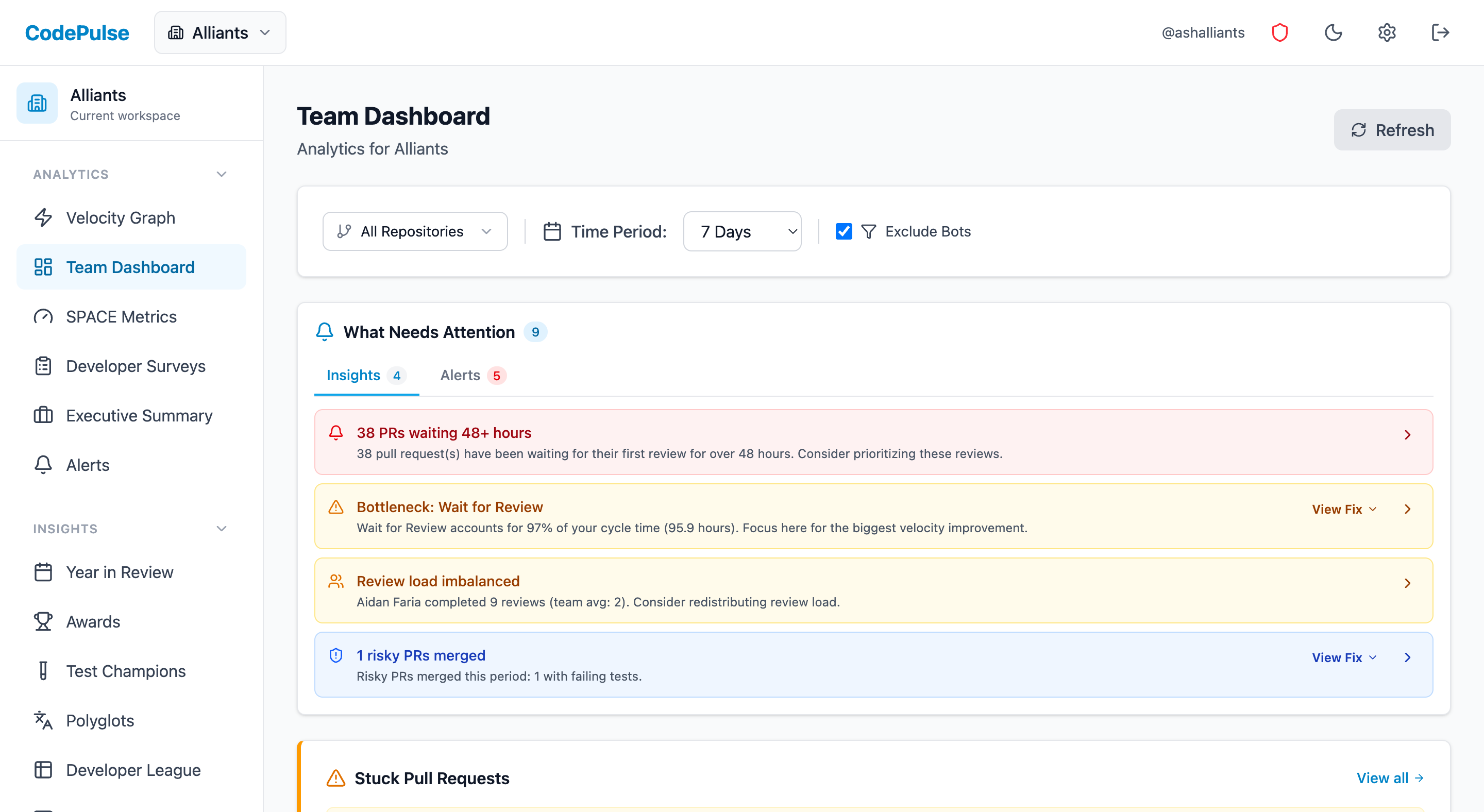
Find out which phase is holding your delivery up
CodePulse splits your cycle time into coding, waiting for review, active review, and merge, so you fix the queue that is actually costing you days. Read-only GitHub, no credit card.
Read-only GitHub · Your code stays yours · Team-level by default · No credit card
See These Features in Action
Break down cycle time into coding, waiting, review, and merge phases.
Track deployment frequency, lead time, and release patterns.
Related Guides
Delivery Excellence: Shipping Fast and Reliably (Without the Heroics)
Delivery excellence is more than shipping fast - it's consistent value delivery with predictability, quality, and sustainability. This guide breaks down the four pillars and how to measure and achieve excellence.
We Cut PR Cycle Time by 47%. Here's the Exact Playbook
A practical playbook for engineering managers to identify bottlenecks, improve review processes, and ship code faster - without sacrificing review quality.
Story Points Are a Scam. Here's What Actually Works
Story points are often waste. Learn how to use historical throughput and cycle time to forecast delivery dates with higher accuracy and less meeting time.
Engineering Metrics Dashboard: The 7 Metrics You Need
Skip vanity metrics. Here are the 7 engineering metrics VPs actually need to track team performance, delivery, and quality.
Value Stream Mapping for Software Teams | Guide
Value stream mapping reveals that most lead time is waiting, not working. This guide shows how to map your software delivery flow, calculate flow efficiency, and identify the biggest improvement opportunities.