
See exactly where your delivery flow is waiting
Preview the phase-by-phase report for review pickup, active review, and merge time. Connect in about five minutes; the initial analysis runs after sync.
Read-only GitHub · Your code stays yours · Team-level by default · No credit card
Delivery excellence isn't just about shipping fast - it's about consistently delivering value to customers with predictability, quality, and sustainability. This guide breaks down what delivery excellence means for engineering organizations and how to measure and achieve it.
What does delivery excellence mean?
Delivery excellence means an engineering organization can reliably turn ideas into working software: shipping frequently, with low failure rates, at a pace the team can sustain. It is measured with leading indicators like cycle time, PR size, and work-in-progress alongside the four lagging DORA metrics (deployment frequency, lead time, change failure rate, MTTR). CodePulse tracks these signals directly from GitHub data, so teams can baseline delivery excellence without CI/CD instrumentation.
What Does Delivery Excellence Mean in Software Engineering?
Delivery excellence is the capability to reliably convert ideas into working software that customers use. It's the outcome of effective software delivery management - the discipline of orchestrating process, tooling, and feedback loops so work flows predictably from commit to customer. Excellence encompasses:
- Speed - Short cycle times from idea to production
- Quality - Low defect rates and stable systems
- Predictability - Consistent delivery cadence
- Sustainability - No burnout, manageable tech debt
- Alignment - Building the right things
Delivery Excellence vs. Related Concepts
| Concept | Focus | Key Metrics |
|---|---|---|
| Delivery Excellence | Holistic delivery capability | DORA, customer satisfaction, predictability |
| Engineering Efficiency | Resource utilization | Output per engineer, cost per feature |
| Developer Productivity | Individual and team output | Velocity, throughput, flow metrics |
| DevOps Maturity | Technical practices | Automation level, deployment frequency |
/// Our Take
Many organizations confuse "delivery excellence" with "shipping fast." But speed without quality isn't excellence - it's technical debt accumulating. And quality without speed isn't excellence either - it's over-engineering.
True delivery excellence requires balance across all dimensions. The DORA metrics framework captures this well: deployment frequency and lead time measure speed, while change failure rate and MTTR measure stability. You need all four.
What Are the Four Pillars of Delivery Excellence?
Pillar 1: Flow Efficiency
Work should flow through your system with minimal waiting. Key aspects:
- Small batch sizes - Smaller PRs, incremental releases
- Low WIP limits - Finish before starting new work
- Fast feedback loops - Quick CI, fast code review
- Reduced handoffs - Cross-functional teams
Pillar 2: Technical Excellence
The codebase and infrastructure enable fast, safe changes:
- Clean architecture - Modular, decoupled systems
- Comprehensive testing - Automated and trustworthy
- Deployment automation - One-click deploys, easy rollback
- Observability - Know when things break
Pillar 3: Process Excellence
The right ceremonies and workflows without bureaucracy:
- Clear priorities - Teams know what matters
- Efficient meetings - Minimal overhead, maximum clarity
- Streamlined approvals - Trust, not gatekeeping
- Retrospectives - Continuous improvement
Pillar 4: Team Excellence
People and culture that enable sustainable delivery:
- Psychological safety - Safe to take risks
- Shared ownership - No hero dependencies
- Continuous learning - Growing skills and practices
- Sustainable pace - No chronic overtime
How Do You Measure Delivery Excellence?
For teams in recovery mode - where delivery has already broken down - measurement starts with a diagnosis, not a dashboard. Our engineering team turnaround plan covers the metrics sequence you need when culture and delivery are both under water. For steady-state teams, the indicators below are the leading/lagging mix to track.
Leading Indicators
Predict future delivery capability:
| Indicator | What It Shows | Good Signal |
|---|---|---|
| Cycle time | How fast work flows | Stable or decreasing |
| WIP | Parallel work in progress | Low relative to team size |
| PR size | Batch size of changes | Small (under 400 lines) |
| Build time | Feedback loop speed | Under 10 minutes |
| Code coverage | Testing investment | Stable or increasing |
Lagging Indicators
Confirm actual delivery outcomes:
| Indicator | What It Shows | Good Signal |
|---|---|---|
| Deployment frequency | Release capability | Daily or more |
| Lead time | Idea to production | Under 1 week |
| Change failure rate | Release quality | Under 15% |
| MTTR | Recovery capability | Under 1 hour |
| Customer satisfaction | Value delivered | NPS trending positive |
📊 How to See This in CodePulse
Track your delivery excellence metrics in CodePulse:
- Executive Summary for overall delivery health grade
- Dashboard for cycle time, throughput, and PR metrics
- Repository Comparison for cross-team benchmarking
What Does a Delivery Excellence Maturity Model Look Like?
Level 1: Ad Hoc
- Unpredictable delivery timelines
- Manual deployment processes
- Firefighting is common
- Metrics: Deploying monthly or less, CFR > 30%
Level 2: Defined
- Consistent processes documented
- Some automation in place
- Regular release cadence
- Metrics: Deploying weekly, CFR 15-30%
Level 3: Optimized
- Continuous improvement embedded
- High automation, fast feedback
- Predictable delivery
- Metrics: Deploying daily, CFR < 15%
Level 4: Elite
- Deploy on demand with confidence
- Near-instant recovery from failures
- Proactive improvement
- Metrics: Multiple deploys/day, CFR < 5%, MTTR < 1 hour
How Do You Improve Delivery Excellence?
Quick Wins (1-4 weeks)
- Reduce PR size limits (enforce 400-line max)
- Add PR review SLAs (24-hour response)
- Eliminate unnecessary approval gates
- Automate repetitive deployment steps
Medium-Term (1-3 months)
- Implement trunk-based development
- Add feature flags for safer releases
- Improve test coverage on critical paths
- Build deployment dashboards
Long-Term (3-12 months)
- Migrate to microservices if bottlenecked
- Implement continuous deployment
- Build platform capabilities for self-service
- Create developer experience team
"The fastest teams aren't moving fast because they're cutting corners. They're moving fast because they've invested in the infrastructure, practices, and culture that makes speed sustainable."
How Do You Build a Delivery Excellence Culture?
Culture is what separates teams that sustain delivery excellence from those that spike and crash. Process changes stick only when the team believes in them. These practices make the difference:
- Make quality everyone's job - When only QA cares about bugs, quality suffers. When every developer owns the stability of their changes, failure rates drop
- Celebrate removal over addition - Reward the engineer who deletes 500 lines while keeping functionality intact. Deletion is harder than creation
- Run blameless postmortems - Incidents are system failures, not personal ones. Teams that fear blame hide problems instead of fixing root causes
- Protect sustainable pace - Burnout is a management failure, not a personal weakness. If your team is routinely working evenings to hit deadlines, the process is broken
- Share context, not just tasks - Engineers who understand why they are building something make better trade-off decisions than engineers who only know what to build
What Are the Most Common Delivery Excellence Anti-Patterns?
Speed Theater
Shipping lots of code without delivering value. Vanity metrics look good but nothing improves for customers. If your team's output doubled but customer satisfaction didn't budge, you optimized the wrong thing. This pattern is covered in depth in our why features aren't shipping faster breakdown of the seven hidden bottlenecks that show up underneath high commit counts.
Quality Gate Overload
So many approval steps that nothing ships. Each gate adds safety in theory but delays delivery in practice. The research is clear: two reviewers catch 90%+ of issues. Adding a third typically adds delay without adding value.
Hero Culture
Reliance on a few key people who can "make things happen." This creates bottlenecks and burnout. When your fastest developer is also your most overworked reviewer, they are not a hero - they are a single point of failure.
Metrics Obsession
Optimizing metrics instead of outcomes. Teams game the numbers while actual delivery suffers. The moment velocity becomes a goal, it stops being useful. You get more PRs, but they are smaller, simpler, and less valuable.
Related Guides
- DORA Metrics Guide - Deep dive into the four key metrics
- Engineering Efficiency Guide - Maximizing output per investment
- Reduce PR Cycle Time - Improving flow efficiency
- DevOps Maturity Model - Assessing technical practices
Conclusion
Delivery excellence is the result of sustained investment across flow, technical practices, processes, and team health. It's not about heroics or shortcuts - it's about building the capability to reliably turn ideas into customer value.
- Balance speed and quality - both matter equally
- Invest in all four pillars - flow, technical, process, team
- Measure leading and lagging indicators - predict and confirm
- Improve continuously - small gains compound over time
- Avoid anti-patterns - speed theater, gate overload, hero culture
Start by assessing your current maturity level using CodePulse's Executive Summary. Then identify the biggest bottleneck in your delivery flow and tackle that first. Excellence is built one improvement at a time.
"Delivery excellence isn't a destination - it's a discipline. The best teams never stop improving, even when they're already good."
Frequently Asked Questions
Delivery excellence is a team capability that measures how reliably an engineering organization ships value to users. Speed alone is not enough - quality, predictability, and sustainable pace matter just as much. A team with delivery excellence ships frequently with low failure rates, recovers quickly from incidents, and does not burn people out in the process.
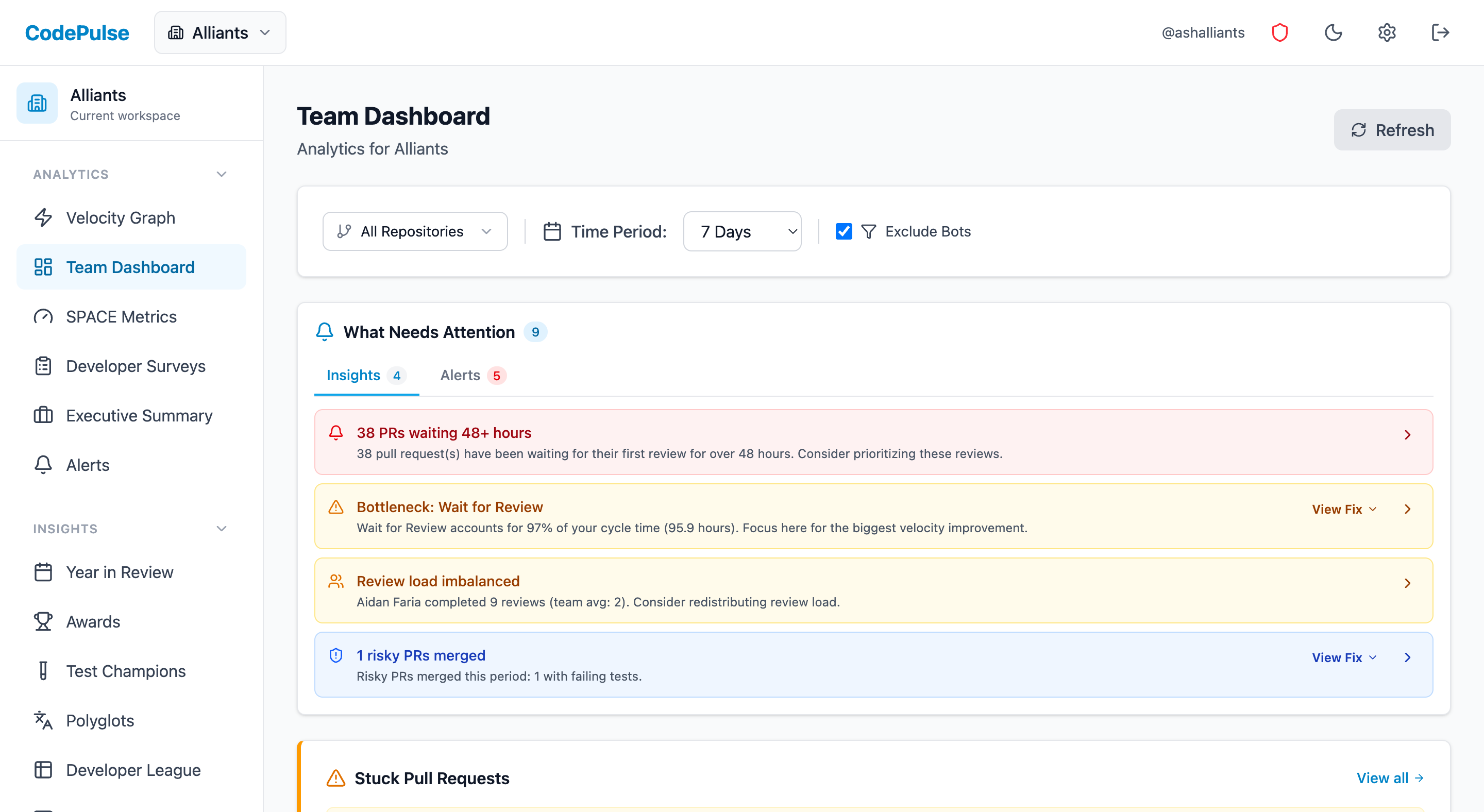
Find out which phase is holding your delivery up
CodePulse splits your cycle time into coding, waiting for review, active review, and merge, so you fix the queue that is actually costing you days. Read-only GitHub, no credit card.
Read-only GitHub · Your code stays yours · Team-level by default · No credit card
See These Features in Action
Break down cycle time into coding, waiting, review, and merge phases.
Track all four DORA metrics and benchmark against industry standards.
Related Guides
DORA Metrics Explained: The 4 Keys Without the Hype
A complete breakdown of the four DORA metrics - deployment frequency, lead time, change failure rate, and MTTR - with honest benchmarks and gaming traps to avoid.
5 Silent Killers Destroying Your Engineering Efficiency
Learn how to measure and improve engineering efficiency without burning out your team. Covers the efficiency equation, bottleneck identification, and sustainable improvement.
We Cut PR Cycle Time by 47%. Here's the Exact Playbook
A practical playbook for engineering managers to identify bottlenecks, improve review processes, and ship code faster - without sacrificing review quality.
DevOps Maturity Model: A Practical Assessment Framework
Assess your DevOps maturity across culture, CI/CD, testing, monitoring, and infrastructure. Includes self-assessment questionnaire and improvement roadmap by level.