
Compare the finished analysis before you choose a platform
See the report CodePulse produces from read-only GitHub workflow data, or connect your own repositories and evaluate the fit with real evidence.
Read-only GitHub · Your code stays yours · Team-level by default · No credit card
Sleuth is a deployment tracking platform focused on DORA metrics and change lead time. This review covers Sleuth's free tier, paid plans, and whether $25/dev/month for the Team plan delivers enough value compared to alternatives.
How much does Sleuth cost?
Sleuth offers a free tier for up to 10 developers with basic deployment tracking and DORA metrics. The Team plan costs $25/dev/month and adds advanced DORA metrics, incident tracking, multiple environments, and Slack notifications. Enterprise pricing requires a sales call. For a 50-developer team on Team, expect $15,000/year.
Pricing Overview
Sleuth is transparent about its pricing. The free tier provides a genuine starting point for small teams, and the Team tier is clearly documented at $25/dev/month. This puts Sleuth in the mid-range of engineering analytics tools, positioned between budget-friendly options and enterprise platforms.
| Plan | Price | Key Features | 50-Dev Annual Cost |
|---|---|---|---|
| Free | $0 (up to 10 devs) | Deploy tracking, basic DORA, change lead time, GitHub | N/A (10-dev limit) |
| Team | $25/dev/month | Advanced DORA, incident tracking, multiple environments, Slack | $15,000/year |
| Enterprise | Contact Sales | Everything in Team + SSO/SAML, custom integrations, SLA support | Custom quote |
What You Get at Each Tier
Free (up to 10 developers)
The free tier tracks deployments and provides basic DORA metrics, specifically change lead time. It integrates with GitHub and gives small teams a real taste of deployment-driven analytics. Unlike some competitors' free tiers, Sleuth's is focused on deployment tracking rather than general PR metrics, which gives it genuine utility for CI/CD-focused teams.
Team ($25/dev/month)
The Team tier unlocks advanced DORA metrics, including deployment frequency, change failure rate, and mean time to recovery. Incident tracking connects deployment events to production issues. Support for multiple environments lets you track staging, production, and other deployment targets separately. Slack notifications keep teams informed about deployment status.
Enterprise (Contact Sales)
Enterprise adds SSO/SAML, custom integrations, and SLA-backed support. This tier is for organizations that need compliance features and guaranteed response times.
Hidden Costs to Watch For
- Narrow scope -- Sleuth focuses on deployment metrics. If you also need PR review analytics, code quality metrics, or team collaboration insights, you will need a second tool.
- Deploy tracking setup -- Sleuth works best when connected to your actual deployment pipeline. This requires CI/CD integration work that varies by environment complexity.
- Free-to-Team jump -- Going from free (10 devs) to Team (11+ devs) costs $275/month minimum. The price increase is steep for the incremental value.
- No code-level insights -- No file hotspots, knowledge silos, or review network analysis. Teams needing code health metrics will need supplementary tooling.
- Limited team comparison -- Sleuth focuses on per-project deployment metrics rather than cross-team comparisons, which limits its value for engineering managers overseeing multiple teams.
"Sleuth measures deployment velocity better than anyone. The question is whether deployment velocity is the only metric that matters to your team."
🔥 Our Take
Sleuth is the best deployment tracking tool in the engineering analytics space. If your primary goal is measuring and improving DORA metrics from actual deployment events (not just PR merges), Sleuth delivers the most accurate data. But deployment metrics are one slice of engineering health, and $25/dev/month for a single dimension of visibility is hard to justify when broader tools exist at similar or lower price points.
The free tier is genuinely useful and worth testing. If deployment tracking alone solves your problem, Sleuth earns its price. If you need PR analytics, review patterns, code quality metrics, and team collaboration insights alongside DORA, you are better served by a platform that covers the full spectrum.
How Sleuth Compares to CodePulse Pricing
| Feature | Sleuth | CodePulse |
|---|---|---|
| Free Tier | Up to 10 devs | Up to 10 devs |
| Starting Price | $25/dev/month | $199/month flat (Pro, up to 50 devs) |
| 50-Dev Annual Cost | $15,000 | $9,000 (Pro) / $15,000 (Business) |
| Deploy Tracking | Excellent (from actual deploys) | DORA metrics from PR merges |
| PR Review Analytics | No | Full review network, sentiment, bottlenecks |
| File Hotspots | No | Yes, with knowledge silo detection |
| Incident Tracking | Yes (Team tier) | No |
"If you already know your problem is deployment frequency, Sleuth is the answer. If you are still figuring out where the bottleneck is, you need broader visibility first."
If you are in that second group, find the bottleneck before you buy a tool aimed at one. An engineering health audit reads your existing GitHub history and tells you whether the delay is in review, in deployment, or somewhere you were not looking - which is the answer you need before deciding what to pay for.
Who Should Pay for Sleuth?
Sleuth is worth the investment when:
- Your primary goal is improving DORA metrics from actual deployment pipelines
- You need accurate change lead time and deployment frequency measurements
- Incident tracking connected to deployment events is important to your workflow
- Your team has a CI/CD pipeline already configured for integration
Look elsewhere when:
- You need a broad engineering analytics platform, not just deployment tracking
- PR review analytics, code quality metrics, and collaboration patterns matter to you
- You want file hotspot detection and knowledge silo analysis
- $25/dev/month feels expensive for deployment metrics alone
- You need team comparison capabilities across multiple squads
"DORA metrics from PR merges and DORA metrics from actual deployments tell different stories. Know which story you need before choosing your tool."
Frequently Asked Questions
Sleuth is free for up to 10 developers. The Team plan costs $25 per developer per month and includes advanced DORA metrics, incident tracking, and Slack notifications. Enterprise pricing is custom.
Pricing last verified March 2026. Visit sleuth.io for current pricing.
Related Reading
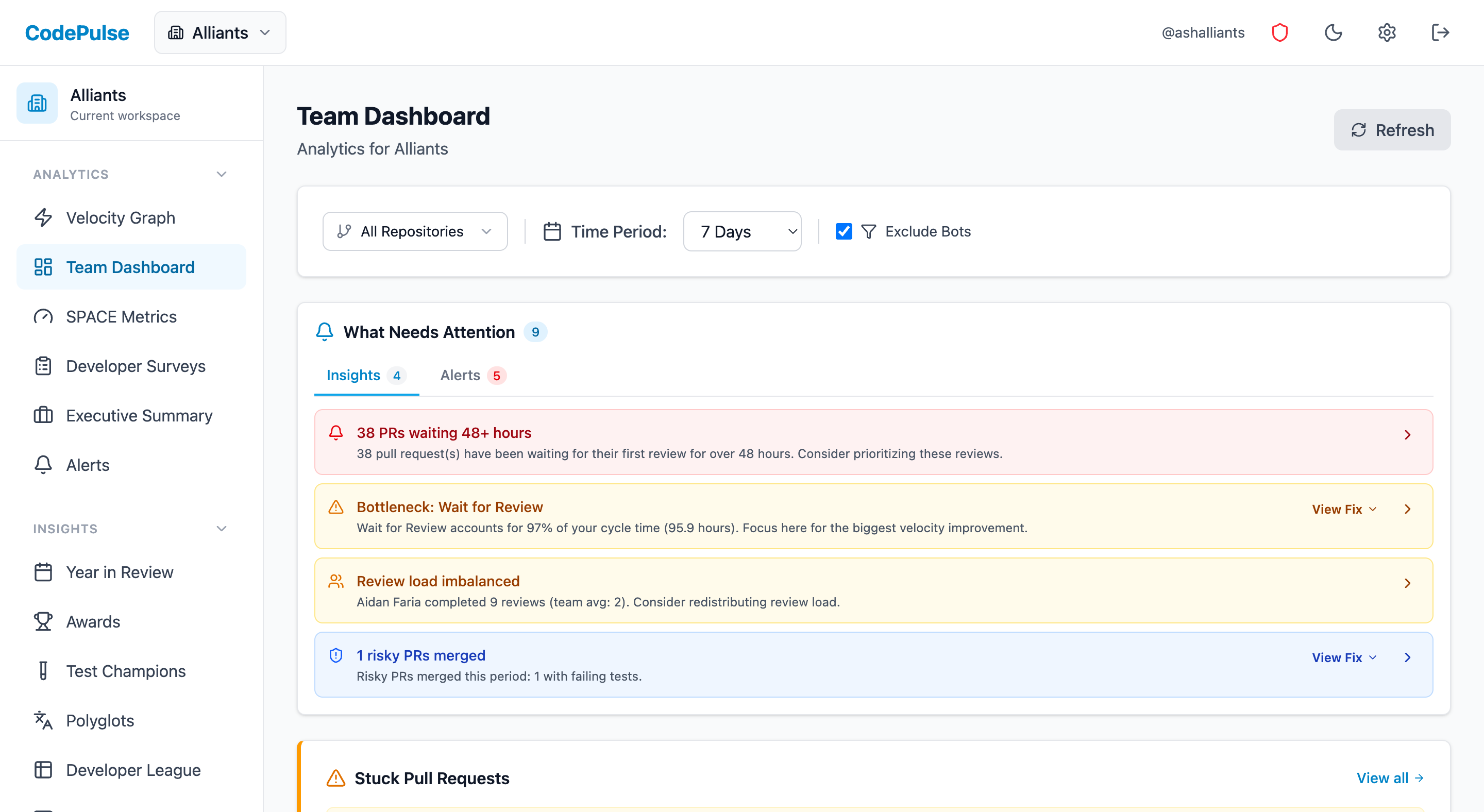
Evaluate CodePulse against your own delivery history
A comparison table only goes so far. Connect read-only GitHub in about five minutes and judge the output on your repositories, at one flat price, with no per-seat math.
Read-only GitHub · Your code stays yours · Team-level by default · No credit card
See These Features in Action
Track all four DORA metrics and benchmark against industry standards.
Track deployment frequency, lead time, and release patterns.
Related Guides
Sleuth Alternative: Why Teams Switch to CodePulse
Honest comparison of Sleuth vs CodePulse for engineering analytics. Feature comparison, pricing, and a decision framework for choosing the right tool.
Jellyfish vs LinearB vs Swarmia: Full 2026 Comparison
Compare Jellyfish, LinearB, Swarmia, Allstacks, Haystack and more engineering analytics tools. Features, pricing, cycle time benchmarks, and integrations.
Best Engineering Analytics Tools for 2026 (Ranked by Real Users)
We ranked the 10 best engineering analytics tools based on metric depth, setup speed, pricing transparency, and privacy posture. Honest pros and cons for each.