
Find quality and ownership risk before it becomes an incident
Preview how CodePulse combines review depth, risky changes, hotspots, and knowledge concentration without turning activity into individual scores.
Read-only GitHub · Your code stays yours · Team-level by default · No credit card
"Quality engineering" gets used two different ways, and the confusion is doing real damage in job postings and vendor pitches alike: sometimes it's a rebrand of QA with a more modern-sounding title, and sometimes it's a genuinely different discipline that treats quality as everyone's job across the whole delivery pipeline, not a checkpoint at the end. The second definition is the one worth building toward, and it changes what you measure as much as what you do.
What is quality engineering?
Quality engineering is the discipline of building quality into every stage of software delivery - design, code review, CI/CD, deployment, and production monitoring - rather than testing for it after the fact. It's broader than traditional QA, which typically means a dedicated team manually verifying a finished build before release. Quality engineering shifts that work left (catching problems earlier, when they're cheaper to fix) and automates most of what used to require a manual test pass, treating metrics like test pass rate, defect escape rate, and code churn as continuous signals rather than a one-time gate.
The shift matters because the economics of a bug change enormously depending on where in the pipeline it's caught. A defect found in code review costs a comment and a re-push. The same defect found by a manual QA tester the week before release costs a context switch and a delay. Found in production, it costs an incident, a rollback, and possibly customer trust. Quality engineering is the set of practices aimed at catching more defects at the cheap end of that curve.
QA asks "did we build it right before we ship it?" Quality engineering asks "how do we make it structurally hard to build it wrong in the first place?"
How Does Quality Engineering Differ From QA?
Traditional QA is a role and a stage: a dedicated team tests a build that developers have already finished, usually close to a release date, often manually, and usually with the authority to block a release but not much upstream influence over how the code was written. It works, but it's expensive per bug caught (defects found this late take longer to fix) and it creates a natural adversarial dynamic between "the people who build it" and "the people who catch what's wrong with it."
Quality engineering distributes that responsibility instead of concentrating it. Automated test suites run on every pull request rather than once before release. CI/CD gates block a merge on a failing check rather than waiting for a human to notice. Developers own testability as part of the design, not as someone else's problem after the fact. The job title "quality engineer" or "SDET" (software development engineer in test) reflects that shift: the person in that role writes test automation and pipeline tooling, not just manual test cases.
What Should You Actually Measure?
No single metric captures quality, and treating any one of them as a scorecard invites gaming it. The pattern across several metrics, tracked over time, is what's actually informative.
| Metric | What it tells you | Where it comes from |
|---|---|---|
| Test pass rate | How often CI catches something before merge | CI check history |
| Defect escape rate | Bugs that make it to production despite the pipeline | Issue tracker + incident data |
| Test coverage | How much of the code automated tests actually exercise | Coverage tooling (not GitHub metadata) |
| Code churn | How much recently merged code gets rewritten soon after | Git history |
| Review coverage | Share of PRs that get a real human review, not a rubber stamp | PR review history |
* Our Take
A "quality engineering" job title with no automated CI gate and no churn tracking is usually QA with a rebrand, not the discipline it's named after.
The tell is where the checks live. If quality work still happens mostly at the end, mostly manually, and mostly by one team, the title changed but the shape didn't. Real quality engineering shows up as automated gates earlier in the pipeline and as metrics tracked continuously rather than reported once before a release.
Where Does CodePulse Fit?
CodePulse covers the delivery-side half of quality engineering - the metrics visible from GitHub and CI history - without covering the test-execution half, which stays the job of your test runner and coverage tooling. It's a complement to a quality engineering practice, not a substitute for one.
* How to See This in CodePulse
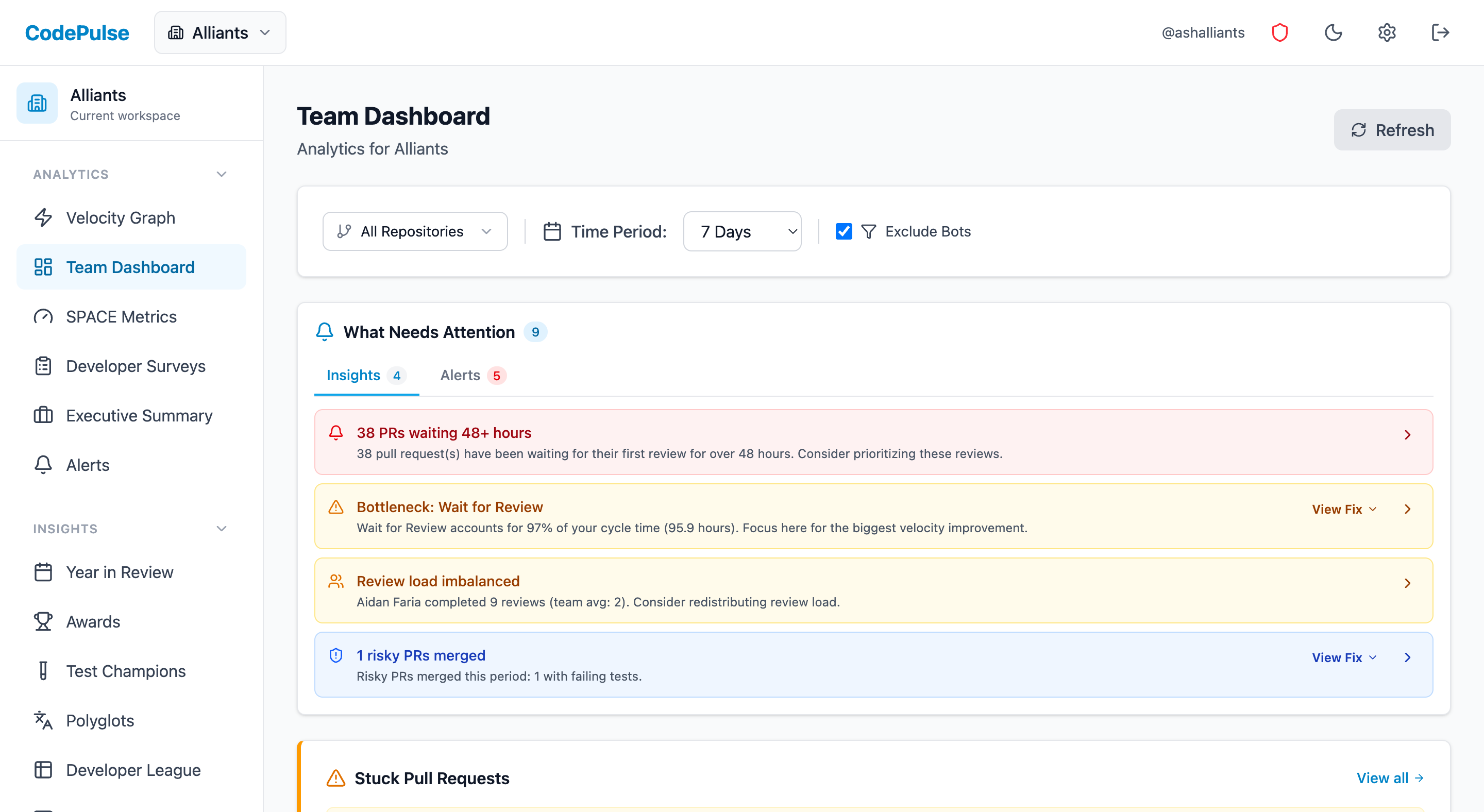
Navigate to Dashboard for the delivery-side quality signals tracked automatically from GitHub:
- Test failure rate from CI check history, with no new instrumentation required
- Code churn trends to see where rework is concentrated
- Review coverage to catch PRs merging with a rubber-stamp approval rather than a substantive review
A quality engineering practice worth the name doesn't stop measuring once the dashboard shows one good sprint.
For the two most-cited complexity metrics that feed into a quality engineering practice, see our cyclomatic complexity and cognitive complexity guides, or our full code quality tools comparison for how the tools stack up.
If you want to see your own delivery-side quality signals before your next retro, start a free CodePulse trial. It reads directly from your GitHub history, so there's nothing to configure before you see real numbers.
Frequently Asked Questions
Quality engineering is the practice of building quality into the software delivery process itself - test automation, CI/CD gates, code review standards, static analysis, and observability - rather than treating quality as a separate inspection step that happens after development finishes. It's a superset of traditional QA: QA historically meant a dedicated team testing a finished build before release, while quality engineering means every stage of the pipeline (design, code review, CI, deployment, monitoring) owns some share of the quality outcome.
See which files and owners carry your real risk
Connect GitHub and get your churn hotspots, single-owner modules, and review-depth signals ranked by exposure. No repository cloning, no file contents read.
Read-only GitHub · Your code stays yours · Team-level by default · No credit card
See These Features in Action
Explore all featuresRelated Guides
Cyclomatic Complexity Explained (With Real Thresholds)
What cyclomatic complexity actually measures, how it is calculated, the widely cited risk bands, and where it falls short as a readability signal.
Cognitive Complexity Explained (vs Cyclomatic)
What cognitive complexity measures, how SonarSource's algorithm scores nesting and control-flow breaks, and how it differs from cyclomatic complexity.
Your CI Is Crying for Help. Here's What It's Telling You
Understand what test failure rate measures, identify patterns causing CI failures, and implement strategies to improve your pipeline reliability.
High Code Churn Isn't Bad. Unless You See This Pattern
Learn what code churn rate reveals about your codebase health, how to distinguish healthy refactoring from problematic rework, and when to take action.
100% Review Coverage Is a Lie (What Actually Matters)
Why 100% review coverage matters, how to track it, and practical steps to build a consistent code review culture across your team.
Code Quality Tools in 2026: Most Are Useless (3 Aren't)
Compare engineering analytics tools specifically for code quality features: hotspot detection, knowledge silos, test analytics, and review sentiment.