
Find quality and ownership risk before it becomes an incident
Preview how CodePulse combines review depth, risky changes, hotspots, and knowledge concentration without turning activity into individual scores.
Read-only GitHub · Your code stays yours · Team-level by default · No credit card
Cognitive complexity exists because cyclomatic complexity, for all its usefulness, answers the wrong question if what you actually care about is readability. SonarSource introduced the metric in 2016 specifically to measure how hard a function is for a human to follow, by weighting nesting depth and control-flow breaks the way a reader actually experiences them - rather than counting every branch as equally costly. It's now SonarQube's default maintainability signal, and increasingly the metric teams reach for when a cyclomatic complexity score doesn't match what code review actually feels like.
What is cognitive complexity?
Cognitive complexity is a code metric from SonarSource (2016) that estimates how hard a function is for a human to read, by scoring nesting depth and breaks in linear control flow more heavily than flat structures. It's designed to fix a specific weakness in cyclomatic complexity: a flat, easy-to-scan switch statement with many cases can score as 'complex' under cyclomatic complexity while scoring low on cognitive complexity, because nesting - not raw branch count - is what actually taxes a reader's working memory. SonarQube defaults its warning threshold to 15 per function.
The two metrics aren't rivals. Cyclomatic complexity is still the better signal for "how many tests does this need." Cognitive complexity is the better signal for "how long will it take someone to safely change this." Most mature code-quality setups track both.
A ten-case switch statement and a triple-nested conditional can carry the same cyclomatic complexity score. Only one of them will actually slow a reviewer down.
How Is Cognitive Complexity Calculated?
SonarSource's algorithm applies three kinds of increments. First, a flat increment of 1 for every break in the normal linear flow: an if, a loop, a catch, a goto-style jump, or a logical operator sequence in a condition. Second, a nesting increment that adds 1 for each level of nesting the structure sits inside - so the same if costs more the deeper it's buried inside other conditionals or loops. Third, and distinctively, some constructs are deliberately exempt from the penalty a naive count would apply: a switch statement's cases don't each add nesting cost the way an equivalent chain of else ifs would, and simple boolean short-circuits are treated more gently than cyclomatic complexity treats them.
Why Was Cognitive Complexity Introduced?
SonarSource's 2016 paper describes a real, recurring problem with using cyclomatic complexity as a refactoring trigger: teams would restructure code specifically to lower the score, without making it any easier to read. A flat, ten-case switch statement is a common target - splitting it into smaller functions to duck under a cyclomatic complexity threshold, when the original was already simple to scan from top to bottom. That's optimizing for the metric instead of the outcome the metric was supposed to represent.
Cognitive complexity was built to close that gap by tracking something closer to felt reading difficulty: how many things a reader has to hold in their head at once, and how deep they have to follow a thread of nested logic before reaching the bottom. It doesn't replace cyclomatic complexity's role in estimating test coverage needs - a flat switch statement genuinely does need more test cases than a single if - it adds a second, complementary lens for the maintainability question specifically.
| Question | Cyclomatic complexity | Cognitive complexity |
|---|---|---|
| Estimates | Test cases needed for full path coverage | How hard the function is for a human to read |
| Weights nesting | No - every branch counts the same regardless of depth | Yes - deeper nesting costs more per branch |
| Flat switch statement | Scores high (one point per case) | Scores low (cases don't add nesting cost) |
| Origin | Thomas McCabe, 1976 | SonarSource, 2016 |
| Tooling coverage | Near-universal across static analysis tools | Primarily SonarQube and its plugin ecosystem |
* Our Take
If your team only tracks one complexity metric, cognitive complexity is the better single choice for guiding refactoring decisions - it's closer to what reviewers actually feel.
Keep cyclomatic complexity around for test-planning purposes; a function still needs a test per independent path regardless of how it reads. But when a code review comment says "this is hard to follow," cognitive complexity is measuring closer to that complaint than cyclomatic complexity ever was.
Where Does CodePulse Fit?
Cognitive complexity is parser-level static analysis - SonarQube's specific domain, not something CodePulse computes from GitHub metadata. What CodePulse can add is context SonarQube doesn't have: which of the files a scanner flags as cognitively complex are also the ones your team keeps coming back to, and how concentrated the knowledge of those files has become.
* How to See This in CodePulse
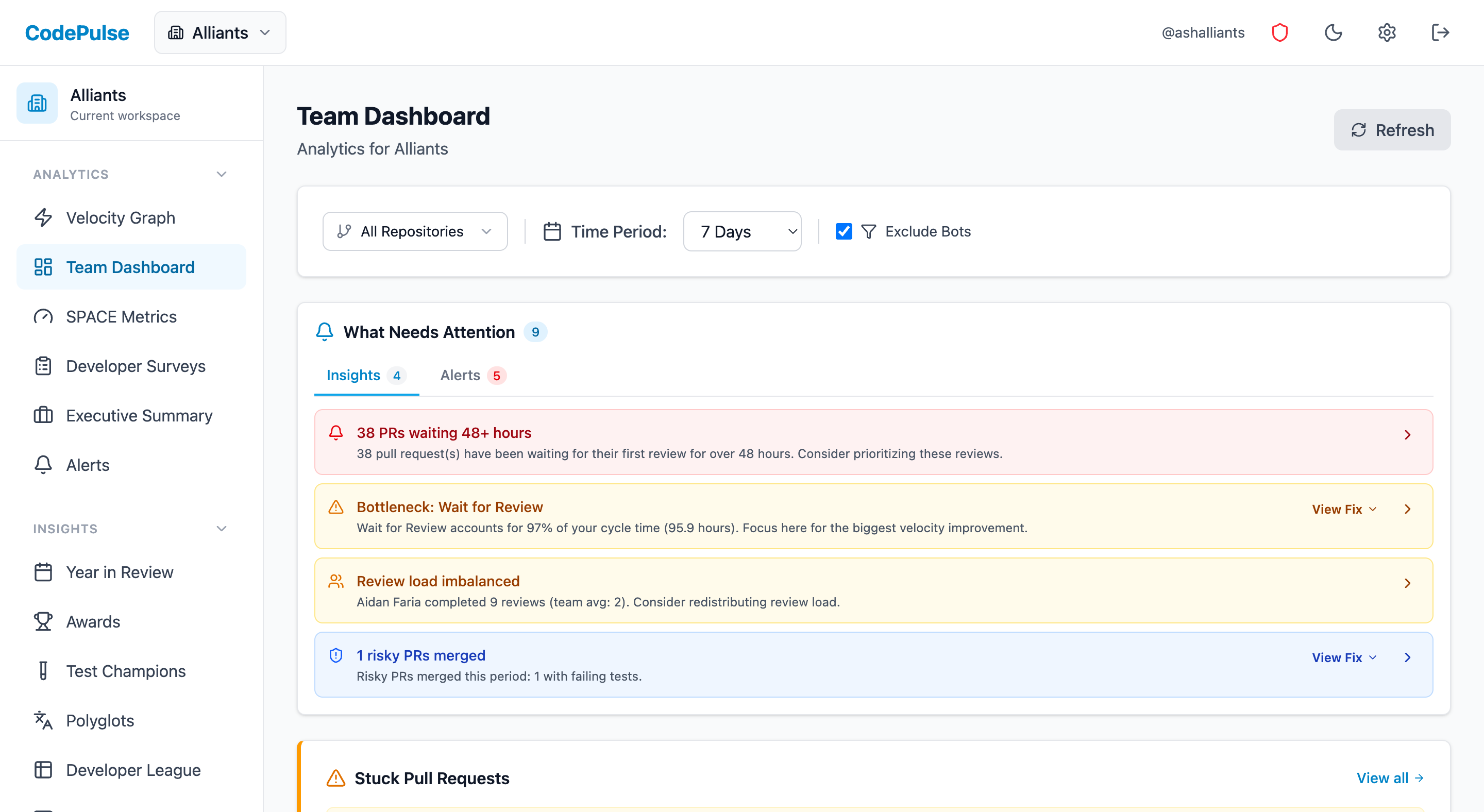
Navigate to File Hotspots to cross-reference SonarQube's flagged files against real change activity:
- Change frequency and lines changed, so you can see whether a "complex" file is actually being touched often
- Unique contributor count, since a hard-to-read file with one owner is a bigger risk than one three people regularly work in
- Check Knowledge Silos for files where a single developer holds most of the recent history
A high cognitive complexity score on a file nobody touches is a someday problem. The same score on a file three people edit every sprint is a this-quarter problem.
For the older, testing-oriented sibling metric, see our cyclomatic complexity guide. For the discipline both feed into, see what quality engineering covers, or our bus factor and knowledge silo guide for the ownership-concentration angle on the same files.
If you want to see your own file hotspots and knowledge concentration before your next refactor sprint, start a free CodePulse trial. It reads directly from your GitHub history, so there's nothing to configure before you see real numbers.
Frequently Asked Questions
Cognitive complexity is a code metric introduced by SonarSource in a 2016 white paper ("Cognitive Complexity, a new way of measuring understandability") designed to estimate how hard a piece of code is for a human to read, rather than how many test cases it needs. It increments for each nesting level and each break in the normal top-to-bottom flow of a function - conditionals, loops, catches, and jumps - and it increments more for logic nested inside other logic. Unlike cyclomatic complexity, it deliberately does not penalize flat structures like a switch statement or a sequence of independent early returns, because those don't add real reading difficulty.
See which files and owners carry your real risk
Connect GitHub and get your churn hotspots, single-owner modules, and review-depth signals ranked by exposure. No repository cloning, no file contents read.
Read-only GitHub · Your code stays yours · Team-level by default · No credit card
See These Features in Action
Explore all featuresRelated Guides
Cyclomatic Complexity Explained (With Real Thresholds)
What cyclomatic complexity actually measures, how it is calculated, the widely cited risk bands, and where it falls short as a readability signal.
What Is Quality Engineering? (vs QA)
Quality engineering distributes quality checks across design, review, CI, and production monitoring instead of a single QA gate before release.
The 'Bus Factor' File That Could Kill Your Project
Use the Bus Factor Risk Matrix to identify where knowledge concentration creates hidden vulnerabilities before someone leaves.
High Code Churn Isn't Bad. Unless You See This Pattern
Learn what code churn rate reveals about your codebase health, how to distinguish healthy refactoring from problematic rework, and when to take action.
Code Quality Tools in 2026: Most Are Useless (3 Aren't)
Compare engineering analytics tools specifically for code quality features: hotspot detection, knowledge silos, test analytics, and review sentiment.