
Turn this metric into a baseline for your team
Preview a system-level engineering health report, then connect GitHub when you are ready to compare this metric with your own delivery history.
Read-only GitHub · Your code stays yours · Team-level by default · No credit card
Product teams measure adoption, retention, and revenue. Engineering teams measure cycle time, quality, and velocity. Both teams claim they want "alignment," but most organizations have no shared language for deciding what to build, how fast to build it, or whether it actually worked. According to the 2024 State of Engineering Management Report by Jellyfish, only 38% of engineering leaders say they have strong alignment with product teams on priorities. This guide is for the other 62%.
"If your product-engineering alignment strategy is 'link every PR to an OKR,' congratulations—you have created the world's most expensive tagging system."
The Product-Engineering Alignment Problem
The gap between product and engineering is not a communication problem. It is a measurement problem. Product teams optimize for outcomes they can see: feature adoption, user retention, revenue per feature. Engineering teams optimize for outcomes they can measure: deployment frequency, code quality, cycle time. Neither set of metrics is wrong. But neither tells the full story.
Here is what the misalignment actually looks like in practice:
- Product ships a feature request. Engineering delivers it in two sprints. Product celebrates. Six months later, usage data shows 3% adoption. Nobody connects the dots.
- Engineering spends a quarter on reliability work. Product sees zero new features shipped. The board asks why velocity dropped. Engineering cannot articulate the business impact of preventing 47 incidents.
- Both teams agree on OKRs. Engineering links PRs to objectives. Product links feature requests to the same objectives. At quarter-end, both teams report "on track" while customers complain about the same issues.
The Product-Engineering Measurement Gap
The root cause is not that teams do not talk. It is that they measure success in incompatible units. Product measures in customer behaviors. Engineering measures in delivery mechanics. Alignment requires a shared measurement framework that translates between the two, not a Jira plugin that draws lines between tickets and OKRs.
Product Metrics Every Engineering Leader Should Know
You do not need to become a product manager. But if you lead an engineering organization, you need to understand the metrics your product counterpart is being measured on. Not because you should optimize for them, but because you need to translate your work into their language.
| Product Metric | What It Measures | Why Engineering Should Care |
|---|---|---|
| Feature Adoption Rate | % of users who use a new feature within 30 days | Low adoption may signal poor UX, not poor product vision. Engineering can help diagnose |
| Time-to-Value | Time from signup to first meaningful action | Performance, onboarding flows, and API latency directly impact this number |
| Feature Usage Decay | Drop-off rate after initial feature use | Bugs, slow performance, and poor error handling accelerate decay |
| NPS Impact of Releases | NPS change correlated with specific releases | Connects deployment quality to customer satisfaction |
| Revenue per Feature | Revenue attributable to specific capabilities | Helps engineering prioritize maintenance and performance investment |
The point is not to make engineering teams responsible for product metrics. The point is to understand what "success" looks like on the other side of the table. When your product leader says a feature "did not land," you need to know whether that means low adoption (discovery problem), high churn (quality problem), or flat revenue impact (positioning problem). Each diagnosis leads to a different engineering response.
For a deeper dive into how to present engineering work in business terms, see our guide on building the business case for engineering metrics.
Engineering Metrics Your Product Team Should Know
Product teams do not need a DORA metrics crash course. They need to understand four things about how engineering works, expressed in terms that connect to their world.
"Product teams do not need to understand cycle time. They need to understand what it means for their launch date. Translate, do not educate."
| Engineering Metric | What It Measures | How to Translate for Product |
|---|---|---|
| Cycle Time | Time from first commit to production | "When you file a request, here is how long it takes to reach customers" |
| Code Churn | % of code rewritten within 2 weeks of merging | "This is our rework rate—high churn means unclear requirements or rushed specs" |
| PR Size Distribution | Lines changed per pull request | "Large changes carry more risk. Big feature requests = more risk per release" |
| Deployment Frequency | How often code reaches production | "We can ship changes X times per week. Feature batching slows this down" |
The translation layer is critical. When engineering tells product "our cycle time increased 40% this quarter," product hears noise. When engineering says "it now takes 5 days instead of 3.5 days for your feature requests to reach customers, and here is why," product hears something they can act on.
This translation is exactly what a board-ready engineering metrics framework provides: engineering data expressed in business language that product leaders, executives, and board members can all understand.
The Proxy Metrics Trap: OKRs, Story Points, and Vanity Alignment
Most organizations attempt product-engineering alignment through proxy metrics. The logic goes: if we link engineering output to product OKRs, we have alignment. This is almost always wrong.
Here is why the common approaches fail:
- OKR-linked engineering metrics create perverse incentives. Engineers optimize for "linked" work and deprioritize unlinked but critical work like security patches, performance improvements, and tech debt reduction. The result is a team that looks aligned on paper but is accumulating invisible risk.
- Story points as alignment currency are meaningless across teams. A "5-point story" on one team is a "13-point epic" on another. Using them to compare product investment across teams is like comparing temperatures in Fahrenheit and Celsius without converting. For more on why, read our take on software OKR examples that actually work.
- Velocity tracking measures activity, not outcomes. A team that ships 50 story points of features nobody uses is not aligned with product. A team that ships 10 points of the right feature with 80% adoption is.
🔥 Our Take
The hardest truth in product-engineering alignment: the most impactful engineering work is often invisible to product metrics. A refactor that prevents 6 months of incidents will never show up in your feature adoption dashboard. Alignment does not mean making engineering metrics look like product metrics—it means giving both teams the shared vocabulary to make trade-offs together.
If your alignment strategy requires engineers to tag every commit with a product objective, you have created overhead, not alignment. Real alignment comes from shared visibility into delivery patterns, work classification, and quality signals—not from metadata tagging.
The Proxy Metrics Trap vs Real Alignment
What actually connects product and engineering is not OKR linkage. It is three things: delivery predictability (can product trust the timeline?), quality signals (does shipped work stay shipped?), and work classification (where is engineering time actually going?).
Building a Product-Engineering Alignment Dashboard
Stop trying to build one dashboard that satisfies both teams. Instead, build a shared view around four metrics that both product and engineering care about, expressed in terms both teams understand.
| Shared Metric | Product Reads It As | Engineering Reads It As | Source |
|---|---|---|---|
| Feature vs. Maintenance Ratio | How much capacity goes to new features vs. keeping the lights on | Investment balance and tech debt pressure | Work classification from PRs |
| Delivery Predictability | Can I trust the date engineering gives me? | Cycle time consistency (std deviation) | PR merge timestamps |
| Quality Gate Pass Rate | How often do releases cause problems? | Change failure rate and review thoroughness | CI/CD and review data |
| Rework Rate | How often do we have to go back and fix what we shipped? | Code churn, hotfix frequency | Git history analysis |
The feature vs. maintenance ratio is the single most productive conversation starter between product and engineering. When product sees that 60% of engineering capacity goes to maintenance, they stop asking "why is velocity down?" and start asking "what do we need to fix so we can ship more features?" That is alignment.
For a detailed breakdown of how to track and optimize this ratio, see our guide on feature vs. maintenance balance.
How CodePulse Enables Product-Engineering Alignment
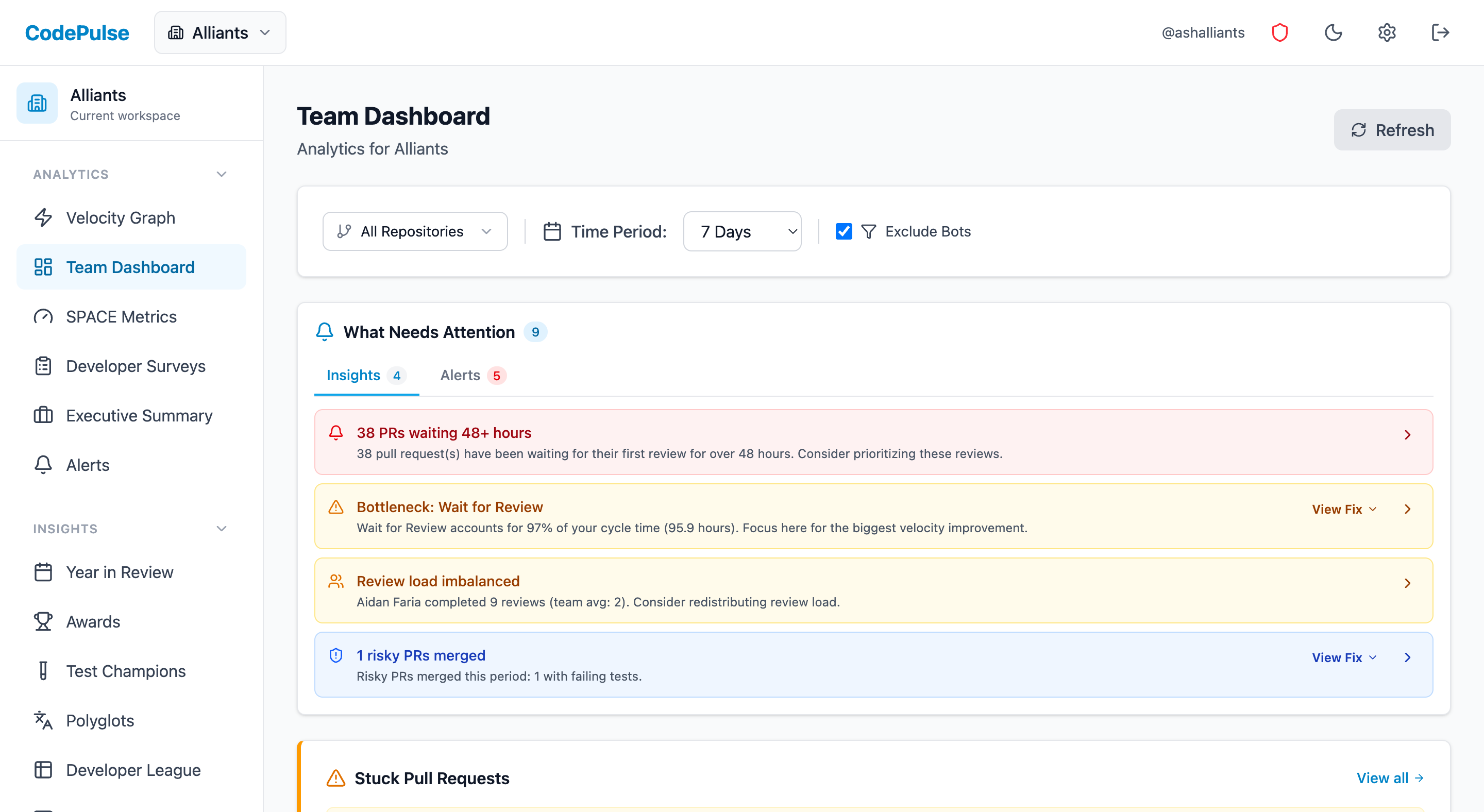
CodePulse automatically classifies engineering work into feature, maintenance, tech debt, bug fix, and infrastructure categories, giving both product and engineering a shared view of where time goes without any manual tagging.
- Dashboard – Real-time delivery metrics both teams can share
- Executive Summary – Board-ready view of engineering investment and velocity
- Repository Comparison – Compare delivery patterns across product areas
Achieving Alignment Without a $200K Platform
Enterprise platforms like Jellyfish sell product-engineering alignment through OKR correlation engines, investment classification powered by Jira metadata, and executive dashboards that promise to show where every engineering dollar goes. The price tag: $150K-$250K per year for a mid-sized organization.
Here is what they actually deliver that matters:
- Shared delivery visibility – both teams can see what shipped and when
- Work classification – automatic categorization of feature vs. maintenance work
- Quality signals – indicators that shipped work is stable
That is it. The OKR correlation, the investment allocation forecasting, the AI-powered strategic insights—these are features that look great in demos but rarely change decisions in practice. The 80% of value comes from the three basics above.
"The companies with the best product-engineering alignment do not have the best tools. They have the shortest feedback loops between 'we shipped it' and 'it worked.'"
You can achieve this with a combination of tools you likely already have—or tools that cost a fraction of an enterprise platform:
- CodePulse for delivery visibility, work classification, and quality signals from your Git data. No manual tagging, no Jira dependency, no six-month implementation.
- Your existing product analytics tool (Amplitude, Mixpanel, PostHog) for feature adoption and usage data.
- A shared weekly review where product and engineering look at the same four metrics from the alignment dashboard above.
The most effective alignment practice is not a tool—it is a 30-minute weekly meeting where product and engineering review the same data together. No platform can replace that habit. For a broader view of how delivery metrics connect to organizational outcomes, see our delivery excellence guide.
Frequently Asked Questions
Feature adoption rate. It is the most direct signal of whether what you built actually matters to users. If your team ships a feature in record time with perfect code quality and zero bugs, but only 3% of users ever touch it, that is a product-engineering alignment failure—not an engineering success.
Now measure this metric on your own repositories
Connect read-only GitHub in about five minutes and get your baseline, your trend, and the constraint behind it. Your fourteen usable trial days start when the first repository finishes syncing.
Read-only GitHub · Your code stays yours · Team-level by default · No credit card
See These Features in Action
Board-ready engineering performance in a single page.
See where engineering effort goes across features, maintenance, and debt.
Related Guides
Engineering OKR Examples That Drive Outcomes (Not Activity)
Most engineering OKRs fail because they measure activity instead of outcomes. This guide provides real OKR examples across delivery, quality, developer experience, and team growth - with templates and anti-patterns.
Why the 70/30 Rule Is Killing Your Engineering Team
Find the right balance between shipping new features and maintaining existing code using engineering metrics and data-driven strategies.
I Got $2M in Budget With These 5 Engineering Metrics
Learn how to create engineering metrics presentations that resonate with board members, investors, and C-suite executives.
How I Got Engineering Metrics Budget Approved in 1 Meeting
Learn how to justify engineering analytics investment to CFOs, CEOs, and boards by translating technical value into business outcomes.
Delivery Excellence: Shipping Fast and Reliably (Without the Heroics)
Delivery excellence is more than shipping fast - it's consistent value delivery with predictability, quality, and sustainability. This guide breaks down the four pillars and how to measure and achieve excellence.