
Turn this metric into a baseline for your team
Preview a system-level engineering health report, then connect GitHub when you are ready to compare this metric with your own delivery history.
Read-only GitHub · Your code stays yours · Team-level by default · No credit card
You know engineering analytics would help your team. But getting budget approval means convincing people who don't speak engineering. This guide helps VPs and Directors of Engineering build the business case for engineering metrics - translating technical value into language that resonates with CFOs, CEOs, and boards.
How do you build the business case for engineering metrics?
Frame engineering metrics as a business investment, not a technical tool. Calculate the cost of invisible problems: a 50-engineer team with typical review bottlenecks wastes roughly $1-6M annually in avoidable wait time alone. Present conservative ROI (20-30% improvement), propose a one-team pilot to prove value, and translate technical metrics into business outcomes like time-to-market, risk reduction, and delivery predictability. CodePulse provides the data to build and sustain this case.
These frameworks help connect engineering visibility to business outcomes, from justifying a new tool to making the case for dedicated headcount or advocating for measurement as a practice.
What Is the Hidden Cost of Not Measuring?
What You Can't See, You Can't Fix
Most engineering organizations operate with significant blind spots. Without measurement, common problems go unaddressed:
- Invisible bottlenecks: PRs waiting days for review while everyone assumes the pipeline is fine
- Uneven workloads: Some engineers overloaded, others underutilized, nobody knows
- Quality problems: Rising defect rates noticed only after major incidents
- Process decay: Best practices eroding without visible indicators
🔥 Our Take
"Engineering productivity" is a trap. You cannot measure what matters most.
The real value of engineering metrics is not measuring productivity. It is making problems visible before they become crises. The business case is not "we'll make engineers more productive." The business case is "we'll see bottlenecks forming, detect burnout signals, and catch quality problems weeks before they become incidents." Prevention is always cheaper than reaction, and you cannot prevent what you cannot see.
The cost of invisible problems:

Scenario: Review bottleneck
Without metrics:
  - PRs wait 2 days on average (nobody knows)
  - 50 PRs/week x 2 days waiting = 100 days of delay/week
  - Engineers context-switch, productivity drops
  - Problem persists for months

With metrics:
  - Dashboard shows review time spike in week 2
  - Investigation reveals: 2 senior engineers on vacation
  - Action: Redistribute review load, add reviewers
  - Problem resolved in days, not months

Cost avoided: Weeks of accumulated delay, frustration, turnover risk
"The most expensive engineering problems are the ones nobody knows about. By the time you notice, the damage is done."
Quantifying the Invisible
Here's a framework for estimating what measurement blindness costs your organization:
- Delayed features: Each day of cycle time delay = one day later to market
- Incident costs: Mean time to detect + mean time to resolve x cost per hour of downtime
- Developer time: Hours spent on preventable rework, context switching, waiting
- Attrition: Turnover correlated with burnout signals you can't see
What Does Engineering Visibility Actually Enable?
Proactive Instead of Reactive
The primary value of engineering metrics isn't the dashboards - it's the shift from reactive firefighting to proactive management.
- Learn about burnout when someone quits
- Discover bottlenecks when deadlines slip
- Notice quality issues after incidents
- Guess at capacity for planning
- Justify decisions with opinions
- Detect overwork patterns and intervene early
- See bottlenecks forming and address them
- Track leading indicators before problems
- Plan based on actual throughput data
- Justify decisions with evidence
"Burnout is a management failure, not a personal one. But you cannot manage what you cannot see. Metrics make burnout signals visible before the resignation letter arrives."
Strategic Decisions Enabled
Engineering metrics enable specific high-value decisions:
- Hiring timing: Know when capacity constraints require new hires vs. process improvement
- Team structure: Identify collaboration patterns that inform re-organizations
- Process investment: Prove which improvements deliver ROI
- Vendor evaluation: Measure impact of new tools objectively
For more on capacity planning, see our headcount planning guide.
How Do You Quantify the Value of Engineering Metrics?
The ROI Framework
Here's how to build a concrete ROI case:
Engineering Metrics ROI Calculation:

INPUTS:
  - Team size: 50 engineers
  - Average fully-loaded cost: $200,000/year ($100/hour)
  - Current average PR cycle time: 72 hours
  - Hours of avoidable waiting per PR: 8 hours (estimate)
  - PRs per engineer per week: 3

CURRENT WASTE:
  - Waiting time: 50 engineers x 3 PRs x 8 hours = 1,200 hours/week
  - Annual waste: 1,200 x 50 weeks = 60,000 hours
  - Cost: 60,000 x $100 = $6,000,000/year in wait time

IMPROVEMENT SCENARIO (30% reduction in waste):
  - Savings: $6M x 30% = $1.8M/year
  - Tool cost: $50,000/year (example)
  - Net ROI: $1.75M/year
  - Payback: < 1 month

NOTE: This captures only direct waiting costs, not:
  - Context switching costs
  - Incident prevention value
  - Retention improvement
  - Decision quality improvement
Conservative Assumptions Win
When building your case, use conservative assumptions. It's better to under-promise and over-deliver than to build a case that seems too good to be true.
- Assume modest improvement percentages (20-30%, not 50%)
- Focus on easily measurable benefits first
- Acknowledge what you can't quantify rather than inflating numbers
- Propose a pilot to prove value before full rollout
See our engineering analytics ROI guide for detailed calculation frameworks.
How Do You Address Common Objections?
Objection: "Engineers Will Feel Surveilled"
This is the most common concern - and a legitimate one. Address it directly:
Countering the Surveillance Concern
"We'll measure team cycle time, not individual output"
"Everyone sees the same dashboards"
"We use this to remove blockers, not rank people"
"We'll design the rollout with engineer input"
"Google, Microsoft, and Spotify all use these metrics"
"This is FOR engineers, not AGAINST them."
For detailed guidance, see our guide on measuring without micromanaging.
Objection: "We Don't Have Time for This"
Position metrics as time-saving, not time-consuming:
- "How much time do we spend in status meetings sharing anecdotes instead of data?"
- "How many hours are lost to bottlenecks we can't see?"
- "How long does it take to prepare reports for leadership manually?"
Objection: "Our Situation Is Unique"
Every team thinks they're special. Acknowledge uniqueness while noting universals:
- "Yes, our codebase is complex - that makes visibility even more important"
- "Our process is unique, but PR cycle time matters regardless of process"
- "We can configure metrics to match our workflow, not force a template"
Objection: "It's Too Expensive"
Reframe cost as investment with ROI:
- Compare tool cost to one week of one engineer's salary
- Show specific cost savings from identified improvements
- Propose a pilot to prove value before full investment
- Note the cost of continuing without visibility
How Do You Build Your Internal Proposal?
Proposal Structure
Engineering Metrics Proposal Template
1. Executive Summary (1 paragraph)
- What we want, why it matters, expected ROI
2. Current State (1 page)
- What visibility we lack today
- Specific incidents/problems from that blind spot
- Current cost of manual reporting/guesswork
3. Proposed Solution (1 page)
- What we'll measure (DORA metrics, cycle time, etc.)
- How we'll use insights (weekly reviews, alerts, planning)
- Rollout approach (pilot team → broader)
4. Expected Benefits (1 page)
- Quantified savings (conservative estimates)
- Qualitative improvements
- Risk mitigation value
5. Investment Required (half page)
- Tool/platform costs
- Implementation time
- Ongoing maintenance
6. Risk Mitigation (half page)
- How we'll address developer concerns
- Rollback plan if it doesn't work
- Success metrics for the pilot
7. Recommendation & Timeline
- Clear ask
- Proposed timeline
- Decision deadline
Getting Early Allies
Before formal proposal, build support:
- Engineering leaders: Get other EMs/Directors on board first
- Senior engineers: Address technical concerns, get advocates
- Product partners: They benefit from predictability too
- Finance: Show them the ROI calculation, get feedback
What Metrics Resonate with CFOs and CEOs?
Translate Engineering to Business
Executives don't care about PR cycle time. They care about:
| Engineering Metric | Business Translation |
|---|---|
| Deployment Frequency | Time-to-market for features |
| Lead Time | Responsiveness to customer needs |
| Change Failure Rate | Product reliability, customer trust |
| Time to Restore | Incident cost, SLA compliance |
| Throughput | Engineering output per dollar invested |
| Review bottlenecks | Utilization of expensive engineering time |
Board-Ready Framing
When presenting to boards or C-suite, focus on:
- Competitive advantage: "We can ship features X% faster than before"
- Risk reduction: "We've reduced production incidents by X%"
- Efficiency: "We deliver the same output with X% less overhead"
- Predictability: "We can forecast delivery with X% accuracy"
For executive reporting formats, see our board-ready metrics guide.
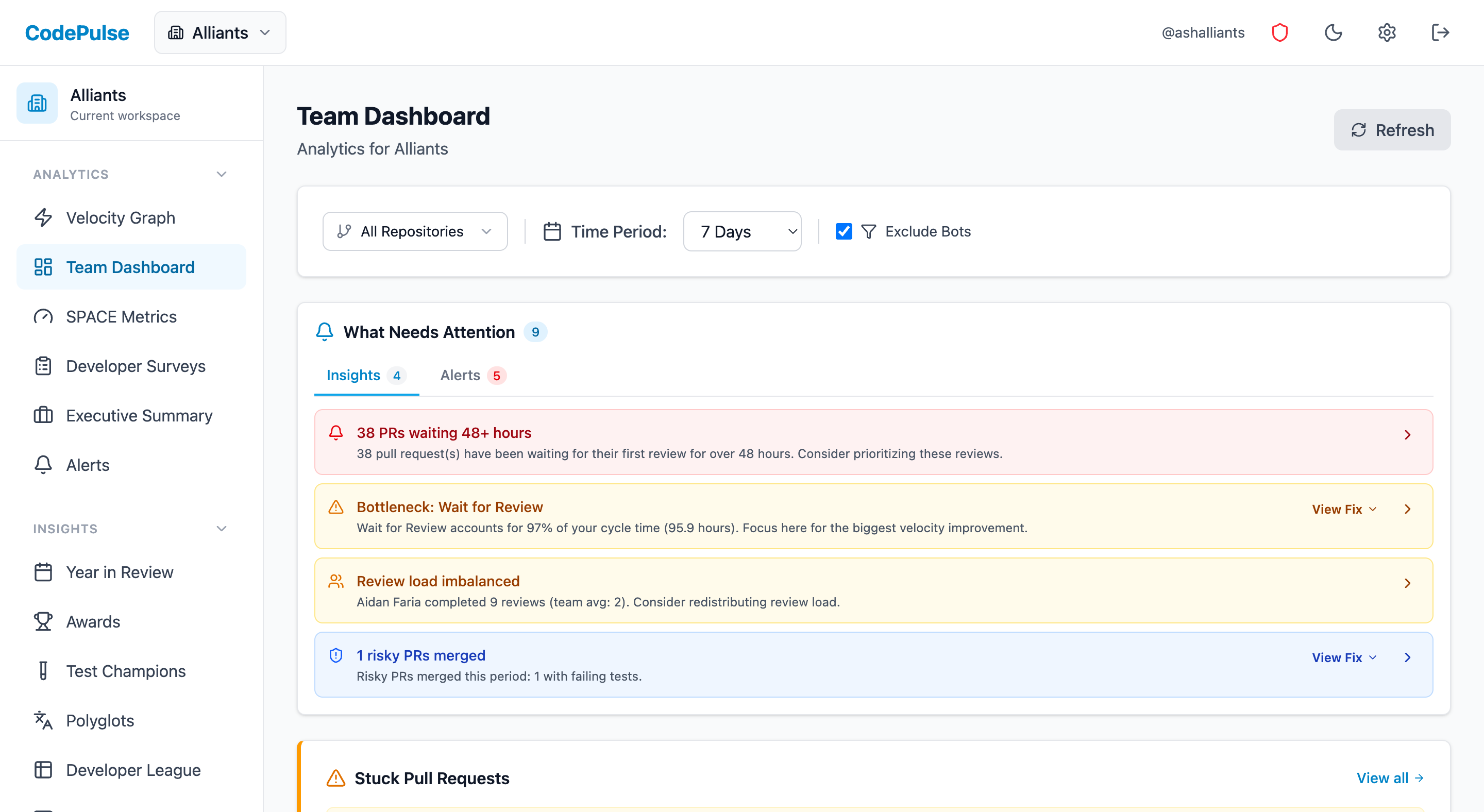
📊 How to See This in CodePulse
CodePulse provides the data you need to make the case:
- Dashboard - DORA metrics and trends for executive reporting
- Executive Summary - Board-ready health grade and key metrics overview
- Export capabilities for presentations and proposals
- Historical data to show improvement over time
💡 Start with a Pilot
If full buy-in is difficult, propose a limited pilot. Pick one team, run for one quarter, measure specific improvements. Pilots reduce risk and create internal case studies. Success with one team makes the broader case easier.
Frequently Asked Questions
Start with avoidable wait time. Multiply your team size by PRs per week, then by average hours of avoidable waiting per PR, then by fully loaded hourly cost. A 50-engineer team with 8 hours of avoidable wait per PR at $100/hour sees roughly $6M/year in waste. Even a conservative 20-30% reduction justifies most tool investments within the first month.
Now measure this metric on your own repositories
Connect read-only GitHub in about five minutes and get your baseline, your trend, and the constraint behind it. Your fourteen usable trial days start when the first repository finishes syncing.
Read-only GitHub · Your code stays yours · Team-level by default · No credit card
See These Features in Action
Explore all featuresRelated Guides
Engineering Analytics ROI: The Budget Approval Playbook
Calculate the ROI of engineering analytics tools with formulas for time savings, payback period, and a business case template tailored to CFOs, CTOs, and CEOs.
I Got $2M in Budget With These 5 Engineering Metrics
Learn how to create engineering metrics presentations that resonate with board members, investors, and C-suite executives.
Engineering Metrics Rollout: The Trust-First Playbook
A change management playbook for rolling out engineering metrics without triggering developer resistance. Covers communication plans, staff engineer buy-in, trial structure, and anti-gaming safeguards.
GitHub Insights Is Useless. Here's What to Use Instead
Learn how to get meaningful team-level analytics from GitHub, including delivery metrics, collaboration patterns, and cross-team insights.
Engineering Effectiveness: Why Fast Teams Still Fail
Efficiency is doing things right. Effectiveness is doing the right things. This guide introduces the Effectiveness Ladder framework and shows how to move from optimizing velocity to optimizing value.
Git Metrics: What You Can (and Cannot) Learn from Git Data
Git data is evidence, not truth. This guide explains what Git metrics actually tell you, which metrics cause harm, and how to interpret commit history without surveillance.