
Turn this metric into a baseline for your team
Preview a system-level engineering health report, then connect GitHub when you are ready to compare this metric with your own delivery history.
Read-only GitHub · Your code stays yours · Team-level by default · No credit card
OKRs (Objectives and Key Results) help engineering teams set ambitious goals with measurable outcomes. But most engineering OKRs fail because they measure activity (deploy 10 features) instead of outcomes (reduce customer churn). This guide shows how to write effective engineering OKRs with real examples.
"A good OKR tells you whether you succeeded - not whether you were busy. 'Ship 20 features' isn't an OKR. 'Reduce time-to-value by 50%' is."
What are OKRs?
OKRs are a goal-setting framework popularized by Intel and Google:
- Objective - What you want to achieve (qualitative, inspiring)
- Key Results - How you measure success (quantitative, 2-5 per objective)
Good OKR Characteristics
| Element | Characteristics |
|---|---|
| Objective | Ambitious, inspiring, qualitative, action-oriented |
| Key Results | Measurable, time-bound, outcome-focused, achievable at ~70% |
/// Our Take
The biggest mistake in engineering OKRs is confusing outputs with outcomes. "Deploy feature X" is an output. "Reduce customer support tickets by 30%" is an outcome. Outputs are things you do; outcomes are changes in the world.
When KRs are outputs, you hit 100% and still fail if the output didn't achieve the desired outcome. When KRs are outcomes, hitting 70% still means real progress.
Engineering OKR Categories
Category 1: Delivery & Velocity
Improving how fast you ship value to customers.
OBJECTIVE: Ship value to customers faster

Key Results:
KR1: Reduce average cycle time from 5 days to 2 days
KR2: Increase deployment frequency from weekly to daily
KR3: Reduce time from feature request to production from
     6 weeks to 3 weeks

───────────────────────────────────────

OBJECTIVE: Eliminate delivery bottlenecks

Key Results:
KR1: Reduce PR review wait time from 48 hours to 8 hours
KR2: Decrease staging environment wait time by 50%
KR3: Achieve 90% of PRs reviewed within 24 hours
Category 2: Quality & Reliability
Improving system stability and reducing defects.
OBJECTIVE: Deliver high-quality, reliable software

Key Results:
KR1: Reduce change failure rate from 25% to under 10%
KR2: Decrease production incidents by 40%
KR3: Achieve 99.9% uptime across all services

───────────────────────────────────────

OBJECTIVE: Build confidence in our codebase

Key Results:
KR1: Increase critical path test coverage from 60% to 85%
KR2: Reduce post-release hotfixes by 50%
KR3: Decrease mean time to recovery from 4 hours to 30 minutes
Category 3: Developer Experience
Making engineers more effective and happier.
OBJECTIVE: Make development friction-free

Key Results:
KR1: Reduce CI build time from 20 minutes to under 5 minutes
KR2: Decrease "time to first PR" for new hires from 2 weeks
     to 3 days
KR3: Increase developer satisfaction score from 65 to 80

───────────────────────────────────────

OBJECTIVE: Eliminate toil from engineering work

Key Results:
KR1: Automate 80% of repetitive deployment tasks
KR2: Reduce time spent on manual testing by 60%
KR3: Decrease on-call alert noise by 50%Category 4: Technical Excellence
Improving architecture and reducing technical debt.
OBJECTIVE: Build a maintainable, scalable codebase

Key Results:
KR1: Reduce code churn on critical modules by 30%
KR2: Eliminate 3 highest-risk knowledge silos
KR3: Decrease average PR size from 600 to 200 lines

───────────────────────────────────────

OBJECTIVE: Modernize our technical infrastructure

Key Results:
KR1: Migrate 50% of workloads to Kubernetes
KR2: Achieve 100% infrastructure-as-code coverage
KR3: Reduce infrastructure provisioning time from days to hours
Category 5: Team Growth
Building team capabilities and knowledge sharing.
OBJECTIVE: Develop a high-performing engineering team

Key Results:
KR1: Increase bus factor on critical systems from 1 to 3
KR2: 100% of engineers participate in cross-team code review
KR3: Reduce time-to-productivity for new hires by 40%

───────────────────────────────────────

OBJECTIVE: Foster a culture of learning and improvement

Key Results:
KR1: 90% of engineers complete at least one tech talk or
     training quarterly
KR2: Achieve 100% participation in retrospectives
KR3: Implement 80% of improvement actions from retros
📊 Measuring KRs with CodePulse
Many engineering KRs can be tracked automatically with CodePulse:
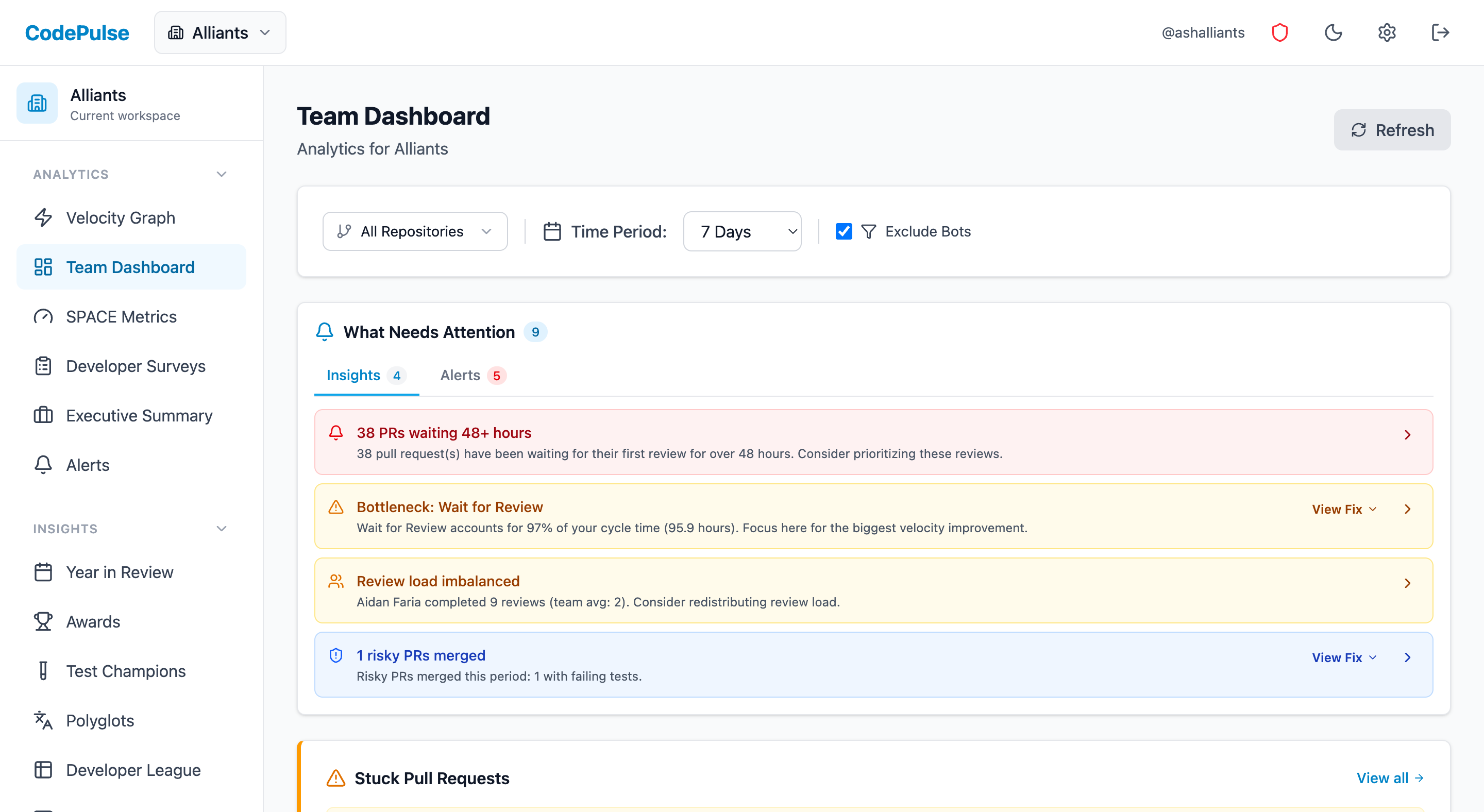
- Cycle time - Dashboard
- Deployment frequency - Dashboard
- PR review time - Review Network
- Knowledge silos - Knowledge Silos
- Code churn - File Hotspots
Common OKR Mistakes
Mistake 1: Output Instead of Outcome
| ❌ Bad (Output) | ✅ Good (Outcome) |
|---|---|
| Ship payment feature | Increase payment conversion by 15% |
| Deploy 10 features | Reduce customer support tickets by 30% |
| Write 500 unit tests | Reduce production bugs by 40% |
| Complete refactoring project | Reduce change failure rate by 50% |
Mistake 2: Too Many OKRs
Teams should have 1-3 objectives max per quarter. More than that dilutes focus and guarantees failure on most of them.
Mistake 3: Sandbagging
Setting easy targets you'll definitely hit at 100%. Good OKRs are stretch goals - hitting 70% should represent real achievement.
Mistake 4: Set and Forget
Writing OKRs in January and checking in December. OKRs need weekly or bi-weekly check-ins to stay relevant.
Mistake 5: Individual OKRs
Engineering work is team-based. Individual OKRs create perverse incentives and ignore collaboration. Focus on team-level OKRs.
"If you're hitting 100% of your OKRs, you're not being ambitious enough. If you're hitting 30%, you're being unrealistic. 70% is the sweet spot."
OKR Process for Engineering Teams
Quarterly Planning
- Review previous quarter results (what worked, what didn't)
- Align with company-level OKRs
- Identify 1-3 objectives for the quarter
- Define 2-5 measurable key results per objective
- Get buy-in from stakeholders
Weekly Check-ins
- Review progress on each KR (on track, at risk, off track)
- Identify blockers
- Adjust tactics if needed (not the KRs themselves)
- Update confidence levels
Quarterly Review
- Score each KR (0.0 to 1.0)
- Overall objective score (average of KRs)
- Reflect on learnings
- Inform next quarter's planning
OKR Template
ENGINEERING OKRs - Q[X] [YEAR]
Team: [Team Name]
───────────────────────────────────────────────────

OBJECTIVE 1: [Inspiring, qualitative statement]
Owner: [Name]

  KR 1.1: [Metric] from [baseline] to [target]
         Current: [value] | Confidence: [High/Med/Low]

  KR 1.2: [Metric] from [baseline] to [target]
         Current: [value] | Confidence: [High/Med/Low]

  KR 1.3: [Metric] from [baseline] to [target]
         Current: [value] | Confidence: [High/Med/Low]

Overall Objective Score: [0.0-1.0]

───────────────────────────────────────────────────

OBJECTIVE 2: [Inspiring, qualitative statement]
Owner: [Name]

  KR 2.1: [Metric] from [baseline] to [target]
         Current: [value] | Confidence: [High/Med/Low]

  KR 2.2: [Metric] from [baseline] to [target]
         Current: [value] | Confidence: [High/Med/Low]

Overall Objective Score: [0.0-1.0]

───────────────────────────────────────────────────
QUARTER END REVIEW

Key Wins:
- [What worked well]

Key Learnings:
- [What we learned]

Carryover Items:
- [What continues next quarter]
Related Guides
- Engineering Metrics Dashboard Guide - Choosing the right metrics
- Board-Ready Engineering Metrics - Presenting metrics to leadership
- DORA Metrics Guide - Standard KRs for delivery
- Goodhart's Law in Engineering - Avoiding metric gaming
Conclusion
Effective engineering OKRs focus on outcomes, not outputs. They're ambitious but achievable, measurable with real data, and reviewed regularly. The best engineering OKRs tie team work to business value and drive real improvement.
- Focus on outcomes - changes in the world, not tasks completed
- Be ambitious - aim for 70% achievement
- Stay focused - 1-3 objectives per quarter max
- Make it measurable - use real metrics, not subjective assessments
- Review regularly - weekly check-ins, quarterly reviews
Use CodePulse to track the metrics that drive your engineering OKRs. Cycle time, deployment frequency, review wait time, and knowledge silos are all measurable - and improving them creates real value for your customers.
"The purpose of OKRs isn't to track work - it's to focus work on the outcomes that matter most. If your OKRs read like a task list, start over."
Now measure this metric on your own repositories
Connect read-only GitHub in about five minutes and get your baseline, your trend, and the constraint behind it. Your fourteen usable trial days start when the first repository finishes syncing.
Read-only GitHub · Your code stays yours · Team-level by default · No credit card
See These Features in Action
Board-ready engineering performance in a single page.
Track all four DORA metrics and benchmark against industry standards.
Related Guides
7 KPIs That Separate Great VPs From Struggling Ones
The essential metrics for VPs of Engineering, Directors, and CTOs. Covers executive dashboards, DORA metrics, team health, and stakeholder communication.
VP Engineering Board Metrics: 7 Numbers That Defend Headcount
The 7 metrics VPs of Engineering need for board presentations: delivery predictability, investment allocation, and team health - with the language to present them.
Engineering Effectiveness: Why Fast Teams Still Fail
Efficiency is doing things right. Effectiveness is doing the right things. This guide introduces the Effectiveness Ladder framework and shows how to move from optimizing velocity to optimizing value.
I Got $2M in Budget With These 5 Engineering Metrics
Learn how to create engineering metrics presentations that resonate with board members, investors, and C-suite executives.