
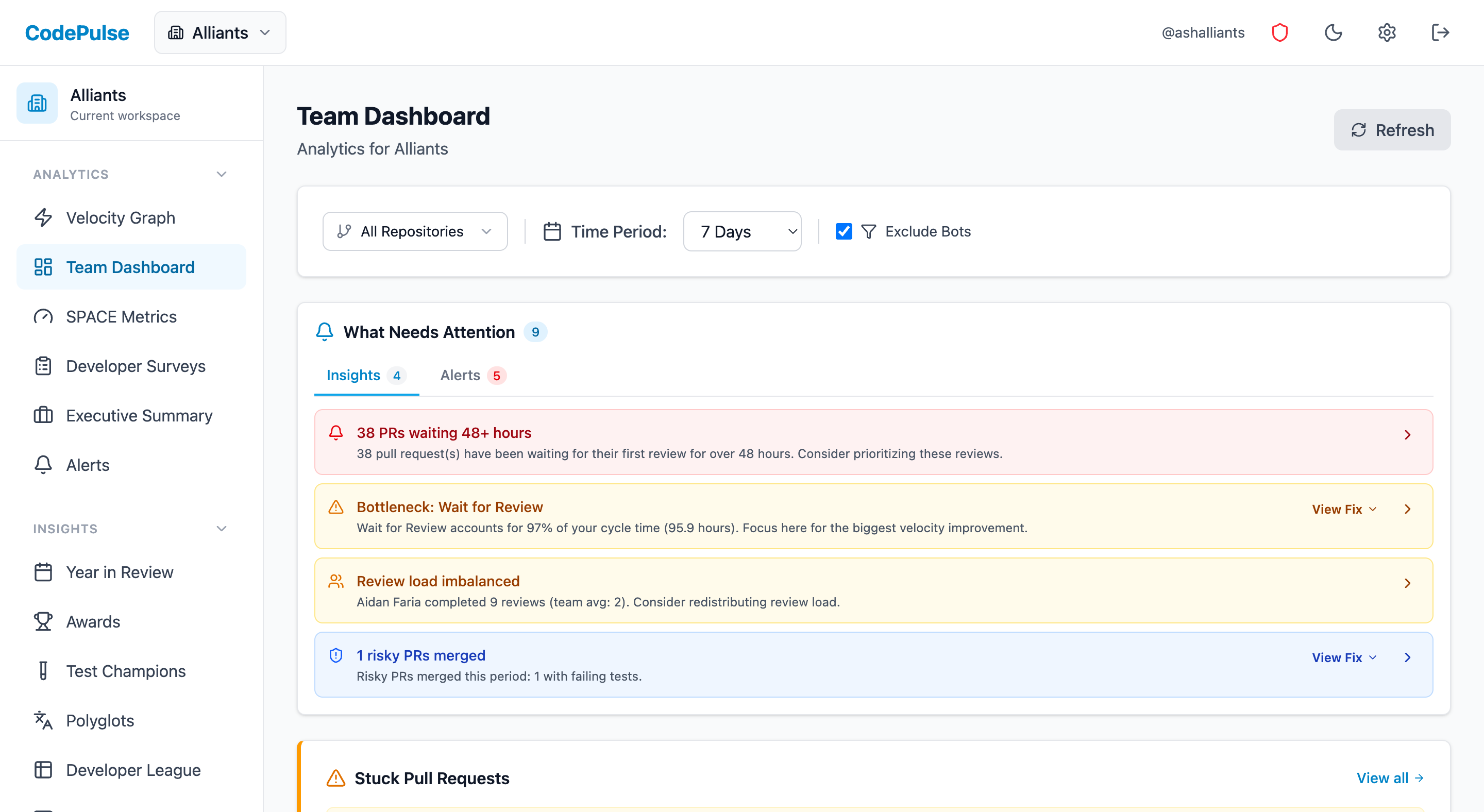
Compare the finished analysis before you choose a platform
See the report CodePulse produces from read-only GitHub workflow data, or connect your own repositories and evaluate the fit with real evidence.
Read-only GitHub · Your code stays yours · Team-level by default · No credit card
OpsLevel and Cortex are the two commercial internal developer portals most teams shortlist together, and both write comparison pages about the other. Neither page is neutral. This one is: sourced pricing data, documented feature boundaries, what each vendor claims about the other (labeled as such), and the question both comparison pages skip - whether you need an IDP at all.
OpsLevel vs Cortex: which should you choose?
Choose Cortex if you need engineering metrics inside the portal - its Eng Intelligence module ships DORA, cycle time, PR analytics and AI-impact dashboards, and buyers report a $75,000 median annual contract (Vendr). Choose OpsLevel if you want the catalog-scorecards-actions core at a lower price - $28,800 median per Vendr - and can live without any metrics product, because OpsLevel ships none. Neither covers review-network analysis, knowledge-silo detection, or PR-level cycle-time root cause; and if you do not have a service-ownership problem, a flat-priced analytics tool may be all you need.
Both products are quote-only, so this comparison leans on buyer-reported contract data from Vendr, vendor documentation, and independent review roundups - all accessed July 2026 and linked inline. Where a claim comes from one vendor about the other, it is attributed and flagged as unverified.
What Are OpsLevel and Cortex Built For?
OpsLevel (Toronto, founded 2018, ~$22M raised including a $15M Series A led by Threshold Ventures) is a focused internal developer portal. Its documented modules: a Software Catalog with auto-discovery, Standards & Scorecards, Self-Service Actions, and OpsLevel AI with an MCP server. The vendor claims 40+ integrations and a "21 days to full rollout" deployment story. It is SOC 2 Type 2 certified and sells two quote-only tiers: Standard (up to 50 users, SSO included) and Enterprise. What it does not sell is equally important: OpsLevel ships no engineering-metrics or DORA product at all. Its own content argues that DORA metrics are "just a part" of the picture and redirects the reader to scorecards.
Cortex (San Francisco, Y Combinator alum) positions itself as "mission control for the AI software factory". It ships the same IDP core - catalog plus a context graph, Scorecards, Workflows - and adds the piece OpsLevel lacks: Eng Intelligence, a metrics module whose documentation lists the four DORA metrics, cycle time, time to first PR review, time to PR approval, PR size, merged PR count, unique PR authors, work-item lead time, AI-adoption and AI-impact dashboards for Copilot, and a Slack AI assistant, with team- and service-level rollups. Cortex has raised $112M (a $60M Series C in September 2024 led by Scale Venture Partners, ~$470M valuation), claims 50+ integrations, holds SOC 2 Type 2 and ISO/IEC 27001:2022, and was a Representative Vendor in the 2025 Gartner Market Guide for Internal Developer Portals.
The structural difference in one line: Cortex bundles an engineering-analytics product into its portal; OpsLevel deliberately does not build one. Everything else - catalog, scorecards, self-service - is a matter of degree, not kind.
How Do Their Features Compare?
| Dimension | OpsLevel | Cortex |
|---|---|---|
| Software catalog | Yes - auto-discovery from repos and integrations | Yes - catalog plus context graph across entities |
| Scorecards / standards | Core product (Standards & Scorecards) | Core product |
| Self-service actions | Yes (Self-Service Actions) | Yes (Workflows) |
| Engineering metrics / DORA | Not offered - no metrics product exists | Eng Intelligence: DORA four, cycle time, PR analytics, work-item lead time |
| AI features | OpsLevel AI + MCP server | AI-adoption and AI-impact dashboards (Copilot), Slack AI assistant |
| Integrations (vendor claims) | 40+ | 50+ |
| Compliance | SOC 2 Type 2 | SOC 2 Type 2 + ISO/IEC 27001:2022 |
| Analyst standing | Not in the 2025 Gartner IDP Market Guide vendor list | Representative Vendor, 2025 Gartner Market Guide for IDPs |
| Pricing model | Quote-only, two tiers, per-user in practice | Quote-only, priced per service/entity, not per user |
| Median contract (Vendr buyer data) | $28,800/yr | $75,000/yr, plus $10K-50K+ implementation |
Sources: opslevel.com and cortex.io product and pricing pages, docs.cortex.io, and Vendr marketplace data, all accessed July 2026. One row deserves emphasis for anyone arriving from a "Cortex vs OpsLevel metrics" search: the metrics gap is absolute, not relative. Cortex ships a documented analytics module; OpsLevel ships nothing in that category, so an OpsLevel purchase means budgeting for a second tool if delivery metrics matter to you.
How Do OpsLevel and Cortex Price?
Neither publishes a number, which is why buyer-reported data is the only usable signal. Vendr records an OpsLevel median of $28,800 a year across 31 purchases (twelve months through February 2026), with negotiated rates landing at $350-600 per developer per year. Cortex's median is $75,000 (range $30,000-134,138): teams with 50-200 services report $25,000-70,000, enterprises with 500+ services $100,000-250,000+, and implementation adds $10,000-50,000+ on top.
The pricing models differ in a way that matters more than the medians. OpsLevel prices around users. Cortex prices per service or entity - so a team of 40 engineers running 300 microservices pays enterprise money for a mid-size headcount. Model your bill on your service count, not your org chart, before taking a Cortex demo.
User sentiment tracks the price gap. One buyer, quoted in Cloudomation's IDP review roundup (April 2025, originally a Reddit comment): "We liked it but their pricing was expensive... We left Cortex for OpsLevel for half the price." The same roundup surfaces AWS Marketplace reviews praising OpsLevel's "extensibility and many APIs" alongside the complaint that "some features are still being worked on".
Cortex costs 2.6x the OpsLevel median because it bundles an analytics product into the portal. If you would use Eng Intelligence weekly, that premium buys something real. If you only need the catalog, you are funding a metrics module you never open.
What Do They Say About Each Other?
Both vendors publish head-to-head pages, and the claims are worth reading with the authorship in mind. OpsLevel's comparison article asserts that Cortex takes "six months or longer" to deploy and cites a $65-69 per-user-per-month cost figure - a number that traces to a Forrester Total Economic Impact study Cortex itself commissioned. Cortex, in turn, claims OpsLevel's ownership detection is less than 50% accurate and that Backstage "averages just 9% adoption". None of these four claims is independently verified; each comes from a vendor with a quota. Treat them as sales copy with footnotes, not benchmarks.
One complaint both vendors' customers share, corroborated across vendor content and independent coverage alike: catalogs go stale. Ownership data, on-call rotations, and service metadata decay the moment teams reorganize, and every IDP - commercial or open-source - needs sustained upkeep to stay trustworthy. Budget maintenance hours into the total cost regardless of which portal wins your evaluation.
What Does Neither Product Cover?
Here is the boundary the vendor comparison pages omit. As of July 2026, the following are not part of either product's documented feature set: review-network and reviewer-load analysis, rubber-stamp and review-depth signals, PR-level cycle-time root-cause decomposition, knowledge-silo and bus-factor detection, and file-hotspot code health analytics. Cortex's Eng Intelligence tells you cycle time went up; it does not decompose which phase, which reviewer bottleneck, or which hotspot file is responsible. OpsLevel does not attempt the question at all.
🔥 Our Take
Most OpsLevel-vs-Cortex evaluations are answering the wrong question. The right question is: do you have a service-ownership problem, a delivery-visibility problem, or both?
If you run hundreds of services with unclear owners, buy an IDP - Cortex if the bundled metrics earn their premium, OpsLevel if they do not. But teams of 50-500 engineers on a handful of repos keep buying portals to get a DORA dashboard, then maintaining a catalog nobody asked for. Delivery visibility is an analytics problem, and analytics-first tools solve it at a tenth of the contract value with nothing to keep stale.
Do You Need an IDP at All?
The IDP category is real and growing - Gartner projects 85% of platform-engineering organizations will have IDPs by 2028, up from 60% in 2025 (cited via Cortex's announcement). But that statistic describes organizations that already have platform-engineering functions. If your estate is a monolith plus a dozen repos, a catalog catalogs nothing, scorecards score nothing, and the five-figure contract buys you the one screen you wanted: metrics.
That slice is where CodePulse sits, and honesty cuts both ways. CodePulse is not an IDP: no service catalog, no scorecards, no self-service actions. It replaces or complements only the metrics slice - and covers that slice deeper than Cortex's module: cycle time decomposed into phases with root cause, DORA metrics, review-network and reviewer-load analysis, rubber-stamp detection, knowledge-silo and bus-factor detection, file-hotspot code health, and AI-tool ROI. It is GitHub-native, there is no catalog to maintain, and pricing is published: $199 a month flat up to 50 developers. Pair it with OpsLevel and you have Cortex's scope for roughly half of Cortex's median contract; run it alone and you have delivery visibility without a portal.
Where to go deeper: our Cortex alternatives guide ranks the full field including Port and Backstage, the platform engineering tools guide covers when portals earn their keep, and the engineering analytics tools comparison maps the analytics-first side of the market.
Frequently Asked Questions
OpsLevel, on cost alone. Vendr buyer data (through February 2026) puts the OpsLevel median contract at $28,800 a year versus $75,000 for Cortex, and Cortex adds $10,000-50,000+ in implementation fees. Both ship the core IDP trio - catalog, scorecards, self-service actions. Cortex justifies its premium with the Eng Intelligence metrics module and a deeper integration catalog; if you will not use those, you are paying roughly 2.6x median for the same catalog-and-scorecards workflow.
Evaluate CodePulse against your own delivery history
A comparison table only goes so far. Connect read-only GitHub in about five minutes and judge the output on your repositories, at one flat price, with no per-seat math.
Read-only GitHub · Your code stays yours · Team-level by default · No credit card
See These Features in Action
Explore all featuresRelated Guides
5 Best Cortex Alternatives 2026: Portal or Analytics
Cortex is a developer portal, not an analytics tool. This guide explains the difference, compares 5 alternatives across both categories, and helps you pick the right tool for your actual problem.
Jellyfish vs LinearB vs Swarmia: Full 2026 Comparison
Compare Jellyfish, LinearB, Swarmia, Allstacks, Haystack and more engineering analytics tools. Features, pricing, cycle time benchmarks, and integrations.
Platform Tools: The Build vs Buy Mistake
A practical guide to platform engineering tools, build vs buy decisions, and the metrics that prove platform impact.
Best DORA Metrics Tools for 2026: 8 Platforms Compared
An opinionated comparison of the 8 best tools for automated DORA metrics reporting, ranked by automation depth, setup speed, metric accuracy, pricing transparency, and real-world usefulness for engineering leaders.