
Understand the system around the team, not a developer leaderboard
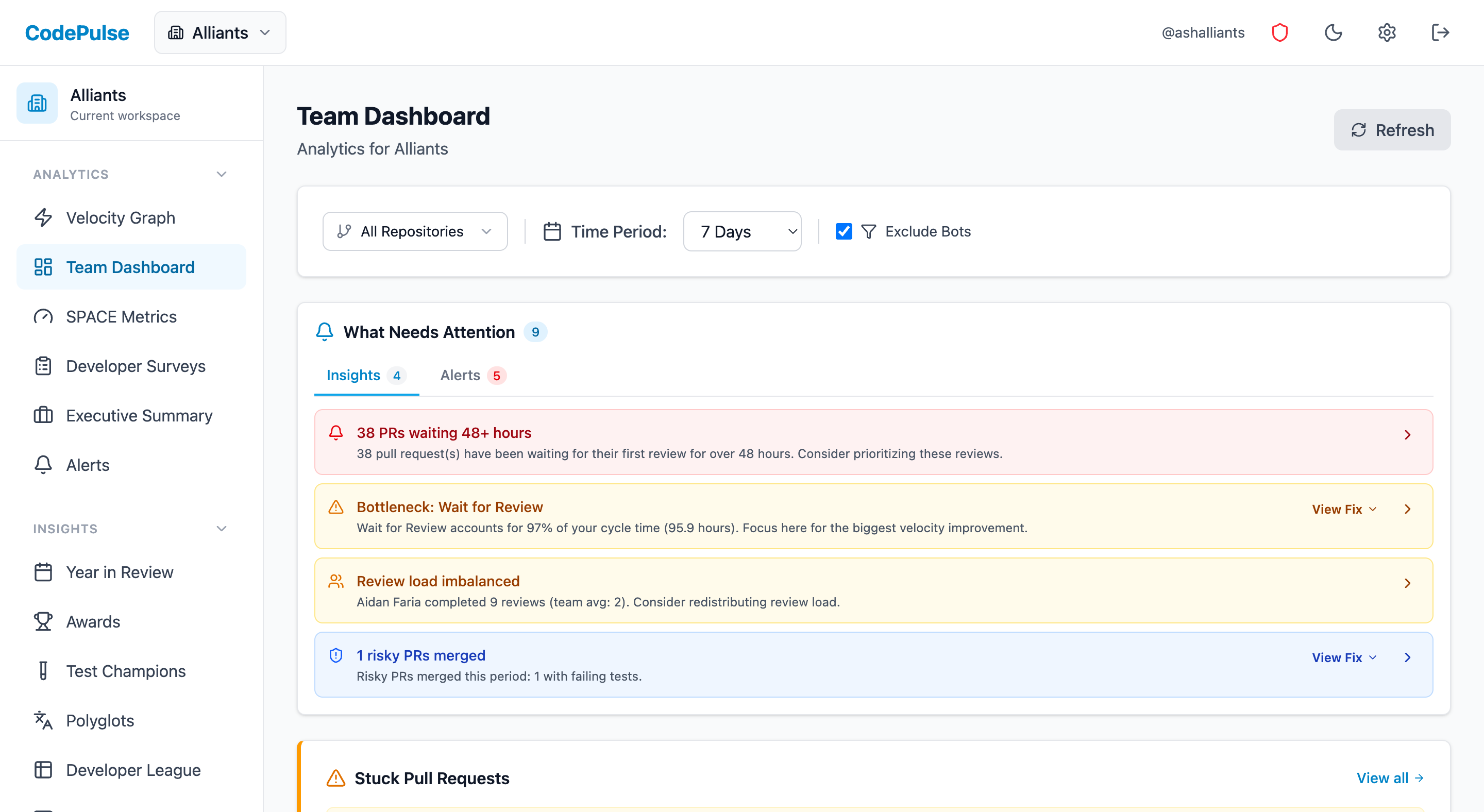
Preview team-level workload, collaboration, and delivery signals designed for process improvement rather than performance grading.
Read-only GitHub · Your code stays yours · Team-level by default · No credit card
Most "productivity initiatives" fail because they add measurement without removing obstacles. This guide takes a different approach: instead of tracking more metrics, we focus on the 5 highest-impact interventions that actually improve how fast your team ships - without burning them out in the process.
These interventions are backed by data and won't destroy team morale, from tactical wins for individual teams to org-wide productivity improvement programs. Want a customized plan? Use our productivity improvement planner to get a prioritized 30-day roadmap based on your team's specific pain points.
🔥 Our Take
The moment velocity becomes a goal, it stops being useful. You'll get more PRs, but they'll be smaller, simpler, and less valuable. You'll hit your numbers while missing your targets.
Velocity is an output, not an input. You improve velocity by removing friction, not by demanding more. Goodhart's Law applies: once a measure becomes a target, it ceases to be a good measure.
The Productivity Improvement Framework
Before diving into interventions, understand the framework: productivity improvement is about removing obstacles, not pushing harder. The formula is simple:
Productivity = (Capability × Focus) - Friction

Where:
├─ Capability: Skills, tools, and knowledge your team has
├─ Focus: Uninterrupted time to do deep work
└─ Friction: Everything that slows work down

Most teams try to increase Capability (training, hiring).
High-performing teams also reduce Friction and protect Focus.
The interventions below target friction and focus - the highest-leverage points that most organizations ignore.
Intervention 1: Reduce Friction, Don't Add Pressure
The first step isn't measuring productivity - it's asking "what's slowing us down?" Your team already knows. Ask them.
How to Identify Friction
- Run a friction audit: Ask each developer to track blockers for one week. Categories: waiting on others, unclear requirements, tooling issues, process overhead, meetings.
- Analyze cycle time breakdown: Where does time go? If 60% of cycle time is "waiting for review," you've found your friction.
- Map the value stream: Trace a feature from idea to production. Every handoff is potential friction.
📊 How to See This in CodePulse
Navigate to Dashboard to view your cycle time breakdown:
- The breakdown shows all 4 phases: coding, waiting, review, merge
- Filter by repository to find specific bottlenecks
- Compare time periods to see if interventions are working
"The right question isn't 'how do we make developers faster?' It's 'what's preventing developers from doing their best work?'"
The 5 Highest-Impact Interventions

1. Cut Cycle Time Waste (Waiting for Review)
In most teams, PRs spend more time waiting than being actively worked on. According to DORA research, elite teams have cycle times under 24 hours; low performers average over a week. The difference isn't coding speed - it's wait time.
| Intervention | Impact | Effort |
|---|---|---|
| Review SLA (4-hour response) | High | Low |
| Dedicated review time blocks | High | Low |
| Auto-assign reviewers | Medium | Low |
| PR size limits (300 lines) | High | Medium |
For a complete playbook, see our We Cut PR Cycle Time by 47% guide.
2. Protect Deep Work Time
According to research by Microsoft, developers need 25 minutes to recover from an interruption. With meetings, Slack pings, and context switches, many developers get zero hours of uninterrupted work per day.
| Intervention | Impact | Effort |
|---|---|---|
| No-meeting days (2/week) | High | Medium |
| Meeting-free mornings | High | Low |
| Async-first communication | High | High |
| Focus time on calendars | Medium | Low |
For more on context switching costs, see our Context Switching Costs $47K Per Developer Per Year guide.
3. Balance Review Load
When one person does 3x the reviews of anyone else, they're not a hero - they're a single point of failure and a burnout risk. Review load imbalance is the hidden bottleneck most teams ignore.
🔥 Our Take
Your "fast" reviewer is probably just your most overworked. Review overload is invisible work - it doesn't show up in commit stats, so it's easy to miss until someone quits.
A healthy review load ratio is 1:1 to 2:1 (reviews given to PRs created). Above 3:1 is a burnout risk. Check your team's ratios and distribute the load.
| Intervention | Impact | Effort |
|---|---|---|
| Visualize review load distribution | High | Low |
| Round-robin reviewer assignment | High | Low |
| Review load caps | Medium | Medium |
| Cross-training for review capacity | High | High |
Use Review Network in CodePulse to visualize your team's review patterns. For a complete guide, see Your Best Engineer Is About to Quit (Check Their Review Load).
4. Shrink PR Sizes
Large PRs are review bottlenecks. They're harder to understand, take longer to review, and are more likely to contain bugs. The data is clear: PRs over 400 lines take exponentially longer to review and merge.
| PR Size | Avg Review Time | Defect Rate |
|---|---|---|
| <100 lines | <2 hours | Low |
| 100-300 lines | 2-4 hours | Low |
| 300-500 lines | 4-8 hours | Medium |
| >500 lines | >24 hours | High |
| Intervention | Impact | Effort |
|---|---|---|
| 300-line guideline | High | Low |
| Stacked PRs for large features | High | Medium |
| PR size alerts | Medium | Low |
| Feature flags for incremental ship | High | High |
See our The 300-Line Rule: Why Big PRs Are Sabotaging Your Team guide for implementation tactics.
5. Clear Blockers Faster
Blocked work is invisible waste. A developer waiting for an answer, a decision, or a dependency is burning time that doesn't show up in any metric.
| Intervention | Impact | Effort |
|---|---|---|
| Daily blocker standup (5 min) | High | Low |
| Blocker escalation path | High | Medium |
| Decision-maker availability SLA | High | Medium |
| Dependency management process | Medium | High |
"A blocker cleared in 2 hours instead of 2 days saves 14 hours of developer time. That's almost 2 full days of productivity from one quick decision."
Measuring Progress Without Gaming
Measuring improvement is necessary, but dangerous if done wrong. Here's how to track progress without creating perverse incentives:
Track Outcomes, Not Activity
| Track This | Not This | Why |
|---|---|---|
| Cycle time | PRs merged | Speed of delivery, not volume |
| Flow efficiency | Commits per day | Active vs waiting time |
| Rework rate | Lines of code | Quality of output |
| Developer satisfaction | Hours worked | Sustainability |
Use Metrics for Conversations
Metrics should start conversations, not end them. "Cycle time increased 20% last month" should lead to "What changed?" not "Who's to blame?"
For more on sustainable measurement, see our What is Developer Productivity? guide.
Team-Level vs Individual Approaches
Productivity improvement should focus on the system, not individuals. Here's why:
Why System-Level Focus Works
- Higher leverage: Fixing a broken process helps everyone; coaching one person helps one person
- No gaming: System metrics can't be easily gamed by individuals
- Preserves trust: Team metrics don't create competition between teammates
- Sustainable: Process improvements persist; individual heroics don't
When Individual Focus Makes Sense
- Onboarding new team members (ramp-up tracking)
- Identifying coaching opportunities (voluntary self-assessment)
- Debugging specific issues ("Why is Alice's PR always blocked?")
Even in these cases, individual metrics should be for insight and support, not evaluation or comparison.
The Burnout Trap: When "Productivity" Becomes Harmful
🔥 Our Take
Burnout is a management failure, not a personal weakness. If your team is burning out, you failed to set boundaries they couldn't set themselves.
Individual developers can't say no to unrealistic deadlines - that's your job. Burnout patterns appear in Git data before anyone complains. Managers who see the signals and don't act are complicit.
Signs Your Productivity Push Is Causing Harm
- After-hours commits increasing
- Weekend work becoming normal
- Review quality declining (faster but more bugs)
- Team morale dropping in 1:1s
- Sick days and PTO declining (fear of falling behind)
Sustainable Productivity Principles
- Speed comes from removing obstacles, not working harder: If your intervention is "work more," it's wrong.
- Productivity gains should benefit the team: Shipping faster shouldn't mean more scope crammed in - it should mean reasonable pace and better outcomes.
- Monitor sustainability signals: Track work patterns alongside velocity. Speed at the cost of health isn't improvement.
For early warning signs, see our Your Git Data Predicts Burnout 6 Weeks in Advance guide.
Productivity Improvement Action Plan
====================================

Week 1-2: Diagnose
├─ Run friction audit with team
├─ Analyze cycle time breakdown
└─ Identify top 3 friction points

Week 3-4: Intervene
├─ Implement review SLA (4 hours)
├─ Add no-meeting mornings
└─ Set up review load visibility

Week 5-6: Measure
├─ Compare cycle time (before/after)
├─ Check developer satisfaction
└─ Identify next intervention

Ongoing: Iterate
├─ Monthly friction review
├─ Quarterly team survey
└─ Continuous improvement cycle
Getting Started This Week
You don't need a massive initiative to improve productivity. Start small:
- Today: Ask your team "What's the biggest thing slowing you down right now?" Don't try to fix it yet - just listen.
- This week: Look at your cycle time breakdown. Where does time go? Pick the biggest wait-time segment.
- Next week: Implement one intervention from the list above. Start with a review SLA or no-meeting mornings - they're high impact and low effort.
- Next month: Measure the change. Did cycle time improve? Did the team notice? What's the next friction point?
"The teams that improve fastest aren't the ones with the most initiatives - they're the ones that fix one thing at a time and actually measure the results."
For more tactical guides, see our PR Cycle Time Playbook or 5 Silent Killers of Engineering Efficiency.
Get this view for your own teams
Connect GitHub for team-level workload, review distribution, and delivery signals. Individual views stay off unless your organisation explicitly turns them on.
Read-only GitHub · Your code stays yours · Team-level by default · No credit card
See These Features in Action
Compare contribution patterns for coaching, not surveillance.
Break down cycle time into coding, waiting, review, and merge phases.
Related Guides
We Cut PR Cycle Time by 47%. Here's the Exact Playbook
A practical playbook for engineering managers to identify bottlenecks, improve review processes, and ship code faster - without sacrificing review quality.
Your Best Engineer Is About to Quit (Check Review Load)
Learn how to identify overloaded reviewers, distribute review work equitably, and maintain review quality without burning out your senior engineers.
Your Git Data Predicts Burnout 6 Weeks in Advance
Use the STRAIN Score framework to detect developer burnout from Git data. Identify after-hours patterns, review overload, and intensity creep before they cause turnover.
Context Switching Costs You $47K Per Developer Per Year
Learn to detect context switching costs from PR data, distinguish productive breadth from harmful fragmentation, and help developers maintain focus.
Engineering Operations: Running a Software Org Like a Business
Engineering ops is the operational discipline connecting your delivery pipeline to business outcomes. The system-level approach to cost per feature, capacity, and predictability.
Engineering Portfolio Reporting: The 4-Section Template That Works
Build engineering portfolio reports that translate dev work into business language. Includes the exact 4-section template, finance translation table, and automation guide.