
Turn this metric into a baseline for your team
Preview a system-level engineering health report, then connect GitHub when you are ready to compare this metric with your own delivery history.
Read-only GitHub · Your code stays yours · Team-level by default · No credit card
Developer productivity isn't about counting lines of code or commits. It's about how effectively your engineering team converts effort into valuable software - sustainably, without burnout. This guide explains what developer productivity actually means, the frameworks used to measure it, and what most organizations get wrong.
If you're an engineering leader trying to explain productivity to your board, or an EM trying to understand why your team feels busy but nothing ships - this guide gives you the vocabulary and frameworks to have that conversation. For a quick read on where your team stands, our free developer productivity score blends efficiency, effectiveness, and experience into a single signal.
🔥 Our Take
The phrase "engineering productivity" is a trap. It implies engineers are like factory workers with countable outputs. They're not. Software development is creative knowledge work - stop trying to measure it like an assembly line.
The productivity framing leads to bad metrics: lines of code, commit counts, story points completed. Better framing: "engineering effectiveness" or "delivery capability." You're not measuring how hard people work - you're measuring how well your system enables great work.
What Developer Productivity Actually Means
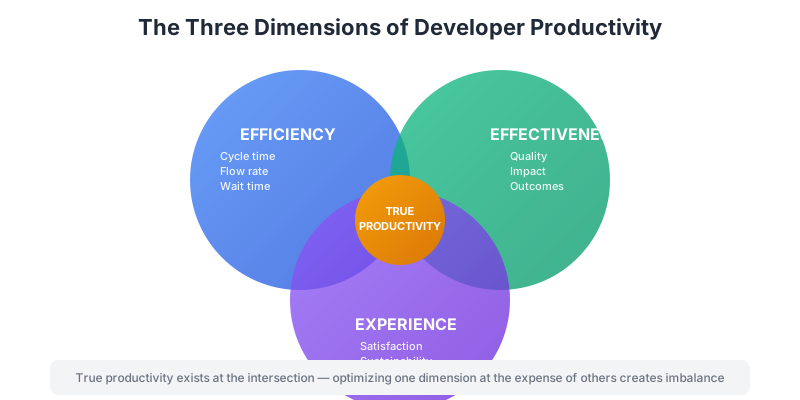
Developer productivity is the degree to which developers can do their work in a frictionless manner - not the individual performance of developers. It's the sum of three interconnected dimensions:
- Efficiency: How quickly and smoothly developers complete tasks with minimal waste (waiting, context switching, blocked work)
- Effectiveness: Whether what's built solves real problems and contributes to product goals - building the right things
- Experience: How the development process affects the people doing the work - satisfaction, autonomy, and sustainable pace
"Productivity is sustainable velocity with team health. Not speed at any cost."
The key insight: productivity measurement should help developers succeed, not catch them failing. When engineers feel metrics are used for them rather than against them, resistance transforms into engagement.
The Three Dimensions of Productivity
1. Efficiency: Removing Friction
Efficiency metrics measure how smoothly work flows through your system. The goal is identifying and removing obstacles - not making people work harder.
| Metric | What It Measures | Healthy Range |
|---|---|---|
| Cycle Time | First commit to merge | <24 hours for most PRs |
| Wait Time for Review | PR ready until first review | <4 hours during work hours |
| Flow Efficiency | Active time vs. waiting time | >40% (elite: >60%) |
| Review Iterations | Rounds before approval | 1-2 iterations typical |
High efficiency means code moves from idea to production without unnecessary delays. Low efficiency signals systemic problems: unclear requirements, review bottlenecks, or insufficient test coverage causing rework.
2. Effectiveness: Building the Right Things
Effectiveness asks whether the work being done actually matters. A team can be highly efficient at producing the wrong output.
| Metric | What It Measures | Data Source |
|---|---|---|
| Feature Completion Rate | Planned work actually shipped | Project management tools |
| Rework Rate | Work that had to be redone | PR reverts, hotfixes |
| Customer Impact | Shipped code improving outcomes | Product analytics |
| Quality Metrics | Defects, test coverage, review quality | CI/CD, GitHub |
Effectiveness is harder to measure from Git data alone - it requires connecting engineering outputs to business outcomes. But you can use proxy metrics: rework rates, hotfix frequency, and code churn often indicate effectiveness problems.
3. Experience: Sustainable Pace
Developer experience measures whether your productivity is sustainable. High output today means nothing if your team burns out in six months.
| Signal | What It Indicates | Data Source |
|---|---|---|
| After-Hours Work | Unsustainable pace, possible burnout | Commit timestamps |
| Weekend Commits | Work-life balance issues | Git data |
| Review Load Distribution | Burnout risk for overloaded reviewers | PR review data |
| Developer Satisfaction | Engagement and retention risk | Surveys, 1:1s |
For more on detecting burnout before it happens, see our Burnout Signals from Git Data guide.
Productivity Frameworks: DORA, SPACE, and DX
Several research-backed frameworks help structure productivity measurement. Each has different strengths:
DORA Metrics
The DORA framework (from Accelerate research by Nicole Forsgren, Jez Humble, and Gene Kim) focuses on software delivery performance:
- Deployment Frequency: How often code ships to production
- Lead Time for Changes: Commit to production time
- Change Failure Rate: Percentage of deployments causing incidents
- Mean Time to Recovery: How fast you fix production issues
DORA metrics are excellent for measuring delivery capability, but they focus on outputs rather than outcomes or developer experience. See our DORA Metrics Guide for implementation details.
SPACE Framework
SPACE (from GitHub and Microsoft Research) takes a more holistic view:
- Satisfaction and well-being
- Performance (quality and impact)
- Activity (work volume)
- Communication and collaboration
- Efficiency and flow
SPACE acknowledges that productivity is multidimensional and can't be captured by any single metric. It explicitly includes developer satisfaction - something DORA ignores. For a deep dive, see our SPACE Framework Guide.
DX (Developer Experience)
The DX framework focuses specifically on the developer's perspective:
- Feedback loops: Speed of build, test, and deployment feedback
- Cognitive load: Mental effort required to complete tasks
- Flow state: Ability to focus without interruptions
DX is useful for identifying tooling and process improvements that boost productivity at the individual level.
📊 How to See This in CodePulse
CodePulse provides metrics across multiple frameworks:
- Dashboard shows cycle time breakdown (Efficiency)
- SPACE Dashboard maps metrics to all five SPACE dimensions
- Executive Summary provides a health score across dimensions
- Benchmarks compares your metrics to industry data
What Developer Productivity Is NOT
Understanding what productivity isn't is as important as understanding what it is. These anti-patterns destroy productivity while appearing to measure it:
Anti-Pattern 1: Lines of Code
The fact that anyone still tracks lines of code today is embarrassing. In the age of AI coding assistants, it's not just useless - it's counterproductive. A developer who deletes 500 lines while maintaining functionality has done better work than one who adds 500.
Anti-Pattern 2: Individual Velocity Rankings
Comparing Alice's cycle time to Bob's turns teammates into competitors. Individual metrics destroy psychological safety and incentivize gaming rather than collaboration.
"The most important engineering work is unmeasurable: architecture decisions that prevented problems, mentorship that made someone better, documentation that saved hours of confusion."
Anti-Pattern 3: Activity Without Context
High commit count doesn't mean high productivity. That developer with 50 commits might be breaking work into tiny pieces or fixing their own bugs. Context matters.
Anti-Pattern 4: Story Points as Output
Story points measure estimated effort, not delivered value. Teams that optimize for points completed often ship less actual value than teams that ignore points entirely.
For more on what not to measure, see our Developer Productivity Metrics Guide.
How to Measure Productivity Sustainably
The goal of measurement is insight, not judgment. Here's how to approach it:
Principle 1: Measure Systems, Not Individuals
Focus on team-level and system-level metrics. "Why is review wait time 8 hours?" is a useful question. "Why is Alice slower than Bob?" is not.
Principle 2: Use Metrics for Conversations
Metrics should start conversations, not end them. A spike in cycle time isn't a failure - it's a signal to investigate. Maybe there was a complex feature, a holiday, or an infrastructure incident.
Principle 3: Balance Multiple Dimensions
Never optimize for a single metric. If you only measure speed, quality suffers. If you only measure quality, velocity drops. Measure across efficiency, effectiveness, and experience simultaneously.
Principle 4: Include Qualitative Data
Quantitative metrics show what happened. Qualitative data (surveys, 1:1s, retrospectives) explains why. Both are necessary for understanding productivity.
Sustainable Productivity Framework
==================================

┌─────────────────────────────────────────────────────┐
│                   PRODUCTIVITY                       │
│                                                     │
│   ┌──────────┐   ┌──────────┐   ┌──────────┐      │
│   │Efficiency│ + │Effective-│ + │Experience│      │
│   │          │   │   ness   │   │          │      │
│   └──────────┘   └──────────┘   └──────────┘      │
│        ↓              ↓              ↓             │
│   Cycle time    Feature         Satisfaction      │
│   Flow rate     completion      Sustainability    │
│   Wait time     Quality         Work patterns     │
│                                                     │
├─────────────────────────────────────────────────────┤
│                                                     │
│   Measure at:  SYSTEM > TEAM > Individual          │
│                                                     │
│   Use for:     INSIGHT > CONVERSATION > never KPIs │
│                                                     │
└─────────────────────────────────────────────────────┘
Where Developer Productivity Engineering Fits In
Developer Productivity Engineering (DPE) is an emerging discipline focused on systematically improving developer productivity. Companies like Netflix, Meta, and Spotify have dedicated DPE teams that:
- Identify and remove friction in development workflows
- Build internal tools that accelerate common tasks
- Measure productivity across dimensions and act on insights
- Optimize CI/CD pipelines for faster feedback
You don't need a massive DPE team to start. Even a single engineer asking "what's slowing us down?" and having the data to answer that question is the beginning of DPE practice. Our free developer productivity engineering assessment scores where your practice sits today and what to tackle next.
For a complete guide to building a DPE function, see our Developer Productivity Engineering Guide.
Getting Started
Here's a practical path to understanding your team's productivity. If you would rather work from a structured plan, our free guide to improving developer productivity turns these steps into a prioritized action list:
- Start with cycle time: It's the most actionable metric. If you don't know how long code takes to ship, start there.
- Break down the phases: Where does time go? Coding? Waiting? Reviewing? The breakdown reveals the real bottlenecks.
- Add quality metrics: Test failure rate and review coverage prevent speed-at-all-costs thinking.
- Survey your team: Quantitative metrics don't capture everything. Ask developers what's slowing them down.
- Benchmark externally: Know where you stand relative to industry norms. Not to compete, but to understand potential.
"The right question isn't 'how productive is my team?' It's 'what's preventing my team from doing their best work?'"
Discover the silent killers of engineering efficiency or learn how to improve developer productivity with our tactical guides.
Now measure this metric on your own repositories
Connect read-only GitHub in about five minutes and get your baseline, your trend, and the constraint behind it. Your fourteen usable trial days start when the first repository finishes syncing.
Read-only GitHub · Your code stays yours · Team-level by default · No credit card
See These Features in Action
Compare contribution patterns for coaching, not surveillance.
Holistic developer productivity using the SPACE framework.
Related Guides
Developer Productivity Metrics That Don't Backfire
Stop treating engineers like factory workers. Learn which developer productivity metrics destroy trust, why lines of code fail, and how to measure productivity, including with AI tools, without surveillance.
Why Microsoft Abandoned DORA for SPACE (And You Should Too)
Learn how to implement the SPACE framework from Microsoft and GitHub research to measure developer productivity across Satisfaction, Performance, Activity, Communication, and Efficiency.
DORA Metrics Explained: The 4 Keys Without the Hype
A complete breakdown of the four DORA metrics - deployment frequency, lead time, change failure rate, and MTTR - with honest benchmarks and gaming traps to avoid.
5 Silent Killers Destroying Your Engineering Efficiency
Learn how to measure and improve engineering efficiency without burning out your team. Covers the efficiency equation, bottleneck identification, and sustainable improvement.