
See exactly where your delivery flow is waiting
Preview the phase-by-phase report for review pickup, active review, and merge time. Connect in about five minutes; the initial analysis runs after sync.
Read-only GitHub · Your code stays yours · Team-level by default · No credit card
Engineering efficiency isn't about working harder - it's about removing friction so your team can focus on what matters. This guide covers how to measure, improve, and sustain engineering efficiency without burning out your team.
In 2025, with economic pressure on engineering budgets and AI promising productivity gains, engineering leaders face intense scrutiny on efficiency. The challenge is improving output without sacrificing quality or team health. Here's how to do it right.
What Is Engineering Efficiency?
Engineering efficiency measures how effectively your team converts effort into valuable output. It's the ratio of value delivered to resources consumed:
- High efficiency: Team delivers significant value relative to their size and investment
- Low efficiency: Large team, long hours, but limited tangible output
Critically, efficiency is NOT the same as utilization. A team working 80-hour weeks isn't efficient - they're burning out. True efficiency means sustainable delivery at a reasonable pace.
The Engineering Efficiency Equation
Engineering efficiency breaks down into three components:
Efficiency = (Value Delivered) / (Time Spent × Friction)
Value Delivered
The numerator - what your team actually ships:
- Features that customers use
- Bug fixes that improve reliability
- Infrastructure improvements that enable future work
- Technical debt reduction that prevents future problems
Time Spent
The denominator - how much time your team invests:
- Coding time
- Review and collaboration time
- Meeting and planning time
- Context switching overhead
Friction (The Hidden Multiplier)
Friction amplifies time spent without adding value:
- Slow builds and tests
- Manual deployment processes
- Unclear requirements and rework
- Waiting for reviews or approvals
- Poor documentation requiring extra investigation
The key insight: reducing friction often has more impact than adding more people or working longer hours.
Measuring Engineering Efficiency
Throughput Metrics
| Metric | What It Measures | Healthy Range |
|---|---|---|
| PRs Merged per Engineer per Week | Individual throughput | 2-5 (context dependent) |
| Deployment Frequency | Team delivery cadence | Daily or more (elite) |
| Feature Lead Time | Idea to production | <1 week (elite) |
Flow Efficiency Metrics
| Metric | What It Measures | Target |
|---|---|---|
| Cycle Time | First commit to merged PR | <48 hours |
| Time in Review | PR open to first review | <4 hours |
| Rework Rate | PRs requiring multiple rounds | <20% |
| Build Time | CI/CD pipeline duration | <10 minutes |
Quality-Adjusted Metrics
Throughput without quality is waste. Track these alongside efficiency metrics:
- Change failure rate: Deployments causing incidents (<15% is good)
- Bug escape rate: Bugs found in production vs. caught in dev
- Customer-reported issues: Problems users find that you didn't
The Top 5 Engineering Efficiency Killers
1. Context Switching
Every interruption costs 15-25 minutes of recovery time. A developer handling 5 different projects loses hours daily to context switching.
Symptoms:
- High work-in-progress per developer (>3 items)
- Frequent ticket reassignments
- Long cycle times with short actual coding time
Solutions:
- Limit WIP per person (2-3 items maximum)
- Batch similar work together
- Protect focus time blocks
2. Meeting Overload
The average developer spends 12+ hours per week in meetings. That's 30% of their time on non-coding activities.
Symptoms:
- Fragmented calendars with no 2+ hour blocks
- Coding happening after hours
- "I can't get anything done during the day"
Solutions:
- Establish meeting-free days or blocks
- Audit recurring meetings (cancel or reduce frequency)
- Replace status meetings with async updates
3. Slow CI/CD Pipelines
A 30-minute build means developers context switch to other work while waiting. Multiply that by 5+ builds per day and you've lost hours.
Symptoms:
- Build times exceeding 15 minutes
- Developers batching commits to avoid slow builds
- PRs sitting "waiting for CI"
Solutions:
- Parallelize test suites
- Implement caching for dependencies
- Run only affected tests for each change
- Invest in faster CI infrastructure
4. Code Review Bottlenecks
PRs waiting days for review kill flow efficiency. Developers lose context, and work stalls.
Symptoms:
- PRs waiting >24 hours for first review
- Review load concentrated on a few people
- Large PRs that are "too scary" to review
Solutions:
- Set review SLAs (first review within 4 hours)
- Distribute review load evenly
- Keep PRs small (<400 lines)
- Use Review Network to visualize and rebalance load
5. Unclear Requirements
Building the wrong thing is the ultimate efficiency killer. Rework from unclear specs wastes everything invested.
Symptoms:
- High code churn (rewriting recent code)
- Features that ship but don't get used
- "That's not what I asked for" conversations
Solutions:
- Invest in upfront design and spec reviews
- Build in stakeholder checkpoints before completion
- Ship incrementally and gather feedback early
💡 The 80/20 Rule of Efficiency
80% of efficiency gains come from removing friction, not adding capacity. Before hiring more engineers or mandating longer hours, audit where time is wasted. Fixing bottlenecks is almost always more cost-effective than adding headcount.
Improving Engineering Efficiency
Quick Wins (Week 1-2)
- Audit meeting calendars: Cancel or reduce frequency of status meetings that could be async
- Set review SLAs: Agreement that PRs get first review within 4 hours
- Limit WIP: Each developer works on max 2-3 items at once
Medium-Term Improvements (Month 1-2)
- Optimize CI/CD: Parallelize tests, add caching, upgrade infrastructure
- Improve documentation: Reduce time spent asking "how does this work?"
- Automate toil: Identify repetitive manual tasks and automate them
Strategic Improvements (Quarter 1-2)
- Platform investment: Build internal tools that multiply developer productivity
- Architecture improvements: Reduce coupling so changes are smaller and safer
- Process redesign: Rethink how work flows from idea to production
Efficiency Anti-Patterns to Avoid
Measuring Individual Productivity
Comparing individual output creates competition instead of collaboration. Top performers often work on the hardest problems - their throughput looks "low" but their impact is high.
Optimizing for Utilization
100% utilization means 0% slack for unexpected work, learning, or helping teammates. Target 70-80% planned utilization to maintain flexibility.
Ignoring Quality
Fast but buggy is not efficient. Technical debt accumulates, and future work slows down. Quality and efficiency are complementary, not trade-offs.
One-Size-Fits-All Metrics
A platform team's efficiency metrics differ from a product team's. A team building new features differs from one maintaining legacy systems. Context matters.
The Engineering Efficiency Dashboard
Track these metrics to monitor and improve efficiency:
Weekly Review
- Cycle time trend - improving, stable, or declining?
- PRs waiting >24 hours - any stuck work?
- WIP per developer - anyone overloaded?
Monthly Review
- Deployment frequency - are we shipping faster?
- Build time trends - is CI getting slower?
- Review load distribution - is it balanced?
Quarterly Review
- Feature lead time - from idea to production
- Quality metrics - change failure rate, bug escape rate
- Developer satisfaction - is pace sustainable?
AI Tools and Engineering Efficiency
AI coding assistants promise 20-40% productivity gains. But realizing those gains requires:
- Proper adoption: Not everyone uses AI tools effectively - training matters
- Quality gates: AI-generated code needs review; bugs are possible
- Realistic expectations: Gains compound slowly over months, not days
Track AI tool impact with before/after metrics: cycle time, throughput, and code review findings. To put a dollar figure on it, our GitHub Copilot ROI calculator estimates payback from assistant adoption against your team size and seat cost.
Getting Started with Efficiency
- Baseline your current state: Use the Dashboard to measure cycle time, deployment frequency, and review wait time before making changes.
- Identify your biggest bottleneck: Use the efficiency killers list above. What's causing the most friction?
- Fix one thing: Don't try to improve everything at once. Pick the biggest bottleneck and focus there.
- Measure impact: After 4-6 weeks, compare to baseline. Did the change help?
- Iterate: Move to the next bottleneck. Continuous improvement beats big-bang transformation.
Engineering efficiency is a journey, not a destination. The most efficient teams constantly look for friction and eliminate it. Start small, measure everything, and improve continuously.
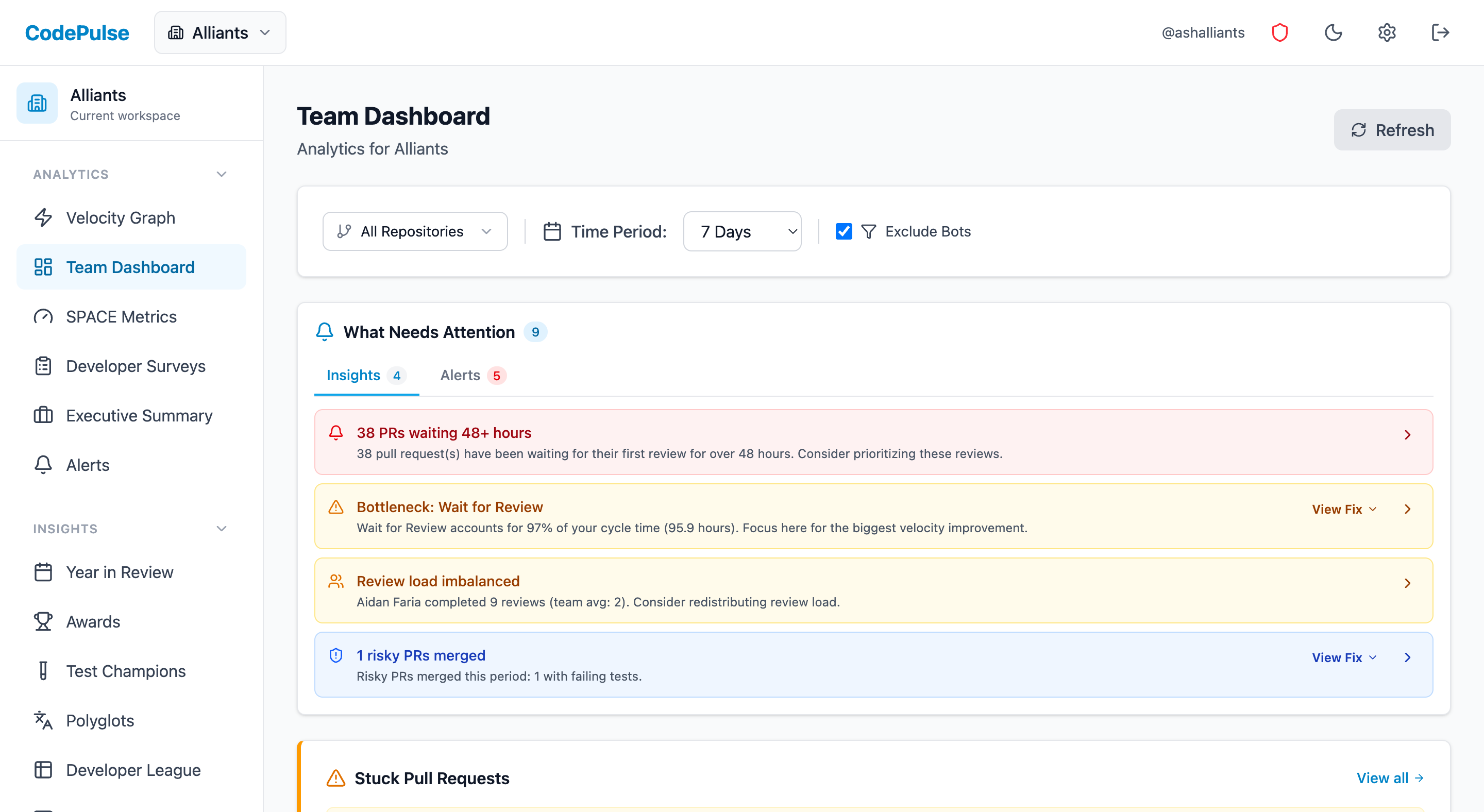
Find out which phase is holding your delivery up
CodePulse splits your cycle time into coding, waiting for review, active review, and merge, so you fix the queue that is actually costing you days. Read-only GitHub, no credit card.
Read-only GitHub · Your code stays yours · Team-level by default · No credit card
See These Features in Action
Break down cycle time into coding, waiting, review, and merge phases.
Track all four DORA metrics and benchmark against industry standards.
Related Guides
We Cut PR Cycle Time by 47%. Here's the Exact Playbook
A practical playbook for engineering managers to identify bottlenecks, improve review processes, and ship code faster - without sacrificing review quality.
Developer Velocity: Metrics Beyond Story Points
Measure developer and engineering velocity without story points: cycle time, deployment frequency, flow efficiency and sustainable pace, plus what DORA tracks today.
Context Switching Costs You $47K Per Developer Per Year
Learn to detect context switching costs from PR data, distinguish productive breadth from harmful fragmentation, and help developers maintain focus.
Story Points Are a Scam. Here's What Actually Works
Story points are often waste. Learn how to use historical throughput and cycle time to forecast delivery dates with higher accuracy and less meeting time.