

Turn this metric into a baseline for your team
Preview a system-level engineering health report, then connect GitHub when you are ready to compare this metric with your own delivery history.
Read-only GitHub · Your code stays yours · Team-level by default · No credit card
DORA. SPACE. Flow. Every engineering leader faces the same question: which metrics framework should we adopt? The answer is rarely "just one." This guide breaks down where each framework excels, where each falls short, and how to combine them for a complete picture of engineering health.
Should you use DORA or SPACE metrics framework?
Use both, but start with DORA. DORA gives you four objective delivery metrics (deployment frequency, lead time, change failure rate, MTTR) from Git data alone, with no surveys required. SPACE adds developer satisfaction and collaboration quality, which requires pulse surveys. Start with DORA to establish baselines in 30 days, then add SPACE satisfaction surveys once you have delivery data to contextualize. CodePulse tracks DORA metrics automatically from GitHub. For SPACE, pair it with a survey tool like DX or Swarmia.
"The framework wars are a distraction. Elite teams don't pick one framework - they pick the right metrics for the questions they're actually trying to answer."
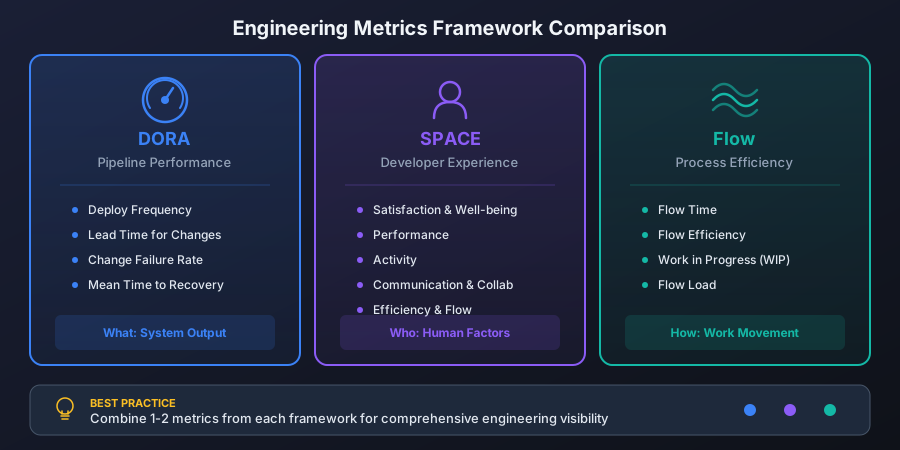
The Metrics Framework Wars: Why This Debate Exists
Engineering metrics have evolved through three major waves. First came activity metrics - lines of code, commits, hours logged. These were easy to measure but easy to game. Then came outcome metrics - DORA's focus on delivery performance. Better, but incomplete. Now we have experience metrics - SPACE's attention to developer well-being and cognitive load.
The tension isn't between frameworks. It's between different questions:
- DORA asks: How fast and reliably do we ship?
- SPACE asks: How productive and sustainable is our work?
- Flow asks: How efficiently does work move through our system?
Each framework emerged from a specific research context. Understanding those origins helps you understand what each framework can - and cannot - tell you.
DORA: What It Measures (And What It Misses)
Origins and Research Context
DORA (DevOps Research and Assessment) emerged from research by Nicole Forsgren, Jez Humble, and Gene Kim. Over seven years, they surveyed 30,000+ professionals to identify what distinguishes high-performing software delivery teams. Their findings, published in Accelerate (2018), identified four metrics that consistently correlated with organizational performance. Before committing to a framework, a baseline DevOps assessment tells you where each dimension sits today - which often surfaces whether DORA's delivery focus or SPACE's broader lens is the better fit for your team.
The Four DORA Metrics
| Metric | What It Measures | Elite Benchmark |
|---|---|---|
| Deployment Frequency | How often code reaches production | Multiple deploys per day |
| Lead Time for Changes | Commit to production time | Less than 1 hour |
| Change Failure Rate | % of deployments causing failures | 0-15% |
| Mean Time to Recovery | Time to restore service after failure | Less than 1 hour |
Once you've picked DORA, the next decision is what actually calculates these four metrics for you - our DORA metrics tools comparison ranks the options on pricing and GitHub-native depth.
DORA's Strengths
- Research-backed. 30,000+ data points across industries. This isn't opinion - it's statistically validated correlation with business outcomes.
- Outcome-focused. Measures delivery performance, not activity. You can't game deployment frequency without actually deploying.
- Balances speed and stability. Change failure rate and MTTR prevent teams from sacrificing quality for velocity.
- Industry standard. Most engineering analytics tools support DORA. Benchmarks are widely available.
DORA's Limitations
- Ignores developer experience. A team with "elite" DORA metrics can still be burning out. DORA says nothing about sustainability.
- Correlation isn't causation. Elite teams have good DORA metrics, but targeting the metrics doesn't make you elite.
- CI/CD dependency. Accurate DORA measurement requires mature deployment pipelines. Many teams can't measure these properly.
- Team-level only. DORA wasn't designed for individual measurement. Using it that way creates perverse incentives.
For a deep dive into implementing DORA correctly, see our DORA Metrics Guide.
SPACE: The Human Dimension
Origins and Research Context
SPACE emerged from Microsoft and GitHub research, published in 2021 by Nicole Forsgren (yes, the same researcher behind DORA), Margaret-Anne Storey, and colleagues. They recognized that DORA's delivery focus missed critical aspects of developer productivity - particularly the human factors that determine whether teams can sustain high performance. To see how your team scores across all five dimensions, our free SPACE framework assessment walks through each one.
The framework name is an acronym for its five dimensions:
The Five SPACE Dimensions
| Dimension | What It Measures | Example Metrics |
|---|---|---|
| Satisfaction | Developer well-being and fulfillment | Survey scores, retention rates |
| Performance | Outcomes and quality of work | Customer satisfaction, reliability |
| Activity | Count of actions completed | PRs merged, commits, reviews |
| Communication | Collaboration and knowledge sharing | Review network density, knowledge silos |
| Efficiency | Flow state and minimal friction | Cycle time, wait time, WIP |
SPACE's Strengths
- Human-centric. Satisfaction and well-being aren't afterthoughts - they're core dimensions. This acknowledges that sustainable performance requires healthy developers.
- Multi-level. SPACE works at individual, team, and organization levels. DORA is team/org only.
- Flexible. Choose metrics from each dimension based on your context. No prescribed benchmarks to chase.
- Balances quantitative and qualitative. Explicitly includes surveys and perceptual data alongside system metrics.
SPACE's Limitations
- Harder to measure. Satisfaction requires surveys. Communication requires social network analysis. Not everything is in your Git data.
- No standard benchmarks. SPACE doesn't tell you what "good" looks like. You're on your own for targets.
- Activity trap. The Activity dimension can be gamed just like traditional metrics. The framework warns against this but doesn't prevent it.
- Less mature tooling. Fewer platforms implement SPACE natively compared to DORA.
For implementation details, see our SPACE Framework Metrics Guide.
"DORA tells you how your pipeline performs. SPACE tells you how your people perform. You need both to understand your team."
Flow Metrics: The Process View
Origins and Research Context
Flow metrics emerged from Lean manufacturing and Kanban thinking, adapted for software by researchers like Donald Reinertsen and practitioners like Dominica DeGrandis. Unlike DORA's outcome focus or SPACE's experience focus, Flow metrics examine how work moves through your system - treating software delivery as a manufacturing pipeline.
Core Flow Metrics
| Metric | What It Measures | Why It Matters |
|---|---|---|
| Flow Velocity | Items completed per time period | Throughput and capacity indication |
| Flow Efficiency | Active time / total time | Reveals wait time and bottlenecks |
| Flow Time | Start to done duration | End-to-end delivery speed |
| Flow Load | Work in progress count | Overload and context switching risk |
| Flow Distribution | Mix of work types | Balance between features, bugs, debt |
Flow's Strengths
- Process visibility. Flow metrics reveal where work gets stuck. A 30-day cycle time means nothing until you see that 25 days were waiting.
- Actionable bottlenecks. Low flow efficiency points directly to where to improve - no interpretation required.
- Investment tracking. Flow distribution shows what you're actually spending engineering time on vs. what you planned.
- WIP limits. Flow Load connects directly to Little's Law and queue theory - reduce WIP to reduce cycle time.
Flow's Limitations
- Requires mature tracking. Accurate flow metrics need work items with state transitions. Teams with loose process can't measure this.
- Doesn't measure quality. Flow velocity of broken features is just expensive failure.
- Manufacturing mindset. Not all software work flows linearly. Research, exploration, and refactoring don't fit the model well.
- Ignores developer experience. Like DORA, Flow says nothing about whether your team is burning out.
The Complete Framework Comparison
| Aspect | DORA | SPACE | Flow |
|---|---|---|---|
| Primary Focus | Delivery performance | Developer productivity | Process efficiency |
| Origin | Google/DORA research | Microsoft/GitHub | Lean/Kanban |
| Published | 2018 (Accelerate) | 2021 | ~2015+ |
| Core Metrics | 4 specific | 5 dimensions | 5 core |
| Benchmarks | Yes (Elite/High/Med/Low) | No standard | Context-dependent |
| Measurement Level | Team/Org | Individual/Team/Org | Team/Value Stream |
| Data Sources | CI/CD, incidents | Git, surveys, systems | Issue tracker, Git |
| Developer Experience | Not measured | Core focus | Not measured |
| Sustainability | Not measured | Satisfaction dimension | Flow Load (indirect) |
| Tooling Maturity | High | Medium | Medium-High |
| Gaming Risk | Medium | Medium (Activity) | Low-Medium |
Our Take
Stop treating frameworks as religions. Use DORA for delivery health, SPACE for team sustainability, and Flow for process optimization.
The real mistake isn't picking the "wrong" framework. It's using any framework as a goal rather than a diagnostic tool. Microsoft famously abandoned their internal DORA dashboard because teams started gaming the metrics. The lesson: measure to understand, not to judge. Use frameworks to ask better questions, not to create leaderboards.
Which Framework Should You Use?
The right framework depends on what questions you're trying to answer.
Framework Selection Decision Tree
FRAMEWORK SELECTION DECISION TREE

START: What's your primary concern?

[A] "We're shipping too slowly"
    └─> Do you have CI/CD with deployment tracking?
        ├─ Yes → DORA (Deployment Frequency + Lead Time)
        └─ No  → Flow (Flow Time + Flow Efficiency)

[B] "Quality is suffering"
    └─> DORA (Change Failure Rate + MTTR)
        + Flow (Flow Distribution for tech debt balance)

[C] "The team seems burned out"
    └─> SPACE (Satisfaction + Activity patterns)
        Track: after-hours commits, weekend work, survey scores

[D] "We don't know where time goes"
    └─> Flow (Flow Efficiency + Flow Distribution)
        Reveals: wait time, rework, investment split

[E] "Reviews are bottlenecking us"
    └─> SPACE (Communication + Efficiency)
        Track: review network density, pickup time, WIP

[F] "We need executive reporting"
    └─> DORA (industry standard benchmarks)
        + Flow Distribution (investment visibility)

RECOMMENDED HYBRID APPROACH:
┌─────────────────────────────────────────────────────────┐
│ TIER 1 (All teams):                                     │
│   • Cycle Time (Lead Time proxy) ─────────────── DORA   │
│   • Deployment/Merge Frequency ───────────────── DORA   │
│   • Wait Time % ──────────────────────────────── Flow   │
│                                                         │
│ TIER 2 (Add when stable):                               │
│   • Change Failure Rate ──────────────────────── DORA   │
│   • Review Coverage ──────────────────────────── SPACE  │
│   • Work Type Distribution ───────────────────── Flow   │
│                                                         │
│ TIER 3 (Mature teams):                                  │
│   • MTTR ─────────────────────────────────────── DORA   │
│   • Developer Satisfaction (quarterly) ───────── SPACE  │
│   • Knowledge Silo Risk ──────────────────────── SPACE  │
└─────────────────────────────────────────────────────────┘
By Team Context
| Team Context | Primary Framework | Supplement With |
|---|---|---|
| Early-stage startup (move fast) | Flow (velocity + efficiency) | DORA (lead time only) |
| Growth-stage (scaling team) | DORA (all four metrics) | SPACE (communication, satisfaction) |
| Enterprise (compliance, reliability) | DORA (CFR, MTTR focus) | Flow (distribution, efficiency) |
| Platform team (internal customers) | SPACE (performance, satisfaction) | Flow (cycle time, WIP) |
| DevOps transformation | DORA (track transformation) | SPACE (sustainability check) |
| Remote/distributed team | SPACE (communication, efficiency) | Flow (async bottlenecks) |
By Role
| Role | Primary Framework | Key Metrics |
|---|---|---|
| VP of Engineering | DORA + Flow Distribution | DORA levels, investment allocation |
| Engineering Manager | SPACE + Flow | Team satisfaction, cycle time, WIP |
| Agile Coach | Flow + SPACE | Flow efficiency, communication patterns |
| DevOps Engineer | DORA | All four DORA metrics |
| Tech Lead | SPACE + DORA | Review coverage, lead time, quality |
How to See This in CodePulse
CodePulse surfaces metrics from multiple frameworks in one dashboard:
- DORA: Cycle time breakdown, merge frequency, and quality metrics on your Dashboard
- SPACE: Review network visualization, knowledge silos, and after-hours patterns via Benchmarks
- Flow: Wait time analysis, work distribution tracking, and WIP monitoring in team views
Common Mistakes When Adopting Frameworks
1. Treating Frameworks as Prescriptions
Frameworks describe what healthy teams look like. They don't prescribe how to become healthy. Copying Google's deployment frequency without Google's infrastructure, culture, and hiring bar gets you broken software shipped fast.
2. Using Team Metrics for Individuals
DORA explicitly warns against individual measurement. SPACE allows it but with caveats. Using any framework to rank developers creates gaming, resentment, and metric manipulation. Measure teams, not people.
3. Measuring Everything at Once
"Let's implement all four DORA metrics, all five SPACE dimensions, and all Flow metrics!" No. Start with 2-3 metrics that address your most pressing problems. Add more only when you're taking action on what you have.
4. Ignoring Context
A fintech company with regulatory deployment gates will never hit "elite" deployment frequency. That's not failure - that's compliance. Always interpret metrics within your context.
5. Measurement Without Action
Dashboards that nobody looks at are vanity projects. Every metric you track should connect to a decision you might make or an action you might take. If knowing the number wouldn't change anything, stop measuring it.
"Metrics are like a check engine light. They tell you something needs attention. They don't tell you what to do about it. That requires investigation, judgment, and context."
FAQ: DORA vs SPACE vs Flow
DORA measures software delivery performance through four quantitative metrics: deployment frequency, lead time, change failure rate, and MTTR. SPACE measures developer productivity across five dimensions including satisfaction and collaboration, requiring both quantitative data and developer surveys. DORA is objective and automated. SPACE includes subjective human experience.
Getting Started: A Practical Roadmap
- Week 1: Baseline. Pick one metric from each framework that you can measure today. Don't optimize - just establish where you are.
- Week 2-4: Investigate. Look for patterns and outliers. Why is cycle time high? What's causing wait time? Where are knowledge silos?
- Month 2: Choose one problem. Based on your investigation, pick the single biggest bottleneck. Focus your improvement efforts there.
- Month 3+: Iterate. Track whether your changes improve the targeted metric. Add new metrics only when you've acted on existing ones.
The goal isn't to achieve "elite" status on any framework. The goal is to continuously improve your ability to deliver valuable software sustainably. Frameworks are tools to help you do that - not destinations to reach.
For more guidance on implementing metrics effectively, explore our guides on DORA Metrics, SPACE Framework, and Engineering Metrics Dashboards.
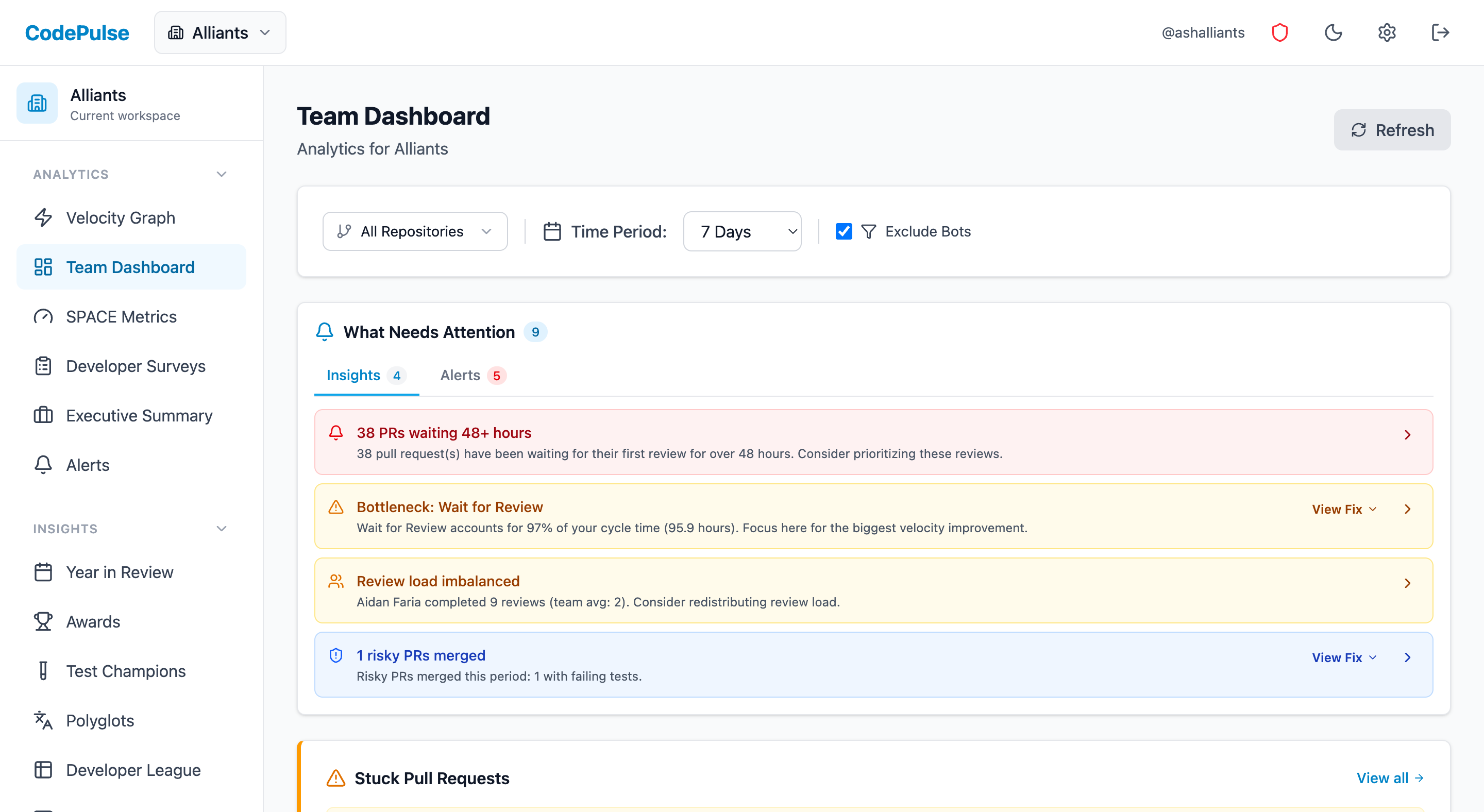
Now measure this metric on your own repositories
Connect read-only GitHub in about five minutes and get your baseline, your trend, and the constraint behind it. Your fourteen usable trial days start when the first repository finishes syncing.
Read-only GitHub · Your code stays yours · Team-level by default · No credit card
See These Features in Action
Track all four DORA metrics and benchmark against industry standards.
Holistic developer productivity using the SPACE framework.
Related Guides
DORA Metrics Explained: The 4 Keys Without the Hype
A complete breakdown of the four DORA metrics - deployment frequency, lead time, change failure rate, and MTTR - with honest benchmarks and gaming traps to avoid.
Why Microsoft Abandoned DORA for SPACE (And You Should Too)
Learn how to implement the SPACE framework from Microsoft and GitHub research to measure developer productivity across Satisfaction, Performance, Activity, Communication, and Efficiency.
Engineering Metrics Dashboard: The 7 Metrics You Need
Skip vanity metrics. Here are the 7 engineering metrics VPs actually need to track team performance, delivery, and quality.
CTO Dashboard: Metrics That Matter for Technical Leaders
Build a CTO dashboard that balances strategic oversight with operational visibility. Learn the 5-layer architecture for executive engineering metrics.