

Understand the system around the team, not a developer leaderboard
Preview team-level workload, collaboration, and delivery signals designed for process improvement rather than performance grading.
Read-only GitHub · Your code stays yours · Team-level by default · No credit card
Developer joy isn't a fluffy concept from HR - it's the single most predictive factor for engineering team performance, retention, and code quality. Teams where developers experience joy ship 31% more often, have 40% lower turnover, and produce code with half the defect rate. Yet most organizations measure everything except the thing that matters most.
"Happy developers aren't a nice-to-have. They're a competitive advantage that compounds quarterly. Every point of developer satisfaction correlates with measurable business outcomes - faster delivery, better retention, fewer bugs."
This guide shows you how to measure developer joy through objective proxies in your Git data, identify the patterns that kill joy before your best people leave, and build a culture where sustainable high performance is the default - not the exception.
What are developer joy metrics?
Developer joy metrics are objective proxies from Git data that correlate with developer satisfaction and retention: consistent work hours, review quality, PR size distribution, feature-to-maintenance ratio, recovery periods, and collaboration breadth. Teams with high joy scores have 40% lower turnover and ship 31% more often. CodePulse tracks these signals automatically through its Review Insights and Developer Analytics pages.
🔥 Our Take
Developer joy isn't soft - it's the hardest metric to game and the most honest signal you have.
You can force more commits, mandate shorter cycle times, and pressure people into weekend deploys. You cannot force joy. When developers experience genuine joy in their work, every other metric follows. When they don't, every intervention you try becomes a game of whack-a-mole with symptoms while the root cause - miserable engineers - remains untreated. Joy is the leading indicator. Everything else is lagging.
Why Is Developer Joy a Strategic Advantage?
The connection between developer happiness and business outcomes is now backed by substantial research. This isn't opinion - it's data:
| Research Source | Finding |
|---|---|
| Google's Project Aristotle | Psychological safety (a joy prerequisite) is the #1 predictor of team effectiveness |
| University of Warwick Study | Happy workers are 12% more productive; unhappy workers are 10% less productive |
| DORA State of DevOps | High-performing teams report 2x higher job satisfaction alongside better metrics |
| Microsoft Research (SPACE Framework) | Developer satisfaction is one of five core dimensions that predict productivity |
| Stack Overflow Developer Survey | Developers who feel productive are 3x more likely to be satisfied with their jobs |
The business case is straightforward: replacing a senior developer costs 1.5-2x their annual salary when you factor in recruiting, onboarding, and lost productivity. A team of 20 developers with 20% annual turnover - the industry average for unhappy teams - costs you the equivalent of 6-8 full salaries every year in churn alone.
"The CEO who says 'we can't afford to focus on developer happiness' is really saying 'we can afford 20% annual turnover, 40% more bugs, and 31% slower shipping.' The math doesn't support that position."
What Does Research Show About the Joy-Productivity Connection?
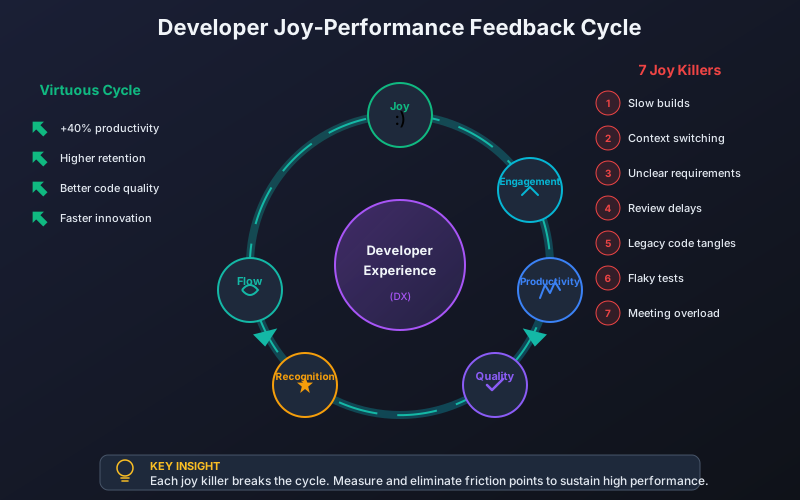
Happiness research has moved far beyond "positive thinking" platitudes. Neuroscience now explains exactly why joyful developers outperform stressed ones:
The Neuroscience of Developer Flow
When developers experience joy in their work, their brains release dopamine, which:
- Enhances working memory: Developers can hold more context in their heads, navigating complex codebases more effectively
- Improves pattern recognition: Spotting bugs, architectural issues, and optimization opportunities becomes easier
- Increases creative problem-solving: Novel solutions emerge more readily when the brain isn't in threat-response mode
- Supports sustained focus: Flow states - where developers are most productive - are only possible when baseline stress is low
Conversely, stressed developers operate with elevated cortisol, which narrows attention, impairs memory, and triggers risk-averse thinking. They don't just feel worse - they literally think worse.
The Happiness-Performance Feedback Loop
The Joy-Performance Cycle
"Developer enjoys work → Flow states increase → High-quality output → Recognition and autonomy → More joy"
"Developer frustrated → Context switching increases → Quality drops → Micromanagement response → More frustration"
"Small interventions can flip which cycle a team is in. The cycles are self-reinforcing once established."
This is why developer joy matters strategically: it's not one metric among many. It's the foundation that makes other metrics achievable. Trying to improve velocity without addressing joy is like trying to run a marathon while holding your breath.
What Are the Measurable Proxies for Developer Joy?
You can't directly measure joy from Git data - but you can measure the conditions that create or destroy it. These proxies correlate strongly with developer satisfaction surveys and, more importantly, with retention outcomes.
Positive Joy Indicators
| Indicator | What It Measures | Healthy Range |
|---|---|---|
| Consistent work hours | Commits primarily during business hours | >85% within 9 AM - 6 PM |
| Review response quality | Thoughtful comments vs. rubber stamps | >3 substantive comments per PR average |
| PR size distribution | Developers have time to break down work | >70% of PRs under 400 lines |
| Feature work ratio | Balance of new features vs. maintenance | 60-70% feature, 30-40% maintenance |
| Recovery periods | Light weeks after intense sprints | At least 1 light week per 4-week cycle |
| Collaboration breadth | Working with multiple teammates | Reviews exchanged with 3+ unique developers |
Joy Score Framework
We recommend tracking a composite "Joy Score" based on these proxies. Score each factor 0-2 and sum for a team-level indicator:
Developer Joy Score
Score range: 0-12 (higher is better)Review Sentiment Analysis
Code review comments are a rich source of joy indicators. Analyze the tone and substance of review exchanges:
Review Sentiment Indicators
- Questions seeking understanding ("Why did you...?")
- Suggestions with context ("Consider X because...")
- Acknowledgment of good work ("Nice approach here")
- Teaching moments ("FYI, we usually...")
- Collaborative problem-solving ("What if we...")
- Terse rejections ("No", "Wrong")
- Criticism without alternatives ("This is bad")
- Sarcasm or passive aggression
- Rubber-stamp approvals (no comments)
- Dismissive responses to questions
💬How to See This in CodePulse
CodePulse helps you track joy proxies across your team:
- Review Insights shows review sentiment patterns and comment quality trends
- Risky Changes flags after-hours work and weekend deploys
- Developer Analytics reveals workload distribution and recovery patterns
- Use Alert Rules to get notified when burnout signals emerge
What Are the Warning Signs of Joy Killers in Git Data?
Certain patterns in your Git data reliably predict declining developer satisfaction. Catch these early, before they drive your best people away:
The Seven Joy Killers
| Joy Killer | Git Signal | Impact |
|---|---|---|
| 1. Context Switching | Multiple PRs across unrelated repos same day | Fragments focus, prevents flow states |
| 2. Review Bottlenecks | PRs waiting 48+ hours for first review | Creates frustration, slows momentum |
| 3. After-Hours Creep | Increasing percentage of evening/weekend commits | Signals unsustainable workload |
| 4. Review Overload | One person doing 3x+ team average reviews | Invisible burnout, single point of failure |
| 5. Maintenance Trap | >50% of work is bug fixes/maintenance | No growth, no creativity, stagnation |
| 6. Large PR Pattern | Consistent PRs over 1000 lines | Signals no time to break down work properly |
| 7. No Recovery | No light weeks in 8+ week window | Chronic overwork, burnout imminent |
The Joy Killer Cascade
Joy killers rarely appear in isolation. They cascade:
How Joy Erodes
"Tight deadline pushes team to work weekends"
"Weekend work becomes normal. No recovery period."
"Best developer, exhausted, starts declining review requests"
"Review bottleneck forms. PRs wait 3 days. Frustration rises."
"Context switching increases as developers juggle blocked PRs"
"Two developers quietly start interviewing"
"First resignation. "Great opportunity." Real reason: burnout."
The cascade is preventable at every stage. But each stage requires more intervention than the last. Catching after-hours creep in Month 1 is a conversation. Fixing the culture in Month 6 is a transformation.
"By the time a developer tells you they're unhappy, they've been unhappy for months. The Git data knew before they did. The question is whether you were watching."
How Do You Build a Joy-Aware Team Culture?
Measuring joy proxies is step one. Building a culture that sustains developer joy requires intentional practices:
1. Protect Focus Time
Flow states require uninterrupted time. Most organizations systematically destroy it:
- No-meeting blocks: Designate 4-hour blocks (minimum) where no meetings can be scheduled. Tuesday and Thursday mornings work well.
- Async by default: Questions that can wait should wait. Set Slack expectations explicitly - not everything needs an immediate response.
- Interrupt budget: Each team member gets limited "interrupt tokens" per week. When they're out, you wait until their focus block ends.
2. Balance Autonomy and Alignment
Developers experience joy when they have autonomy over how they work while understanding why their work matters:
- Context, not control: Share the "why" behind priorities. Let developers figure out the "how."
- Ownership over tickets: Assign problems, not solutions. "We need faster checkout" beats "Add caching to the cart service."
- Growth alignment: Connect project assignments to individual development goals where possible.
3. Make Workload Visible
Joy killers thrive in darkness. Making workload visible helps teams self-correct:
- Weekly review load sharing: In standups, briefly note who's doing heavy review duty. Redistribute actively.
- After-hours as team metric: Track after-hours work as a team health indicator, not individual performance data.
- WIP limits: No one should have more than 2-3 active PRs. If they do, something's blocking them.
4. Celebrate the Right Things
What you celebrate shapes culture:
Celebration Patterns
- Shipping during work hours
- Thoughtful code reviews that caught issues
- Saying no to scope creep
- Taking actual vacation (offline)
- Helping a teammate learn something new
- Heroic all-nighters to meet deadlines
- "Crushing it" (unsustainable output)
- Working through vacation
- Reviewing 50 PRs in a week (why was that necessary?)
- Single-handedly fixing production at 2 AM
5. Regular Joy Check-Ins
Metrics catch patterns. Conversations catch context. Do both:
- Monthly 1:1 joy question: "On a scale of 1-10, how much are you enjoying your work right now?" Then: "What would move that number up?"
- Quarterly team retros on joy: Dedicated time to discuss what's making work enjoyable or frustrating.
- Skip-level conversations: VPs should hear directly from individual contributors about their experience.
What Intervention Strategies Work for Each Joy Score Level?
Different Joy Score levels require different interventions:
Score 10-12: Thriving
- Protect what's working: Document the conditions creating joy. Don't let "improvements" erode them.
- Share the playbook: Help other teams learn from your practices.
- Watch for complacency: Success can breed assumptions. Keep measuring.
Score 7-9: Healthy
- Identify the gap: Which specific factor is pulling the score down? Focus there.
- Small experiments: Try one intervention at a time. Measure impact.
- Prevent erosion: This is a good place to be. Don't let it slip.
Score 4-6: Warning Zone
- Direct conversations: Talk to the team about what's frustrating them. The data gives you permission to ask.
- Workload audit: Is the team overcommitted? What can be cut or delayed?
- Address systemic issues: Often it's one or two root causes (e.g., flaky tests, unclear priorities) causing multiple joy killers.
Score 0-3: Critical
- Immediate action required: This team is likely already experiencing turnover or about to.
- Cut scope aggressively: Whatever you're building is less important than keeping the team intact.
- Leadership involvement: This isn't a team-level fix. It requires organizational commitment.
- Honest conversations: Ask directly: "What would need to change for you to be happy here?"
How Do You Start Measuring Joy This Week?
This Week
- Calculate your team's Joy Score: Use the proxy metrics table to assess where you stand today.
- Check for joy killers: Look at your Risky Changes and Developer Analytics for after-hours patterns and review overload.
- Ask one question in your next 1:1: "How much are you enjoying your work right now, 1-10?"
This Month
- Implement one joy-protecting practice: No-meeting blocks, async defaults, or WIP limits.
- Set up joy killer alerts: Use Alert Rules to get notified about after-hours spikes or review bottlenecks.
- Run a team retro on joy: Dedicate 30 minutes to discussing what's making work enjoyable or frustrating.
This Quarter
- Track Joy Score weekly: Look for trends, not just absolute numbers.
- Connect joy to outcomes: Correlate your joy metrics with velocity, quality, and retention.
- Build the business case: Use the correlation data to advocate for continued investment in developer joy.
Developer joy isn't a perk - it's a strategy. The teams that understand this will attract better talent, ship better products, and outperform competitors who treat their engineers as interchangeable resources. Start measuring joy today, and you'll wonder how you ever managed without it.
For related guidance on building healthy, sustainable engineering teams, see our guides on Detecting Burnout Signals from Git Data, Improving Developer Experience, and Measuring Team Performance Without Micromanaging.
Frequently Asked Questions
Developer experience (DevEx) focuses on the tools, processes, and systems developers use. Developer joy is the emotional outcome of that experience combined with culture, autonomy, and purpose. You can have excellent DevEx (fast CI, great tools) and still have low joy (micromanagement, unclear priorities, no growth). Joy is the outcome; DevEx is one input.
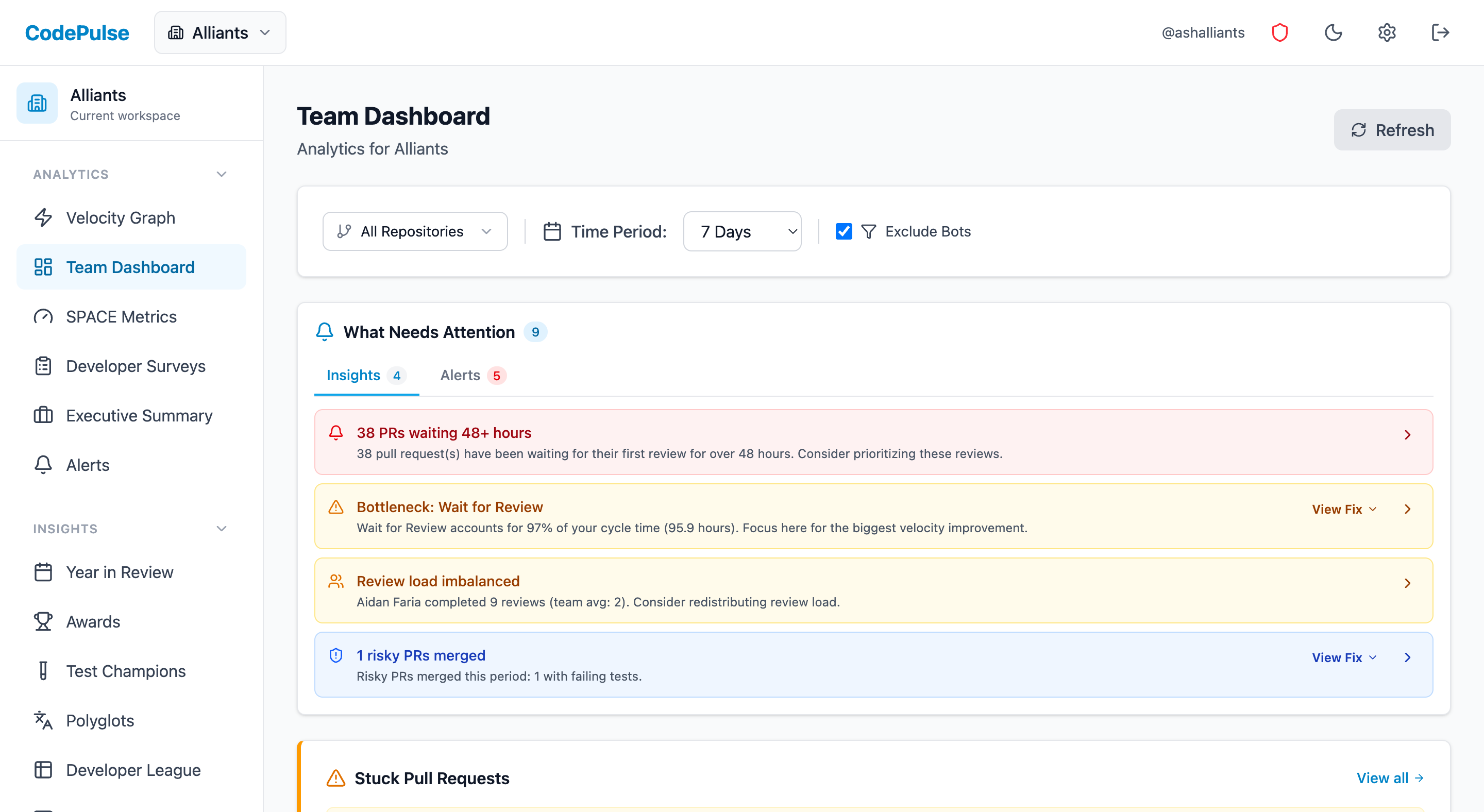
Get this view for your own teams
Connect GitHub for team-level workload, review distribution, and delivery signals. Individual views stay off unless your organisation explicitly turns them on.
Read-only GitHub · Your code stays yours · Team-level by default · No credit card
See These Features in Action
Holistic developer productivity using the SPACE framework.
Compare contribution patterns for coaching, not surveillance.
Related Guides
Your Git Data Predicts Burnout 6 Weeks in Advance
Use the STRAIN Score framework to detect developer burnout from Git data. Identify after-hours patterns, review overload, and intensity creep before they cause turnover.
Improve Developer Experience: Proven Strategies
A practical guide to improving developer experience through surveys, team structure, and proven strategies that actually work.
Engineering Metrics That Won't Get You Reported to HR
An opinionated guide to implementing engineering metrics that build trust. Includes the Visibility Bias Framework, practical do/don't guidance, and a 30-day action plan.
Engineering Team Management: Using Data to Lead Without Micromanaging
Managing software teams requires balancing delivery, quality, team health, and individual growth. This guide shows how to use data for visibility while avoiding surveillance, with practical scenarios and communication patterns.