

Understand the system around the team, not a developer leaderboard
Preview team-level workload, collaboration, and delivery signals designed for process improvement rather than performance grading.
Read-only GitHub · Your code stays yours · Team-level by default · No credit card
Half the arguments in a sprint review come down to one word: done. The developer says the story is finished. The tester found no automated coverage. The product owner expected documentation. Everyone was right, because nobody agreed what "done" meant. A Definition of Done ends that argument before it starts.
What is a definition of done?
A Definition of Done (DoD) is a shared checklist of quality criteria that every piece of work must meet before a team calls it complete. It applies to all backlog items equally, covering things like code review, testing, documentation, and deployment readiness. In Scrum, the 2020 Scrum Guide names it as a formal commitment attached to the Increment: if a backlog item does not meet the Definition of Done, it cannot be released and returns to the Product Backlog. It is a team-owned quality bar, not a manager's approval gate.
This guide covers what a Definition of Done is, what belongs in one, how it differs from acceptance criteria, how to write one your team will actually use, and how to tell whether people are following it. There's a copy-paste example you can steal near the end.
🔥 Our Take
A Definition of Done belongs to the people who build the product, not to the person who reviews their performance. The moment it turns into a stick that managers use to grade individuals, engineers start gaming it, and the checklist stops describing quality.
The point of a shared bar is to make quality a team habit instead of a personal judgement call. Written well, a Definition of Done protects developers from the "just ship it" pressure that produces the bugs they'll be blamed for later. Written as a surveillance tool, it becomes one more thing to resent. The difference is who owns it.
What Is a Definition of Done?
A Definition of Done is a shared set of criteria that a piece of work must meet before the team agrees it's complete. It applies to every backlog item in the same way, so "done" means the same thing whether the story was a one-line fix or a two-week feature. It goes well beyond "the code runs." It covers whether the work was reviewed, tested, documented, and made ready to release.
In Scrum, this isn't optional folklore. The 2020 Scrum Guide lists the Definition of Done as one of three commitments, sitting alongside the Product Goal (committed to the Product Backlog) and the Sprint Goal (committed to the Sprint Backlog). The Definition of Done is the commitment attached to the Increment. The guide describes it as "a formal description of the state of the Increment when it meets the quality measures required for the product."
The consequence is what gives it teeth. If a backlog item doesn't meet the Definition of Done, it can't be released or even shown at the Sprint Review. It goes back to the Product Backlog for later. That's the line between work that ships and work that only looks finished.
"A story isn't done when it works on your machine. It's done when it meets the same quality bar as everything else your team ships."
What Should a Definition of Done Include?
There's no universal list, because the right bar depends on your product and risk tolerance. A Definition of Done for a payments system carries heavier checks than one for an internal dashboard. That said, most solid definitions group their checks into a handful of categories.
- Code: merged to the main branch, follows the team style guide, and carries no leftover debug logging or commented-out blocks.
- Review: reviewed and approved by at least one other engineer, with review comments resolved rather than ignored.
- Testing: automated tests written for new behaviour, the existing suite green in CI, and the change checked against its acceptance criteria.
- Documentation: public interfaces and config changes written up, and release notes updated when the change is user-facing.
- Operability: logging and metrics in place for new behaviour, and the change deployed to a staging environment and smoke-tested.
Notice that none of these mention story points, estimates, or how fast the work moved. A Definition of Done measures quality, not speed. Keep delivery-pace conversations in your sprint velocity discussion, where they belong, and keep the "is this good enough to ship?" question here.
Start lean. A Definition of Done isn't fixed forever. The healthiest approach is to begin with a small, honest list and add checks as the team learns where quality slips. A bar you actually meet every sprint beats an aspirational one you quietly ignore.
How Is a Definition of Done Different From Acceptance Criteria?
This is the most common point of confusion, and the answer comes down to scope. Acceptance criteria belong to one specific user story and describe what that feature must do. The Definition of Done applies to every story equally and describes the quality bar all of them share.
Put simply, acceptance criteria answer a product question and the Definition of Done answers an engineering question. Both have to be satisfied before a story is truly complete. A feature can pass every acceptance criterion and still fail the Definition of Done because nobody wrote tests for it.
"Acceptance criteria ask 'did we build the right thing?' Your Definition of Done asks 'did we build it well enough to ship?'"
| Aspect | Acceptance Criteria | Definition of Done |
|---|---|---|
| Scope | One specific user story | Every backlog item |
| Question it answers | Does the feature do what we wanted? | Is the work ready to release? |
| Changes per story | Yes, unique each time | No, stays constant |
| Owned by | Product Owner, with the team | The Developers who build it |
| When it's used | During the sprint, to guide the build | At the finish line, to confirm completion |
How Do You Write a Good Definition of Done?
Write it as a team, in a room, in about an hour. A Definition of Done handed down from a manager or copied wholesale from a blog rarely survives contact with real work, because the people who have to meet it every day never bought into it. Here's a sequence that works.
- Ask what "done" already means to each person. You'll get different answers, and that gap is exactly the problem you're solving. Write every answer on the board.
- Group the answers into categories. Most cluster into code, review, testing, documentation, and operability. This becomes the skeleton of your list.
- Cut anything you can't actually verify. "Code is clean" is a wish, not a check. "Linter passes with no warnings" is a check. Keep the ones you can point at.
- Make each item pass or fail. A Definition of Done is a checklist, so every line needs a clear yes-or-no answer. Vague items get argued about, which defeats the purpose.
- Agree it's the floor, not the ceiling. The Definition of Done is the minimum bar for every item. Individual stories can demand more through their acceptance criteria.
One more rule: keep it short. A Definition of Done that fills two pages is one nobody reads, and a bar nobody reads isn't a bar. Aim for something that fits on a single screen and lives where the team already works, pinned in the pull request template or the team wiki.
"The best Definition of Done is short enough to remember and strict enough to catch the corners you keep cutting."
What Does a Definition of Done Look Like? (Example)
Here's a Definition of Done you can copy, paste into your team wiki or pull request template, and adjust. It's written for a team shipping a web application from GitHub, so trim the checks that don't apply and add the ones your product needs.
## Definition of Done

### Code
- [ ] Merged to the main branch
- [ ] Follows the team style guide (linter passes, no warnings)
- [ ] No commented-out code or debug logging left behind

### Review
- [ ] Reviewed and approved by at least one other engineer
- [ ] All review comments resolved or turned into follow-up tickets

### Testing
- [ ] Automated tests written for the new behaviour
- [ ] Full test suite green in CI
- [ ] Manually verified against the story's acceptance criteria

### Documentation
- [ ] Public APIs and config changes documented
- [ ] Release notes updated if the change is user-facing

### Operability
- [ ] Feature flag added for anything risky
- [ ] Logging and metrics in place for new behaviour
- [ ] Deployed to staging and smoke-tested
This is a starting point, not a mandate. A team new to writing a Definition of Done might drop the operability section on day one and add it once the basics stick. A team on a regulated product might add checks for security review or audit logging. The list should describe your bar, not somebody else's.
How Do You Enforce a Definition of Done?
A Definition of Done only matters if the team meets it, and the honest truth is that most teams drift. Under deadline pressure, the testing check gets skipped, the documentation check becomes "later," and within a few sprints the list on the wiki no longer matches what actually ships. Enforcement is the difference between a real quality bar and a poster on the wall.
Start with automation, because a check a machine can enforce never gets skipped under pressure. Branch protection rules can require an approving review and a green CI run before a merge. A pull request template can put the checklist in front of every author. Your pull request checklist is the natural home for the code and review parts of your Definition of Done, and a good review culture is what makes the human checks worth having.
Automation covers the mechanical checks, but it can't tell you whether the habit is holding across the team over time. That's where your GitHub history earns its keep. If your Definition of Done says every change needs a review, the share of pull requests that merge without an approval tells you whether that's true. If it says tests must pass, your CI pass rate tells the same story. Read these at the team level and take them into a retro, the same way you'd read your DORA metrics.
💡See Whether Your Definition of Done Holds Up
CodePulse reads your pull request history straight from GitHub, so you can check the parts of your Definition of Done that involve review and testing without asking anyone. The Review Network shows how review actually flows across the team, so a "must be reviewed" rule stops being an honour system.
- Spot pull requests that merged without an approval, against your "reviewed" check.
- Track review coverage and CI health as team-level trends, not individual scorecards.
- Bring the numbers to a retro so the team can tighten or relax the bar together.
You don't need a tool to start. Open your repository's merged pull requests, sort by most recent, and check twenty of them by hand against two or three lines of your Definition of Done: did each one get an approving review, and did CI pass before the merge? If most did, your bar is holding. If a third slipped through, you've found the check that needs a branch protection rule rather than a reminder in standup. Doing this by hand every sprint gets old fast, which is where automated tracking pays for itself, but it's a fine way to prove the problem is real before you spend anything.
Keep enforcement developmental. A Definition of Done that becomes ammunition in performance reviews teaches people to hide corners instead of raising them. When the data shows the bar slipping, treat it as a question for the group: is the check still worth having, is the team under too much pressure to meet it, or has the work changed? A bar the team keeps adjusting honestly is worth more than one it pretends to hold.
Done well, a Definition of Done quietly removes a whole class of arguments and a whole class of late surprises. It won't make anyone code faster, and it isn't meant to. It makes "done" mean something, so the next sprint review is about the product instead of the paperwork. For teams working on how to ship that product sooner, pair it with our guide on reducing PR cycle time.
Frequently Asked Questions
Yes. The 2020 Scrum Guide names the Definition of Done as one of three commitments, alongside the Product Goal and the Sprint Goal. It's the commitment attached to the Increment. The guide describes it as "a formal description of the state of the Increment when it meets the quality measures required for the product."
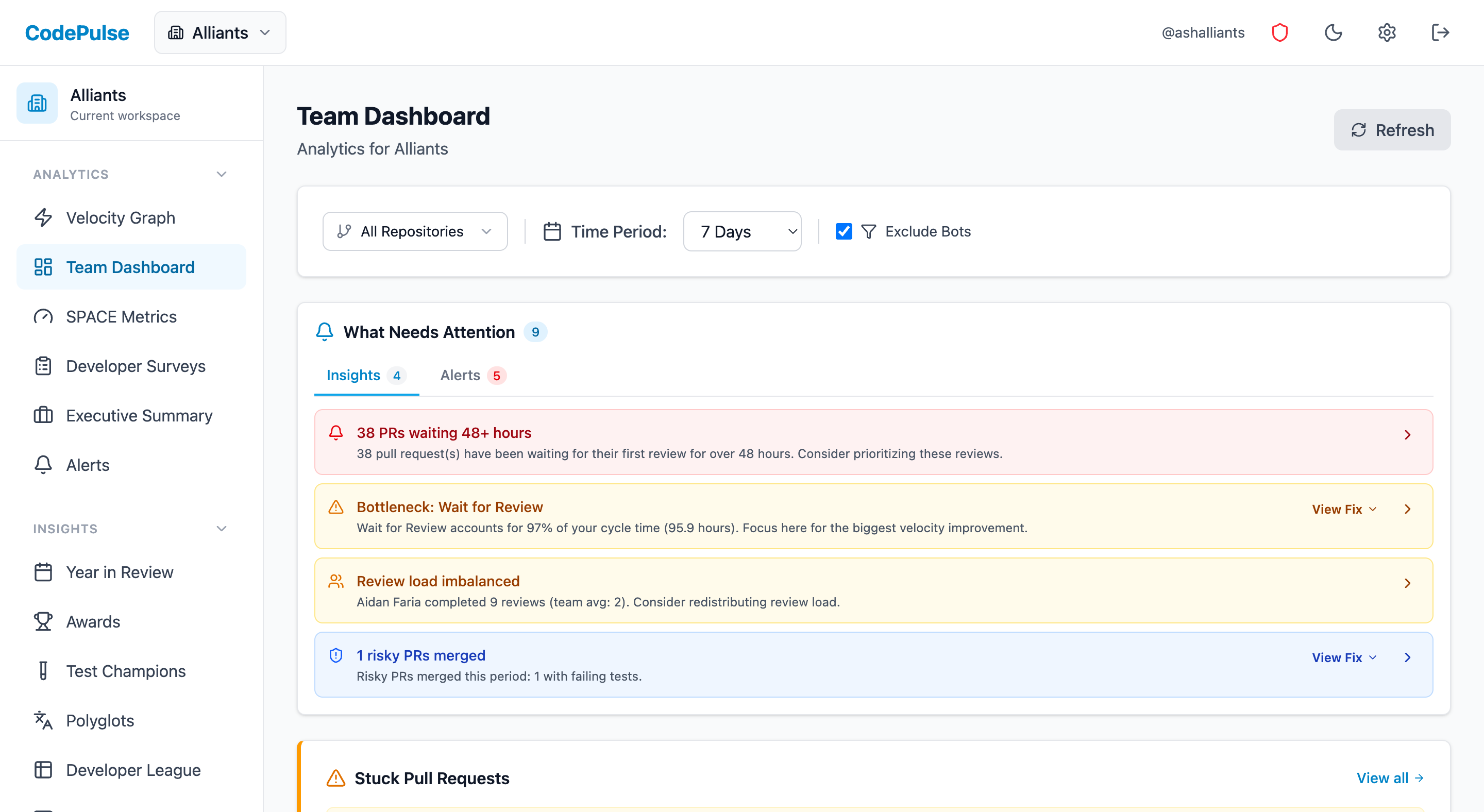
Get this view for your own teams
Connect GitHub for team-level workload, review distribution, and delivery signals. Individual views stay off unless your organisation explicitly turns them on.
Read-only GitHub · Your code stays yours · Team-level by default · No credit card
See These Features in Action
Interactive graph of review relationships and workload distribution.
Break down cycle time into coding, waiting, review, and merge phases.
Related Guides
The Pull Request Checklist That Ships Better Code
A practical pull request checklist for authors and reviewers - what to check before you open a PR, before you approve, and how to make it stick without slowing the team down.
7 Code Review Rules That Actually Get PRs Approved Faster
Learn code review best practices backed by metrics. Covers reviewer guidelines, author guidelines, team practices, and how to measure review effectiveness.
Sprint Velocity: What It Is and How to Use It
A plain-English guide to sprint velocity in Scrum: what it measures, how to calculate it, and why it fails the moment you treat it as a productivity metric.
We Cut PR Cycle Time by 47%. Here's the Exact Playbook
A practical playbook for engineering managers to identify bottlenecks, improve review processes, and ship code faster - without sacrificing review quality.
DORA Metrics Explained: The 4 Keys Without the Hype
A complete breakdown of the four DORA metrics - deployment frequency, lead time, change failure rate, and MTTR - with honest benchmarks and gaming traps to avoid.