
Understand the system around the team, not a developer leaderboard
Preview team-level workload, collaboration, and delivery signals designed for process improvement rather than performance grading.
Read-only GitHub · Your code stays yours · Team-level by default · No credit card
You have access to more engineering data than any previous generation of leaders. Commit histories, PR metrics, cycle times, deployment frequencies, code coverage, and dozens more signals are at your fingertips. Yet the hardest question remains: how do you use this data to actually lead better? This guide shows you how to build a data-driven leadership practice that improves decisions without losing the human judgment that makes great engineering leaders irreplaceable.
"Data-driven doesn't mean data-controlled. The best engineering leaders use metrics to sharpen their intuition, not replace it."
What Data-Driven Leadership Actually Means
Let's start by clearing up a misconception. Data-driven engineering leadership doesn't mean:
- Making every decision based on metrics
- Requiring data to justify any engineering choice
- Tracking individual developer productivity
- Building dashboards that nobody looks at
- Optimizing metrics instead of outcomes
Data-driven leadership means using evidence to inform decisions while maintaining the judgment to know when data is incomplete, misleading, or simply irrelevant to the decision at hand.
According to research from Harvard Business Review, organizations that effectively use data for decision-making are 5% more productive and 6% more profitable than their competitors. But the key word is "effectively" - many organizations drown in data while still making poor decisions.
"The goal isn't to eliminate gut decisions - it's to ensure your gut is educated by reality rather than wishful thinking."
🔥 Our Take
The best data-informed decisions happen when you're suspicious of your own data.
If your metrics perfectly confirm what you already believed, that's a red flag - not validation. Good data practice means actively seeking disconfirming evidence and asking "what would prove me wrong?" The moment you stop questioning your dashboards, you've become data-driven in the worst way: blindly following numbers without understanding what they actually represent.
The Metrics Maturity Model
Not all organizations are ready for the same level of data sophistication. Jumping straight to advanced analytics when you can't trust your basic measurements is a recipe for expensive mistakes. Here's a five-level maturity model to assess where you are - and what to work on next.
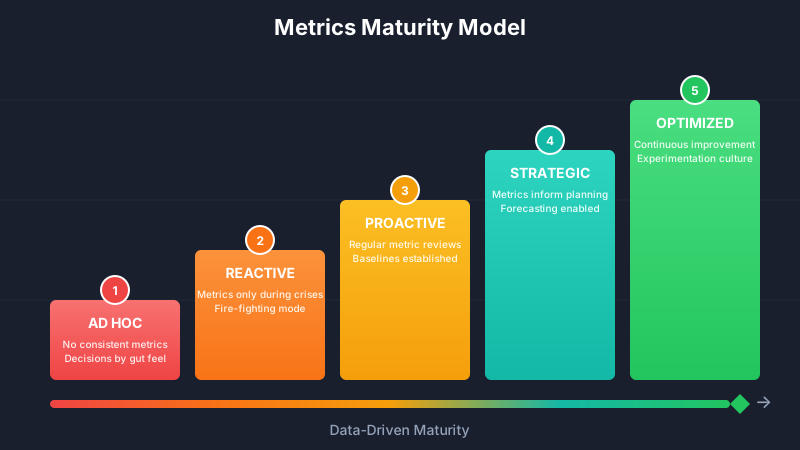
| Level | Name | Characteristics | Focus Area |
|---|---|---|---|
| 1 | Ad Hoc | No consistent metrics; decisions based on anecdotes and memory | Establish basic measurement |
| 2 | Reactive | Metrics exist but only checked during crises; no regular cadence | Build review habits |
| 3 | Proactive | Regular metric reviews; trends tracked; baselines established | Connect metrics to action |
| 4 | Strategic | Metrics inform planning; predictive insights; cross-team visibility | Enable forecasting |
| 5 | Optimized | Continuous improvement; experimentation culture; metrics evolve with needs | Maintain balance |
Level 1: Ad Hoc
At this level, decisions are based on whoever speaks loudest or most recently. "The team seems slow" might trigger a response, but there's no baseline to know if the team is actually slower than before or just feels that way.
How to advance: Pick three to five core metrics and start measuring them consistently. Don't worry about perfection - just establish the habit of looking at the same numbers regularly.
Level 2: Reactive
Metrics exist, but they're only consulted when something goes wrong. The dashboard gets pulled up during post-mortems or when a stakeholder asks pointed questions. There's no regular review cadence.
How to advance: Schedule a weekly 15-minute metrics review. Even if nothing looks wrong, build the muscle of checking data before it becomes urgent.
Level 3: Proactive
Regular reviews happen. Teams know their baselines and notice when trends shift. Leaders can answer basic questions about engineering performance with data rather than guesses.
How to advance: Start connecting metrics to decisions. When you make a process change, track whether it moved the needle. Begin experimenting with leading indicators.
Level 4: Strategic
Metrics actively inform planning and resource allocation. Leaders can forecast capacity and identify bottlenecks before they become crises. Cross-team comparisons are made with appropriate context.
How to advance: Build a culture of experimentation. Test hypotheses about what drives improvement. Start measuring the metrics program itself - is it delivering value?
Level 5: Optimized
The organization continuously refines its measurement practice. Metrics that stop being useful are retired. New ones are added thoughtfully. There's a healthy skepticism of numbers combined with respect for evidence.
How to maintain: Guard against metric ossification. Regularly ask "should we still be measuring this?" and "what important thing are we not measuring?"
From Gut Feel to Evidence-Based Decisions
Most engineering leaders have developed strong intuition through years of experience. That intuition is valuable - but it can also be wrong. The challenge is building a practice that respects intuition while testing it against reality.
The Decision Framework
For any significant decision, run through this checklist:
- What does my gut say? Document your initial instinct before looking at data.
- What data is relevant? Identify what metrics would inform this decision.
- What does the data say? Review the evidence objectively.
- Does data confirm or contradict intuition? Note the alignment.
- What's missing? Acknowledge gaps in the data.
- Final decision: Combine evidence with judgment.
This process accomplishes two things: it forces you to actually look at data, and it builds your calibration over time. If your gut is consistently wrong, you'll notice. If it's consistently right, you'll have evidence to trust it more.
When to Trust Data
Data is most trustworthy when:
- The measurement is direct (not a proxy)
- You've seen the pattern across multiple time periods
- The sample size is sufficient
- You understand how the data was collected
- The metric hasn't been gamed
When to Trust Intuition
Intuition is more reliable when:
- The decision involves human dynamics
- Available data is incomplete or lagging
- The situation is genuinely novel
- Speed matters more than precision
- You have deep domain experience in this specific context
"An experienced leader's intuition is pattern matching on thousands of past observations. Data is pattern matching on millions. Neither is complete without the other."
Avoiding Metrics Dysfunction
The road to hell is paved with good metrics intentions. Here are the most common ways data-driven cultures go wrong - and how to prevent each failure mode.
Goodhart's Law Traps
"When a measure becomes a target, it ceases to be a good measure." This isn't just theoretical - it happens constantly in engineering organizations:
| Metric | Gaming Behavior | Prevention |
|---|---|---|
| Cycle time | Merging incomplete PRs; skipping reviews | Balance with quality metrics |
| Deployment frequency | Splitting changes unnecessarily | Track meaningful releases, not commits |
| Lines of code | Verbose code; unnecessary changes | Don't measure this at all |
| PR count | Tiny PRs for easy wins | Combine with scope/impact assessment |
| Bug count | Reclassifying issues; not logging bugs | Measure customer impact instead |
The fix: Never tie metrics directly to individual performance evaluations. Use metrics to understand systems, not to judge people.
Analysis Paralysis
Some organizations become so enamored with data that they can't decide anything without a full analysis. This creates its own dysfunction: slow decisions, missed opportunities, and teams that feel they need "permission from the dashboard."
The fix: Establish decision categories with different data requirements. Reversible decisions can be made quickly with minimal data. High-stakes, irreversible decisions warrant deeper analysis.
Metric Inflation
It's easy to add metrics. It's hard to remove them. Over time, organizations accumulate dashboards full of measurements that nobody really looks at or acts upon.
The fix: Quarterly metric audits. For each metric, ask: "What decision did this change in the last quarter?" If the answer is "none," consider retiring it.
False Precision
Engineering metrics often create an illusion of precision that doesn't exist. Reporting cycle time as "2.47 days" implies accuracy that the underlying measurement doesn't support.
The fix: Use ranges and confidence intervals. "Cycle time is typically 2-3 days" is more honest than "cycle time is 2.47 days."
🔥 Our Take
The most dangerous metric is the one nobody questions.
When a number becomes organizational gospel, people stop asking what it actually measures. "We've always tracked velocity this way" is a warning sign, not a justification. The best data-driven cultures maintain healthy skepticism about their own measurements - especially the ones that have been around longest.
Building Your Data-Driven Toolkit
A practical data-driven leadership practice requires the right combination of tools, processes, and habits. Here's what to build.
Core Metrics Dashboard
Start with a focused set of metrics that matter for engineering leadership. Resist the temptation to measure everything:
| Category | Metric | Why It Matters |
|---|---|---|
| Delivery | Cycle time | How fast can we ship changes? |
| Delivery | Deployment frequency | How often do we release? |
| Quality | Change failure rate | How often do deployments cause problems? |
| Quality | Review coverage | Is code being properly reviewed? |
| Health | Review load distribution | Is work distributed fairly? |
| Health | Knowledge concentration | Where are our single points of failure? |
This core set - built on DORA foundations plus team health indicators - gives you enough signal without overwhelming complexity.
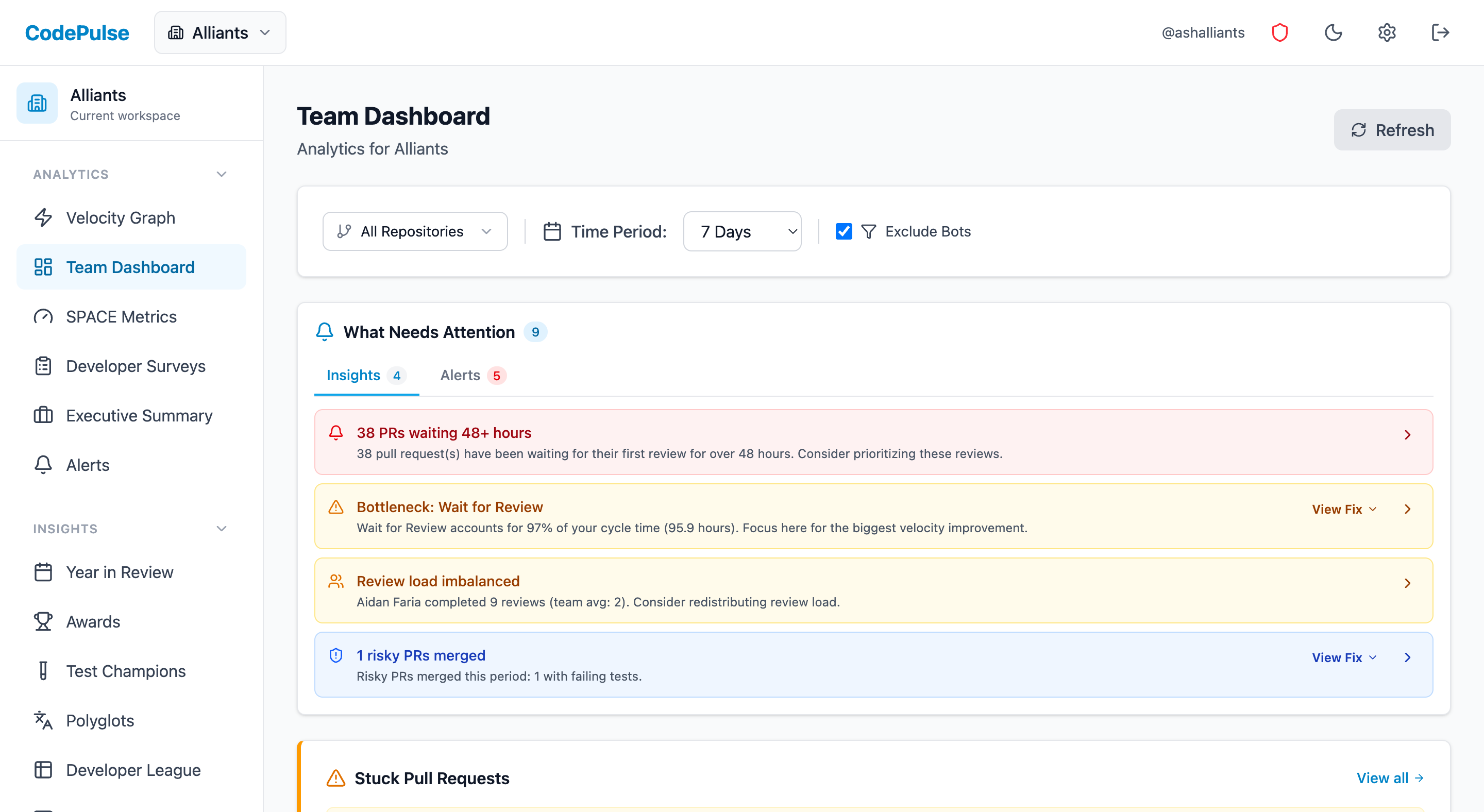
📊How to See This in CodePulse
CodePulse provides the metrics foundation for data-driven leadership:
- View your overall engineering health at Executive Summary
- Compare your metrics against benchmarks at Benchmarks
- Drill into team-level details from the dashboard
- Set up alerts to surface issues before they become crises
Review Cadence
Data is only useful if you look at it. Establish a regular review rhythm:
Data Review Cadence:

WEEKLY (15 min)
- Cycle time trends: improving, stable, or degrading?
- Any alerts or anomalies from the past week?
- Blocked PRs or stalled work?

MONTHLY (30 min)
- Month-over-month comparisons
- Team-level breakdowns
- Are we hitting improvement targets?
- What changed, and why?

QUARTERLY (60 min)
- Strategic metric review
- Benchmark comparisons
- Metric audit: what should we add/remove?
- Update targets for next quarter
Decision Log
Keep a lightweight log of significant decisions and what data informed them. Over time, this builds your calibration and creates institutional memory about what works.
Decision Log Format:

Date: [date]
Decision: [what you decided]
Initial Intuition: [what your gut said]
Data Considered: [metrics reviewed]
Data Gap: [what you couldn't measure]
Expected Outcome: [what you think will happen]
Review Date: [when to check results]

---

Example:
Date: 2025-01-15
Decision: Add second reviewer requirement for core modules
Initial Intuition: Quality will improve, but velocity will drop
Data Considered: Change failure rate 12%; 68% of failures in core modules
Data Gap: Don't know review thoroughness on core modules specifically
Expected Outcome: CFR drops to <8%; cycle time increases 10-15%
Review Date: 2025-04-15
Experimentation Practice
The highest level of data-driven maturity involves running experiments. This doesn't require complex A/B testing infrastructure - just disciplined before/after measurement.
When you make a process change:
- Document current baselines
- Define what success looks like (in measurable terms)
- Set a review date (usually 4-8 weeks out)
- Compare results against baseline
- Decide: keep, modify, or revert the change
Frequently Asked Questions
Start by being transparent about what you're measuring and why. Make clear that metrics are for improving systems, not judging individuals. Share the data openly with the team and invite their input on what to measure. Most resistance comes from fear of surveillance - address that directly.
The Bottom Line
Data-driven engineering leadership isn't about worshipping numbers or abandoning judgment. It's about building a practice where evidence informs decisions, intuition is tested against reality, and the organization continuously learns what actually drives improvement.
Start by assessing your current maturity level. Pick one level to advance. Establish a regular review cadence. Keep a decision log to build calibration. And always remember: the point isn't to have the best metrics - it's to make better decisions that lead to better engineering outcomes.
For more guidance on specific aspects of engineering measurement, explore:
- VP Engineering Metrics Guide - metrics that matter for executive visibility
- Engineering Manager Guide - using metrics without destroying trust
- Engineering Metrics Dashboard Guide - building dashboards executives find useful
Get this view for your own teams
Connect GitHub for team-level workload, review distribution, and delivery signals. Individual views stay off unless your organisation explicitly turns them on.
Read-only GitHub · Your code stays yours · Team-level by default · No credit card
See These Features in Action
Board-ready engineering performance in a single page.
Track all four DORA metrics and benchmark against industry standards.
Related Guides
VP Engineering Board Metrics: 7 Numbers That Defend Headcount
The 7 metrics VPs of Engineering need for board presentations: delivery predictability, investment allocation, and team health - with the language to present them.
The EM Dashboard That Won't Get You Reported to HR
With 83% of developers suffering from burnout and a 12-point perception gap between engineers and executives, EMs need metrics that reveal team health - not just delivery. Here is what to track, what to ignore, and how to use data without destroying trust.
Engineering Metrics Dashboard: The 7 Metrics You Need
Skip vanity metrics. Here are the 7 engineering metrics VPs actually need to track team performance, delivery, and quality.
Developer Joy Metrics: Measuring What Makes Developers Happy
Developer joy isn't soft - it's strategic. Learn measurable proxies for developer happiness, warning signs in git data, and how to build joy-aware teams.