

Find quality and ownership risk before it becomes an incident
Preview how CodePulse combines review depth, risky changes, hotspots, and knowledge concentration without turning activity into individual scores.
Read-only GitHub · Your code stays yours · Team-level by default · No credit card
Every codebase has areas where knowledge concentrates in dangerous ways. Some modules have clear owners who review every change. Others sit abandoned, touched by no one until a critical bug forces attention. A code ownership heatmap reveals these patterns before they become emergencies - showing you exactly where knowledge lives, where it's missing, and where bottlenecks form.
"The most dangerous code isn't the complex code - it's the code no one owns. When something breaks, you'll discover who doesn't understand it the hard way."
Why Code Ownership Visibility Matters
Code ownership isn't just about who wrote the code - it's about who understands it well enough to maintain, debug, and evolve it safely. Without visibility into ownership patterns, teams face predictable problems:
- Invisible bottlenecks: PRs queue up waiting for the same expert, but no one realizes why cycle times are slow
- Knowledge loss: When developers leave, their institutional knowledge evaporates with them. The decision history behind a design is the tribal knowledge that disappears completely, because nothing in the code records a choice that was never written down
- Uneven risk: Critical systems depend on single individuals who could be sick, on vacation, or interviewing elsewhere
- Abandoned code: Modules that "just work" accumulate technical debt because no one feels responsible
A code ownership heatmap transforms these invisible patterns into actionable data. Instead of discovering knowledge gaps during incidents, you identify them during planning.
What Git Blame Actually Tells You
Git blame shows who last touched each line of code. But "last touched" doesn't equal "understands." The person who fixed a typo three months ago isn't necessarily the person who can safely refactor the module.
Effective ownership analysis looks at multiple signals:
| Signal | What It Reveals | Limitations |
|---|---|---|
| Recent commits | Who's actively working in this area | Misses historical knowledge holders |
| Lines authored | Who wrote the bulk of the code | Original authors may have left |
| Review activity | Who reviews changes (often the real experts) | Reviewers may lack implementation depth |
| PR approvals | Who has authority over the code | May reflect seniority, not expertise |
A comprehensive ownership heatmap combines these signals to show true knowledge distribution, not just commit attribution.
The Ownership Spectrum: From Abandoned to Bottlenecked
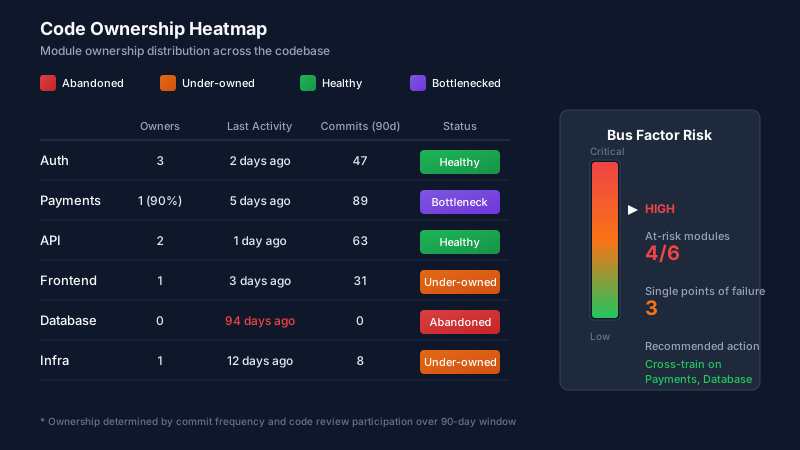
"Perfect ownership distribution is a myth. The goal is understanding your current state well enough to manage risk intentionally."
Code ownership exists on a spectrum. Each position carries different risks and requires different interventions:
Abandoned: No Active Owners
Definition: No commits or reviews from anyone in the past 6+ months. No one on the current team claims responsibility.
Characteristics:
- Last meaningful change was 6-12+ months ago
- Original authors have left the organization
- Documentation is outdated or missing
- Test coverage is unknown or minimal
- When issues arise, everyone points elsewhere
Risk: When abandoned code needs changes - security patches, API deprecations, performance fixes - you start from zero understanding. Estimates become wild guesses. Bugs multiply.
Action: Assign explicit ownership, schedule documentation sprints, add integration tests before attempting changes.
Under-Owned: Single Point of Failure
Definition: One person handles all commits, reviews, and decisions. No backup understands the code.
Characteristics:
- One contributor accounts for 80%+ of recent activity
- PRs stall when that person is unavailable
- Knowledge transfer attempts haven't stuck
- The "owner" may be burning out from the load
Risk: The classic bus factor problem. One resignation, illness, or vacation creates a bottleneck or crisis. The owner becomes a gatekeeper whether they want to be or not.
Action: Pair programming rotations, mandatory second reviewers, documented decision logs, deliberate cross-training.
Healthy: Distributed Expertise
Definition: Multiple team members can confidently modify and review the code. No single person is a bottleneck.
Characteristics:
- 3-4+ contributors active in the past 90 days
- Review responsibilities rotate naturally
- Team members can cover for each other
- Documentation exists and stays current
- New team members can ramp up reasonably
Risk: Minimal, but can degrade over time. Watch for concentration creep as people specialize.
Action: Maintain current practices. Monitor for drift toward under-owned status.
Bottlenecked: Too Much Traffic, Too Few Reviewers
Definition: High-change code where reviews concentrate in 1-2 people, creating queue delays even if others could contribute.
Characteristics:
- High commit frequency (10+ commits/week)
- Review assignments always go to the same people
- Long wait times for review despite other team capacity
- CODEOWNERS rules may be too restrictive
Risk: Cycle time suffers. The bottleneck reviewers burn out. Quality declines as overloaded reviewers rubber-stamp to clear queues.
Action: Expand CODEOWNERS teams, implement review rotation, train additional reviewers explicitly.
Ownership Spectrum Summary
| State | Contributors | Primary Risk | Intervention |
|---|---|---|---|
| Abandoned | 0 active | Total knowledge loss | Assign ownership, document |
| Under-Owned | 1 person | Bus factor = 1 | Cross-train, pair program |
| Healthy | 3-4+ people | Minimal | Maintain, monitor |
| Bottlenecked | Many writers, few reviewers | Cycle time, burnout | Expand reviewer pool |
🔥 Our Take
"Ownership" is a loaded word. We're not talking about territorial gatekeeping - we're talking about responsibility and knowledge distribution. The goal isn't to create fiefdoms but to ensure every critical system has multiple people who can maintain it.
When someone "owns" code in a healthy way, they're accountable for its health but actively spreading knowledge to others. Unhealthy ownership hoards information. The heatmap helps you tell the difference.
Building a Code Ownership Heatmap
A code ownership heatmap visualizes contributor concentration across your codebase. Here's how to build one from git data.
Step 1: Extract Contributor Data
For each significant file or directory, count unique contributors over a meaningful time window (typically 6-12 months):
# Count contributors per directory (last 12 months)
git log --since="12 months ago" --format='%an' --name-only | \
  awk 'NF==0{author=""} NF>0 && author==""{author=$0} NF>0 && author!=""{
    dir=$0; gsub(/\/[^\/]*$/, "", dir); print dir "\t" author
  }' | sort -u | cut -f1 | sort | uniq -c | sort -rn

# Detailed breakdown for a specific path
git log --since="12 months ago" --format='%an' -- src/billing/ | \
  sort | uniq -c | sort -rn
Step 2: Classify by Ownership State
Apply thresholds to categorize each module:
| State | Contributor Count (12mo) | Concentration Threshold |
|---|---|---|
| Abandoned | 0 | No activity |
| Under-Owned | 1-2 | Top contributor > 75% |
| Healthy | 3+ | Top contributor < 50% |
| Bottlenecked | 3+ authors, 1-2 reviewers | High change frequency |
Step 3: Incorporate Review Data
Commits alone miss the review dimension. Layer in PR review data to find bottlenecks:
# GitHub CLI: Get reviewers for recent PRs touching a path
gh pr list --state merged --limit 50 --json number,files,reviews | \
  jq '.[] | select(.files[].path | startswith("src/billing/")) |
      .reviews[].author.login' | sort | uniq -c | sort -rn

# Result shows who actually reviews billing changes
#   23 sarah    <- Bottleneck indicator
#    4 alex
#    2 jordan
Step 4: Visualize the Heatmap
Create a visual representation mapping modules to ownership states. Options range from spreadsheets to dedicated tools:
+------------------+-------------+------------------+-----------+
| Module           | State       | Primary Owner    | Risk      |
+------------------+-------------+------------------+-----------+
| src/billing/     | Under-Owned | Sarah (87%)      | HIGH      |
| src/auth/        | Healthy     | Team (4 active)  | LOW       |
| src/legacy-api/  | Abandoned   | (none active)    | CRITICAL  |
| src/checkout/    | Bottlenecked| Team/Sarah reviews| MEDIUM   |
| src/common/      | Healthy     | Team (5 active)  | LOW       |
+------------------+-------------+------------------+-----------+
Interpreting Ownership Patterns
"A heatmap shows you where knowledge lives. The harder question is deciding what to do about it."
Pattern: The Abandoned Legacy
What you see: A module with zero commits in 12+ months. No active contributors. Often critical infrastructure that "just works."
What it means: When this code needs changes - and it will, eventually - you'll face a cold-start problem. No one on the team understands it. Documentation is stale. Test coverage is unknown.
Questions to ask:
- Is this code actually stable, or just neglected?
- What would force us to change it? (Security, dependencies, features)
- Who on the current team is best positioned to learn it?
- Should we schedule proactive documentation before we need changes urgently?
Pattern: The Hero Developer
What you see: One person with 80%+ of commits and reviews in a high-change area. They're fast, reliable, and always available.
What it means: You have a bus factor of 1 in critical code. The "hero" is likely overloaded. When they're unavailable, work stalls. They may be preventing others from learning the code unintentionally.
Questions to ask:
- Is this concentration deliberate or accidental?
- What happens when this person is on vacation?
- Are they declining help, or has no one offered?
- What's the cross-training plan?
Pattern: The Review Bottleneck
What you see: Multiple contributors write code, but reviews always route through 1-2 people. Long wait times for approval.
What it means: CODEOWNERS or team norms are too restrictive. The review bottleneck affects everyone's cycle time. Reviewers may be burned out.
Questions to ask:
- Why do reviews concentrate? (Trust, expertise, process)
- Can we expand the approved reviewer pool?
- Are junior developers excluded from reviewing?
- Is the bottleneck in specific files or everywhere?
Pattern: The Distributed Ideal
What you see: 3-5 contributors with reasonably balanced activity. Reviews spread across multiple people. No single point of failure.
What it means: This module has healthy ownership. Knowledge is distributed. The team can absorb departures without crisis.
Questions to ask:
- What practices created this healthy state?
- Can we replicate this in under-owned areas?
- Is ownership staying balanced, or concentrating over time?
📊How to See This in CodePulse
CodePulse automatically surfaces ownership patterns across your repositories:
- Knowledge Silos shows modules with concentrated ownership and bus factor risks
- File Hotspots reveals which files change most and who owns them
- The Review Network exposes review bottlenecks and collaboration patterns
- Developer profiles show each person's ownership footprint across the codebase
Healthy Ownership Distribution Strategies
Identifying ownership problems is the first step. Fixing them requires deliberate intervention. Here are proven strategies for each ownership state.
For Abandoned Code: Adopt and Document
- Assign explicit ownership: Someone must be accountable, even if they're not yet an expert
- Schedule exploration time: Let the new owner investigate without delivery pressure
- Document the "why": Capture design decisions and gotchas while investigating
- Add characterization tests: Capture current behavior before making changes
- Create runbooks: "How to debug X" and "How to deploy Y" guides
For Under-Owned Code: Spread Knowledge Deliberately
- Pair programming rotations: The expert works with a partner on every task for 2-4 weeks
- Mandatory second reviewer: All PRs require review from someone besides the primary owner
- Knowledge transfer sessions: Recorded walkthroughs of key decisions and patterns
- Assign "stretch" tasks: Give non-experts small tasks in the area with expert backup
- Document decision logs: Capture the "why" behind design choices
For Bottlenecked Code: Expand the Reviewer Pool
- Audit CODEOWNERS: Are review requirements too strict? Can teams replace individuals?
- Train additional reviewers: Explicitly onboard new reviewers with the current experts
- Implement review rotation: Distribute reviews algorithmically rather than by habit
- Set review SLAs: If the primary reviewer doesn't respond in 4 hours, escalate to alternates
- Split large CODEOWNER scopes: Instead of one person owning all of /api/, split by subdomain
For Healthy Code: Maintain and Monitor
- Track ownership trends: Watch for concentration creeping back
- Onboard new team members: Ensure knowledge spreads to new hires
- Rotate review assignments: Prevent patterns from calcifying
- Keep documentation current: Update docs as the code evolves
🔥 Our Take
The biggest mistake teams make is treating ownership problems as individual failures. "Sarah owns billing because she's the best at it" isn't praise - it's a process failure that puts both Sarah and the code at risk.
Healthy ownership distribution is a team practice, not an individual trait. It requires deliberate effort, management support, and time allocation. The heatmap shows you where to focus; culture change makes it sustainable.
Frequently Asked Questions
Quarterly reviews work well for most teams. Review more frequently during periods of high turnover or significant codebase changes. The goal is catching drift before it becomes a crisis.
Getting Started This Week
- Run the analysis: Use the git commands above or CodePulse's File Hotspots to identify your current ownership distribution
- Identify the top 3 risks: Which modules are abandoned or under-owned and also critical to your business?
- Assign ownership actions: For each risk, identify who will lead knowledge transfer or documentation
- Schedule quarterly reviews: Add ownership health to your technical debt discussions
For deeper dives into related topics, see our guides on Code Hotspots and Knowledge Silos and Review Load Balancing.
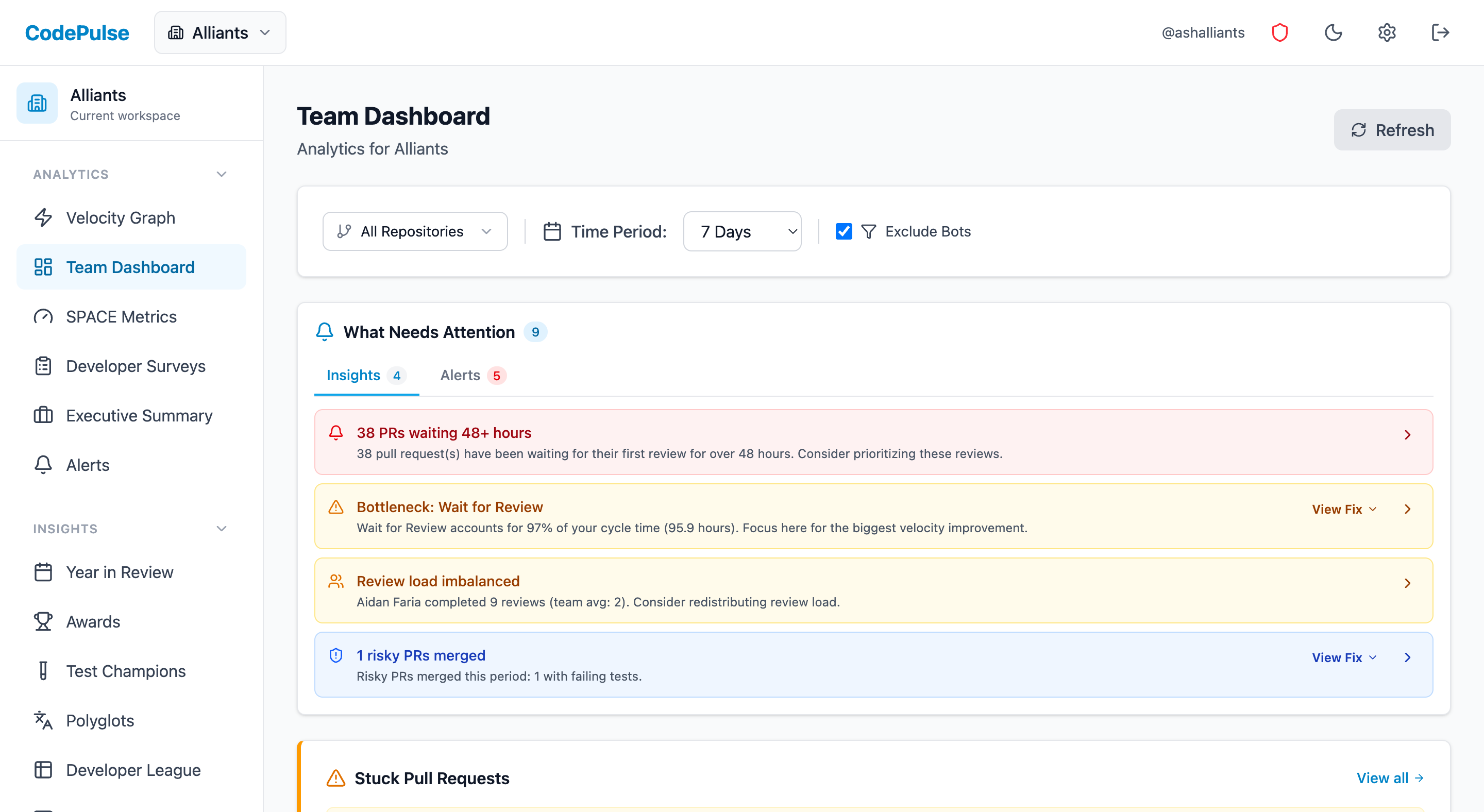
See which files and owners carry your real risk
Connect GitHub and get your churn hotspots, single-owner modules, and review-depth signals ranked by exposure. No repository cloning, no file contents read.
Read-only GitHub · Your code stays yours · Team-level by default · No credit card
See These Features in Action
Detect bus-factor-1 code before it becomes an operational risk.
Find high-churn files and correlate change frequency with ownership.
Related Guides
The 'Bus Factor' File That Could Kill Your Project
Use the Bus Factor Risk Matrix to identify where knowledge concentration creates hidden vulnerabilities before someone leaves.
Your Best Engineer Is About to Quit (Check Review Load)
Learn how to identify overloaded reviewers, distribute review work equitably, and maintain review quality without burning out your senior engineers.
Shift Left Metrics: Measuring Early Detection ROI
Shift left means catching bugs earlier. This guide covers the metrics that prove shift-left ROI, what to shift first, and how to implement without slowing delivery.
Git Branch Aging Report: Finding and Cleaning Stale Branches
Track branch aging to identify technical debt. Learn branch lifecycle stages, hygiene policies that scale, and safe cleanup automation strategies.