
Find quality and ownership risk before it becomes an incident
Preview how CodePulse combines review depth, risky changes, hotspots, and knowledge concentration without turning activity into individual scores.
Read-only GitHub · Your code stays yours · Team-level by default · No credit card
"Shift left" means moving testing, security, and quality activities earlier in the development lifecycle. But how do you know if it's working? This guide covers the metrics that prove shift-left ROI and help you identify where to shift next.
How do you measure if shift-left testing is working?
Track four metrics to prove shift-left ROI: defect escape rate (bugs found in production vs caught earlier), test coverage at PR level (percentage of PRs with automated tests), change failure rate (should decrease over time), and time-to-fix for defects (should decrease as bugs are caught earlier in the pipeline). A successful shift-left initiative shows fewer production incidents and faster fix times. CodePulse tracks change failure rate and PR-level quality indicators to help measure shift-left effectiveness.
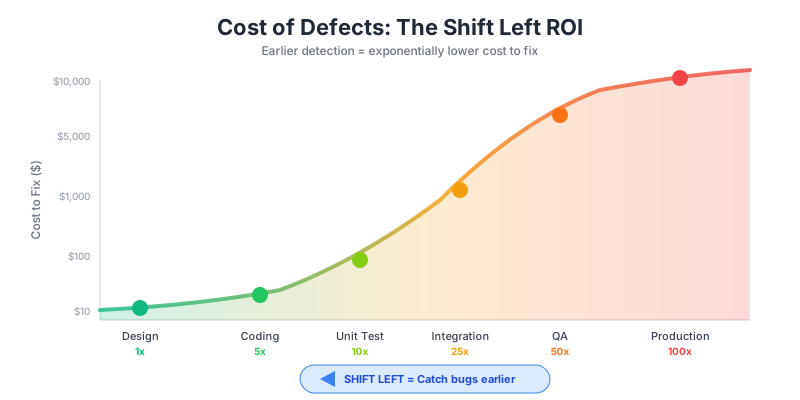
"Every bug caught in development saves 10x the cost of catching it in production. Shift left isn't a philosophy - it's a financial decision."
What Does "Shift Left" Mean?
In a traditional software timeline, testing, security review, and quality gates happen late - often right before release. "Shift left" means moving these activities earlier, to where problems are cheaper and faster to fix.
What Shifts Left
- Unit testing: Write tests first (TDD)
- Security scanning: In IDE and CI, not just pre-release
- Code review: Small PRs reviewed early
- Performance testing: Baseline checks in CI
- Compliance checks: Automated in pipeline
Core Shift-Left Metrics
Detection Timing Metrics
| Metric | Definition | Target |
|---|---|---|
| Defect Discovery Stage | Where bugs are found (dev/CI/staging/prod) | >80% in dev/CI |
| Escaped Defect Rate | Bugs reaching production | <10% of total bugs |
| Mean Time to Discovery | Code commit to bug discovery | <24 hours |
| Pre-commit Detection Rate | Issues caught before code merges | >60% |
Cost Metrics
| Metric | Definition | Why It Matters |
|---|---|---|
| Cost per Defect by Stage | Average fix cost at each stage | Proves ROI of early detection |
| Rework Rate | % of work redone due to late issues | Should decrease with shift-left |
| Pipeline Failure Cost | Engineer time lost to failed builds | Early tests reduce wasted cycles |
Prevention Metrics
| Metric | Definition | Target |
|---|---|---|
| Static Analysis Coverage | % of code scanned in CI | 100% |
| Pre-commit Hook Adoption | % of developers using hooks | >90% |
| Test-First Rate | % of PRs with tests before code | Increasing trend |
Calculating Shift-Left ROI
Shift-Left ROI Calculator
═══════════════════════════════════════════════════

COST MULTIPLIER BY STAGE (Industry Average)
────────────────────────────────────────────
Development/IDE:     1x    ($50/fix)
CI Pipeline:         5x    ($250/fix)
QA/Staging:         10x    ($500/fix)
Production:         30x    ($1,500/fix)
Post-Incident:     100x    ($5,000/fix)

EXAMPLE ROI CALCULATION
───────────────────────

Before Shift-Left:
• 100 bugs/quarter
• 20% found in dev (20 × $50 = $1,000)
• 30% found in CI (30 × $250 = $7,500)
• 30% found in staging (30 × $500 = $15,000)
• 20% found in prod (20 × $1,500 = $30,000)
• Total: $53,500/quarter

After Shift-Left:
• 100 bugs/quarter
• 60% found in dev (60 × $50 = $3,000)
• 25% found in CI (25 × $250 = $6,250)
• 10% found in staging (10 × $500 = $5,000)
• 5% found in prod (5 × $1,500 = $7,500)
• Total: $21,750/quarter

Quarterly Savings: $31,750
Annual Savings: $127,000
/// Our Take
The biggest shift-left wins aren't technical - they're cultural.
Tools can move testing earlier, but real shift-left happens when developers own quality from the start. The best leading indicator isn't test coverage - it's whether engineers write tests before code and feel responsible for production issues.
What to Shift Left (Priority Order)
Tier 1: Highest ROI
- Unit testing: Fastest feedback, lowest cost to fix
- Static analysis: Catches bugs before code runs
- Dependency scanning: Known vulnerabilities caught immediately
- Code formatting/linting: Eliminates style debates in review
Tier 2: High ROI
- Secret scanning: Credentials caught before commit
- Security scanning (SAST): Security issues in CI
- Integration tests: API contracts verified early
- Performance baselines: Catch regressions in CI
Tier 3: Medium ROI
- E2E tests: Critical paths verified (but slow)
- Compliance checks: License, policy violations
- Accessibility testing: WCAG violations in CI
Implementation Roadmap
Shift-Left Implementation Timeline
═══════════════════════════════════════════════════

PHASE 1: Foundation (Weeks 1-4)
───────────────────────────────
□ Add linting to CI (ESLint, Pylint, etc.)
□ Add type checking to CI
□ Set up pre-commit hooks (formatting, lint)
□ Enable Dependabot/Renovate for dependency updates
□ Baseline metrics: where are bugs found now?

PHASE 2: Testing (Weeks 5-8)
────────────────────────────
□ Require unit tests for new code
□ Add test coverage gates (not just metrics)
□ Integrate static analysis (SonarQube, CodeClimate)
□ Add integration test suite to CI

PHASE 3: Security (Weeks 9-12)
──────────────────────────────
□ Enable secret scanning (GitLeaks, GitHub)
□ Add SAST scanning to pipeline
□ Set up container scanning for images
□ Create security gates (block on critical)

PHASE 4: Optimization (Ongoing)
───────────────────────────────
□ Track defect discovery stage monthly
□ Tune gates (reduce false positives)
□ Add IDE plugins for instant feedback
□ Review and expand coverage
📊 How to Track This in CodePulse
CodePulse tracks delivery metrics that correlate with shift-left effectiveness:
- Change Failure Rate: Should decrease as defects are caught earlier
- Lead Time: Should stabilize (no late-stage surprises)
- PR Cycle Time: May increase slightly (more checks) but overall delivery improves
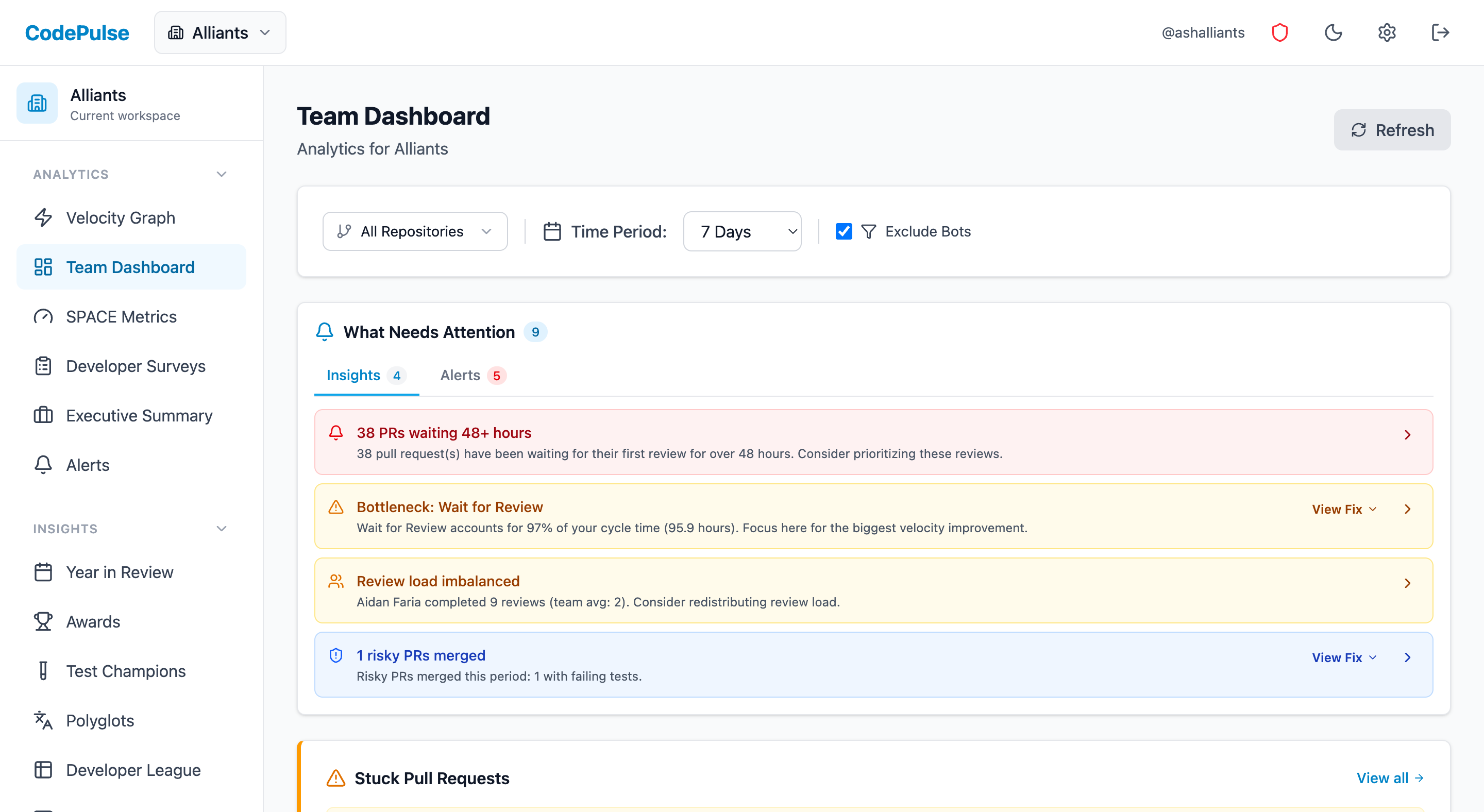
Monitor trends in the Dashboard to see shift-left impact on delivery.
Common Shift-Left Pitfalls
Pitfall 1: Shifting Too Much Too Fast
Adding 10 new CI checks overnight frustrates developers. Start with fast, high-value checks. Add more gradually as the team adapts.
Pitfall 2: Blocking on False Positives
If security scans block builds for non-issues, developers lose trust in the tools. Start with warnings, tune for precision, then add hard blocks.
Pitfall 3: Ignoring Cycle Time Impact
Shift-left checks add time to the pipeline. If CI goes from 5 minutes to 30, you've traded one problem for another. Keep fast checks fast.
Pitfall 4: Not Measuring Before and After
Without baseline metrics, you can't prove shift-left ROI. Track where bugs are found before you start, then measure improvement.
"Shift left isn't about adding more gates - it's about giving developers the tools to catch problems before they push."
Related Guides
- DevSecOps Metrics Guide - Security-specific shift-left metrics
- Continuous Testing Guide - Testing metrics and strategies
- Test Failure Rate Guide - Measuring test effectiveness
- DORA Metrics Guide - Change failure rate and delivery metrics
Conclusion
Shift left is about catching problems when they're cheap to fix. Measure where defects are found today, then systematically move detection earlier. The ROI is clear: a bug caught in development costs a fraction of one caught in production.
Start with the highest-ROI activities (unit tests, static analysis, dependency scanning), measure the impact, and expand. Don't shift everything at once - build the habit of early detection gradually.
Track your delivery metrics with CodePulse to see how shift-left investments improve your change failure rate and overall delivery performance.
Frequently Asked Questions
Shift left means moving testing, security scanning, and quality checks earlier in the development lifecycle, closer to when code is written. The goal is catching defects when they are cheapest to fix: a bug found during development costs roughly 1/30th of one found in production.
See which files and owners carry your real risk
Connect GitHub and get your churn hotspots, single-owner modules, and review-depth signals ranked by exposure. No repository cloning, no file contents read.
Read-only GitHub · Your code stays yours · Team-level by default · No credit card
See These Features in Action
Flag large PRs, single-owner changes, and untested modifications.
Find high-churn files and correlate change frequency with ownership.
Related Guides
Continuous Testing in DevOps: Metrics That Actually Matter
Continuous testing is more than running tests in CI. This guide covers testing metrics for DevOps, the testing pyramid, how to handle flaky tests, and test automation strategy.
The DORA Metric Everyone Ignores (Until Production Breaks)
Learn how to measure Change Failure Rate and Mean Time to Restore using GitHub data, even without full incident tracking integration.
DevSecOps Metrics: Security Without Killing Velocity
Learn how to measure the "Sec" in DevSecOps using GitHub data. Track check failure rates, time-to-fix vulnerabilities, and security impact on delivery speed.
Your CI Is Crying for Help. Here's What It's Telling You
Understand what test failure rate measures, identify patterns causing CI failures, and implement strategies to improve your pipeline reliability.