
Find quality and ownership risk before it becomes an incident
Preview how CodePulse combines review depth, risky changes, hotspots, and knowledge concentration without turning activity into individual scores.
Read-only GitHub · Your code stays yours · Team-level by default · No credit card
Your architecture diagrams are lying to you. That clean microservice boundary? In reality, every change to Service A requires changes to Services B, C, and D. This hidden coupling is why "simple" refactors turn into multi-sprint sagas. This guide shows Principal Engineers and Architects how to detect coupling that doesn't appear in import statements - and what to do about it.
"The architecture you think you have and the architecture you actually have are rarely the same. Git history tells the truth your diagrams hide."
What is Code Coupling (And Why It's Dangerous)
Code coupling measures how dependent different parts of your codebase are on each other. High coupling means changes ripple across boundaries. Low coupling means modules can evolve independently. The danger isn't coupling itself - some coupling is necessary - it's hidden coupling that violates your intended architecture.
The Two Faces of Coupling
Most developers only think about physical coupling - the import statements, function calls, and type dependencies visible in code. But there's another, more insidious form: logical coupling.
Physical vs Logical Coupling
- Visible in import statements
- Detected by static analysis
- Compiler/linter can catch issues
- Example: Service A imports types from Service B
- Hidden in change patterns
- Detected only via Git history
- Silent until something breaks
- Example: Changing users.py always requires changing orders.py
Logical coupling is more dangerous because it's invisible to traditional tooling. Your IDE won't warn you. Your type checker won't complain. You only discover it when a "small change" cascades into a multi-file refactor.
The Real Cost of Hidden Coupling
- Unpredictable timelines: Estimates assume isolated changes, but coupled code means touching 5 files instead of 1
- Brittle deployments: Deploy one service, and another breaks - even though they're "independent"
- Review bottlenecks: Large PRs spanning multiple domains because changes can't be separated
- Knowledge silos: Only senior engineers understand which files "secretly" depend on each other
- Failed modularization: Microservice migrations that create distributed monoliths instead of independent services
🔥 Our Take
Every failed microservice migration we've seen shared one trait: the team analyzed physical dependencies but ignored logical coupling.
They drew perfect boundaries on a whiteboard, moved code into separate repos, then discovered that every feature still required coordinated changes across 4 "independent" services. They hadn't decoupled - they'd distributed the coupling and added network latency. Git history would have shown this before they wrote a single line of migration code.
Types of Coupling: Logical vs Physical
Understanding coupling types helps you diagnose root causes and choose appropriate solutions.
Physical Coupling (Structural Dependencies)
| Type | Description | Detection Method | Risk Level |
|---|---|---|---|
| Import/Module | Direct code imports between files | Static analysis, IDE | Low - visible and expected |
| Type/Interface | Shared data structures across modules | Type checker, compiler | Medium - schema changes cascade |
| API Contract | Services calling each other's endpoints | API docs, OpenAPI specs | Medium - versioning helps |
| Database Schema | Multiple services reading/writing same tables | Schema analysis | High - migration nightmares |
Logical Coupling (Behavioral Dependencies)
| Type | Description | Detection Method | Risk Level |
|---|---|---|---|
| Change Coupling | Files that consistently change together in commits | Git history analysis | High - invisible to static tools |
| Temporal Coupling | Operations that must happen in specific order | Manual analysis, integration tests | High - race conditions, sequencing bugs |
| Semantic Coupling | Shared business concepts without shared code | Domain analysis | Critical - silent contract violations |
| Configuration Coupling | Services sharing config values or feature flags | Config audit | Medium - coordinated deploys needed |
"Physical coupling is a known debt. Logical coupling is a hidden tax - you pay it on every change, but it never shows up in the budget."
Real-World Example: The "Independent" Payment Module
Consider a team that extracted their payment logic into a separate module. The import graph showed clean boundaries. But Git history revealed:
# Files changed together in 78% of payment-related commits
payments/processor.py        # Payment logic
orders/checkout.py           # Order finalization
notifications/emails.py      # Receipt sending
analytics/events.py          # Transaction tracking
users/billing_info.py        # User payment methods

# Despite "clean" architecture:
# - Processor has no imports from orders
# - Emails has no imports from payments
# - Yet they ALWAYS change together

# Conclusion: Logical coupling exists even without physical coupling
# The "payment module" boundary is an illusion
The team's mistake was assuming that removing import statements removed coupling. In reality, the business logic - "when a payment succeeds, send a receipt and log an event" - creates coupling that exists regardless of code organization.
Detecting Coupling from Git History
Git commits are a record of how your code actually evolves. Files that consistently change together have implicit coupling, whether or not they share code.
The Coupling Score Formula
For any two files A and B, their coupling score measures how often they change together:
Coupling Score = Commits containing both A and B
                 ─────────────────────────────────
                 Total commits containing A

Example:
- file_a.py appears in 100 commits
- file_b.py appears in 80 commits
- Both appear together in 65 commits

Coupling(A→B) = 65/100 = 0.65 (65%)
Coupling(B→A) = 65/80  = 0.81 (81%)

Interpretation:
- 65% of changes to A also change B
- 81% of changes to B also change A
- This asymmetry reveals that B is MORE dependent on A than vice versa
Git Commands for Coupling Detection
Find Files That Change Together
# Find files that most often change with your target file
TARGET="src/payments/processor.py"

git log --since="6 months ago" --name-only --pretty=format:"---" -- "$TARGET" | \
  grep -v "^---$" | grep -v "^$" | grep -v "$TARGET" | \
  sort | uniq -c | sort -rn | head -15

# Example output:
#   47 src/orders/checkout.py          <- 47/62 commits = 76% coupling
#   38 src/notifications/emails.py     <- 61% coupling
#   35 tests/test_payments.py          <- Expected (tests)
#   28 src/analytics/events.py         <- 45% coupling
#   12 src/users/billing_info.py       <- 19% coupling
Calculate Coupling Percentage
# Get total commits for target file
TARGET="src/payments/processor.py"
TOTAL=$(git log --since="6 months ago" --oneline -- "$TARGET" | wc -l)

# Get co-occurrence count for a specific pair
COUPLED_FILE="src/orders/checkout.py"
TOGETHER=$(git log --since="6 months ago" --name-only --pretty=format:"---" -- "$TARGET" | \
  grep -c "$COUPLED_FILE")

# Calculate coupling percentage
echo "Coupling: $TOGETHER / $TOTAL = $(echo "scale=2; $TOGETHER * 100 / $TOTAL" | bc)%"

# Output: Coupling: 47 / 62 = 75.80%
Build a Coupling Heatmap
# For a directory, find all internal coupling relationships
DIR="src/payments"

# Get all files in directory with commit counts
for file in $(git ls-files "$DIR"/*.py); do
  commits=$(git log --since="6 months ago" --oneline -- "$file" | wc -l)
  if [ $commits -gt 5 ]; then
    echo "=== $file ($commits commits) ==="
    git log --since="6 months ago" --name-only --pretty=format:"---" -- "$file" | \
      grep -v "^---$" | grep -v "^$" | grep -v "^$file$" | \
      grep -v "^tests/" | sort | uniq -c | sort -rn | head -5
    echo ""
  fi
done🔍How to See This in CodePulse
CodePulse automates coupling detection across your repositories:
- Navigate to File Hotspots to identify files with high change frequency
- Use the Risky Changes page to see PRs that span multiple high-churn areas
- Check PR size patterns - consistently large PRs often indicate hidden coupling
- Review contributor overlap - files changed by the same people suggest domain coupling
The Coupling Risk Matrix
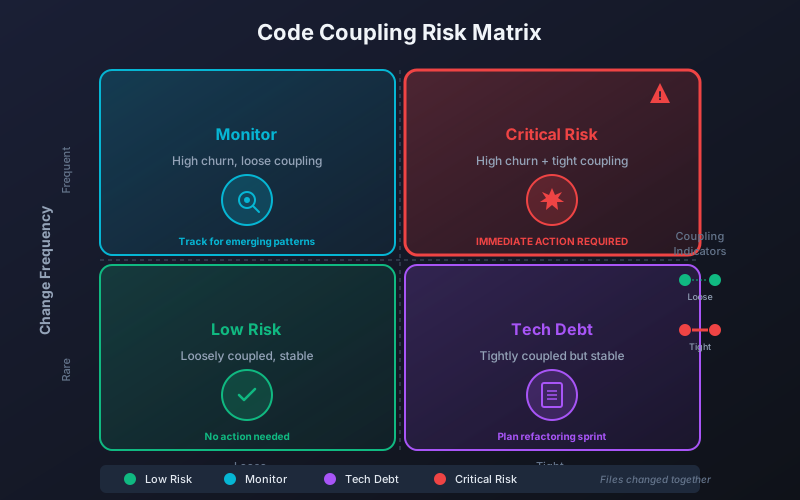
Not all coupling is equally dangerous. The Coupling Risk Matrix helps you prioritize decoupling efforts by evaluating both the coupling strength (how often files change together) and the change frequency (how active those files are).
THE COUPLING RISK MATRIX
Interpreting the Matrix
| Quadrant | Coupling Score | Change Rate | Action |
|---|---|---|---|
| Critical Risk | > 50% | > 10/quarter | Immediate decoupling sprint. This coupling costs you every week. |
| Technical Debt | > 50% | < 10/quarter | Document the coupling. Plan decoupling before next major feature. |
| Monitor | < 30% | > 10/quarter | Good separation. Review quarterly to catch coupling creep. |
| Safe | < 30% | < 10/quarter | No action needed. Check annually. |
Example Analysis
Coupling Analysis Results
E-commerce Platform - Q4 AssessmentThe Coupling Risk Score
Combine coupling strength and change frequency into a single risk score for prioritization:
COUPLING RISK SCORE CALCULATION
═══════════════════════════════════════════════════════════════

Risk Score = (Coupling Strength × 2) + (Change Frequency Score)

Where:
  Coupling Strength = Percentage (0-100) of co-occurrence
  Change Frequency Score = Commits/quarter normalized:
    0-5   commits → 10 points
    6-15  commits → 25 points
    16-30 commits → 50 points
    31+   commits → 75 points

═══════════════════════════════════════════════════════════════
RISK THRESHOLDS:
═══════════════════════════════════════════════════════════════

Score 0-75:    LOW RISK       → Annual review
Score 76-150:  MEDIUM RISK    → Quarterly review, document
Score 151-225: HIGH RISK      → Next quarter priority
Score 226+:    CRITICAL RISK  → This sprint priority

═══════════════════════════════════════════════════════════════
EXAMPLE:
═══════════════════════════════════════════════════════════════

checkout.py ↔ inventory.py:
  Coupling: 78%  → 78 × 2 = 156 points
  Commits: 45/qtr → 75 points
  TOTAL: 231 → CRITICAL RISK

payments.py ↔ notifications.py:
  Coupling: 52%  → 52 × 2 = 104 points
  Commits: 8/qtr → 10 points
  TOTAL: 114 → MEDIUM RISK
Decoupling Strategies That Work
Once you've identified problematic coupling, you need strategies to reduce it without breaking your system. The key is incremental decoupling - not big-bang rewrites.
"The goal isn't zero coupling - it's intentional coupling. You want coupling where it makes sense and independence where it matters."
Strategy 1: Event-Driven Decoupling
Replace direct calls with events. Instead of checkout calling inventory, checkout emits an "OrderPlaced" event that inventory subscribes to.
Direct Call vs Event-Driven
- checkout.py imports inventory
- Changes require both files
- Failures cascade immediately
- Testing requires both modules
- checkout.py emits events
- inventory subscribes independently
- Failures are isolated
- Each module tests in isolation
When to use: High coupling score (>60%) between modules that have clear trigger/response relationships.
Strategy 2: Interface Extraction
When two modules share data structures, extract the shared interface into a separate package. Both modules depend on the interface, not on each other.
# Before: checkout.py and billing.py both define Order
# Changes to Order break both files

# After: shared/interfaces/order.py
class OrderInterface(Protocol):
    order_id: str
    total: Decimal
    items: List[OrderItem]

# checkout.py and billing.py both import from shared
# Changes to Order only touch one file
# Coupling score drops from 78% to ~15%
When to use: Type/interface coupling where multiple modules share schemas.
Strategy 3: Anti-Corruption Layer
When you can't fully decouple (legacy systems, external APIs), add a translation layer that isolates the coupling to a single file.
# Before: 5 files directly call legacy billing API
# Every API change touches all 5 files
# Coupling score: 65-85% across all pairs

# After: billing_adapter.py wraps legacy API
# Only adapter knows about legacy quirks
# Other files call clean, stable adapter interface
# Coupling score drops to 0% between consumers
When to use: External dependencies, legacy systems, or third-party APIs that can't be modified.
Strategy 4: Temporal Decoupling with Queues
When operations must happen in sequence but don't need immediate completion, use message queues to decouple timing.
When to use: Temporal coupling where operations A, B, C must execute in order but don't need synchronous completion.
Decoupling Prioritization Framework
| Coupling Type | Best Strategy | Effort | Risk Reduction |
|---|---|---|---|
| Change Coupling | Events or Interface Extraction | Medium (1-2 sprints) | High - breaks the change cascade |
| Temporal Coupling | Message Queues | High (2-3 sprints) | High - enables independent scaling |
| Schema Coupling | Interface Extraction | Low (days) | Medium - localizes schema changes |
| External API Coupling | Anti-Corruption Layer | Low (days) | High - isolates external volatility |
📊Tracking Decoupling Progress in CodePulse
Measure whether your decoupling efforts are working:
- Track PR size trends - decoupled code enables smaller, focused PRs
- Monitor cycle time by area - decoupled modules should have faster turnaround
- Watch for contributor distribution - decoupled code enables parallel work
- Check File Hotspots quarterly to see if coupling scores decrease
Frequently Asked Questions
Next Steps
Coupling analysis is one piece of a comprehensive code health strategy. To build the full picture:
- Code Hotspots and Knowledge Silos - Identify where change concentrates and who owns what
- Detecting Risky Deployments - Catch high-risk changes before they ship
- De-risking Refactors with Git Data - Execute architectural changes safely
Start with the highest-activity files in your codebase. Run the coupling detection commands. Plot results on the Coupling Risk Matrix. You'll likely discover "independent" modules that aren't - and that discovery alone is worth the 30 minutes of analysis.
See which files and owners carry your real risk
Connect GitHub and get your churn hotspots, single-owner modules, and review-depth signals ranked by exposure. No repository cloning, no file contents read.
Read-only GitHub · Your code stays yours · Team-level by default · No credit card
See These Features in Action
Find high-churn files and correlate change frequency with ownership.
Detect bus-factor-1 code before it becomes an operational risk.
Related Guides
The 'Bus Factor' File That Could Kill Your Project
Use the Bus Factor Risk Matrix to identify where knowledge concentration creates hidden vulnerabilities before someone leaves.
The PR Pattern That Predicts 73% of Your Incidents
Learn how to identify high-risk pull requests before they cause production incidents.
The Rewrite That Killed a $50M Startup (And How to Avoid It)
Rewrites kill companies. Refactors cause regressions. Learn how to use the Refactor Risk Matrix, hotspots, coupling analysis, and churn data to execute architectural changes safely.
Continuous Testing in DevOps: Metrics That Actually Matter
Continuous testing is more than running tests in CI. This guide covers testing metrics for DevOps, the testing pyramid, how to handle flaky tests, and test automation strategy.