
Find quality and ownership risk before it becomes an incident
Preview how CodePulse combines review depth, risky changes, hotspots, and knowledge concentration without turning activity into individual scores.
Read-only GitHub · Your code stays yours · Team-level by default · No credit card
"We need to rewrite the backend." These words strike fear into the heart of every CTO. Rewrites are notorious for failing - Netscape, Borland, and countless startups have died on that hill. Refactors introduce regressions. But you can't run on legacy forever. This guide shows how to use Git data to identify exactly where risk lives in your codebase, who understands what, and how to execute architectural changes without betting the company.
"The safest refactor is the one you don't do. The second safest is the one you do with complete knowledge of what you're touching and who will be affected."
The "Big Bang" Rewrite Trap
The classic mistake: "Let's pause features for 3 months and rewrite X from scratch." This approach fails so consistently it has a name - Joel Spolsky called it "the single worst strategic mistake that any software company can make."
Here's what actually happens:
- It takes 2-3x longer than estimated. Always. You're re-implementing years of edge cases.
- The business starves for features. Competitors ship while you're refactoring.
- The new system is missing 20% of the functionality. Nobody documented the edge cases the old system handled.
- Team morale craters. Engineers burn out rewriting instead of building.
- Customers experience regressions. "It used to work" becomes the team's most-heard phrase.
"Every successful refactor I've seen was incremental. Every failed one was a big bang."
The Alternative: Incremental refactoring (the Strangler Fig Pattern), guided by data. Instead of replacing the system all at once, you grow a new system around the old one, gradually routing traffic and functionality until the old system can be safely removed.
The Refactor Risk Matrix
Before you touch a single line of code, you need to understand where the risk lives. Not all parts of your codebase are equally dangerous to refactor. The Refactor Risk Matrix helps you classify code by two dimensions: change frequency and knowledge concentration.
THE REFACTOR RISK MATRIX
Key insight: HIGH CHURN + FEW CONTRIBUTORS = maximum risk. These are the files where refactoring has the highest chance of failure.
How to Score Your Refactor Target
| Factor | Low Risk | Medium Risk | High Risk |
|---|---|---|---|
| Contributor Count | 4+ active in 6 months | 2-3 active | 1 active (silo) |
| Change Frequency | <5 commits/quarter | 5-15 commits/quarter | >15 commits/quarter |
| Test Coverage | >80% coverage | 50-80% coverage | <50% coverage |
| Code Churn Rate | <10% | 10-25% | >25% |
| External Dependencies | Self-contained | 2-5 dependents | >5 dependents |
Scoring: 2+ factors in "High Risk" = stop and de-risk before refactoring. Any single "High Risk" factor deserves careful consideration and mitigation planning.
🔥 Our Take
Most "tech debt" isn't debt - it's just code you don't like. Real debt has interest: it costs you something every time you touch it.
If that ugly file hasn't slowed anyone down in months, it's not debt. It's legacy code - and there's nothing wrong with that. Stop using the debt metaphor to justify rewriting things you're bored with. Focus your refactoring energy on code that's actively causing pain: high churn, high bug rate, or blocking new features. The Refactor Risk Matrix helps you distinguish real debt from aesthetic preferences.
Mapping the Territory: Hotspots and Change Frequency
Don't start refactoring at the letter "A". Start at "Pain."
The first step in any safe refactor is understanding where change actually happens. Your codebase isn't uniformly active - 80% of changes typically happen in 20% of files. These are your hotspots, and they deserve the most attention during refactoring.
Why Hotspots Matter for Refactoring
- High-churn files are high-impact targets. Improving a file that changes daily benefits the team daily. Improving a file that changes yearly? Yearly benefit.
- Hotspots reveal actual pain. Files that change frequently are files that need to change frequently - often because they're poorly designed or overly coupled.
- Refactoring hotspots is riskier but more valuable. These files are touched often, so mistakes affect more people - but improvements compound.
# Find your top 20 hotspots in the last 90 days
git log --since="90 days ago" --name-only --pretty=format: | \
  sort | uniq -c | sort -rn | head -20

# Example output:
#   47 src/billing/invoice_calculator.py    <- Hotspot candidate
#   38 src/api/order_handler.py             <- Hotspot candidate
#   35 src/auth/legacy_auth.py              <- Hotspot candidate
#   12 src/utils/helpers.py
#    8 src/models/user.py
#    3 src/config/settings.py               <- Leave alone

# The top 3 files get more commits than all others combined.
# These are your refactor priorities - and your refactor risks.
🔥Identifying Hotspots in CodePulse
Skip the manual analysis - CodePulse surfaces hotspots automatically:
- Navigate to File Hotspots
- Sort by change frequency to find your most active files
- Check the contributor count for each - single contributor hotspots are danger zones
- Review churn rate - high churn means frequent rewrites, often a sign of poor design
- Use time filters to compare: are the same files hot every quarter, or is it shifting?
The "Museum Exhibit" Rule
"If a messy file hasn't changed in 2 years, it's not technical debt - it's a museum exhibit. Leave it alone."
You should only refactor code that is active. Code that doesn't change doesn't cost you anything - it's just sitting there, working. The urge to clean it up is aesthetic, not economic.
Ask yourself: "When was the last time someone actually needed to modify this file?" If the answer is "I don't remember," it's not a refactor priority.
Understanding Code Ownership Before Refactoring
The second critical dimension is who knows this code. Refactoring code that only one person understands is playing Russian roulette with your timeline. Our code ownership heatmap guide covers how to visualise ownership concentration across a repo before you commit to a refactor plan.
Why Ownership Matters
- Knowledge silos create refactor risk. If the expert leaves, gets sick, or burns out mid-refactor, you're stuck with half-completed work and no one who understands it.
- Code review quality depends on reviewer knowledge. If only one person can review changes to a module, reviews become rubber stamps.
- Edge cases live in people's heads. The original author knows why that weird condition exists. A refactor that removes it might break a customer.
# Check ownership concentration for your refactor target
git log --since="6 months ago" --format='%an' -- src/billing/ | \
  sort | uniq -c | sort -rn

# Example output:
#   142 Sarah          <- 78% of commits (DANGER: knowledge silo)
#    27 Alex
#    12 Jordan
#     2 Marcus

# If top contributor has >60% of commits, you have a knowledge silo.
# DO NOT start refactoring until at least one more person is cross-trained.
👥Mapping Ownership in CodePulse
Understand who knows what before you start:
- Developer Leaderboard shows who dominates which code areas
- Review Network reveals who reviews changes to each module
- Look for single-contributor modules - these need cross-training before refactoring
- Check if the primary contributor is still active - ownership from 2 years ago doesn't help
Analyzing Logical Coupling
Before you extract a module or split a service, you must understand what is coupled to it. Logical coupling means: "When I touch File A, I always have to touch File B." This coupling often isn't visible in import statements - it's behavioral. Our dedicated code coupling analysis guide walks through how to extract these patterns from Git history at scale.
Finding Hidden Coupling
# Find files that consistently change together
# (files appearing in the same commits as your target)

git log --since="6 months ago" --name-only --pretty=format:"---" \
  -- src/billing/invoice_calculator.py | \
  grep -v "^---$" | grep -v "^$" | \
  grep -v "invoice_calculator.py" | \
  sort | uniq -c | sort -rn | head -10

# Example output:
#   34 src/billing/tax_calculator.py        <- Always changes together
#   28 src/api/billing_endpoints.py         <- Tight coupling
#   25 src/models/invoice.py                <- Model dependency
#   12 tests/test_billing.py                <- Test coupling (expected)
#    8 src/notifications/billing_emails.py  <- Hidden dependency!

# If you refactor invoice_calculator without considering tax_calculator,
# you'll create a distributed monolith - same coupling, more latency.
Types of Coupling to Watch For
| Coupling Type | How to Detect | Refactor Risk |
|---|---|---|
| Data Coupling | Files that change together share data structures | Medium - schema changes cascade |
| Temporal Coupling | Changes must happen in specific order | High - migrations get complex |
| Logical Coupling | Business logic is spread across files | High - easy to miss edge cases |
| Test Coupling | Tests for one module test another's behavior | Medium - test rewrites needed |
| API Coupling | External clients depend on interface | Critical - breaking changes affect users |
"If you extract A without B, you'll build a distributed monolith - all the coupling, plus network latency."
The Pre-Refactor Checklist
Before writing any refactoring code, complete this checklist. Every "No" is a risk factor that should be addressed or explicitly accepted.
Knowledge and Ownership
| Check | Why It Matters | Status |
|---|---|---|
| At least 2 people understand the code being refactored | If expert leaves mid-refactor, someone can continue | [ ] Yes / [ ] No |
| Original author available for questions | They know the edge cases that aren't documented | [ ] Yes / [ ] No |
| Historical context documented (PRs, issues, docs) | Understand WHY it was built this way | [ ] Yes / [ ] No |
| All hidden dependencies identified | Know what will break before you break it | [ ] Yes / [ ] No |
Test Coverage and Safety
| Check | Why It Matters | Status |
|---|---|---|
| Test coverage >70% for target module | Tests catch regressions during refactor | [ ] Yes / [ ] No |
| Integration tests exist for critical paths | Unit tests miss interaction bugs | [ ] Yes / [ ] No |
| Rollback plan documented | If refactor fails, how do we revert? | [ ] Yes / [ ] No |
| Feature flags available for gradual rollout | Test with subset of users first | [ ] Yes / [ ] No |
Business and Timing
| Check | Why It Matters | Status |
|---|---|---|
| No major feature work dependent on this code in next sprint | Refactoring during active development = merge hell | [ ] Yes / [ ] No |
| Not in a critical business period (holiday, launch) | Regressions during peak hurt more | [ ] Yes / [ ] No |
| Stakeholders informed and aligned | Surprise slowdowns erode trust | [ ] Yes / [ ] No |
| Success metrics defined | How will you know the refactor succeeded? | [ ] Yes / [ ] No |
Risk Assessment Summary
PRE-REFACTOR RISK SCORE
Count your 'No' answersData-Driven Strangler Pattern
The Strangler Fig Pattern (named by Martin Fowler after figs that grow around host trees) is the safest way to refactor large systems. Instead of replacing code all at once, you build new functionality alongside the old, gradually migrating until the old code can be removed.
The Five-Step Process
- Identify (Week 1): Use hotspots and coupling analysis to find the highest-value, lowest-risk starting point. Often this is a leaf module with few dependents.
- Characterize (Week 1-2): Write characterization tests that capture current behavior, including edge cases. If you can't test it, you can't safely change it.
- Isolate (Week 2-3): Create a clean boundary around the target code. Move it to its own namespace/folder. Make dependencies explicit. This is NOT a new repo yet.
- Reimplement (Week 3-6): Build the new version behind a feature flag. Run both old and new in parallel. Compare outputs to catch regressions.
- Migrate (Week 6-8): Gradually shift traffic to the new implementation. Monitor metrics. Only remove the old code when the new version is proven.
📈Tracking Refactor Progress in CodePulse
Monitor your refactor's health with these metrics:
- Dashboard - Compare cycle time before/during/after the refactor
- Did cycle time spike during the refactor? That's expected - watch for it to drop below baseline after
- Monitor test failure rate - spikes indicate regressions
- Check code churn on new modules - high churn means instability
- Compare Repositories - Is the new code measurably better than the old?
Metrics to Monitor During Refactoring
Refactoring is surgery. Monitor the patient's vitals throughout.
Leading Indicators (Watch Daily)
| Metric | Healthy Range | Warning Sign | Action |
|---|---|---|---|
| Test Failure Rate | <5% | >10% | Stop refactoring, fix tests first |
| Code Churn Rate | <15% | >30% | Too much rewriting - simplify scope |
| PR Merge Time | Normal + 20% | Normal + 50% | Reviews are struggling - need more context |
| Bug Reports | Baseline | 2x baseline | Regressions escaping - pause and stabilize |
Lagging Indicators (Review Weekly)
- Feature Velocity: It will dip initially - that's expected. If it stays down for more than 2 sprints, the refactor scope is too ambitious. Scale back.
- Cycle Time Trend: Should return to baseline within 4-6 weeks. Sustained increases mean the refactor is making things worse, not better.
- Team Sentiment: Check in on the team. Refactors that drag on kill morale.
REFACTOR HEALTH DASHBOARD
Expected metrics by phaseWhy Refactors Fail: Patterns and Prevention
After analyzing hundreds of engineering teams, patterns emerge in failed refactors. Most failures are preventable - if you know what to watch for.
Failure Pattern 1: The Scope Creep
What happens: "While we're in here, let's also fix X, Y, and Z." The refactor grows from one module to five. Timeline doubles. Team burns out.
How to prevent: Define scope in writing before starting. Create a "not doing" list. When you find related problems, add them to the backlog for AFTER the current refactor ships.
Failure Pattern 2: The Knowledge Silo Exit
What happens: The one person who understands the code leaves mid-refactor. New team members can't finish what they didn't start. Refactor stalls or ships broken.
How to prevent: Never start a refactor with a bus factor of 1. Pair program during the early phases. Document decisions as you make them.
Failure Pattern 3: The Missing Tests
What happens: Refactoring without adequate test coverage. Changes break things silently. Regressions ship to production. Customer trust erodes.
How to prevent: Write characterization tests BEFORE refactoring. If you can't get coverage above 60%, invest in tests first. A refactor without tests is a rewrite with a prayer.
Failure Pattern 4: The Big Bang
What happens: Merging 10,000 lines of refactored code in one PR. Reviews are superficial because no one can understand it all. Bugs hide in the volume.
How to prevent: Small, incremental PRs. Each PR should be reviewable in under 30 minutes. Use feature flags to merge refactored code without activating it.
Failure Pattern 5: The Zombie Refactor
What happens: Refactor goes on indefinitely. Never quite finishes. Team stops believing it will ever ship. Old and new code both exist, neither maintained properly.
How to prevent: Set a hard deadline. If the refactor isn't complete by week 8, ship what you have or revert. Zombie refactors are worse than no refactor.
Complete Refactor Workflow with CodePulse
Here's how to use CodePulse through each phase of a safe refactor:
Phase 1: Assessment (Before Starting)
- Identify Candidates: Go to File Hotspots. Look for high-churn files with high code churn rates - these are causing active pain.
- Check Ownership: For each candidate, check contributor concentration. Single-contributor hotspots need cross-training before refactoring.
- Map Dependencies: Use Review Network to see who reviews changes to these files. Concentrated reviews = knowledge silo.
- Baseline Metrics: Record current cycle time, test failure rate, and velocity for the target repository. You'll compare against this later.
Phase 2: Monitoring (During Refactor)
- Set Up Alerts: Go to Alerts and create:
- Test failure rate > 10% alert
- Cycle time > 150% of baseline alert
- Code churn rate > 30% alert
- Daily Check: Quick look at Dashboard for any metric spikes.
- Weekly Review: Compare current week to baseline. Adjust scope if degradation is sustained.
Phase 3: Validation (After Completion)
- Compare Before/After: Use Compare Repositories if you created a new module. Compare cycle time, churn, and contributor distribution.
- Verify Improvement: Did cycle time decrease? Is churn lower? Are more people contributing (reduced knowledge silo)?
- Document Wins: Export metrics for stakeholder communication. Show the ROI in concrete numbers.
🔔Refactor Alert Rules
Set up these alerts before starting any major refactor:
- Navigate to Alert Rules
- Create alert: "Test Failure Rate > 10%" - triggers immediate investigation
- Create alert: "Average Cycle Time > X hours" - X = 150% of your baseline
- Create alert: "High Churn in [target repo]" - catches instability early
- Route alerts to the refactor lead for quick response
Your Refactor Readiness Action Plan
This Week: Assess Your Codebase
- Run hotspot analysis: Identify your top 10 most-changed files in the last 90 days using CodePulse or git commands.
- Check ownership: For each hotspot, count unique contributors. Flag any with fewer than 3 active contributors.
- Score using the Risk Matrix: Plot each potential refactor target on the matrix. Prioritize "High Churn + Many Contributors" first.
Before Starting Any Refactor: Complete the Checklist
- Knowledge check: Are at least 2 people ready to work on this code?
- Test check: Is coverage above 60%? If not, write tests first.
- Coupling check: Have you identified all files that change together?
- Timing check: Is this a good time (no launches, no holidays)?
- Scope check: Is the scope written down with clear boundaries?
During Any Refactor: Monitor Weekly
- Review metrics: Test failure rate, cycle time, code churn, velocity.
- Check team health: Is anyone overwhelmed? Is morale dropping?
- Adjust scope: If metrics are degrading for 2+ weeks, reduce scope.
After Any Refactor: Validate and Document
- Compare metrics: Is the code objectively better? Faster cycle time? Lower churn? More contributors?
- Document learnings: What worked? What didn't? Update your refactor playbook.
- Communicate wins: Show stakeholders the improvement in concrete terms.
For more on managing code quality and risk, see our guides on Code Hotspots and Knowledge Silos, Quantifying Technical Debt, Regression Prevention, and Understanding Code Churn.
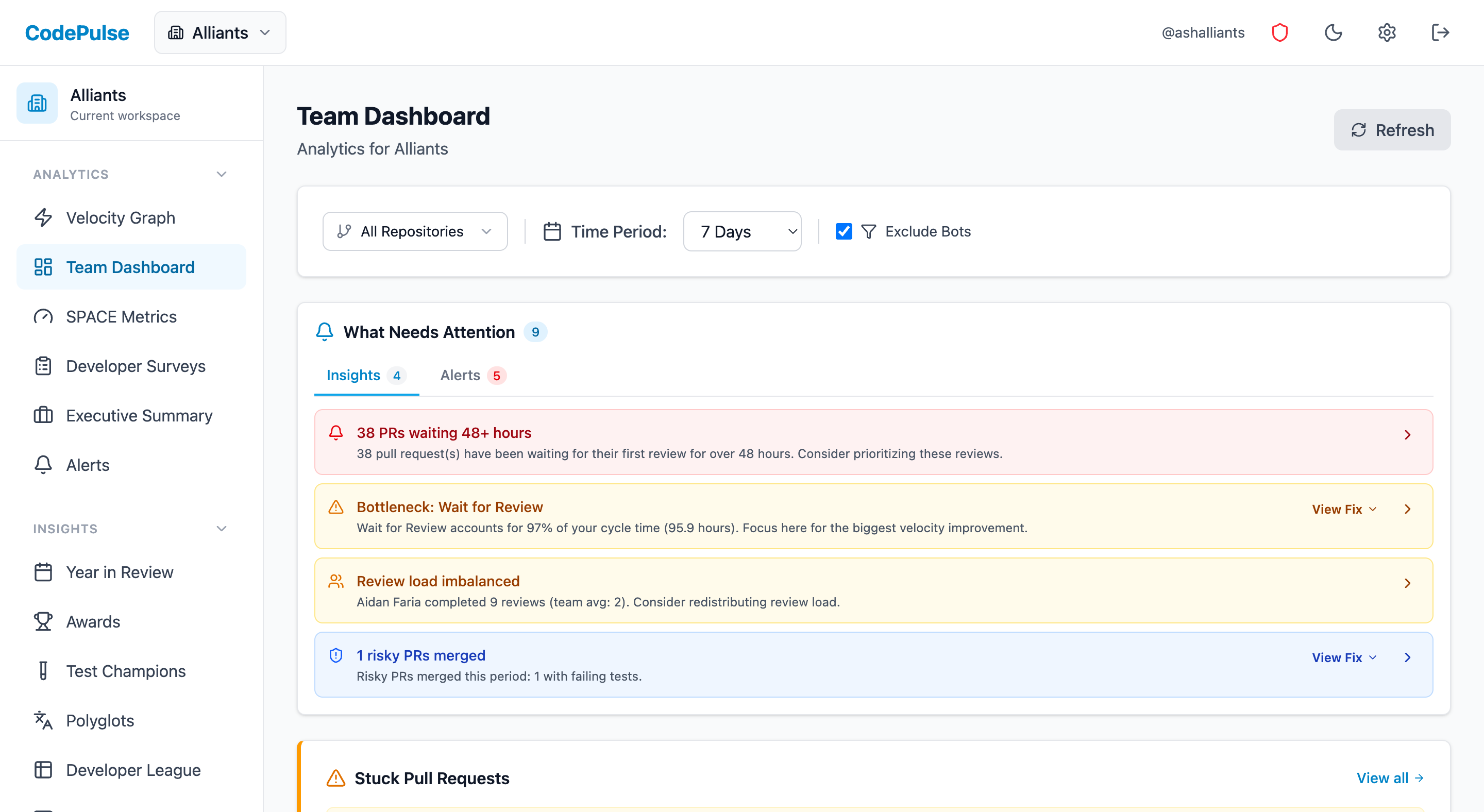
See which files and owners carry your real risk
Connect GitHub and get your churn hotspots, single-owner modules, and review-depth signals ranked by exposure. No repository cloning, no file contents read.
Read-only GitHub · Your code stays yours · Team-level by default · No credit card
See These Features in Action
Find high-churn files and correlate change frequency with ownership.
Flag large PRs, single-owner changes, and untested modifications.
Related Guides
The 'Bus Factor' File That Could Kill Your Project
Use the Bus Factor Risk Matrix to identify where knowledge concentration creates hidden vulnerabilities before someone leaves.
How We Ship Daily Without Breaking Production
Learn how to identify high-risk PRs, implement review strategies, and build processes that catch regressions before they reach production.
Your Technical Debt Costs $127K/Year. Here's the Math
Stop calling it "technical debt" - call it what it is: an engineering tax. Learn to calculate the Debt Tax Rate, quantify innovation drag, and build a board-ready business case.
High Code Churn Isn't Bad. Unless You See This Pattern
Learn what code churn rate reveals about your codebase health, how to distinguish healthy refactoring from problematic rework, and when to take action.
The PR Pattern That Predicts 73% of Your Incidents
Learn how to identify high-risk pull requests before they cause production incidents.