

Find quality and ownership risk before it becomes an incident
Preview how CodePulse combines review depth, risky changes, hotspots, and knowledge concentration without turning activity into individual scores.
Read-only GitHub · Your code stays yours · Team-level by default · No credit card
Most searches for a "SonarQube alternative" are really three different searches wearing the same phrase: teams tired of self-hosting overhead, teams that outgrew the default rule set's noise, and teams looking for something structurally different - not another static analyzer, but a way to see where risk accumulates without parsing code at all. The right answer depends entirely on which of those three you actually are.
What are the best alternatives to SonarQube?
DeepSource and Codacy are the closest like-for-like replacements, both offering hosted multi-language static analysis with less self-hosting overhead than SonarQube's Community Edition. CodeClimate leans toward maintainability scoring and technical debt trends. Qodana fits teams already using JetBrains IDEs. Language-native free tools (ESLint, Pylint/Ruff, Checkstyle, golangci-lint) cover a meaningful subset of the same ground without a unified platform. None replicate SonarQube's exact rule taxonomy - switching means rebuilding gate logic, not importing a config.
Before picking a replacement, it's worth being honest about which of the three reasons is actually driving the search - the right alternative for "self-hosting is a pain" is not the right alternative for "I want a fundamentally different approach to risk detection."
"SonarQube alternative" usually means "a better static analyzer." Sometimes it should mean "a different question entirely."
What Are the Real Alternatives?
| Tool | Best for | Trade-off |
|---|---|---|
| DeepSource | Teams that want SonarQube's breadth without self-hosting | Different rule taxonomy to relearn |
| Codacy | Multi-language teams wanting a hosted dashboard | Similar per-seat/per-repo pricing pressure as SonarQube |
| CodeClimate | Maintainability scoring and technical debt trends | Lighter on security-specific rules than SonarQube |
| Qodana | Teams already standardized on JetBrains IDEs | Best experience is IDE-integrated, less so outside JetBrains tooling |
| Language-native linters (ESLint, Pylint/Ruff, Checkstyle) | Free, single-language codebases, teams comfortable configuring several tools | No unified cross-language dashboard |
Static Analysis vs Git-History Signals
Every tool in the table above shares SonarQube's fundamental approach: parse the source code and flag issues based on rules applied to that parsed structure. A different category of tool answers a genuinely different question by never parsing code syntax at all - instead tracking how files change over time (churn, review coverage, ownership concentration) to flag where risk is accumulating in practice, regardless of what a static rule set does or doesn't catch in the code itself.
* Our Take
If self-hosting is the actual complaint, switch static analyzers. If the complaint is "we can't tell which files are actually risky," a static analyzer switch won't fix it - that's a different tool entirely.
The two categories solve different problems well and solve each other's problem badly. A team that runs both - a static analyzer for rule-based code issues, a git-history tool for where to point that analyzer first - gets more signal than either alone, without pretending one can substitute for the other.
Where Does CodePulse Fit?
CodePulse is not a SonarQube alternative in the static-analysis sense - it can't flag a SQL injection risk or an unused variable, because it never parses code syntax at all. What it tracks instead, from the same GitHub history a static analyzer would need repository access to anyway, is which files change constantly, how concentrated ownership has become, and how much churn a file absorbs release after release - a companion signal for where a static-analysis tool's findings matter most.
* How to See This in CodePulse
Navigate to File Hotspots to see which files are worth running a static analyzer against first:
- Change frequency and total lines changed per file, ranked by risk level
- Unique contributor count, so a static analyzer's findings on a single-owner file get flagged as higher priority
- Pair it with our code quality tools comparison for how the full field of static-analysis tools compares, including where SonarQube itself still fits
Switching static analyzers solves a tooling complaint. Adding a git-history view solves a visibility gap neither SonarQube nor its alternatives were built to close.
For a direct comparison of SonarQube against a GitHub-native approach, see our SonarQube vs GitHub code quality guide, or our broader code quality tools comparison for how the rest of the category stacks up.
If you want to see your own file hotspots before deciding what a static analyzer should focus on first, start a free CodePulse trial. It reads directly from your GitHub history, so there's nothing to configure before you see real numbers.
Frequently Asked Questions
It depends on what's driving the search. DeepSource and Codacy are the closest like-for-like replacements - both do multi-language static analysis with a hosted, lower-maintenance setup than self-hosted SonarQube. CodeClimate leans more toward maintainability scoring and technical debt trends than deep security rules. Qodana (JetBrains) is the pick if your team is already IDE-integrated with JetBrains tools. None of them replicate SonarQube's specific Quality Gate/Clean Code taxonomy exactly - each has its own rule model.
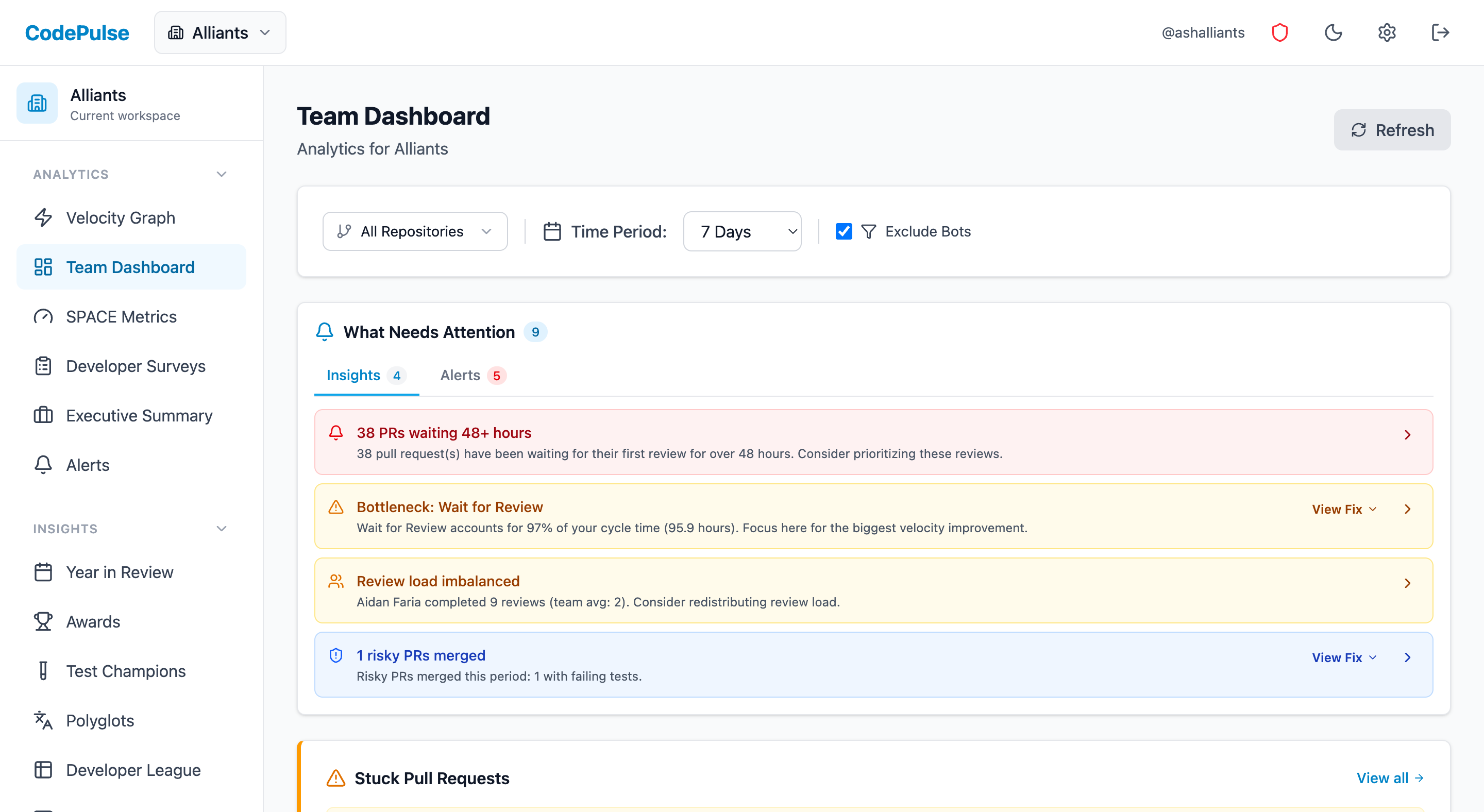
See which files and owners carry your real risk
Connect GitHub and get your churn hotspots, single-owner modules, and review-depth signals ranked by exposure. No repository cloning, no file contents read.
Read-only GitHub · Your code stays yours · Team-level by default · No credit card
See These Features in Action
Explore all featuresRelated Guides
SonarQube vs GitHub Code Quality: Which Do You Need?
SonarQube is static analysis with quality gates; GitHub-native is security scanning plus AI review. They solve different problems - and neither measures the process quality that decays first.
Code Quality Tools in 2026: Most Are Useless (3 Aren't)
Compare engineering analytics tools specifically for code quality features: hotspot detection, knowledge silos, test analytics, and review sentiment.
The 'Bus Factor' File That Could Kill Your Project
Use the Bus Factor Risk Matrix to identify where knowledge concentration creates hidden vulnerabilities before someone leaves.
GitHub Code Quality: Skip SonarQube, Use Git History
Learn how to extract actionable code quality metrics from your GitHub repository, including churn rate, hotspots, review coverage, and more.