
Compare the finished analysis before you choose a platform
See the report CodePulse produces from read-only GitHub workflow data, or connect your own repositories and evaluate the fit with real evidence.
Read-only GitHub · Your code stays yours · Team-level by default · No credit card
SonarQube and GitHub's native scanning get compared as if they were rivals, but they mostly measure different things: SonarQube is static code analysis with quality gates, GitHub's tooling is security scanning with an AI reviewer bolted on. And there is a third layer of quality - what happens in your review process - that neither touches. Here is how to work out which you actually need - or if you're looking to replace SonarQube specifically rather than compare it to GitHub's own tooling, see our SonarQube alternatives guide.
SonarQube vs GitHub code quality tools: which do you need?
Choose SonarQube if you want maintainability measurement - code smells, duplication, coverage, complexity - enforced through quality gates that can block merges; Cloud starts free under 50k LoC, then $34/month. Choose GitHub-native (free scanning for public repos; Secret Protection $19 and Code Security $30 per active committer/month for private) if your concern is vulnerabilities and leaked secrets with near-zero setup. Neither measures process quality - review coverage, review depth, churn, CI pass-rate trends - which is where engineering analytics like CodePulse sits. Teams over ~50 engineers usually end up running static analysis and process metrics together.
Are SonarQube and GitHub Code Quality Even the Same Category?
Not really, and the naming makes it worse. Since Sonar's October 2024 rebrand, SonarCloud is SonarQube Cloud, the self-hosted product is SonarQube Server, the free self-hosted edition is Community Build, and SonarLint is SonarQube for IDE. On the GitHub side, "code quality" is not one product but a bundle of features: CodeQL code scanning, secret scanning, Copilot Autofix, and Copilot code review - sold since April 1, 2025 as two unbundled products, Secret Protection and Code Security, after GitHub broke up the old Advanced Security bundle.
The categories differ at the root. SonarQube's unit of analysis is the codebase: it rates maintainability and reliability and blocks merges when new code fails a quality gate. GitHub's unit of analysis is the vulnerability: find it, alert on it, autofix it. Overlap exists - both find bugs, both comment on PRs - but buying one expecting the other's job is the most common mistake in this comparison.
What Does Each Actually Measure?
SonarQube measures bugs, vulnerabilities, security hotspots, code smells, test coverage, duplication density, and cyclomatic complexity across 34-40+ languages depending on edition, and rolls them into quality gates - pass/fail conditions like "new code has ≥80% coverage and zero new blocker issues." Recent additions target AI-generated code: AI Code Assurance applies stricter gates to AI-authored projects, and AI CodeFix suggests fixes for findings. The cost side is infrastructure as much as licensing: a Server deployment means Java 17, a PostgreSQL database, and a scanner wired into every CI pipeline. That is a real operations commitment, not a checkbox.
GitHub-native scanning centers on CodeQL, which covers roughly 12 languages with default setup enabled in a few clicks, plus secret scanning and Copilot Autofix. Copilot code review, which went GA in April 2025, reviews any language and moved to usage-based AI Credits billing from June 2026. What you will not find in the documented feature set: maintainability ratings, code smells, duplication metrics, coverage enforcement, or composite quality gates. That is an inference from GitHub's published feature lists rather than an official "we don't do this" - but it is a consistent gap.
SonarQube tells you the code is getting harder to maintain. GitHub tells you the code is dangerous. Neither tells you your review process stopped catching either.
How Do They Compare on Price?
| Product | Free tier | Paid entry point | Pricing axis |
|---|---|---|---|
| SonarQube Cloud | Private projects ≤50k LoC | Team from $34/month (up to 100k LoC); Enterprise custom | Lines of code |
| SonarQube Server | Community Build | Developer Edition from $750/year per instance; Enterprise/Data Center quote-only | Lines of code per instance |
| GitHub Secret Protection | Public repos | $19/active committer/month | Active committers |
| GitHub Code Security | Public repos (CodeQL) | $30/active committer/month | Active committers |
Sources: sonarsource.com/plans-and-pricing and GitHub's Advanced Security pages, accessed July 2026. The axes matter more than the numbers. Sonar bills by lines of code, so a large legacy monolith is expensive even with a small team - and the per-LoC tables beyond the published starting prices are not public, so budget for a quote. GitHub bills by active committers, so a small codebase with many contributors flips the equation. A 50-committer team on both GitHub products pays $29,400 a year; the same team on SonarQube Cloud Team could pay a few hundred dollars if the codebase is small, or an Enterprise quote if it is not.
What About False Positives and Noise?
This is where developer sentiment on SonarQube splits hardest. A July 2024 Hacker News thread (121 points) collected both extremes. One developer: "I've yet to experience a single true positive in 2 years." Another, more structurally: "Sonar tries hard to have an authority of a compiler, while having the resources of a linter." But the counterpoint came from the same thread: "Sonar was good about finding bugs that junior contractors should have fixed... like not closing database connections on all paths."
Sonar's own position is that the noise problem is solved - the company claims a 3.2% false-positive rate in a February 2026 benchmark it published itself, which you should weigh as a vendor claim. The honest synthesis: signal quality depends on tuning. An untuned default profile pointed at a ten-year-old codebase produces thousands of findings, developers learn to scroll past the bot comment, and the tool's authority dies. Teams that gate only on new code and prune rules aggressively report far better experiences.
What Quality Signals Does Neither Cover?
Both tools inspect the code artifact. Neither inspects the process that produced it - and process is where quality usually decays first. Was the merged code reviewed at all, or waved through? Are reviews substantive, or is one senior approving forty PRs a week with no comments? How much merged code gets rewritten within weeks (churn)? Is the CI test pass rate trending down? The SPACE framework (Forsgren et al., ACM Queue 2021) makes the case that no single dimension - certainly not static-analysis findings - can stand in for developer productivity or quality, and DORA lists code maintainability as a capability measured by how easily teams change code they depend on, not by a scanner grade.
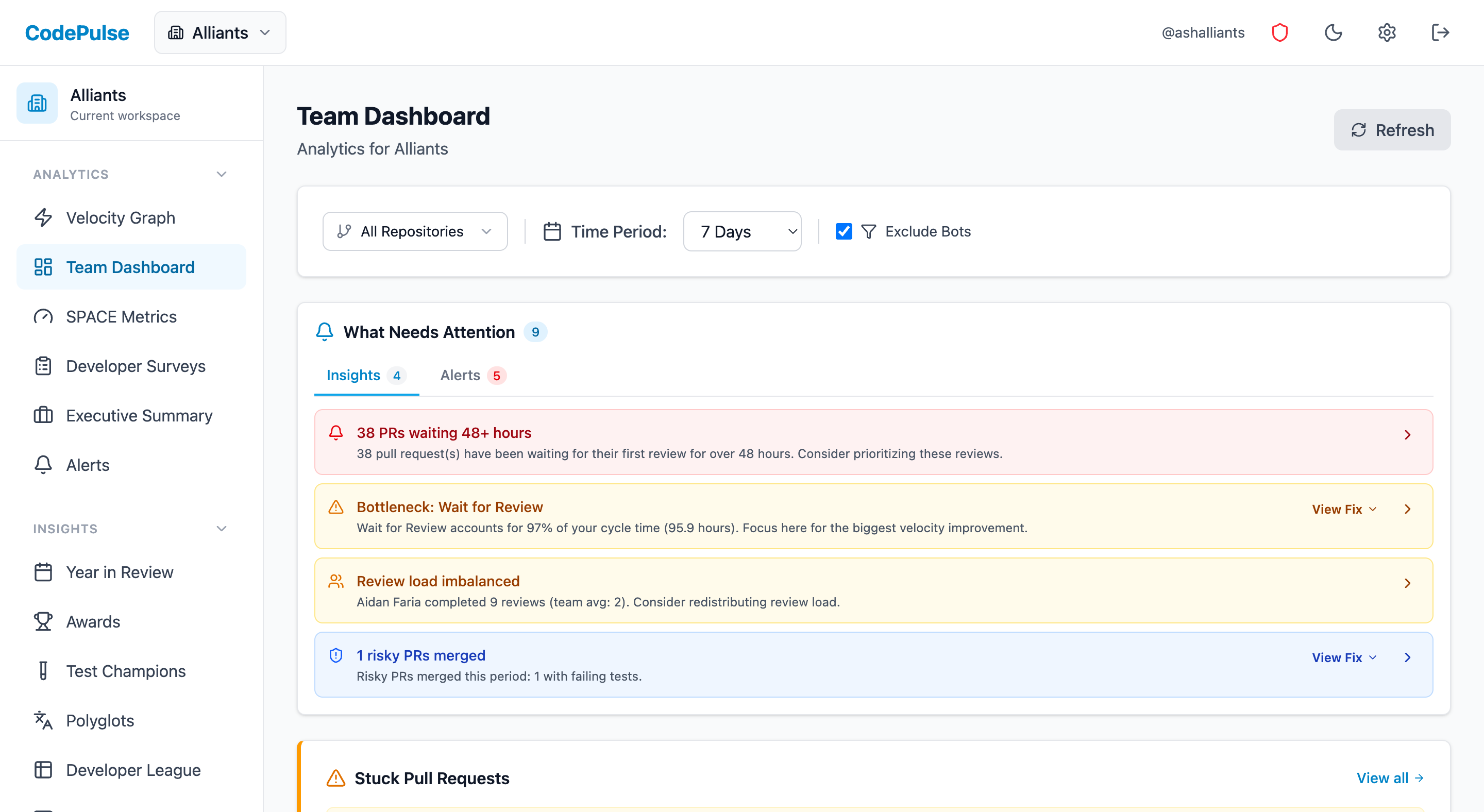
That third category is where engineering analytics lives. CodePulse reads review coverage, review depth, rubber-stamp rates, churn, and cycle time from your GitHub history - complementing a scanner rather than replacing it. For the metric definitions, see our GitHub code quality metrics guide and the broader software quality metrics guide; for how review tooling fits around it, the code review platforms comparison maps the field.
🔥 Our Take
This is not an either/or decision, and pretending it is wastes a quarter. Under ~20 engineers on GitHub: turn on the free scanning, skip SonarQube until a quality gate would change behavior. Over ~50 engineers: you will almost certainly run static analysis and process metrics side by side, because they fail independently.
A clean SonarQube dashboard above a review process where 30% of PRs merge without a substantive review is a false sense of security. A healthy review culture shipping unscanned code has the opposite blind spot. Instrument both layers, gate on new code only, and treat the scanner's authority as something you maintain by pruning noisy rules - not something the license fee buys.
Frequently Asked Questions
SonarQube Cloud is free for private projects up to 50k lines of code, then the Team plan starts at $34/month for up to 100k LoC, with Enterprise custom-priced. Self-hosted SonarQube Server starts at $750/year per instance for Developer Edition; Enterprise and Data Center editions are quote-only, and Community Build is free. Both Cloud and Server scale price with lines of code, and the per-LoC tables beyond the starting tiers are not fully published - large codebases should expect a quote conversation.
Evaluate CodePulse against your own delivery history
A comparison table only goes so far. Connect read-only GitHub in about five minutes and judge the output on your repositories, at one flat price, with no per-seat math.
Read-only GitHub · Your code stays yours · Team-level by default · No credit card
See These Features in Action
Find high-churn files and correlate change frequency with ownership.
Flag large PRs, single-owner changes, and untested modifications.
Related Guides
GitHub Code Quality: Skip SonarQube, Use Git History
Learn how to extract actionable code quality metrics from your GitHub repository, including churn rate, hotspots, review coverage, and more.
Software Quality Metrics: 8 That Predict Incidents
Most quality dashboards track lagging indicators. These 8 metrics actually predict production incidents before they happen, backed by research from Microsoft, DORA, and IEEE.
Best Code Review Tools 2026: GitHub, Graphite +4
Compare code review platforms and approaches, from GitHub native features to specialized tools and analytics solutions. Includes stacked PR tools, review benchmarks from 803K PRs, and a 6-tool feature matrix.
Best DORA Metrics Tools for 2026: 8 Platforms Compared
An opinionated comparison of the 8 best tools for automated DORA metrics reporting, ranked by automation depth, setup speed, metric accuracy, pricing transparency, and real-world usefulness for engineering leaders.