
Turn this metric into a baseline for your team
Preview a system-level engineering health report, then connect GitHub when you are ready to compare this metric with your own delivery history.
Read-only GitHub · Your code stays yours · Team-level by default · No credit card
Aggregating engineering metrics across codebases presents unique challenges, from monorepos with dozens of services to separate repositories per team. How do you compare performance across repos? How do you roll up metrics for executive reporting? And how do you avoid the "my repo is different" excuse?
This guide covers strategies for measuring engineering performance across multiple repositories, comparing team metrics fairly, and setting up org-level visibility.
Monorepo vs Multi-Repo Metrics Challenges
The Monorepo Challenge
In a monorepo, all code lives in one repository. This creates specific measurement challenges:
- Attribution: Who owns which directory? How do you slice metrics by team?
- Scale: Thousands of PRs per week can overwhelm simple dashboards
- Cross-cutting changes: Some PRs touch multiple teams' code
- Noise: Infrastructure changes can skew metrics for everyone
The Multi-Repo Challenge
With separate repositories per team or service, the challenges differ:
- Aggregation: How do you roll up metrics across 50 repos?
- Comparison: Is it fair to compare the platform repo to a small service repo?
- Visibility: Leaders need org-level views, not repo-by-repo spelunking
- Consistency: Different repos may have different branching strategies or review norms
Hybrid Approaches
Many organizations use a mix: a core monorepo plus satellite repos for specific purposes (mobile apps, documentation, tools). This compounds both sets of challenges.
Aggregating Metrics Across Repositories
What to Aggregate
Not all metrics should be aggregated the same way:
Sum across repos:
- Total PRs merged
- Total commits
- Active contributors
- Lines changed
Average across repos (weighted):
- Cycle time (weighted by PR volume)
- Review coverage
- First review time
Minimum/maximum:
- Worst-case cycle time (highlights problems)
- Best-case deployment frequency (shows what's possible)
Weighting Strategies
Simple averages can be misleading. A small repo with 2 PRs and 10-day cycle time shouldn't equally weight against a busy repo with 200 PRs and 1-day cycle time.
Weighting approaches:

1. PR-weighted average:
   Org cycle time = Sum(repo_cycle_time × repo_pr_count) / Total PRs

2. Contributor-weighted:
   Weight by number of active contributors in each repo

3. Strategic weighting:
   Manually assign weights based on business importance

Example:
  Repo A: 100 PRs, 2-day cycle time
  Repo B: 10 PRs, 5-day cycle time

  Simple average: (2 + 5) / 2 = 3.5 days
  PR-weighted: (100×2 + 10×5) / 110 = 2.27 days

The PR-weighted average better reflects actual team experience.
Handling Outliers
Some repos will always have unusual metrics:
- Documentation repos: Fast cycle times, low complexity
- Infrastructure/DevOps repos: Slower reviews, high scrutiny
- Legacy repos: Minimal activity, occasional maintenance
- Prototype repos: High velocity, low quality standards
Consider excluding or separately categorizing these in org-level aggregations.
📊 How CodePulse Helps
CodePulse automatically aggregates metrics across all your repositories:
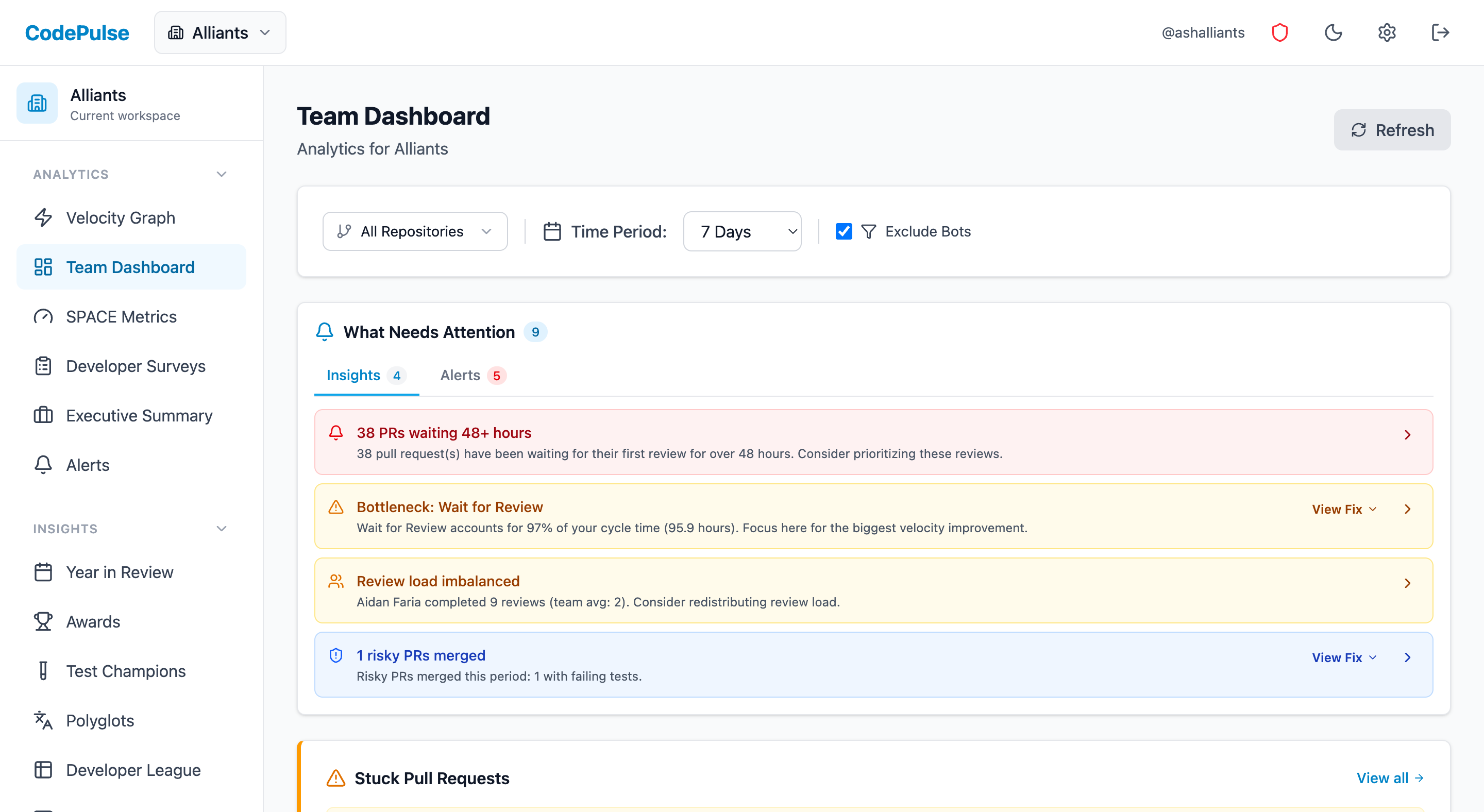
- Dashboard shows org-level metrics aggregated across all repos
- Repositories page lists per-repo breakdowns for comparison
- Filter any view by repository to drill down into specific teams/services
Comparing Team/Service Performance
Fair Comparison Principles
Comparing repos/teams requires acknowledging context:
- Team size matters: A 3-person team can't match the throughput of a 15-person team
- Domain complexity differs: Payment processing requires more scrutiny than marketing pages
- Stage of development: Greenfield projects move faster than mature systems
- External dependencies: Some teams are blocked by vendors, other teams, or compliance
Normalization Strategies
To compare fairly, normalize metrics:
Per-capita metrics:
- PRs merged per engineer per week
- Commits per contributor
- Review load per reviewer
Efficiency ratios:
- Cycle time (same for all, regardless of team size)
- First review time
- Review-to-merge time
Quality metrics:
- Merge without approval rate
- Revert rate
- Bug fix ratio (fixes as % of total PRs)
Comparison Dashboards
Repository Comparison Template:

| Repo/Team      | Contributors | PRs/Week | Cycle Time | First Review |
|----------------|--------------|----------|------------|--------------|
| payments       | 8            | 24       | 1.8 days   | 4.2 hours    |
| user-service   | 5            | 18       | 1.2 days   | 2.1 hours    |
| frontend       | 12           | 45       | 0.8 days   | 1.8 hours    |
| platform       | 6            | 12       | 3.2 days   | 8.4 hours    |
| mobile-ios     | 4            | 8        | 2.1 days   | 6.2 hours    |

Per-capita view (PRs/engineer/week):
| Repo/Team      | PRs/Engineer | Notes                           |
|----------------|--------------|----------------------------------|
| payments       | 3.0          | Stable, good efficiency          |
| user-service   | 3.6          | High performer                   |
| frontend       | 3.75         | Highest throughput               |
| platform       | 2.0          | Complex infrastructure work      |
| mobile-ios     | 2.0          | Release cycle constraints        |
For more on benchmarks, see PR Cycle Time Benchmarks by Team Size.
Identifying Cross-Repo Patterns
What Patterns to Look For
Analyzing across repos reveals patterns invisible at the individual repo level:
Consistency patterns:
- Do all repos have similar cycle times, or is there high variance?
- Are review practices consistent across teams?
- Do some repos have much higher quality issues than others?
Bottleneck patterns:
- Do the same reviewers appear across multiple repos?
- Are certain repos blocking others (dependencies)?
- Is one team's slow velocity affecting downstream teams?
Risk patterns:
- Which repos have the most risky changes? See Detecting Risky Deployments
- Where are knowledge silos concentrated? See Code Hotspots & Knowledge Silos
- Which repos have declining health trends?
Cross-Team Dependencies
In multi-repo environments, teams often depend on each other:
Dependency analysis questions:

1. When team A's velocity drops, does team B's follow?
   → Suggests dependency or shared resources

2. Do certain PRs require reviewers from multiple repos?
   → Cross-cutting concerns that may need better ownership

3. Are there "critical path" repos that block many others?
   → Investment in those repos has outsized impact

4. Do release cycles of different repos align or conflict?
   → Coordination overhead that could be reduced
Setting Up Org-Level Dashboards
Executive View
For leadership, the org-level view should be simple:
Org Engineering Health Dashboard

Overall Health: B+ (up from B last quarter)

Key Metrics:
  Total PRs this quarter: 1,247 (+12% QoQ)
  Avg cycle time: 1.6 days (target: <2 days) ✓
  Active contributors: 47
  Review coverage: 94%

Highlights:
  ✓ Frontend team cut cycle time by 40%
  ✓ Zero P0 incidents this quarter
  ⚠ Platform team velocity down (hiring ramp)

By Repository:
  [Expandable list with drill-down to repo details]
For more on executive reporting, see Board-Ready Engineering Metrics.
Team Lead View
Team leads need more detail on their repos plus context on how they compare:
Payments Team Dashboard

My Repos: payments, payment-gateway, billing-service

Combined Metrics:
  PRs this week: 24
  Avg cycle time: 1.8 days (org avg: 1.6)
  First review: 4.2 hours (org avg: 3.1)
  Contributors: 8

How We Compare:
  Cycle time: 75th percentile (room to improve)
  Throughput per engineer: 90th percentile (strong)
  Review coverage: 100% (best in org)

Attention Needed:
  - payment-gateway has 2-day first review time
  - 3 PRs currently blocked >24 hours
Building the Dashboard
Key decisions when building org-level dashboards:
- Refresh frequency: Daily for operational, weekly for executive
- Time ranges: Show trends (week, month, quarter) not just snapshots
- Drill-down capability: Org → Team → Repo → Individual PR
- Alerting: Notify when metrics deviate significantly from norm
- Export: Enable data export for custom analysis
🏢 How CodePulse Helps
CodePulse is built for multi-repository visibility:
- Executive Summary aggregates across all repos with a single health grade
- Repositories page enables side-by-side comparison
- Every view can filter by repository for team-specific analysis
- Alerts can be set at org or repo level
Avoiding Dashboard Sprawl
The danger with multi-repo metrics is creating too many dashboards:
- Start with one org-level view that serves 80% of needs
- Add team-level views only when requested and justified
- Resist per-repo dashboards unless there's clear ownership
- Consolidate rather than creating new views for each question
The goal is visibility that drives action, not data that drives dashboard maintenance. Keep it simple, make it actionable, and iterate based on what questions actually get asked.
Now measure this metric on your own repositories
Connect read-only GitHub in about five minutes and get your baseline, your trend, and the constraint behind it. Your fourteen usable trial days start when the first repository finishes syncing.
Read-only GitHub · Your code stays yours · Team-level by default · No credit card
See These Features in Action
Explore all featuresRelated Guides
Engineering Metrics Dashboard: The 7 Metrics You Need
Skip vanity metrics. Here are the 7 engineering metrics VPs actually need to track team performance, delivery, and quality.
Your PR Cycle Time Is Fine (Here's the Benchmark)
What is a good PR cycle time? Benchmarks and targets based on team size, industry, and engineering maturity.
The 'Bus Factor' File That Could Kill Your Project
Use the Bus Factor Risk Matrix to identify where knowledge concentration creates hidden vulnerabilities before someone leaves.
DORA Metrics Explained: The 4 Keys Without the Hype
A complete breakdown of the four DORA metrics - deployment frequency, lead time, change failure rate, and MTTR - with honest benchmarks and gaming traps to avoid.
GitHub Is Hiding Your Repo's Real Health Score
Learn which repository-level metrics matter for engineering managers and staff engineers, how to track them across multiple repos, and when to intervene based on health signals.
The DORA Metric Everyone Ignores (Until Production Breaks)
Learn how to measure Change Failure Rate and Mean Time to Restore using GitHub data, even without full incident tracking integration.