

Turn this metric into a baseline for your team
Preview a system-level engineering health report, then connect GitHub when you are ready to compare this metric with your own delivery history.
Read-only GitHub · Your code stays yours · Team-level by default · No credit card
DevOps automation promises faster delivery, fewer errors, and happier engineers. But how do you know if your automation investments are actually paying off? This guide covers the metrics that matter for measuring automation effectiveness, how to calculate ROI, and what to automate next for maximum impact.
"Reporting metrics like 'number of pipelines created' does not prove value. Leadership seeks delivery acceleration, risk reduction, and measurable cost impact."
Why Measuring Automation Matters
Most teams know they should automate more. Few can quantify the impact of the automation they've already done. This creates two problems:
- You can't prioritize: Without data, you can't decide whether to automate deployments, testing, or infrastructure provisioning next
- You can't justify investment: "We need more time for automation" fails without ROI data to back it up
According to Gartner research, AI-driven DevOps automation will reduce downtime costs by 40% by 2025. But you won't capture that value if you're not measuring the right things.
Core Metrics for Automation Effectiveness
Measure automation at three levels: speed, quality, and efficiency.
Speed Metrics
| Metric | What It Measures | Target After Automation |
|---|---|---|
| Deployment Frequency | How often code reaches production | Daily to multiple times per day |
| Lead Time for Changes | Commit to production | Hours to days (not weeks) |
| Build Time | CI pipeline duration | <10 minutes for most builds |
| Deployment Time | Deploy artifact to production | <15 minutes |
Quality Metrics
| Metric | What It Measures | Target After Automation |
|---|---|---|
| Change Failure Rate | % of deployments causing incidents | <15% (elite: <5%) |
| Time to Restore | How fast you recover from failures | <1 hour (elite: <15 min) |
| Escaped Defects | Bugs found in production vs. earlier | Decrease over time |
| Test Coverage | % of code with automated tests | >80% for critical paths |
Efficiency Metrics
| Metric | What It Measures | Why It Matters |
|---|---|---|
| Manual Intervention Rate | % of deploys requiring human action | Goal: <5% (true automation) |
| Toil Percentage | Time on repetitive manual work | SRE target: <50% |
| Infrastructure Provisioning Time | New environment setup | Minutes, not days |
| Rollback Time | Time to revert a bad deploy | <5 minutes with automation |
Calculating Automation ROI
ROI isn't just "we feel faster." Here's how to quantify it. For a ready-made interactive model you can plug your own numbers into, try our DevOps ROI calculator.
DevOps Automation ROI Formula
═══════════════════════════════════════════════════

ROI = (Time Saved × Hourly Cost) + (Incidents Avoided × Incident Cost)
      ─────────────────────────────────────────────────────────────────
                         Investment in Automation

EXAMPLE CALCULATION
───────────────────

Before Automation:
• 10 deploys/week × 2 hours manual work = 20 hours/week
• 3 incidents/month × 4 hours to fix = 12 hours/month
• Average engineer cost: $75/hour

After Automation:
• 10 deploys/week × 10 min = 1.7 hours/week
• 1 incident/month × 1 hour to fix = 1 hour/month

Time Saved:
• Deploy time: (20 - 1.7) × 4 weeks = 73 hours/month
• Incident time: (12 - 1) = 11 hours/month
• Total: 84 hours/month × $75 = $6,300/month saved

Investment:
• 2 engineers × 2 weeks = 160 hours × $75 = $12,000

ROI = $6,300/month ÷ $12,000 = 52.5% monthly ROI
Payback Period: ~2 months
Real-world example: Teams at Development Bank of Canada reduced PR cycle time by 70% and achieved 10x ROI in just 3 months.
/// Our Take
The biggest ROI from automation isn't time saved - it's incidents avoided and engineers unblocked.
A 2-hour manual deploy costs $150 in engineer time. A deploy that fails and causes an incident can cost $10,000+ in engineer scramble time, customer impact, and reputation damage. Focus automation efforts on reducing failure rates, not just saving minutes.
What to Automate (In Priority Order)
Not all automation delivers equal value. Here's the priority order based on typical ROI:
Tier 1: High ROI, Automate First
| Area | Why High ROI | Tools |
|---|---|---|
| CI/CD Pipelines | Every commit benefits; compounds over time | GitHub Actions, GitLab CI, Jenkins |
| Automated Testing | Catches bugs before production; enables fast deploys | Jest, Pytest, Cypress |
| Deployment Automation | Eliminates manual deploy errors; enables rollback | ArgoCD, Spinnaker, Octopus |
Tier 2: Medium ROI, Automate Second
| Area | Why Medium ROI | Tools |
|---|---|---|
| Infrastructure as Code | Reproducible environments; faster onboarding | Terraform, Pulumi, CloudFormation |
| Environment Provisioning | On-demand dev/staging environments | Kubernetes, Docker Compose |
| Security Scanning | Shift-left security; avoid late-stage rework | Snyk, Dependabot, SonarQube |
Tier 3: Lower ROI (But Still Valuable)
| Area | Why Lower (But Real) ROI | Tools |
|---|---|---|
| Monitoring & Alerting | Faster incident detection; requires tuning | Datadog, PagerDuty, Prometheus |
| Incident Response | Auto-remediation for known issues | PagerDuty, OpsGenie, Runbook automation |
| Documentation | Auto-generated API docs, changelogs | Swagger, Release Drafter |
Measuring Before and After
To prove automation value, you need baseline measurements before you start:
Automation Measurement Checklist
════════════════════════════════════════════════════════

BEFORE AUTOMATION (Baseline)
─────────────────────────────
□ Deployment frequency: ___ per week
□ Average lead time: ___ hours/days
□ Manual deploy steps: ___ count
□ Average deploy time: ___ minutes
□ Incidents per month: ___
□ MTTR: ___ hours
□ Engineer hours on toil: ___ per week
□ Failed deployments: ___ % of total

AFTER AUTOMATION (Track Monthly)
────────────────────────────────
□ Deployment frequency: ___ per week (target: 2x baseline)
□ Average lead time: ___ hours (target: 50% reduction)
□ Manual steps remaining: ___ (target: 0-2)
□ Average deploy time: ___ minutes (target: <15 min)
□ Incidents per month: ___ (target: 50% reduction)
□ MTTR: ___ hours (target: <1 hour)
□ Engineer hours on toil: ___ (target: 50% reduction)
□ Failed deployments: ___ % (target: <15%)
"If you can't measure the improvement, you can't justify the investment. Track baselines before every automation project."
📊 How to Track This in CodePulse
CodePulse tracks the key metrics that show automation impact:
- Cycle Time Breakdown: See where time is spent (coding vs. waiting vs. review)
- Deployment Frequency: Track how often you ship over time
- Lead Time Trends: Watch lead time improve as automation kicks in
- Change Failure Rate: Measure quality improvements from automated testing
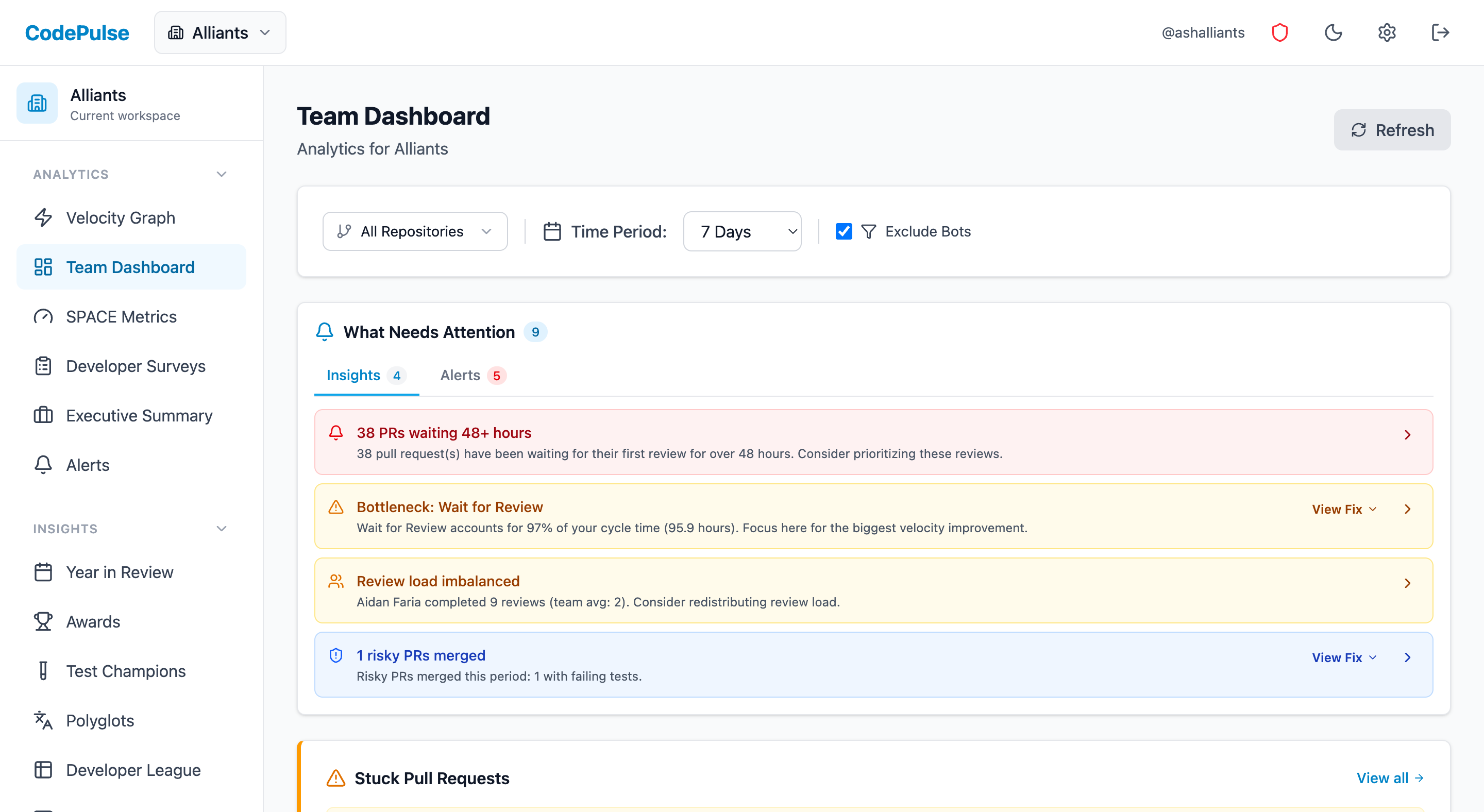
Use the Dashboard to track trends and the Executive Summary for leadership-ready ROI data.
Common Automation Measurement Pitfalls
Pitfall 1: Measuring Activity Instead of Outcomes
"We created 15 new pipelines" means nothing. "We reduced deployment time from 2 hours to 10 minutes" means everything. Focus on outcomes (speed, quality, efficiency) not activity (things built).
Pitfall 2: Ignoring Maintenance Costs
Automation isn't free after setup. Pipelines break, tests flake, infrastructure drifts. Factor in ongoing maintenance when calculating ROI - typically 10-20% of initial investment annually.
Pitfall 3: Automating the Wrong Things
Automating a process that happens once a month saves far less than automating something that happens 50 times per day. Prioritize by frequency × time saved.
Pitfall 4: Not Measuring Developer Experience
Some automation improvements don't show up in traditional metrics. Developer satisfaction surveys and qualitative feedback matter too. Faster builds and easier deploys improve morale even when hard numbers are modest.
The Automation Maturity Ladder
Use this framework to assess and plan your automation journey:
Automation Maturity Levels
═══════════════════════════════════════════════════

Level 5: Self-Healing ███████████████████████████████████ Elite
         Auto-remediation, predictive scaling, minimal human touch
         Metrics: <1% manual intervention, <5 min MTTR

Level 4: Fully Automated ████████████████████████████░░░░ High
         Zero-touch deployments, auto-rollback, feature flags
         Metrics: Daily deploys, <15% change failure rate

Level 3: Mostly Automated █████████████████████░░░░░░░░░░ Medium
         CI/CD in place, some manual gates (security, approval)
         Metrics: Weekly deploys, <1 hour lead time

Level 2: Partially Automated ██████████████░░░░░░░░░░░░░░░ Low-Med
         CI builds, manual deployments, some automated tests
         Metrics: Bi-weekly deploys, hours to days lead time

Level 1: Manual ███████░░░░░░░░░░░░░░░░░░░░░░░░░░░░░ Low
         SSH to servers, manual testing, tribal knowledge
         Metrics: Monthly deploys, days to weeks lead time
Related Guides
- DORA Metrics Guide - The research-backed metrics for software delivery
- DevOps Maturity Model Guide - Assess and improve your overall DevOps practices
- Engineering Analytics ROI Guide - Build the business case for engineering metrics
- Reduce PR Cycle Time - Practical playbook for faster code review and deployment
Conclusion
DevOps automation is only as valuable as you can prove it is. Measure before and after. Track speed, quality, and efficiency metrics. Calculate ROI in terms leadership cares about: time saved, incidents avoided, and cost reduced.
"Automation that reduces human error by 70% is worth more than automation that saves 70% of time. Incidents are expensive. Prevention is priceless."
Start by measuring your current baselines, then prioritize automation efforts based on expected ROI. Use CodePulse to track the delivery metrics that prove your automation investments are paying off.
Now measure this metric on your own repositories
Connect read-only GitHub in about five minutes and get your baseline, your trend, and the constraint behind it. Your fourteen usable trial days start when the first repository finishes syncing.
Read-only GitHub · Your code stays yours · Team-level by default · No credit card
See These Features in Action
Track deployment frequency, lead time, and release patterns.
Track all four DORA metrics and benchmark against industry standards.
Related Guides
DORA Metrics Explained: The 4 Keys Without the Hype
A complete breakdown of the four DORA metrics - deployment frequency, lead time, change failure rate, and MTTR - with honest benchmarks and gaming traps to avoid.
DevOps Maturity Model: A Practical Assessment Framework
Assess your DevOps maturity across culture, CI/CD, testing, monitoring, and infrastructure. Includes self-assessment questionnaire and improvement roadmap by level.
Engineering Analytics ROI: The Budget Approval Playbook
Calculate the ROI of engineering analytics tools with formulas for time savings, payback period, and a business case template tailored to CFOs, CTOs, and CEOs.
We Cut PR Cycle Time by 47%. Here's the Exact Playbook
A practical playbook for engineering managers to identify bottlenecks, improve review processes, and ship code faster - without sacrificing review quality.